
On this page
SaaS content marketing often stalls because growing platforms default to targeting broad keywords with crushing competitive difficulty. For early-stage and expanding software companies, true organic growth requires a deliberate shift toward underserved search queries that signal specific user frustrations and high purchase intent. This saas competitor content strategy case study explores how a hypothetical project management software company, InnovateCo, achieved niche keyword dominance saas by abandoning generic high-volume terms in favor of an automated competitor blog watch framework. By tracking where industry giants left core developer problems unanswered, they established an agile content operation that turned market gaps into direct conversions. Founders can replicate this data-driven framework to transform product knowledge into highly discoverable assets. Shifting from guesswork to continuous competitive tracking allows a small team to build authority, capture transaction-ready buyers, and maximize search visibility without expanding internal marketing headcount.
The Pitfalls of Volume-First SaaS Content Strategies
Many software companies measure marketing success entirely by publication volume and broad keyword tracking. Founders often assume that publishing dozens of articles on high-level industry trends will eventually capture organic search traffic and drive signups. This approach frequently burns through early capital without establishing a durable pipeline or meaningful search authority. In crowded software categories, competing for top-tier industry keywords sets up a head-on battle against multi-billion-dollar enterprise competitors. These incumbents possess massive backlink profiles, aged domains, and dedicated SEO agencies that protect their top rankings. A growth-stage SaaS attempting to rank for these broad queries will find its content buried deep in search results. Furthermore, search engines and modern generative answer models have evolved to penalize redundant, shallow content that lacks unique perspective. Publishing generic definitions or regurgitated listicles provides no information gain for the reader. Without deep technical differentiation or specific product integration context, content volume alone fails to generate qualified inbound interest.
The Trap of Broad High-Volume Keywords
Broad keywords like 'team collaboration' or 'task manager' attract thousands of monthly searches but carry prohibitive keyword difficulty ratings. Attempting to rank for these queries requires years of continuous domain optimization and thousands of dollars spent on high-authority backlink campaigns. For a lean product team, this is an inefficient allocation of capital that yields minimal short-term pipeline. The user intent behind broad keywords is also highly exploratory, meaning visitors are rarely looking to purchase software immediately. Someone searching for a generic definition is usually seeking basic educational material, not evaluating specific technical features. Consequently, even when broad content managed to rank, the resulting traffic converted at a fraction of a percent. Targeting generic terms forces your marketing to remain superficial, obscuring the unique product capabilities that solve specific customer pain points. Software buyers do not purchase an application because it defines an industry standard; they buy it because it addresses their operational bottlenecks. Focusing on high-volume terms dilutes your brand messaging and wastes organic traffic on unqualified audiences.
The Stagnation of Content Redundancy
When marketing teams lack real-time market data, they typically default to manual competitive auditing that mimics what rivals have already written. This surface-level strategy results in an internal content library that mirrors the exact topic architecture of existing industry platforms. Copying competitor outlines ensures that your content remains structurally identical and thoroughly uninspired. Search engines easily identify repeated topical structures and naturally favor the original, higher-authority source. A redundant article has almost no chance of breaking onto the first page of search results if it contains no proprietary metrics, screenshots, or distinct workflows. This creates an operational cycle where a company pays for content that is structurally invisible to its target market. Modern AI discovery models and search engine features actively reward informational depth and lived engineering experience over sheer publication frequency. Content that reads like a basic glossary entry fails to secure citations in AI-driven search overviews. To cut through the noise, SaaS founders must abandon manual content duplication and focus on precise topical gaps that competitors have left completely exposed.
The Anatomy of Competitor Blog Analysis for SaaS
Unlocking profitable organic growth channels requires moving past static keyword lists and embedding deep competitor blog analysis saas into your core marketing operations. True competitive analysis involves dissecting exactly how rival brands map their product capabilities to customer problems. This analysis allows you to uncover the exact areas where their documentation, product guides, and feature-focused blogs are failing to answer technical questions. This diagnostic framework focuses on long-tail informational queries and transactional comparison terms where large competitors have published incomplete content. Incumbents often write broad overviews to satisfy corporate stakeholders but neglect the micro-workflows required by practicing engineers or operational managers. These structural omissions represent highly valuable real estate for a nimble software platform. By capturing these specific competitive gaps, a growing software company can build highly tailored, product-led resources that answer urgent user questions. This market-driven content generation model ensures that every published article acts as a direct wedge into a rival's audience. Instead of chasing broad traffic, your team builds authority around highly specific solutions that your software is uniquely built to deliver.
Identifying Content Gaps and Underserved Audiences
A genuine content gap exists where your competitor's product intersects with an active user problem, but their blog fails to provide a thorough implementation guide. For example, an enterprise platform might publish a high-level guide on engineering productivity but neglect the step-by-step setup required to clear repository syncing blocks. This creates a group of frustrated users who are searching for technical answers but finding only corporate marketing filler. These underserved audiences possess exceptionally high commercial intent because they are actively trying to solve an operational issue. If your blog provides the precise script, workflow, or configuration required to resolve their bottleneck, you earn immediate technical trust. They view your company not merely as a software vendor, but as a direct engineering authority that understands their workflow constraints. Isolating these gaps manually requires hours of tedious reading, checking competitor sitemaps, and cross-referencing keyword databases. An automated system eliminates this operational strain by tracking competitor publications in real time and highlighting areas where their content lacks depth. This enables a lean startup team to capture highly motivated buyers before major competitors realize their content is deficient.
Deconstructing Competitor Keyword Layouts
Enterprise competitors systematically structure their blog architecture and internal linking models to maintain search authority across their primary landing pages. Deconstructing this semantic layout allows you to understand exactly which keywords drive their trial signups and which topics they consider highly profitable. By analyzing their internal linking context, you gain a transparent blueprint of their organic traffic engine. This structural mapping quickly reveals the outer limits of your competitor's content perimeter. Large brands rarely have the internal agility to update their entire catalog when new integrations, development tools, or niche workflows emerge. This lag creates highly profitable topical pockets that an agile SaaS can claim by publishing high-fidelity, targeted resources immediately. Capturing these peripheral keywords allows you to intercept buyers during the consideration stage of their software search. When a prospect realizes that an enterprise giant lacks detailed documentation for a specific integration, your hyper-focused guide serves as the perfect alternative. This systematic approach transforms competitive search layout data into actionable, high-ranking assets for your brand.
Case Study: How InnovateCo Transformed Its Growth with Competitor Blog Watch
To see this framework in action, consider the case of InnovateCo, a hypothetical project management SaaS built specifically for asynchronous communication in distributed engineering teams. In their early days, the founders struggled to gain traction against massive enterprise project management applications that dominated traditional search queries. Their internal team spent months writing high-level articles about 'agile workflows' that completely failed to rank or generate product trial signups. The turning point occurred when InnovateCo transitioned away from generic keyword research and deployed a continuous competitor blog watch strategy. Instead of guessing what topics to write about, they focused exclusively on tracking the content updates, product announcements, and documentation gaps of their direct rivals. This allowed them to spot the precise technical areas where corporate competitors were failing to answer the questions of software engineering managers. By turning these real-time competitive insights into product-led articles, InnovateCo engineered a highly scalable organic marketing engine. They bypassed the high cost of paid advertising and focused their limited budget on capturing underserved, high-intent traffic. Within six months, this strategic pivot completely transformed their user acquisition pipeline and established their tool as a technical authority.
Phase 1: Setting up Continuous Competitive Intelligence
InnovateCo began their implementation by identifying four primary enterprise competitors whose software lacked advanced asynchronous tracking features. Instead of performing ad-hoc manual sitemap audits every few months, they established an automated pipeline to continuously monitor these competitor blogs. The system tracked every new article publication, updated documentation page, and structural content adjustment across all four rival sites. This setup provided an unbroken stream of structural market intelligence, giving InnovateCo an immediate view of their competitors' editorial direction. The moment an enterprise rival adjusted its messaging or targeted a new software sub-niche, InnovateCo's founding team saw the data. This continuous monitoring eliminated the traditional delay between market changes and strategic content execution.
Phase 2: Executing Gap Analysis and Discovering Niche Keywords
With continuous tracking active, InnovateCo's marketing team began analyzing how enterprise competitors explained complex developer integrations. They noticed a glaring trend: while rivals wrote extensive, generic articles about team communication, they completely ignored highly specialized technical problems. For example, competitors regularly omitted detailed guides on managing repository syncing delays across multi-region engineering teams. This specific technical issue represented a high-intent long-tail keyword with minimal search difficulty but massive commercial relevance for an asynchronous project tool. Software engineering managers facing this exact operational bottleneck were searching for a technical solution, not high-level productivity advice. InnovateCo systematically compiled a target list of dozens of these niche engineering keywords, matching each one directly to their product's core strengths.
Phase 3: Autonomous Content Drafting via Blogged's Knowledge Engine
To transform these highly technical keyword opportunities into comprehensive blog posts without draining their engineering team's time, InnovateCo implemented an automated writing pipeline. They integrated their core product context directly into the platform's creation engine to ensure every draft was technically accurate. By leveraging the Knowledge Engine for Autonomous SaaS Blogs, the founders provided public product sources, uploaded engineering documents, pasted technical links, or a written product description. This direct integration allowed the autonomous platform to ingest the deep, inner workings of InnovateCo's software features. The system did not generate generic, high-level summaries typical of basic AI writers; instead, it drafted structured, product-led articles that read like practitioner-grade technical guides. The platform handled the exhausting tasks of keyword integration, semantic enrichment, and structural optimization autonomously, allowing the founders to maintain a consistent publishing schedule while remaining focused on building their product.
Phase 4: Multi-CMS Publishing and Performance Tracking
Once the technical drafts were automatically generated, InnovateCo's small marketing team conducted a rapid final review to ensure complete alignment with their brand tone. They then utilized native CMS integrations to deploy the optimized articles across their existing web infrastructure without manual copy-pasting. For instance, Blogged's WordPress AI Blog Publishing integration lets users create and review articles in Blogged, then deliver them to their WordPress website. The platform connects to self-hosted WordPress through the Blogged Publishing plugin and an application password, making the publication pipeline fully automated. For teams operating on alternative web stacks, the platform provides equal flexibility across major content engines. Blogged's Ghost AI Blog Publishing integration manages content creation and review while Ghost renders the reader experience. Setting up this connection is straightforward: Blogged's Ghost AI Blog Publishing integration lets users create a custom integration in Ghost, copy its Admin API key, and verify their Ghost connection in Blogged. This ensures that no matter your web architecture, technical layout deployment remains instantaneous and clean. To close the loop on their marketing investment, InnovateCo monitored reader actions through integrated behavior tracking. Blogged's Webflow CMS AI Blog Publishing integration lets users collect consented visits and configured conversions for verified articles. This technical insight allowed the founders to track exactly how many software managers read a niche integration guide and subsequently clicked through to sign up for a free product trial, providing definitive proof of content ROI.
Get practical updates on saas competitor content strategy case study
Receive new articles and practical insights by email.
The Quantifiable Shift: Achieving Niche Keyword Dominance
The outcomes of InnovateCo's competitor-driven content transition reveal the strategic power of targeting underserved search traffic. Within six months of launching their automated competitive framework, the startup achieved top-three Google rankings for over forty hyper-specific engineering search queries. Because their enterprise competitors had completely ignored these deep technical problems, InnovateCo's articles became the authoritative answers on search engines. This surge in visibility did not just drive empty traffic metrics; it attracted a continuous stream of highly qualified leads directly into their product funnel. Organic traffic grew steadily, but more importantly, the conversion rate from visitor to active trial account rose significantly above their historical averages. By focusing entirely on niche keywords, they managed to capture a highly profitable slice of the market right out from under their larger rivals.
Attracting High-Intent Practitioners
Unlike exploratory top-of-funnel traffic that bounces almost immediately, users searching for long-tail technical solutions possess immediate operational pain points. When an engineering manager encounters a comprehensive article detailing how to solve an asynchronous development block using InnovateCo's features, the value proposition is unmistakable. The prospect recognizes that the tool was built specifically to handle their unique technical environment, which accelerates their timeline to sign up. This targeted approach transforms your company's blog from a generic company announcement page into an active user acquisition engine. Buyers do not require lengthy sales conversations because the product-led content has already demonstrated the application's utility. By answering specialized technical questions, your brand captures practitioner buyers who are already educated on your product's unique differentiation before they ever interact with a sales representative.
Building Authentic Authority and Contextual Backlinks
Consistently publishing high-fidelity content on complex subtopics quickly elevates a growth-stage software platform into a trusted industry voice. As InnovateCo's blog filled critical informational gaps, software developers, engineering community leaders, and industry newsletter editors began naturally linking to their articles. These organic backlinks served as a powerful endorsement of the brand's practical expertise and technical depth. This compounding backlink acquisition naturally raised the platform's overall domain authority, making it significantly easier to rank for increasingly competitive search terms over time. By focusing on doing one thing exceptionally well—solving technical search queries with clear product data—they built a durable marketing moat. Enterprise competitors could not easily replicate this authority through broad paid ad budgets alone, cementing InnovateCo's market position.
Choosing the Right Content Strategy for Your SaaS
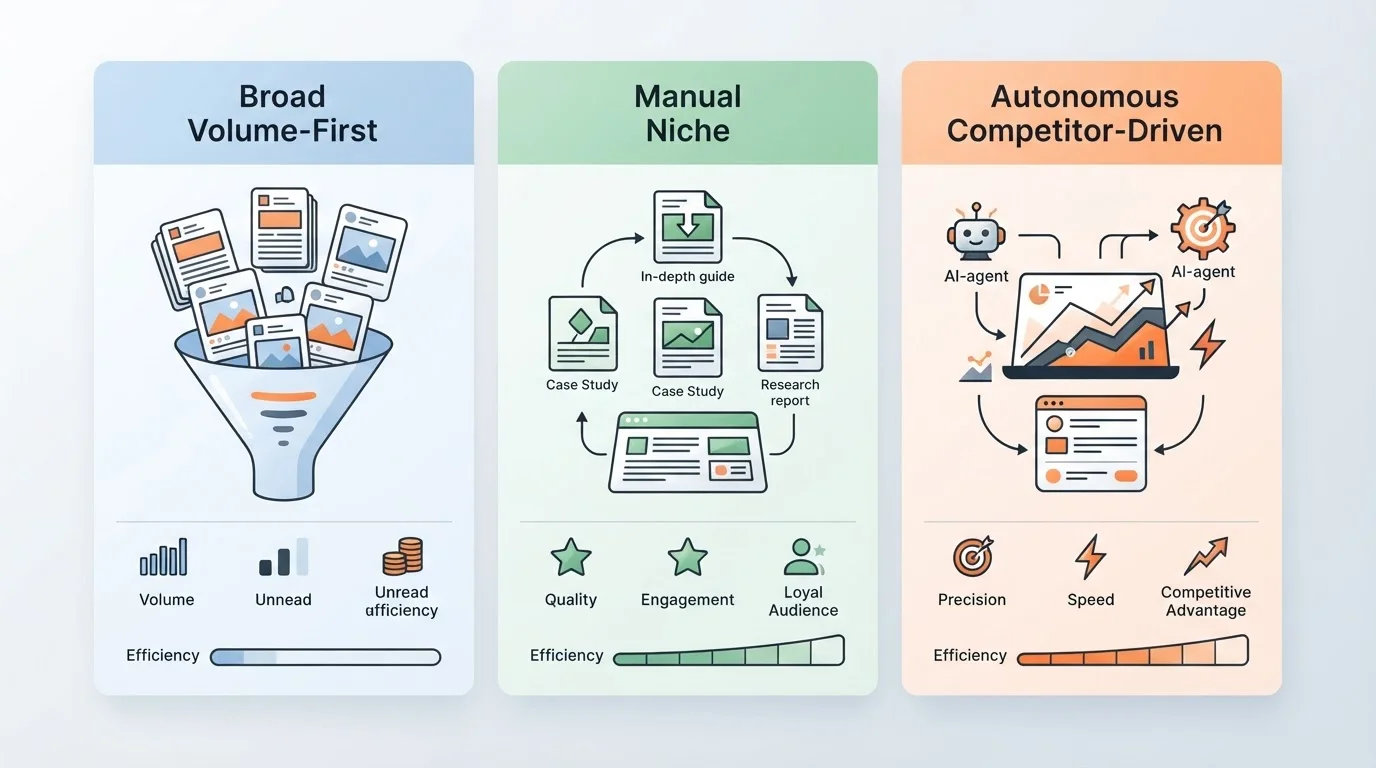
SaaS founders must balance immediate product development timelines with the long-term compounding benefits of organic traffic channels. Selecting the correct content path depends heavily on your team's internal technical bandwidth, available marketing capital, and the competitive density of your software category. The following comparison matrix breaks down the essential trade-offs, resource constraints, and performance capabilities of the three primary content methodologies utilized by modern software businesses:
| Strategic Dimension | Broad Volume-First Strategy | Manual Niche Strategy | Autonomous Competitor-Driven |
|---|---|---|---|
| Primary Traffic Focus | High-volume generic terms | Selective long-tail terms | Dynamically detected competitor gaps |
| Resource Requirements | High agency or freelance costs | Intense internal founder bandwidth | Minimal oversight with automated software |
| Speed to Publish | Slow editorial cycles | Very slow due to limited time | Hyper-efficient automated execution |
| Data Ingestion Model | Static monthly keyword spreadsheets | Ad-hoc personal observations | Continuous real-time competitor tracking |
| Target Audience Fit | Exploratory top-of-funnel visitors | High-intent specific practitioners | Maximized transaction-ready buyers |
Reviewing these strategic options clearly shows that while manual niche targeting offers exceptional depth, it strains the limited time of a growing product team. Combining autonomous competitor data gathering with automated, product-grounded writing allows founders to execute a highly advanced saas competitor content strategy case study without expanding internal headcount or sacrificing content fidelity.
Leveraging Blogged's Autonomous Ecosystem for Market-Driven Execution
Sustaining a sophisticated competitive content campaign requires an infrastructure built specifically for the unique demands of fast-moving software startups. This is precisely where Blogged transforms organic marketing from an operational bottleneck into a fully automated growth asset. Blogged runs your SaaS blog on Autopilot, from research and writing to SEO, GEO, internal links, and publishing for growth. By automatically transforming your deep product knowledge and feature documentation into discoverable, product-led content, the platform eliminates the constant pressure of managing content creators. Founders can easily input their core system capabilities and let the platform research, plan, write, optimize, interlink, and publish product-led content that drives organic growth through SEO and GEO. This autonomous operation allows your founding team to maintain complete focus on building outstanding software features.
Seamless System Integrations and Data Tracking
Blogged integrates natively across the modern web ecosystem to ensure that your technical articles are published instantly and tracked with complete accuracy. In addition to standard content systems, Blogged's Next.js AI Blog Publishing integration lets users collect consented visits and configured conversions for verified articles. This gives development teams absolute programmatic flexibility over how content is rendered on custom JavaScript web apps. For engineering teams requiring completely custom distribution paths or headless setups, Blogged's API lets users collect consented visits and configured conversions for verified articles. By leveraging the Signed Webhook and Content API, your development team can pipe verified articles into any proprietary application frontend effortlessly. This technical framework ensures that tracking user signups and measuring true content performance remains incredibly accurate, giving founders exact clarity on their organic marketing ROI.
Transparent Pricing Built to Scale with Your Growth
Scaling your organic footprint should never involve unpredictable agency retainers or restrictive per-seat licensing fees that punish team collaboration. Blogged provides simple, flat-rate monthly subscriptions that align perfectly with your startup's growth stage, and every single paid plan includes unlimited team seats. This allows your entire product, marketing, and engineering team to log in, review drafts, and collaborate on content direction without incurring extra monthly charges. The platform's entry tier, Blogged Starter, is listed at $99 per month, offering a highly accessible path for early-stage applications looking to secure their initial niche keywords. For growing software platforms expanding their market footprint, Blogged Growth is listed at $169 per month, and the advanced Blogged Ultra Growth is listed at $229 per month. These higher tiers provide expanded competitor watch channels along with 3 revisions per article to ensure your highly technical product details are perfectly refined before going live.
Decision Guidance: Is a Market-Driven Autonomous Content Approach Right for You?
Deciding how to allocate your company's growth resources requires a clear appraisal of internal operational constraints and current organic search performance. Founders should evaluate their startup's current position against the following four diagnostic points to determine if an autonomous market-driven approach is necessary for their business:
- Bandwidth Limits: Is your core product or engineering team spending more than four hours a week drafting, editing, or managing freelance technical writers instead of shipping code?
- Incumbent Domination: Are your main software competitors well-funded enterprise platforms that heavily dominate high-volume keywords, rendering a traditional broad content strategy financially unviable?
- Knowledge Availability: Do you possess existing internal technical documentation, customer support logs, setup guides, or product markdown repositories that can be converted into discoverable marketing content?
- Consistency Bottlenecks: Has your software's blog remained stagnant for weeks or months at a time because urgent product roadmap shipping deadlines always disrupt your manual content calendar?
If these diagnostics highlight an active strain on your operational resources, transitioning toward an autonomous competitor watch structure is a highly logical step. This shift will allow your SaaS to maintain high-velocity search authority and continuous market-driven content generation while keeping your builders completely focused on product excellence.
Frequently Asked Questions
Q: How does a competitor blog watch identify high-intent keywords that traditional SEO software misses?
Traditional SEO databases rely on macro-scrape cycles that often lag behind immediate industry shifts. A live competitor blog watch monitors changes directly on competitor domains, immediately identifying when a rival creates an integration guide or targets a new customer pain point, revealing highly profitable niche keywords long before they show search volume in legacy tools.
Q: Can autonomous blogging software write accurately about highly specialized or technical software features?
Yes, if the platform features a dedicated knowledge engine. Grounding the generation process in actual technical documentation, uploaded system files, and pasted product links allows the software to avoid generic summaries and write highly precise, product-led articles that accurately explain your application's unique technical workflows.
Q: What is the primary difference between SEO and GEO in modern content strategy?
SEO optimizes articles for traditional search engine rankings and keyword algorithms. GEO, or Generative Engine Optimization, focuses on structuring content so your product's specific features, workflows, and brand name are cited and recommended by AI-driven search models, answer overviews, and conversational discovery engines.
Q: How much founder oversight is required when managing an autonomous blogging platform?
The operational model shifts from time-consuming content drafting to high-level quality assurance. Founders generally spend less than thirty minutes a week inputting competitive targets, confirming automated briefs, and completing a quick visual review of finished drafts before scheduling publication, saving dozens of hours of manual labor.
Q: Do autonomous publishing platforms require us to migrate our existing website or blog CMS?
No, advanced platforms integrate seamlessly into your current technical stack through native plugins, API keys, or webhooks. Whether your company website operates on WordPress, Ghost, Webflow, or a custom Next.js application, verified articles are delivered directly into your existing database without breaking your design formatting.
Dominating organic search in a crowded software category does not require matching the multi-million-dollar marketing budgets of enterprise incumbents. As demonstrated by InnovateCo's strategic success, executing a focused saas competitor content strategy case study through an autonomous competitor blog watch allows growth-stage SaaS platforms to capture highly valuable, transaction-ready search traffic. By leveraging autonomous platform workflows to turn internal product documentation into discoverable, product-led content, founders can build sustainable search and AI-engine authority while keeping their primary focus exactly where it belongs: building an exceptional product.