
On this page
For SaaS founders, scaling organic growth is often a difficult operational balancing act. Building a reliable pipeline of organic inbound leads requires high-quality, product-led content published with absolute consistency. Yet, the manual labor required to manage keyword research, write comprehensive drafts, and optimize pages frequently competes with core product engineering. When a lean team is focused on hitting feature roadmaps, the company blog is often the first asset to languish.
Transitioning to an autonomous blogging strategy solves this fundamental resource constraint. Instead of outsourcing content to generalist writing agencies or consuming founder hours in a document editor, SaaS platforms can now leverage automated execution systems. This comprehensive guide explores how founders structure an autonomous blogging operation to convert internal product expertise into a high-performing lead generation engine. By automating the mechanics of research, optimization, and delivery, teams can build sustainable search equity while staying fully focused on software development.
The Core Bottleneck: Why Manual Content Creation Fails Lean SaaS Teams
Traditional content marketing models depend heavily on manual coordination, a process that introduces significant operational friction for early-and-mid-stage SaaS companies. In a typical manual setup, a growth marketer or founder must identify target keywords, draft a detailed content brief, hire a freelance writer, and manage multiple rounds of revisions. This sequential workflow routinely breaks down due to three structural issues inherent to technical software environments.
First, a lack of deep subject matter expertise creates an acute verification bottleneck. Because SaaS products solve highly specific, technical problems, external generalist writers frequently miss the functional nuance of core features. As a result, the technical founder is forced to become a permanent editor, spending hours correcting inaccurate product descriptions to protect the brand's industry authority. If the founder lacks the time to execute this meticulous technical review, the entire publishing pipeline stalls.
Second, top-of-funnel content velocity often plateaus before driving tangible business outcomes. Traditional content efforts frequently prioritize broad informational keywords with high search volumes but low commercial intent. These articles fail to explain how the software directly resolves the reader's immediate pain point, transforming the corporate blog into an expensive informational library rather than an active pipeline for saas organic lead generation.
Finally, the financial cost of scaling manual content production remains structurally prohibitive for lean teams. Doubling monthly article output requires a linear increase in freelance writing budgets, editor salaries, or agency retainer fees. For an expanding SaaS startup, that capital is far more productive when allocated directly to engineering, product design, or customer success initiatives. Decoupling organic search visibility from human labor hours is the only viable path to sustainable scale.
The Architecture of Autonomous Content: Shifting from Writers to Engines
Many software teams attempt to solve publishing limits by using generic artificial intelligence text interfaces. However, standard language models operating without structured context often produce shallow, generic copy that provides zero information gain for the reader. These general tools tend to hallucinate technical features and rely on repetitive phrases, which alienates sophisticated B2B buyers and fails to establish true authority.
An authentic autonomous blogging lead generation platform operates as an integrated execution engine rather than a simple text-completion wrapper. The system takes complete operational ownership of the background tasks that consume marketing hours. It autonomously manages initial keyword research, intent analysis, strategic article planning, technical search engine optimization, generative engine optimization (GEO), internal link building, and direct publishing.
This operational shift redefines the founder’s relationship with content marketing. Instead of operating as a manual word processor or copyeditor, the founder assumes the role of an editor-in-chief or strategic director. You define the high-level operational guardrails and product truths, while the software execution layer handles the complex, repetitive mechanics of building search engine presence.
By shifting production from manual human labor to an automated context-driven engine, SaaS companies can maintain an active web presence. This ensures your marketing assets continue to mature and attract potential users even when the core team is completely offline executing an intensive product launch.
Deep Dive into the Knowledge Engine: Structuring Technical Context
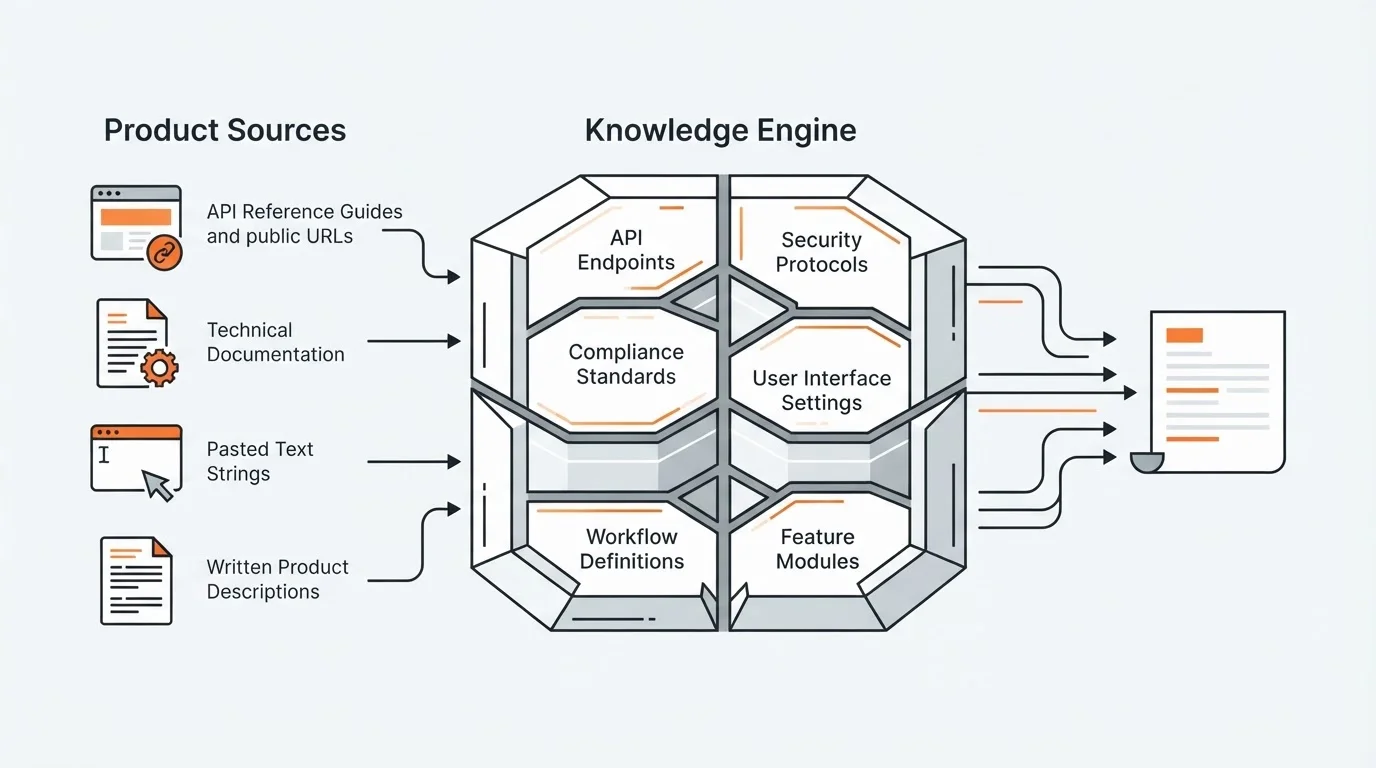
The foundational element of a successful autonomous content strategy is the programmatic preservation of technical truth. To eliminate generic text generation, an autonomous system must be anchored to the actual capabilities, architecture, and user workflows of your specific software. This exact challenge is resolved by utilizing Blogged's Knowledge Engine, which serves as the core repository for all product-led content creation.
The platform allows founders and product managers to feed specific, high-fidelity source materials directly into the system to build a comprehensive reference base. Supported source types include public product URLs, uploaded technical documents, pasted text strings, and comprehensive written product descriptions. By ingesting these direct assets, the underlying engine avoids industry generalizations and writes with the precise authority of an internal software engineer.
Within the administrative portal, teams can organize these facts systematically through a dedicated product context interface. This architecture enables users to segment information cleanly by specific product entities and distinct functional facets. For example, a founder can isolate core API endpoints, security compliance protocols, or specific user interface settings into distinct context segments.
This structured data mapping completely changes the draft generation phase. When the platform constructs an article targeting an optimization query, it draws directly from the verified facts stored in that entity matrix. This targeted retrieval ensures every sentence matches the real-world functionality of your application, removing the editing burden from the founder's schedule.
Autopilot Content Planning: Transitioning from Manual Calendars to Approved Content Directions
Maintaining a consistent editorial calendar manually requires constant cognitive effort and recurring team meetings. Marketers often spend valuable hours every month analyzing search software, checking competitor activity, and arguing over which topics to prioritize next. This scattered planning process frequently leads to inconsistent publication intervals and missed search opportunities.
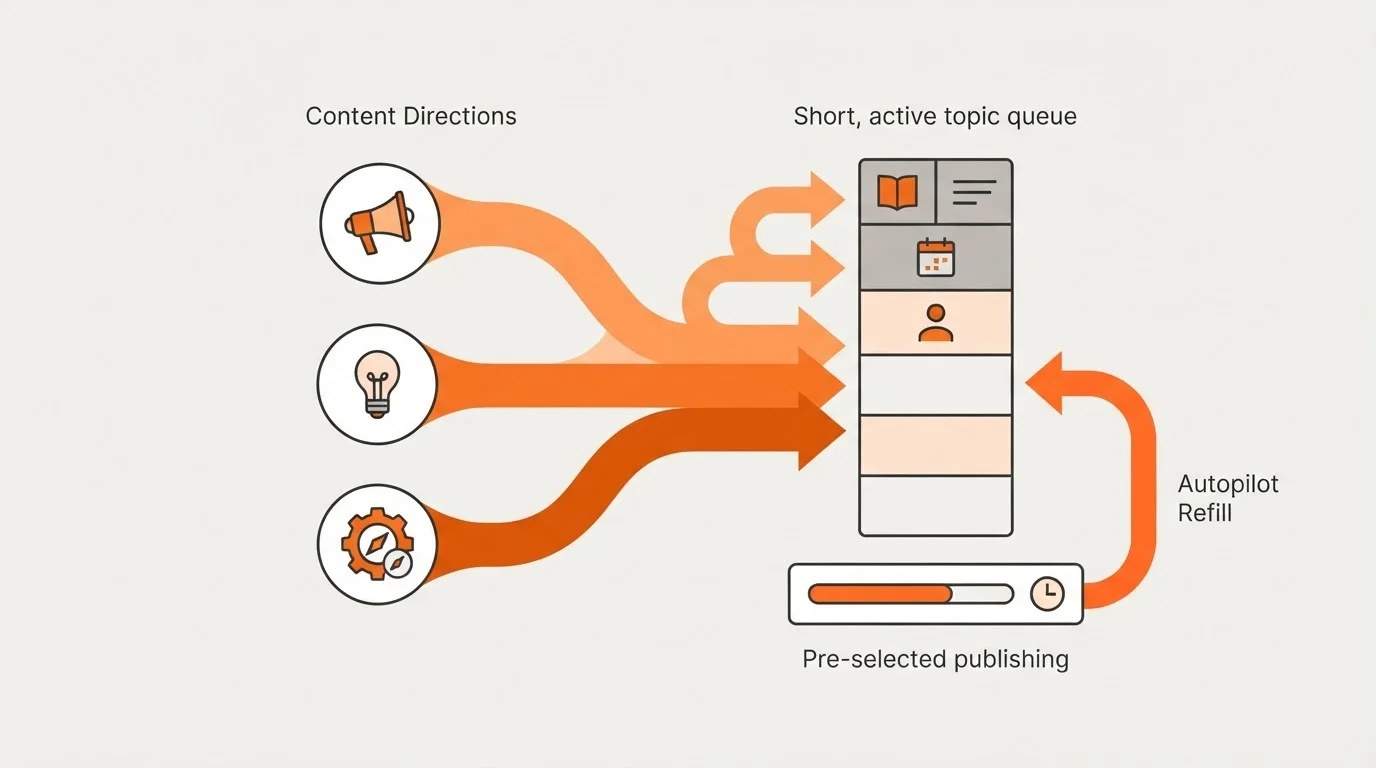
Autonomous systems eliminate this operational overhead by shifting from individual blog post brainstorming to high-level content design. Founders establish broad, strategic parameters known as Content Directions. These directions map closely to primary product features, ideal customer personas, and specific commercial problems that your SaaS platform is uniquely engineered to solve.
Once these foundational guidelines are established, users can build a durable SaaS content plan and publish on their preferred cadence. The system handles the ongoing logistical burden by allowing a Full Autopilot topic refill mechanism to systematically replenish a short, active topic queue from those approved Content Directions. This mechanism continuously discovers high-intent search queries that align with your strategic focus.
This automated supply pipeline guarantees that your content queue never sits empty. The software looks ahead, researches keyword clusters, and queues relevant drafts for creation without requiring a human manager to initiate the process. This maintains absolute consistency in search engine indexing while keeping your content roadmap aligned with your engineering milestones.
Integrating with Your Current Stack: CMS Automations for Hands-Off Delivery
An autonomous content strategy is only as efficient as its downstream publishing mechanics. If a team must manually copy text, download images, reformat headers, and fix broken hyperlinks inside a separate content management system (CMS), the automation chain is broken. True operational leverage requires a frictionless transition from completed draft to live web page.
For organizations running their primary marketing sites on traditional web infrastructure, the platform offers a dedicated WordPress AI Blog Publishing integration. This system establishes a secure connection to self-hosted WordPress sites through the native Blogged Publishing plugin and a standard application password. This integration allows users to create, review, and optimize articles natively in Blogged, then deliver them directly to their WordPress website on autopilot.
For companies leveraging alternative modern design ecosystems, the platform maintains equally robust native connections. The Webflow CMS AI Blog Publishing integration enables seamless sync to Webflow collections, while the Ghost AI Blog Publishing integration manages the automated creation and editorial review loops while letting Ghost handle the reader-facing rendering. For teams utilizing custom codebases, a Next.js AI Blog Publishing integration or a custom Signed Webhook and Content API can be deployed easily.
Crucially, these integrations do more than just transfer raw text blocks across systems. They are specifically engineered to collect consented visits and track configured conversions for every single verified article. This granular data connection ensures that every piece of published content acts as a functional analytics node, mapping traffic directly to lead outcomes.
Establishing a Human-in-the-Loop Review System for Editorial Quality
Deploying an autonomous blogging framework does not require a software company to sacrifice editorial control or brand safety. Many founders worry that automation means letting an unmonitored script publish text directly to their primary business domain. To address this concern, modern autonomous workflows use a highly secure, human-in-the-loop review methodology.
The platform acts as an elite digital writer and technical SEO specialist, executing all heavy research, structuring, drafting, and optimization tasks automatically. However, the final publishing decision always remains with your core team. Members can access a collaborative workspace to review generated drafts, evaluate internal link distributions, and inject personalized brand stories or unique product screenshots before any post goes live.
This collaborative oversight is highly accessible because every paid plan on Blogged includes unlimited team seats. This pricing structure allows product managers, growth marketers, engineering leads, and external consultants to participate in the review and approval process without incurring additional per-user license fees. A marketer can verify the positioning, while a product manager verifies the technical accuracy of a feature description simultaneously.
This hybrid model delivers massive operational leverage. A lean software team can effectively publish multiple high-quality articles per week with minimal collective effort. The platform eliminates the exhausting blank-page problem entirely, leaving humans to perform the high-value tasks of final refinement, brand alignment, and strategic validation.
Quantifying the Strategic Value: Data Tracking and Performance Metrics
Organic marketing strategies must justify their existence through clear, quantifiable business data. Unlike generic text tools that detach content creation from actual web performance, an enterprise-grade autonomous system builds a direct feedback loop between production and results. Founders must actively monitor their dashboard analytics to properly optimize their ongoing Content Directions.
The integrated interface lets users track Search Console performance, homepage engagement, on-site searches, CTA and lead outcomes, lead growth, and reader feedback natively. This direct visibility removes the need to constantly stitch together disparate analytics platforms to answer simple attribution questions. You can see exactly which articles are ranking, how long users stay on the page, and what specific queries drive signups.
Monitoring internal on-site searches and immediate reader feedback provides deep insight into user intent. If readers are arriving via search and then searching for specific technical terms within your blog site, those inputs can be instantly recycled into the platform's product context library. This continuous flow of performance data ensures your automated engine refines its topical focus over time.
Ultimately, tracking call-to-action (CTA) and lead outcomes allows SaaS teams to measure their content's true return on investment. By observing which product-led content lead growth articles successfully convert readers into active product trials or newsletter subscribers, founders can double down on high-performing product entities and facets. Content ceases to be a speculative cost center and becomes a predictable engine for user acquisition.
Practical Evaluation: Is Autonomous Blogging Strategic for Your SaaS?
Deciding when to transition from manual content creation to an autonomous model depends on your startup's specific operational constraints. Many early-stage software companies suffer from a substantial "Cost of Inaction"—the invisible loss of compounding search equity caused by leaving a business blog completely dormant for months at a time. Evaluating your company against three specific operational criteria will clarify if an autonomous shift is required as part of a broader saas founder organic lead growth case study workflow.
First, analyze your current text-based documentation depth. If your company has already developed internal knowledge bases, technical FAQs, user guides, or public API references, you possess an abundance of raw fuel. This existing text infrastructure provides everything needed for a dedicated product context database to function with high precision from day one.
Second, review your historical publishing cadence over the last few quarters. If your marketing team is currently publishing less than once a week due to time limits, engineering distractions, or resource allocation, you are losing ground to competitors. Accelerating growth requires a predictable rhythm that is incredibly difficult to maintain manually without a dedicated, expensive in-house writing team.
Third, evaluate the technical complexity of your product ecosystem. If your software operates in a highly specialized niche where freelance marketplace writers routinely fail to grasp the core workflow, human outsourcing becomes a net-negative process. An autonomous engine trained on your actual internal developer documents will consistently maintain a higher standard of technical accuracy than a generic content agency.
Frequently Asked Questions
Q: How much control do founders retain over autonomous drafts?
Teams retain absolute editorial control over every article generated by the system. The platform handles the automated research, initial drafting, and keyword optimization, but every post is placed into an approval queue where you can review, edit, or adjust text before it goes live.
Q: How does the system ensure technical accuracy for niche features?
The platform utilizes the information stored within your specific product context database rather than relying on public internet training data. By drawing exclusively from your uploaded manuals, API text, and source links, the engine ensures all feature details are factually accurate.
Q: What content management systems can integrate with the automated pipeline?
Native publishing integrations are available for self-hosted WordPress sites, Webflow collections, and Ghost installations. Additionally, custom applications built on frameworks like Next.js can connect seamlessly using a secure Content API or signed webhooks.
Q: How are lead generation outcomes tracked within the portal?
The system automatically tracks critical performance metrics including Search Console metrics, user conversions, homepage engagement levels, and on-site search queries. This direct connection lets you map organic traffic growth to concrete subscription and lead outcomes.
Q: Is there an extra charge for adding team members to the review portal?
No, every paid plan includes unlimited team seats as a standard feature. This allows founders to bring in product managers, marketers, and technical editors to collaborate on draft approvals without facing variable per-user software fees.
Get practical updates on saas founder organic lead growth case study
Receive new articles and practical insights by email.
Building an enduring SaaS company requires absolute focus on high-impact strategic tasks. Spending valuable hours managing freelance writers or manually formatting blog posts represents a significant misallocation of executive energy. Organic search remains one of the most sustainable channels for acquiring software users, but it should not function as a constant drain on your engineering resources.
Shifting to an autonomous blogging platform allows SaaS founders to treat internal product knowledge as a scalable marketing asset. By anchoring an automated execution engine to your actual developer documentation, you build an organic lead generation engine that operates continuously in the background. This approach turns your blog into a self-sustaining asset that captures high-intent traffic and turns readers into users.
The path to scalable organic growth does not require expanding your marketing payroll or sacrificing your personal schedule to write articles. By utilizing automated topic planning, deep context tracking, and native CMS integrations, you can unlock predictable search engine visibility. Put your company's blog on Autopilot, clear your content bottleneck, and return your full attention to building an elite product.