
On this page
SaaS founders often sit on a goldmine of data without realizing it. Your product documentation, internal Slack discussions, and customer support logs aren't just technical necessities; they are the raw materials for high-performing, discoverable content. Transforming this internal product knowledge into blog posts allows you to capture high-intent search traffic while demonstrating immediate utility to prospects.
Modern search engines and AI discovery tools increasingly reward specific, factual, and experience-backed content. By shifting from generic industry advice to product-led narratives, you establish authority that competitors cannot easily replicate. This guide provides a strategic framework for auditing your knowledge base, extracting high-value ideas, and scaling your content production without sacrificing your focus on building the product.
Extracting these insights requires a systematic approach. You must move beyond simply listing features to explaining the 'why' and 'how' behind your software’s architecture. When executed correctly, this strategy turns your blog into an extension of your product, driving both organic growth and user retention.
Auditing Your Internal Knowledge Repositories
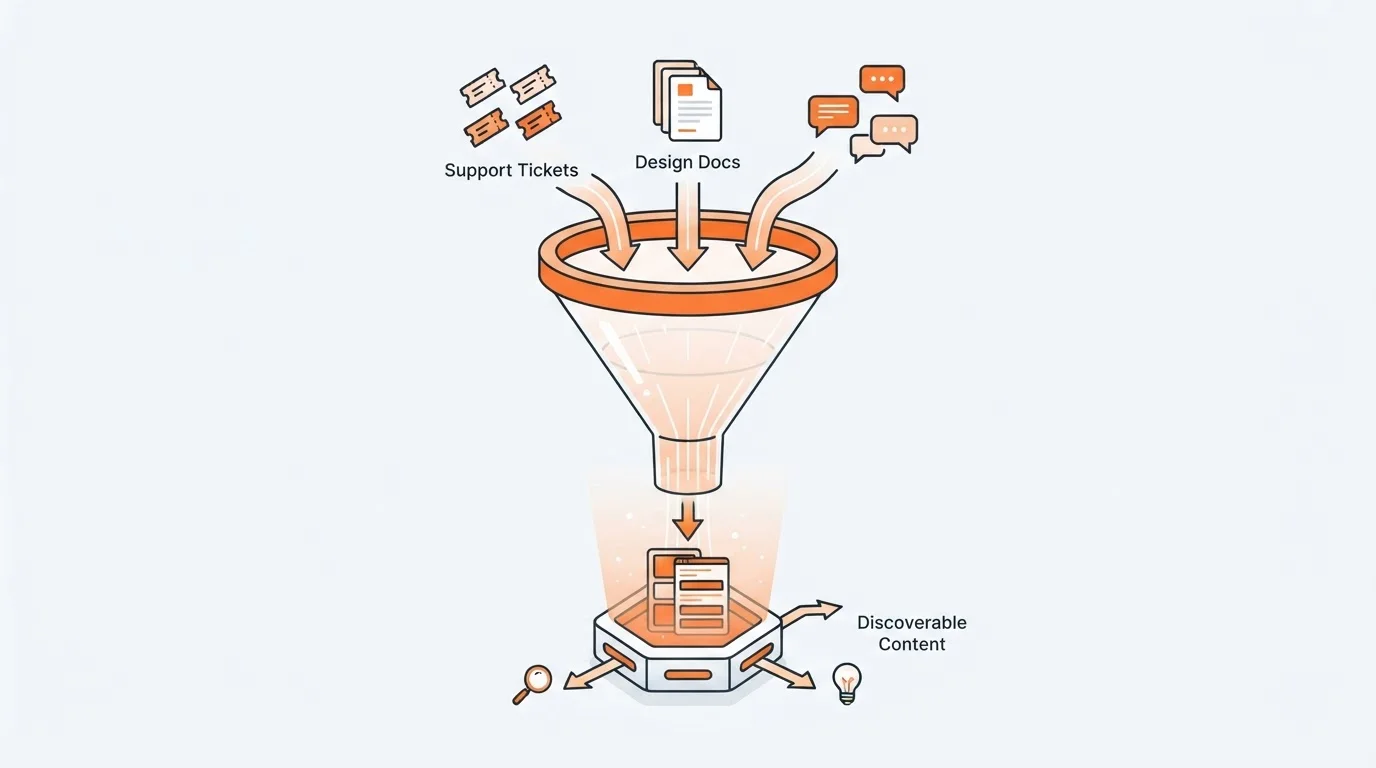
The first step in a product-led content strategy is identifying where your best insights are hidden. Most SaaS teams have deep pools of knowledge that never reach the public eye. To build a consistent pipeline, you must establish a process for reviewing these internal sources regularly.
Product Specifications and PRDs are excellent starting points. These documents detail the specific problems your team intended to solve when a feature was conceived. By revisiting the 'problem statement' in a design document, you can craft a blog post that addresses that exact pain point for potential users searching for a solution.
Customer Support Tickets and FAQs serve as a real-time pulse of user confusion and curiosity. If multiple users ask how to achieve a specific outcome, there is likely a larger audience searching for that same answer on Google. Repurposing a support resolution into a comprehensive guide transforms a reactive cost center into a proactive growth asset.
Sales Enablement Materials often contain the most persuasive arguments for your product. Battle cards and competitor analyses highlight your unique selling propositions (USPs). These insights can be reframed into objective comparison articles that help prospects in the consideration stage make informed decisions.
Frameworks for Extracting Discoverable Content Ideas
Once you have identified your sources, you need a method to translate technical details into discoverable narratives. Not every feature update warrants a full blog post, but every user problem does. Focus on mapping your product's capabilities to the search intent of your target audience.
One effective method is Problem-Solution Mapping. For every core feature, identify the specific struggle a user faces before using it. For example, if your SaaS automates data entry, don't just write 'Announcing our new API.' Instead, write 'How to Save 10 Hours a Week by Automating Manual Data Workflows.' This approach targets the user's pain rather than your internal milestone.
Another strategy is the User Story Deep Dive. Review the use cases that guided your development team. Each user story represents a potential article that tells a narrative of transformation. These posts should detail a specific scenario, the obstacles encountered, and the step-by-step path to achieving a successful outcome using your software.
To keep your content pipeline full, consider using an autonomous system that can ingest these insights. Blogged lets users build a durable SaaS content plan, allowing you to set a publication cadence while the Full Autopilot feature refills a short Topic queue from approved Content Directions. This ensures your product-led ideas are consistently converted into live articles without manual intervention every week.
Structuring Product-Led Posts for Maximum SEO Impact
Discoverability depends on more than just good ideas; it requires a structure that search engines and AI models can easily parse. A well-organized post improves the user experience and increases the likelihood of ranking for relevant terms. Your goal is to make complex product information accessible and actionable.
Every post should begin with a Clear Introduction that hooks the reader by acknowledging their specific challenge. Immediately state how the article will solve that challenge, positioning your product as the primary tool for the job. This alignment between the reader's problem and your solution is the foundation of product-led SEO.
Use a logical hierarchy with H2 and H3 headings to break up technical explanations. Incorporate screenshots or GIFs to visually demonstrate how a feature works in practice. This not only aids comprehension but also signals to search engines that the content is original and highly relevant to the topic.
Finally, ensure your articles are published on a platform that supports technical optimization. For example, Blogged's WordPress AI Blog Publishing integration allows users to create and review articles within a central dashboard before delivering them directly to their site. Similar integrations exist for Webflow, Ghost, and Next.js, ensuring that your content reaches your audience regardless of your tech stack.
High-Conversion Content Formats for SaaS
Not all content is created equal when it comes to driving sign-ups. Some formats are naturally better at demonstrating value and moving a reader toward a trial or demo. By focusing on these high-conversion types, you ensure your organic traffic actually impacts your bottom line.
How-To Guides and Tutorials are the backbone of product-led content. These articles provide step-by-step instructions for solving a specific problem. By including your product as the vehicle for the solution, you show rather than tell your value proposition. These posts often capture 'bottom-of-funnel' traffic from users ready to take action.
Comparison Articles are vital for prospects who are evaluating multiple solutions. Be objective and factual in these comparisons. Highlighting where your product excels while honestly acknowledging different use cases for competitors builds trust. A 'Your Product vs. Competitor' post is often the final piece of content a user reads before making a purchasing decision.
Success Stories and Case Studies leverage real-world outcomes to provide social proof. While these are less technical than a documentation-based post, they are powerful for conversion. They show the tangible ROI of your product knowledge in action, providing the evidence prospects need to justify a purchase.
Scaling Content Production with Automation
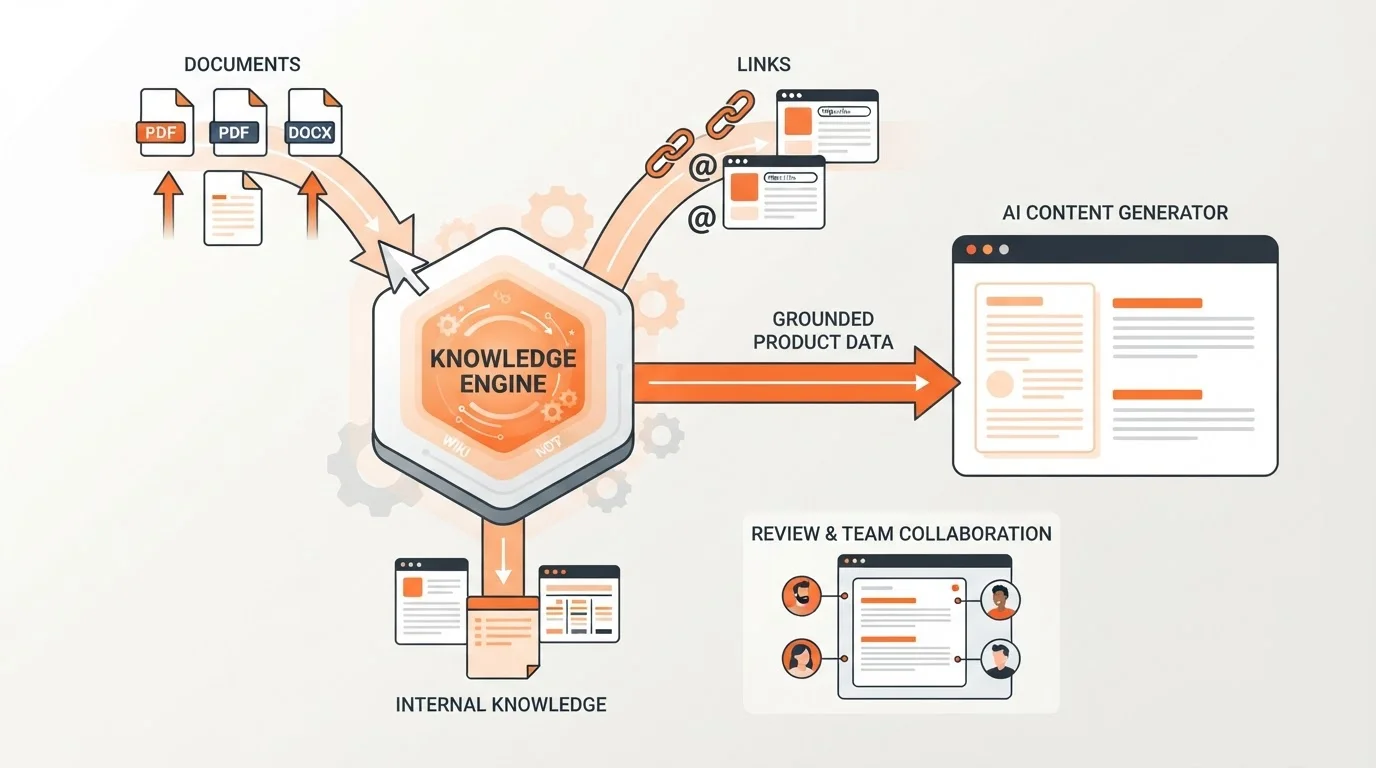
The biggest challenge for founders is maintaining a consistent content output while building their company. Manual research, writing, and optimization are time-consuming tasks that often fall to the bottom of the priority list. Automation is the only way to scale these efforts without increasing headcount.
Centralizing your product knowledge is the first step toward effective automation. By creating a 'single source of truth'—such as an internal wiki or documentation site—you provide the necessary data for AI systems to generate accurate content. Blogged's Knowledge Engine specifically allows users to provide public product sources, uploaded documents, or written descriptions to inform the writing process.
This system ensures that the AI understands the nuances of your product before it ever starts writing. It eliminates the 'hallucinations' often found in generic AI tools by grounding the output in your actual documentation. You can then manage the review process efficiently, as Blogged includes multiple revisions per article on its paid plans, ensuring every post meets your quality standards.
Furthermore, scaling requires involving your broader team without increasing costs. Blogged includes unlimited team seats on every paid plan, allowing your product managers and engineers to participate in the review process. This collaborative approach ensures technical accuracy while the autonomous platform handles the heavy lifting of SEO and distribution.
Frequently Asked Questions About Product-Led Content
Q: How often should I update my product-led blog posts?
You should review your content at least quarterly or whenever a major feature update occurs. Outdated tutorials can frustrate users and harm your SEO rankings. Regular audits ensure your content remains a reliable source of truth.
Q: Can I automate the publishing process to different platforms?
Yes, modern platforms offer deep integrations. For instance, the Ghost AI Blog Publishing integration manages content creation and review while Ghost renders the reader experience. Similarly, the Webflow CMS integration lets users collect consented visits and track conversions directly from their verified articles.
Q: What metrics matter most for product-led content?
Beyond organic traffic, you should track 'configured conversions' such as trial sign-ups, demo requests, or feature adoption. Tools like Blogged allow you to monitor Search Console performance and lead outcomes to see exactly how your content contributes to growth.
Transforming your product knowledge into discoverable content is one of the most sustainable ways to grow a SaaS company. It allows you to build an organic marketing engine that compounds over time, reducing your reliance on paid acquisition. By auditing your internal assets, choosing the right frameworks, and leveraging automation, you can turn your technical expertise into a powerful growth lever.
Start by identifying three common problems your users face and map them to specific features. Use these as the foundation for your first product-led articles. As you see the impact on your organic traffic and lead quality, you can scale the process using autonomous tools designed for the modern SaaS founder. The knowledge is already there; you simply need to make it discoverable.
Stay updated on autonomous blogging for SaaS
Get insights and strategies on transforming product knowledge into discoverable content. Learn how to drive organic growth for your SaaS.