
On this page
For many early-stage SaaS founders, the content marketing journey follows a predictable, frustrating arc. You invest heavily in educational blog posts targeting high-volume keywords, watch your impressions climb in Search Console, and then realize your trial sign-ups haven't moved an inch. This gap exists because traditional SEO focuses on attracting a crowd, while a product-led content strategy is designed to build a pipeline. By weaving your product directly into the narrative as the primary solution to a user’s pain point, you shift from simply educating a reader to activating a potential customer.
In an era where AI-driven discovery and large language models can summarize generic how-to guides in seconds, the only content that remains defensible is that which cannot be replicated without your specific product logic and user interface. Product-led content (PLC) is not about shoehorning a pitch into every paragraph; it is about providing tangible proof of value before the user ever enters a credit card. This guide explores how to leverage your technical expertise to drive sustainable organic growth, transforming your blog from a cost center into a high-converting growth engine that fuels your SaaS without requiring a massive marketing team.
The Strategic Shift: From Generic SEO to Product-Led Growth
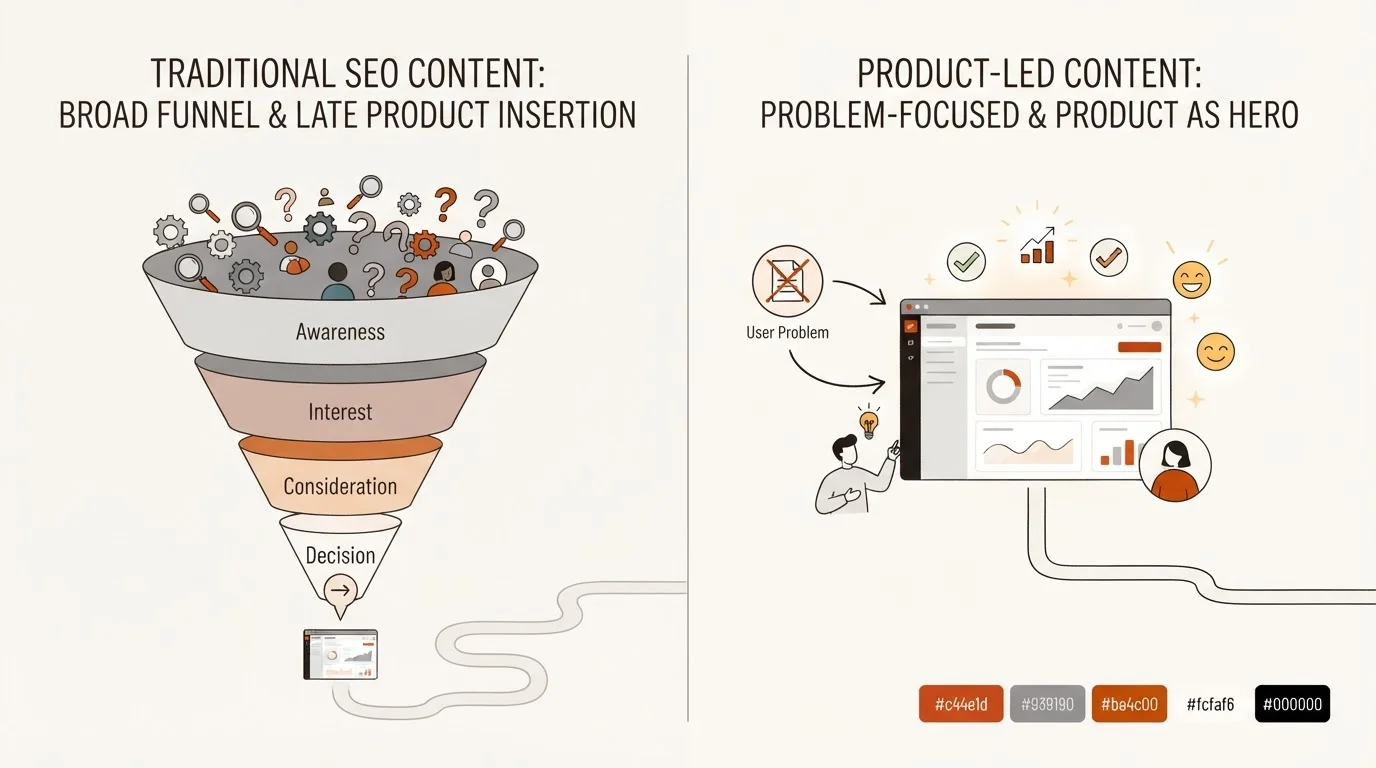
Traditional content marketing often treats the product as a secondary call-to-action buried at the end of a long essay. In contrast, product-led content positions your software as the natural hero of the story. Instead of writing a generic post titled "How to Improve Team Productivity," a product-led approach might focus on "How to Automate Sprint Planning with [Your Product Name]." This change in perspective ensures that every reader who finds your content is already looking for the specific type of solution you provide.
This shift is particularly powerful for founders who are still in the early stages of scaling. According to Koka Sexton on Founder-Led Growth, founder-led growth is a strategic advantage that compounds with time. When you integrate your unique expertise and product logic into your content, you create a library approach rather than a linear funnel. Each piece of content builds on the last, addressing specific hurdles for problem-aware and product-aware readers alike. The goal is to generate a revenue pipeline from organic traffic by showing exactly how the product functions in a real-world context.
Mapping Product Features to User Pain Points
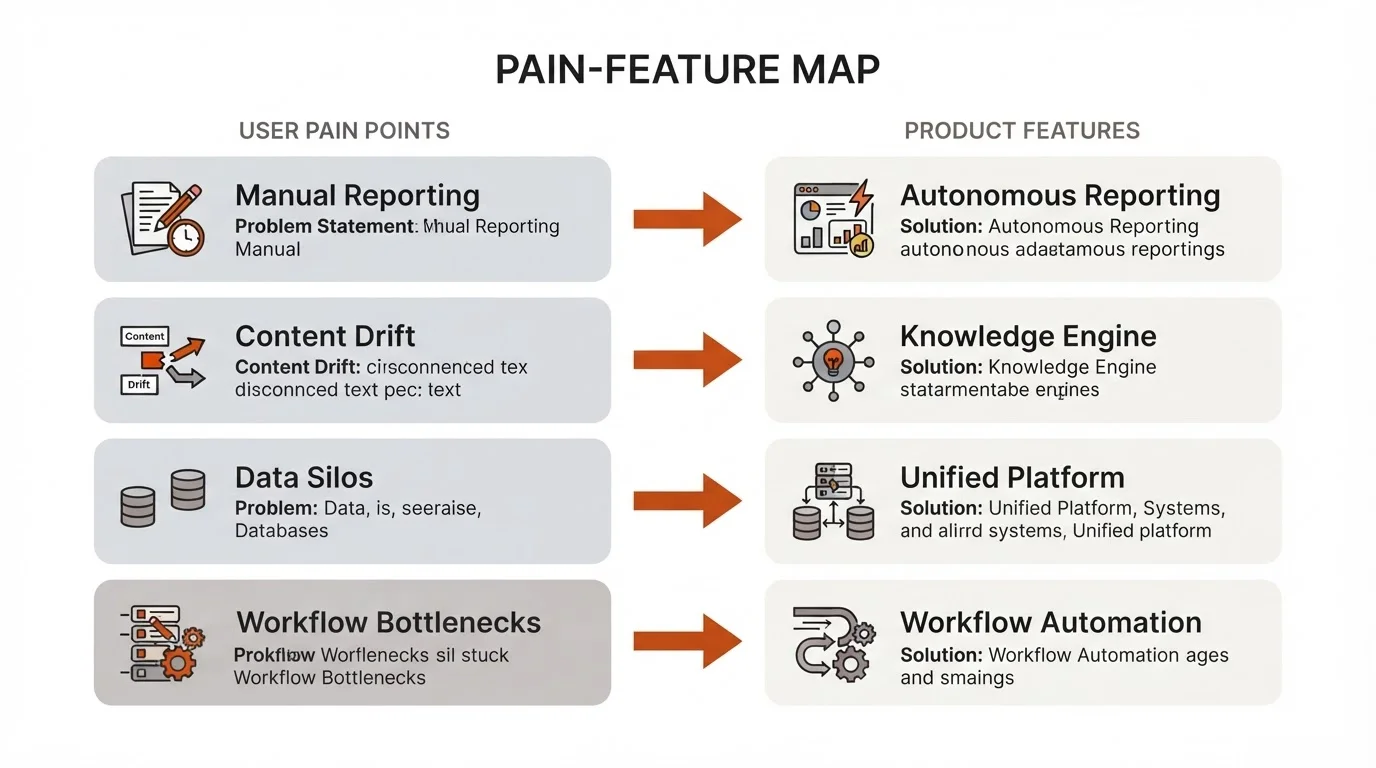
The foundation of a successful PLC strategy is a robust Pain-Feature Map. This is not just a list of features, but a bridge between a user’s daily frustration and your technical solution. To build this, founders must look beyond the code and analyze customer feedback, support tickets, and sales conversations to identify recurring themes. By focusing on how your software actually solves problems, you create content that is highly relevant to both search engines and human readers.
Start by analyzing customer feedback and looking for the exact language users use to describe their wins. If a customer says, "This saved me three hours on Mondays," the pain point is manual start-of-week reporting. You then draw direct connections between that pain and a specific feature. For every hurdle your users face, there should be a corresponding product capability that alleviates it. For instance, if a content team struggles with maintaining a consistent publishing schedule while building their core product, you would highlight a feature like Autonomous Blog Publishing for SaaS to show how the loop can be automated. By systematically connecting what your code does to what your user needs, you ensure your content feels like a solution rather than a commercial.
Identifying the 'Aha!' Moment
Not all features are created equal when it comes to content. Focus your highest-priority articles on the features that offer the most immediate Aha! moment—that point where a user first experiences the value of your software. These moments are the ideal focal points for tutorials because they demonstrate a high level of utility. By prioritizing these high-impact features, you can create content that not only attracts traffic but also drives users to initiate a trial to see the results for themselves.
Creating Content That Shows, Not Just Tells
Product-led content works because it provides proof of value before a user even signs up. To execute this, you need to move beyond abstract descriptions and provide concrete demonstrations of your product in action. The most effective formats include workflow how-to guides, honest comparison pages, and deep-dive problem/solution articles. These formats allow you to use your product as the primary example of how to solve a problem.
A common challenge for founders is maintaining this depth while building the product. This is where autonomous systems like Blogged become essential. Blogged lets users build a durable SaaS content plan and use Full Autopilot to refill a topic queue from approved Content Directions. This ensures that even high-quality, deep-dive content stays on schedule without the founder having to write every word manually. By automating the planning and research phases, you can focus on ensuring the product logic reflected in the content is accurate and compelling.
The Comparison and Alternative Framework
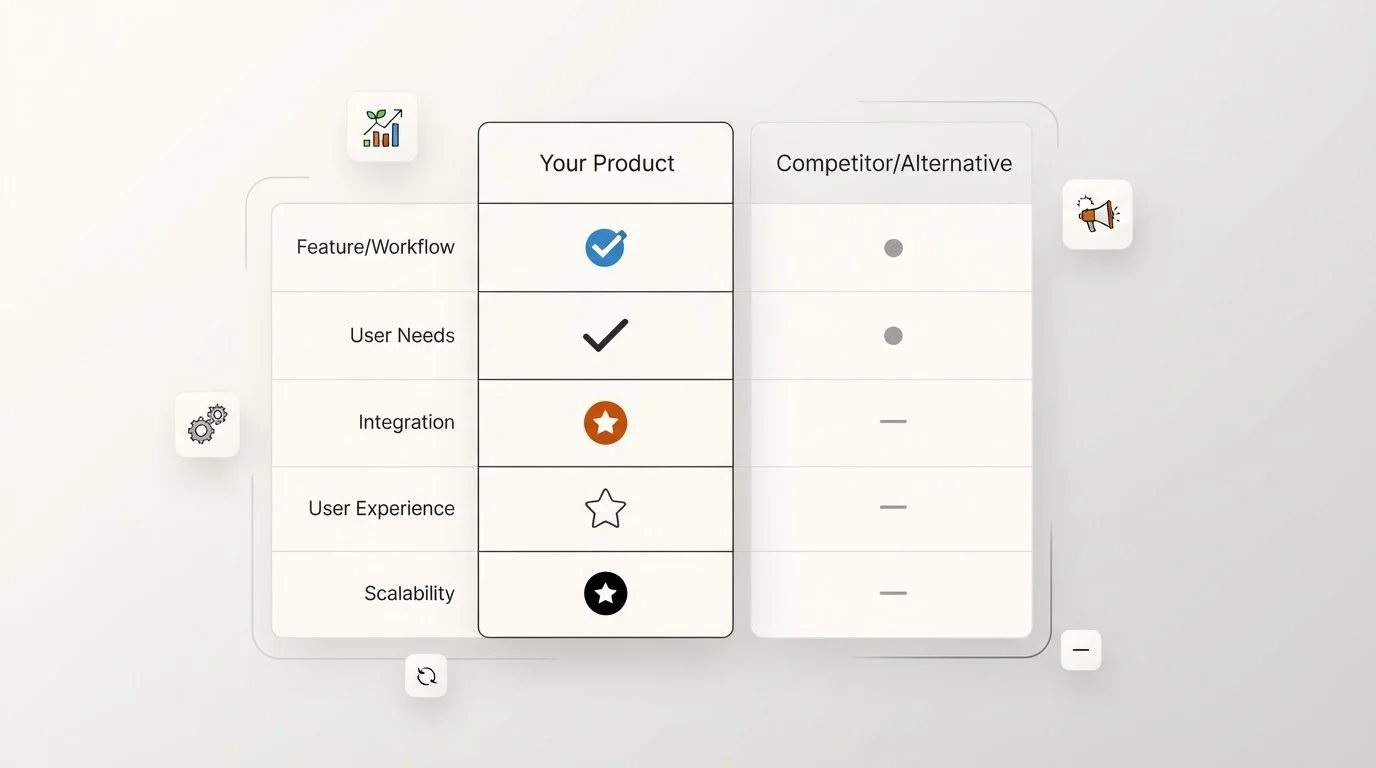
Honest comparison pages are one of the most effective PLC tools. Many successful SaaS companies use this to show how their specific user interface handles a task differently than the status quo. When creating comparison content, evaluate your product honestly against competitors. Focus on specific workflows and unique technical advantages.
For example, you might highlight how your platform handles internal linking by allowing an editor to insert or undo links without leaving the post, a specific capability that might be missing from more generic alternatives. This level of detail helps potential customers make an informed decision based on their actual needs. Avoid making the comparison a one-sided pitch; instead, focus on why your specific architecture is better suited for your Ideal Customer Profile (ICP).
Get practical updates on product-led content strategy
Receive new articles and practical insights by email.
The Infrastructure of Product Knowledge
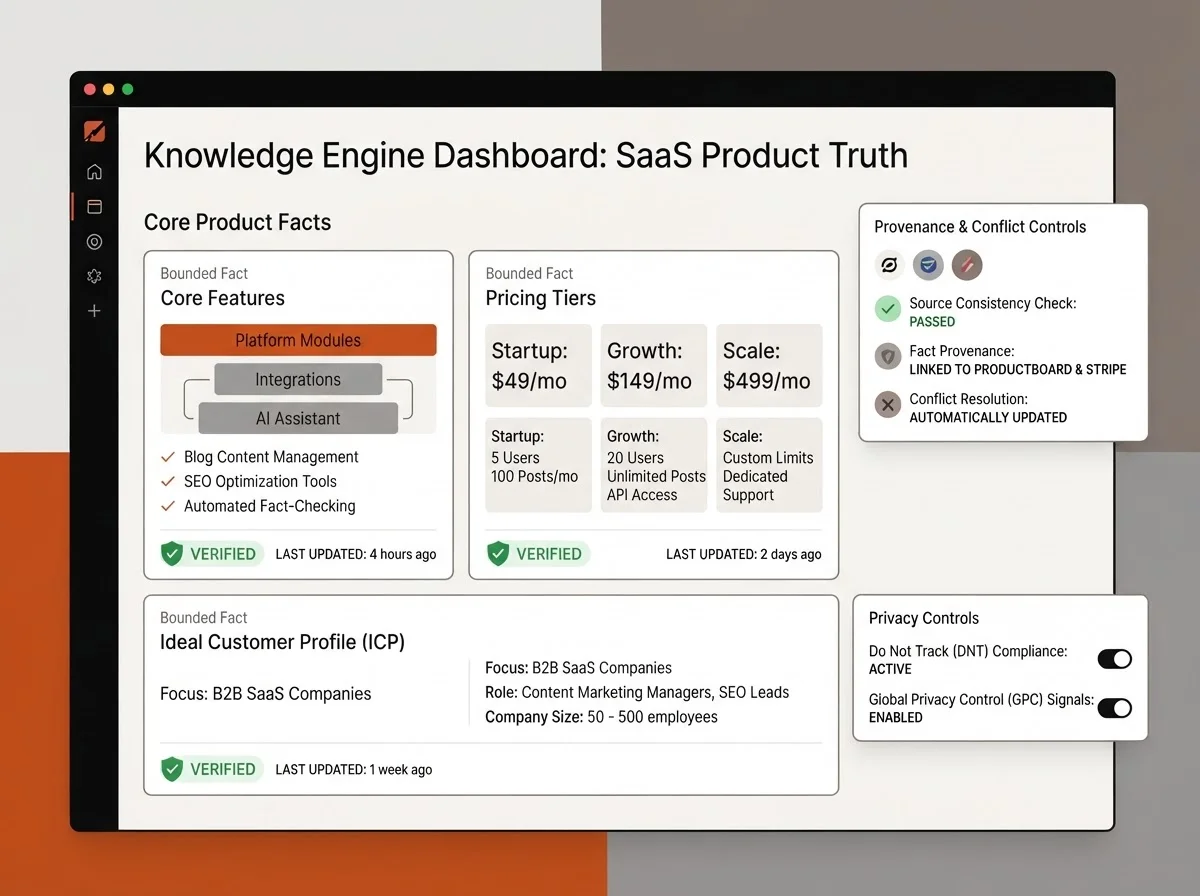
A common failure point in SaaS content is content drift, where the blog claims a feature exists that was actually updated or removed months ago. To maintain authority, your content must be grounded in a verified knowledge base. A capable system should organize your product details, ICP, and pricing facts into a single source of truth. This prevents errors and ensures that every article published reflects the current state of your software.
Blogged’s Knowledge Engine for Autonomous SaaS Blogs is designed specifically for this purpose. It organizes product, competitor, keyword, and source knowledge into bounded facts with provenance, verification states, freshness, and conflict controls. By treating your product knowledge as a structured asset, you can reuse specific context across your entire blog. This means when you update a product limit or pricing detail, future content reflects those changes without manual fact-checking for every new post. This infrastructure also allows you to integrate specific privacy controls, such as connecting approved tags with Do Not Track or Global Privacy Control (GPC) behaviors, ensuring your blog remains professional and compliant.
Scaling via Autonomous Topic Supply
Sustainability is the key to organic growth. Many founders start with great intentions but stop publishing when product development gets busy. Using an autonomous system to maintain a cadence is critical for long-term SEO success. By utilizing a system that refills a topic queue from approved directions, you ensure a consistent flow of product-led content that builds your domain authority over time. This approach allows a single founder or a small team with unlimited seats to act like a full-scale content department, maintaining the research, writing, and optimization every week while they continue to build the company.
Measuring Success: PQLs Over MQLs
In a product-led strategy, pageviews are often a vanity metric. The real goal is the generation of Product Qualified Leads (PQLs)—users who have discovered your product through content and experienced its value firsthand. To track this, you need visibility into the entire reader journey. You should monitor Search Console performance to see which product-specific queries are driving traffic, but you must also track what happens once they land on your site.
Founders should track lead growth, reader feedback, and specific CTA outcomes. Platforms like Blogged enable users to track Search Console performance, homepage engagement, and lead growth directly. This data allows you to see if a reader who consumed a deep dive on a specific feature actually clicked through to start a trial. The compounding advantage of this founder-led approach is that it generates a revenue pipeline that is far more resilient than generic informational content. By focusing on how content converts into product usage, you can refine your strategy to focus on the topics that drive the most growth.
Frequently Asked Questions
Q: How long does it take to see results from product-led content?
Organic PLC is a compounding asset. Most SaaS companies see significant movement in lead quality and search visibility within three to six months of consistent publishing.
Q: Does product-led content work for top-of-funnel awareness?
Yes. The key is to address a broad problem first and then introduce the product as the most efficient way to solve it. For example, start with "How to Grow a SaaS Blog" and move toward using autonomous workflows to scale.
Q: Can I implement this with a small team?
Absolutely. Small teams often have an advantage because they are closer to the product. Using automation tools to handle research and internal linking allows a small team to maintain high quality without a full marketing department.
Q: What is the biggest mistake founders make with PLC?
The "ghost blog." Founders often start publishing but stop when development demands increase. Using an autonomous system to maintain a consistent cadence is critical for maintaining SEO momentum.
Q: How do I handle product updates in my content?
Using a centralized knowledge engine allows you to manage product facts in one place. When a feature changes, you update the fact once, and future content reflects the updated version, preventing content drift.
Product-led content is more than a marketing tactic; it is a fundamental alignment of your growth strategy with your product’s core utility. By centering your content on specific workflows, verified facts, and clear pain-point mapping, you build an organic engine that educates and converts simultaneously. For founders who need to focus on building their SaaS while scaling their reach, implementing an autonomous PLC system is the fastest way to turn technical knowledge into a durable market advantage. The shift from vanity traffic to product-qualified leads starts with recognizing that your product is your best content asset.