
On this page
Quick answer: Automated content planning for SaaS founders is the use of integrated technology to handle the ideation, research, asset management, and scheduling of product-led content. Unlike simple social media schedulers, a true automation strategy removes the founder as the primary bottleneck by building a self-sustaining system that transforms product knowledge into high-quality, discoverable articles. By leveraging tools like a centralized knowledge engine and autonomous topic queues, founders can maintain a consistent publishing cadence without sacrificing the hours needed to build their product.
The Hidden Cost of Manual Planning
For most early-to-mid-stage SaaS founders, content is a high-leverage activity with a high-friction process. The manual workflow typically involves juggling disparate spreadsheets for keyword research, checking competitor blogs once a month, and scrambling to write an update whenever the product shipping schedule allows. This approach leads to inconsistent publishing and missed organic growth opportunities.
The mental load of context switching—from coding a new feature to researching long-tail keywords—is the primary reason many SaaS blogs stagnate. When you manually aggregate information from product specs, market insights, and customer feedback, the process is prone to errors and version control issues. Without a unified system, your content strategy becomes a series of disjointed tasks rather than a repeatable engine.
Manual content planning consumes significant resources that should be directed toward product development. By identifying where manual handoffs create friction—such as waiting for asset approvals or manually updating a publishing calendar—you can begin to map out where automation will provide the highest return on investment (ROI).
The Foundation: Building a Scalable Knowledge Engine
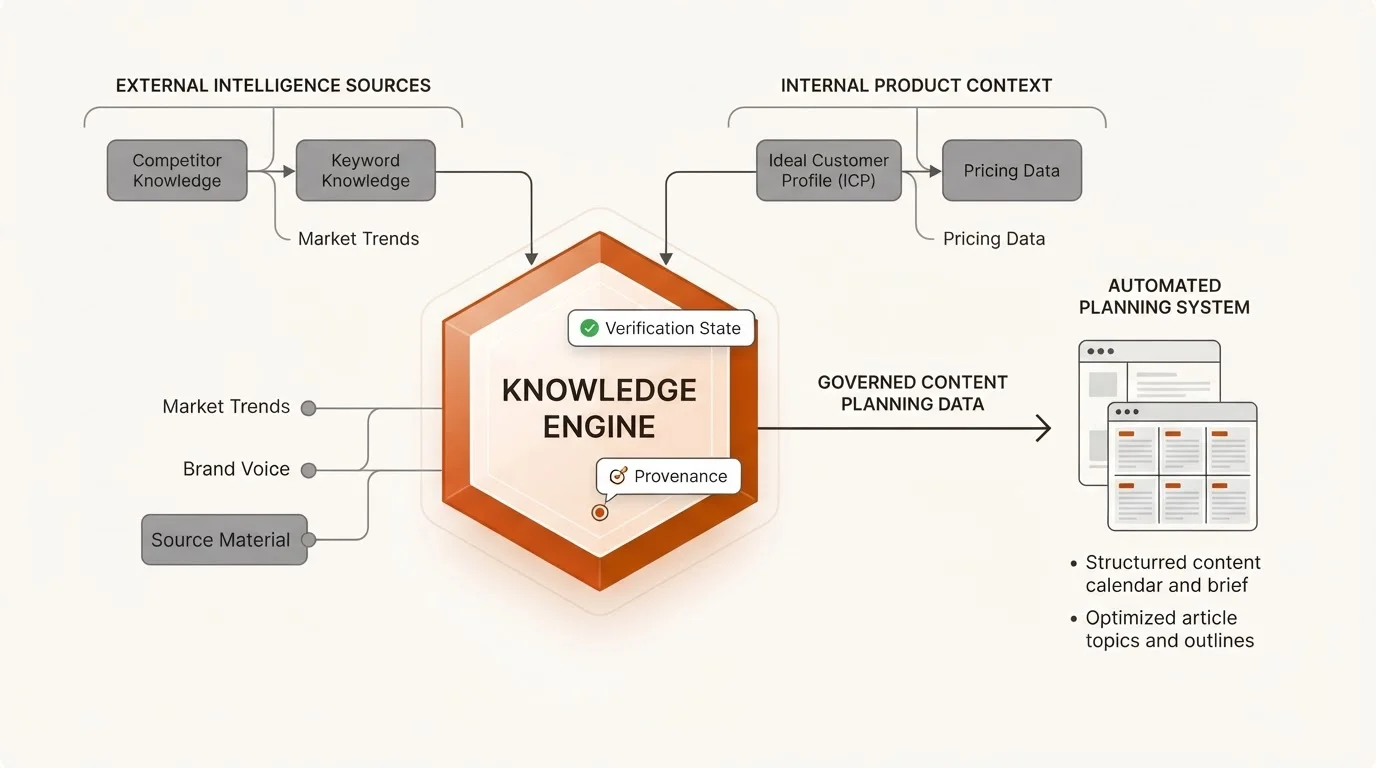
Effective automation does not start with AI writing; it starts with structured data. To automate content planning, you must first centralize your product and market intelligence. This ensures that any content produced is accurate, product-led, and aligned with your brand voice.
Blogged's Knowledge Engine for Autonomous SaaS Blogs allows founders to organize product, competitor, keyword, and source knowledge into bounded facts. This system includes provenance, verification state, freshness, and conflict controls, ensuring that your automated planning is built on a foundation of truth rather than generic AI assumptions.
When your product descriptions, pricing, and Ideal Customer Profile (ICP) are organized into a structured library, an automated system can reuse this context across all content. This eliminates the need to re-explain your product's core value proposition every time you plan a new article. By maintaining AI Knowledge Freshness & Governance, you ensure that your blog remains accurate even as your product evolves, preventing the common trap of outdated information appearing in your organic search results.
Automating Research Without Losing Strategic Depth
Research is often the most time-consuming phase of content planning. Automating this stage involves moving away from manual data collection toward insights-driven automation. Start by auditing your current research habits: how much time is spent checking keyword volume or analyzing competitor updates?
Modern automation tools can track competitor rankings and industry news automatically, providing regular updates without manual intervention. This allows you to identify content gaps—topics your competitors are covering that you have neglected—without spending hours on manual audits. The goal is to let technology handle the data aggregation so you can focus on the strategic decision of which topics to prioritize.
Asset management is another critical component of research automation. Managing a private SaaS product asset library with review queues and visible approvals ensures that your team always uses the latest, approved product screenshots. Systems that offer bulk decisions, alt text generation, and safe archiving reduce manual errors and significantly speed up the production cycle.
AI-Driven Topic Generation and Durable Content Plans
Once your research is automated, the next step is filling your editorial pipeline. AI plays a transformative role here, but it requires specific guardrails to remain effective for SaaS. Rather than asking a generic AI for "blog ideas," a founder should use a system that generates topics based on approved Content Directions.
Blogged lets users build a durable SaaS content plan and publish on their preferred cadence. The system uses Full Autopilot to refill a short Topic queue from these approved Content Directions. This ensures a continuous supply of content that is strategically aligned with your growth goals. Instead of starting from a blank page every week, your role shifts to reviewing and refining a queue of data-backed topics.
When implementing AI for topic generation, focus on these three layers:
- Content Pillars: Broad areas of interest (e.g., "Remote Work Productivity").
- Topic Clusters: Specific keyword groups that support those pillars.
- Actionable Headlines: Targeted titles that address specific user pain points.
This hybrid approach—combining AI efficiency with human strategic oversight—ensures that your content remains both data-driven and authentically reflective of your brand identity.
Streamlining Calendar Management and Internal Linking
A content calendar is the pulse of your marketing operations. Manual calendar management in spreadsheets often breaks down as you scale. Automated systems integrate your content generation directly with a visual calendar, offering features like drag-and-drop rescheduling and automated notifications for upcoming deadlines.
Beyond just scheduling dates, automation can handle the technical architecture of your blog. For example, internal linking is often neglected in manual planning because it requires a comprehensive memory of every article previously published. An automated platform like Blogged can verify link destinations, explain why a link fits a specific section, and allow editors to insert or undo links without leaving the post editor.
By setting up rules that trigger actions based on content status—such as moving an article to the publishing queue once an editor marks it as "Approved"—you eliminate the need for constant status updates and manual handoffs.
Get practical updates on automated content planning saas
Receive new articles and practical insights by email.
Integrating Planning with Autonomous Publishing
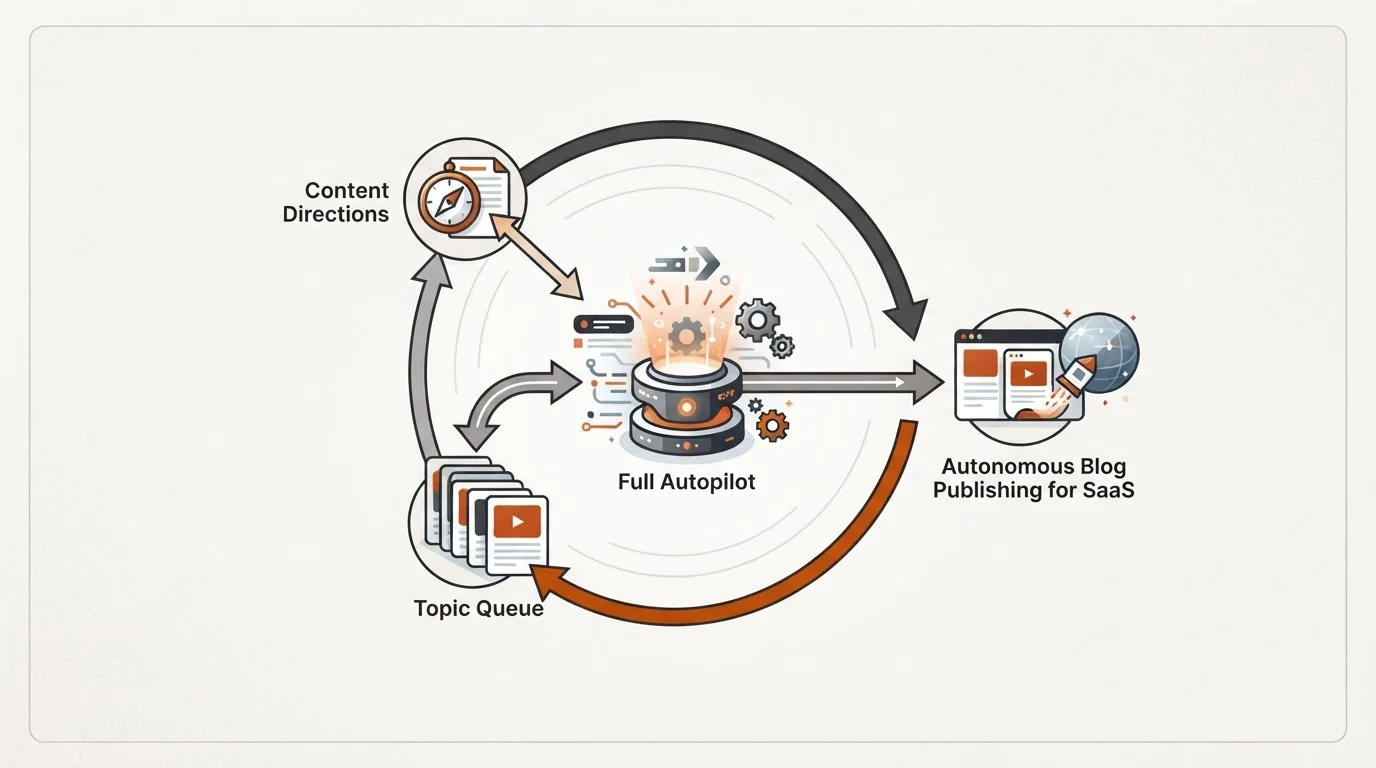
The final stage of content planning automation is closing the loop with autonomous publishing. This transforms content creation from a series of tasks into a continuous, self-executing process. When your planning tool is directly integrated with your CMS, an approved draft can be published automatically at the optimal time for your audience.
Blogged's Autonomous Blog Publishing for SaaS feature allows you to automate the entire loop. This includes not just the publishing of the text, but the technical optimization that search engines require. Before fully automating, founders should implement a phased approach:
- Phase 1: Automate research and topic generation to build a pipeline.
- Phase 2: Automate scheduling and internal linking to save editorial time.
- Phase 3: Enable full autonomous publishing for a hands-off organic growth engine.
This integration minimizes manual copy-pasting and ensures that your technical SEO, such as metadata and internal link structures, is consistently applied to every post. Always maintain a final review stage to ensure quality, but let the automation handle the heavy lifting of distribution and optimization.
Measuring Impact Through Data Feedback Loops
Automation is only as good as the data it produces. After each publishing cycle, your system should log performance metrics to inform future planning. This includes tracking Search Console performance, homepage engagement, and lead outcomes.
By monitoring which articles drive the most lead growth and reader feedback, you can refine your Content Directions. If a specific pillar is performing exceptionally well, your automated system can be adjusted to generate more topics in that cluster. This creates a virtuous cycle where your blog becomes more effective and targeted over time, all while requiring less manual intervention from the founder.
Useful frequently asked questions
Q: How much time can a founder realistically save with automated content planning?
While results vary based on existing workflows, founders often save several hours per week by automating research, topic generation, and scheduling. By removing the need to manually aggregate facts and manage calendars, you can shift your focus entirely to strategic review and product development.
Q: Does automated planning mean I lose control over my brand voice?
No. The most effective systems, like Blogged, use a Knowledge Engine to store your specific brand positioning, facts, and ICP. You maintain control by approving Content Directions and reviewing the topic queue, while the automation handles the repetitive execution.
Q: What is the difference between a scheduler and autonomous publishing?
A scheduler simply publishes a finished draft at a set time. Autonomous publishing handles the entire loop—from identifying a topic and researching facts to optimizing for SEO/GEO and managing internal links—before finally publishing the content.
Q: Can I involve my team in an automated workflow?
Yes. Blogged includes unlimited team seats, allowing you to invite editors or product managers to review facts, approve assets, and oversee the content pipeline without per-user licensing costs.
Transitioning to automated content planning is a strategic shift that allows SaaS founders to scale their organic reach without scaling their workload. By centralizing product knowledge, leveraging AI for topic generation, and integrating autonomous publishing, you transform your blog from a chore into a self-sustaining growth engine. To begin, audit your current workflow for manual bottlenecks and start by automating a single stage—such as research or topic refilling. As you gain confidence in the system, you can close the loop, freeing yourself to focus on building the next generation of your SaaS product.