
On this page
Integrating product knowledge into content strategy is the systematic process of using your software’s specific capabilities, use cases, and technical facts to drive organic growth. For SaaS founders, this strategy ensures that every article published is not just a collection of generic keywords, but a specialized resource that solves user problems while positioning the product as the primary solution.
Traditional content marketing often fails SaaS companies because it relies on generic writers who lack access to the core product vision. When content is disconnected from the product, it attracts high-volume traffic that rarely converts. By grounding your strategy in product-specific facts, you transform your blog from a generic marketing expense into a discoverable engine for customer acquisition.
The Strategic Value of Product-Led Content Strategy
For a SaaS startup, content serves as a digital bridge between a customer’s pain point and your technical solution. Generic advice—like general productivity tips—is plentiful and highly competitive. However, specific, product-informed insights—such as how a specific feature automates task delegation for distributed engineering teams—offer a level of utility that generic content cannot match.
Search engines and AI discovery tools now prioritize specificity. They reward content that provides unique, verifiable data over surface-level summaries. Integrating product knowledge content strategy ensures your content remains relevant even as search algorithms shift toward Generative Engine Optimization (GEO) and AI-driven answer engines.
Founders often struggle to sustain this level of deep research while building their company. Effective scaling requires a content planning system that supports continuous generation based on approved product directions. For instance, using an autonomous platform like Blogged lets you build a durable SaaS content plan, publish on your cadence, and let Full Autopilot refill a short Topic queue from approved Content Directions. This ensures that your product-led insights remain consistent without demanding your daily attention.
Aligning Product Features with Customer Needs
An effective saas content strategy product focus does not simply list features; it maps them to specific customer outcomes. This requires a deep understanding of why a feature was built and who it was built for. To start, founders should audit their existing content to identify "authority gaps"—sections where a problem is discussed but the product’s unique solution is omitted.
You can streamline this by organizing product information into structured entities. For example, Blogged lets users organize facts by product entity and facet, allowing a content engine to draw on specific technical benefits or use cases depending on the target persona. This structured approach prevents product knowledge content marketing from becoming a repetitive feature dump, keeping every piece distinct and focused on real-world application.
Identifying Problem-Solution Narratives
Create a matrix that pairs every major product feature with a specific customer pain point. Instead of writing about broad industry trends, write about specific solutions like resolving data synchronization lag in distributed databases. By focusing on the intersection of user intent and product capability, you create product-led content execution that is naturally rich in the long-tail keywords your ideal customers are actually searching for.
Structuring Product Knowledge for Content Teams
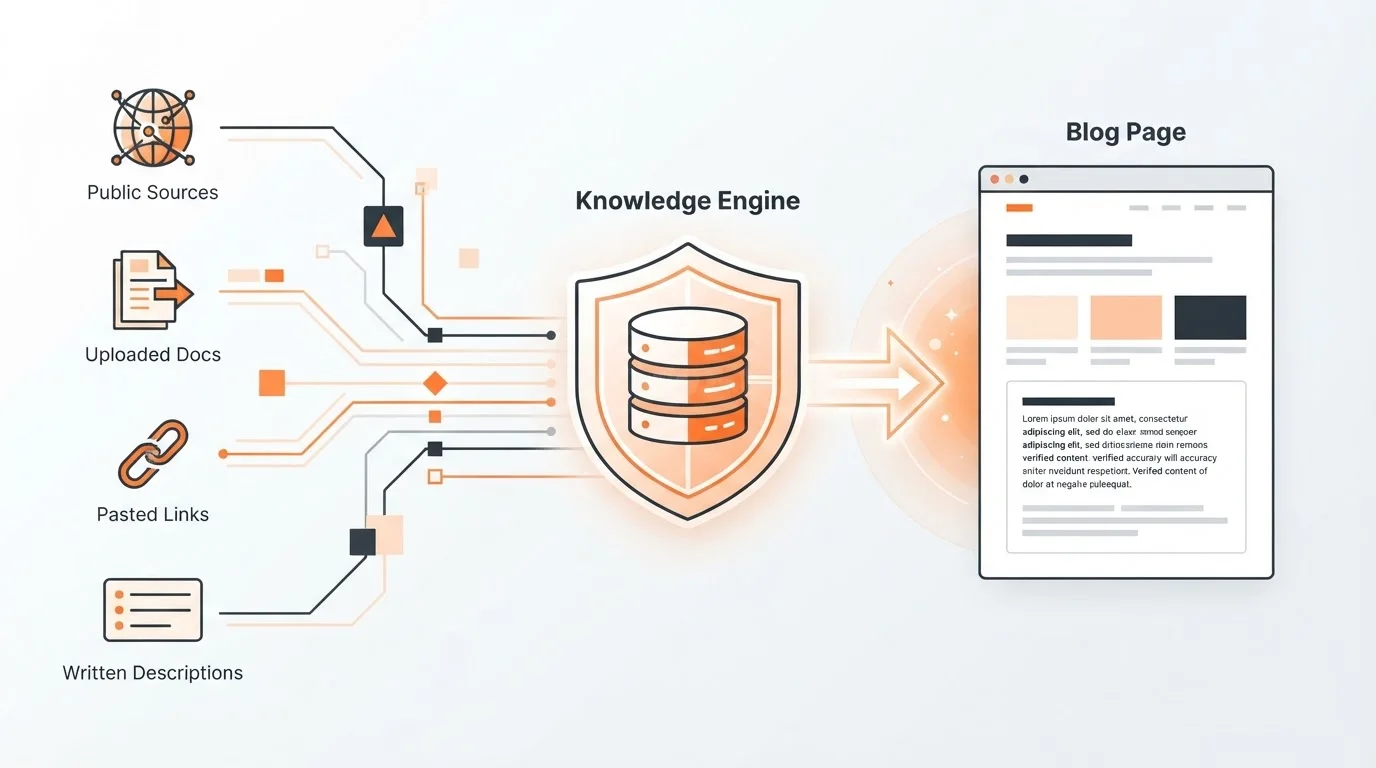
A content team or automation engine is only as good as the information it can access. Without a centralized "source of truth," content creators often resort to external research, which dilutes your brand's unique perspective and technical accuracy. SaaS founders must implement a system to capture product knowledge in real-time.
Modern platforms like Blogged use a Knowledge Engine for Autonomous SaaS Blogs feature that lets users provide public product sources, uploaded documents, pasted links, or a written product description to ground content in reality. By centralizing this data, you ensure that every piece of content—whether reviewed by a human or an autonomous system—remains accurate to your latest software updates.
Steps to Build Your Knowledge Base
- Consolidate Internal Docs: Upload your technical documentation, roadmap, and internal FAQs to a centralized engine.
- Define Product Facets: Categorize information by technical specs, user benefits, and integration capabilities.
- Automate Updates: Ensure that when a new feature launches, the facts are immediately available to your content planning tool.
- Train the System: Use your unique founder voice and product descriptions to set the tone for all future output.
Leveraging Product Specificity for Discoverability
In the era of AI-driven search, Generative Engine Optimization (GEO) is becoming as important as traditional SEO. AI models look for specific, authoritative data to include in their summaries. Content that is deeply integrated with product knowledge provides the entity-based information these models crave.
When your content mentions specific features, proprietary workflows, or technical benchmarks, it increases the likelihood of being cited as a primary source. This discoverability drives organic growth by placing your product in front of users exactly when they are asking an AI or search engine for a solution to their problem.
Measuring the Impact on Organic Growth
Organic growth should not be measured by page views alone. For SaaS founders, the goal is to attract users who sign up for trials, buy subscriptions, or request demos. Measuring the effectiveness of product-grounded content requires tracking metrics that link reading behavior to business outcomes.
You should track performance specifically from articles that mention product features. Blogged lets users track Search Console performance, homepage engagement, on-site searches, CTA and lead outcomes, lead growth, and reader feedback. This provides a clear picture of which product-specific topics are actually driving revenue, allowing you to double down on integration-focused or feature-focused content that converts.
Scaling Execution Through Integration
As your SaaS grows, manual publishing becomes a bottleneck. Scaling a product-led content strategy requires a workflow that bridges the gap between content creation and your website. Automation should handle the mechanical tasks—formatting, interlinking, and publishing—while you focus on the product strategy.
If you use WordPress, look for integrations that allow seamless updates. Blogged's WordPress AI Blog Publishing integration lets users create and review articles in Blogged, then deliver them to their WordPress website. Blogged connects to self-hosted WordPress through the Blogged Publishing plugin and an application password. For those using Ghost, Blogged's Ghost AI Blog Publishing integration lets users create a custom integration in Ghost, copy its Admin API key, and verify their Ghost connection in Blogged, managing content creation and review while Ghost renders the reader experience. Across platforms like Webflow, Next.js, WordPress, Ghost, or when using the custom API, these integrations let users collect consented visits and configured conversions for verified articles.
Streamlining the Review Process
Scaling doesn't mean losing control. Founders should use systems that allow for team collaboration. For example, Blogged includes unlimited team seats on its plans, allowing product managers and marketers to participate in the review and approval process without additional costs. This ensures that every article is vetted for technical accuracy before it goes live, maintaining the integrity of your product knowledge.
Frequently Asked Questions About Integrating Product Knowledge
Q: How is product-led content different from standard SEO content?
Standard SEO content often targets generic, high-volume keywords to generate raw traffic. Product-led content targets specific user problems and demonstrates exactly how your product solves them, leading to higher conversion rates and better qualified leads.
Q: Does every blog post need to mention the product?
No, but every post should be informed by your product's domain expertise. Even top-of-funnel awareness content should be grounded in the technical realities and unique perspectives of your SaaS niche.
Q: How do I get my technical team to contribute to content?
You don't necessarily need them to write articles. Instead, use a knowledge engine to ingest their technical documentation, Slack discussions, or Loom demos. An autonomous platform can then translate that technical knowledge into readable, optimized blog posts.
Q: What are the best CMS platforms for scaling SaaS content?
WordPress and Ghost are the industry standards for SaaS blogs. Look for tools that offer native integrations, such as the Blogged WordPress plugin or Ghost Admin API, to automate the publishing pipeline while collecting consented visits and conversions.
Integrating product knowledge into your content strategy is the most sustainable way to drive organic growth for a SaaS company. It moves your brand away from the content treadmill of high-volume, low-value publishing and toward a product-led model that builds true authority and trust. By centralizing your product facts, aligning features with user needs, and automating the publishing workflow, you can build a discoverable content engine that scales alongside your software.