
On this page
Organic growth for modern software companies is no longer a volume war; it is a relevance war. Traditional SEO often involves chasing broad, high-volume keywords that attract casual readers but fail to generate trial sign-ups. Product-led SEO flips this model by using your software’s specific features, data, and utility to capture high-intent traffic.
For SaaS founders, this strategy represents a shift from marketing-led blogging to product-driven discovery. It ensures that when a potential user searches for a solution to a specific operational bottleneck, your product is not just a mention in a list—it is the direct answer. By integrating product knowledge into your content engine, you build a compounding asset that captures buyers at the exact moment they are ready to evaluate a solution.
Defining Product-Led SEO: Beyond the Blue Link
Product-led SEO is a strategy where your software's core attributes, use cases, and user experiences fuel your inbound traffic. Unlike traditional SEO, which often starts with a keyword research tool and works backward to a topic, product-led SEO starts with the product. It focuses on how your software solves real-world problems and builds content that makes the product and the search result virtually indistinguishable.
This approach is particularly critical for SaaS because the buyer journey has become increasingly non-linear. Modern buyers prefer to self-educate through deep dives, templates, and integration guides before ever speaking to a sales representative. By prioritizing relevance and intent over raw search volume, you attract a smaller but significantly more qualified audience that is ready to convert into trial sign-ups and paid users.
The Rise of Generative Engine Optimization (GEO)
The emergence of Generative Engine Optimization (GEO) means your content must be structured for AI engines like Perplexity and Google AI Overviews. While SEO gets you ranked in traditional lists, GEO ensures you are the cited source in a synthesized AI response. Product-led content provides the specific, factual evidence these engines require to recommend your software as a solution.
To succeed here, content must be authoritative and grounded in verifiable data. When an AI engine answers a user's question, it looks for structured facts about product capabilities and limitations. Product-led SEO prepares your brand to be the primary citation in these zero-click environments.
Finding Your Product’s Knowledge Goldmines
The foundation of a successful product-led strategy is identifying the 'goldmines' of information buried within your product development and customer success cycles. You aren't just looking for features; you are looking for the 'why' behind the build and the 'how' of the user's success.
To scale this, you must treat product knowledge as structured data. This includes your unique positioning, Ideal Customer Profile (ICP) nuances, pricing logic, and even technical limits. Organizing these into bounded facts ensures that your content remains accurate and consistent, even when generated at scale.
Building a Durable Knowledge Engine
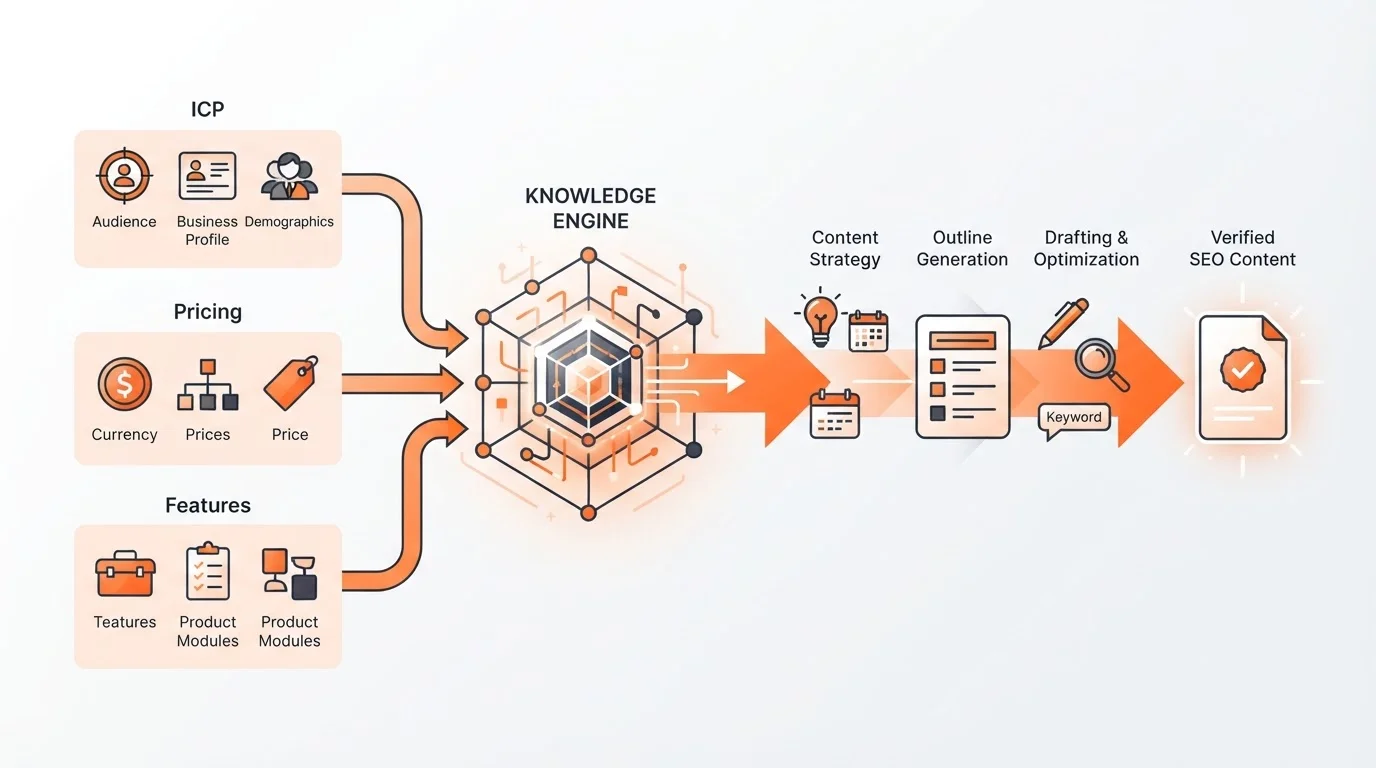
Organizing these facts allows you to provide public sources, uploaded documents, or simple pasted links to build a durable knowledge base. This prevents the common problem of automated content falling into "hallucinations" or generic filler. By anchoring your content in verified facts, every post serves a strategic purpose and reflects the current state of your platform.
Platforms like Blogged facilitate this by organizing product descriptions, competitor facts, and ICP data into a verifiable repository. This system ensures that your content is based on your actual product facts rather than generic industry observations. It transforms your internal documentation and product vision into a library of discoverable assets.
Mapping Features to Intent: From SEO to GEO
Once you have your product facts, you must map them to how users search. This mapping must account for both traditional keywords and natural language queries handled by generative engines. The goal is to align your product’s capabilities with the specific pain points users express in their search queries.
Focus on these three intent categories:
- Informational/GEO: Queries like 'How to automate inventory tracking in retail' demand specific, authoritative guides that establish your product as a subject matter expert.
- Commercial Investigation: Searches for 'Product A vs Product B' or 'Best CRM for small teams' are opportunities to use product data to prove differentiation.
- Navigational/Transactional: 'Product X pricing' or 'Product X API docs' represent high-intent users looking for friction-free access to your platform's specifics.
Crafting Content That Converts
Product-led SEO is at its strongest when it targets Bottom-of-Funnel (BOFU) searchers. These users have already identified their problem and are actively evaluating solutions. Your content should act as a 'demo-in-a-doc,' showing rather than just telling how your software works.
Key formats include Integration Guides, which show how your product fits into the user's existing tech stack, and Feature Deep Dives, which explore the advanced utility of a single feature. These articles explain the tangible benefits—like time saved or revenue generated—rather than just the technical specs. This approach ensures that your content is not just driving traffic, but actively moving users toward a conversion.
Strengthening Internal Architecture
To keep readers engaged, utilize tools that streamline the editorial process and maintain site structure. Blogged's internal linking tool verifies the destination and shows exactly why a link fits a specific section, allowing editors to insert or undo links without leaving the editor. This keeps your internal site architecture strong, which is a key signal for both search engines and human readers who want to explore related topics.
Scaling Without the Burnout
The biggest challenge for SaaS founders is not knowing what to write, but finding the time to write, optimize, and publish it every week while building the company. Scaling a product-led strategy requires moving away from manual, one-page-at-a-time creation toward a systematic, autonomous approach.
Automation should augment your expertise, not replace it. By using an autonomous platform, you can set a publishing cadence and trust the system to maintain a short topic queue based on your approved content directions. This allows you to scale from a few core pages to a comprehensive library of product-led assets that compound in value over time.
The Role of Autonomous Publishing

Blogged's Full Autopilot refills your topic queue and manages the research-to-publishing loop, ensuring your blog remains active and relevant without requiring daily oversight. Founders can retain editorial control with features like one revision per article, ensuring the final tone and factual accuracy meet their standards. This shift to autonomy allows the founding team to focus on core product development while the organic growth engine runs in the background.
Measuring the Impact of Product-Led SEO
In a product-led world, organic traffic is a vanity metric unless it correlates with business growth. Founders should focus on outcomes that reflect revenue quality and marketing efficiency. Tracking how organic visitors move to your sign-up page is more important than raw pageview counts.
Key indicators to monitor include:
- Qualified Pipeline Created: The number of visitors who transition to a trial or demo request.
- CAC Payback Period: How quickly a customer acquired through organic search pays for their acquisition cost.
- Retention by Source: Whether users who find you through product-led content stay longer due to their initial self-education on your platform's utility.
Analytics and Feedback Loops
Monitoring Search Console performance, CTA outcomes, and lead growth provides a clear picture of what is working. By reviewing homepage engagement and reader feedback, you can continuously refine your 'Knowledge Engine' to address the questions your customers are actually asking. This feedback loop ensures your content strategy evolves alongside your product.
Frequently Asked Questions About Product-Led SEO
Q: How is product-led SEO different from traditional SEO?
Traditional SEO often targets high-volume industry keywords to build broad awareness. Product-led SEO centers content on the product itself, using specific features and use cases to attract users who are ready to solve a problem with software.
Q: What is GEO and why does it matter for my SaaS?
Generative Engine Optimization (GEO) is the practice of ensuring your brand and product are cited in AI-powered answers from tools like ChatGPT or Perplexity. It is essential for capturing discovery in an era where users increasingly get direct answers instead of clicking through a list of links.
Q: Can I automate product-led SEO without losing quality?
Yes, by using an autonomous platform that anchors its writing in a verified 'Knowledge Engine.' This ensures the content is based on your actual product facts and ICP data rather than generic AI-generated filler.
Q: What metrics should I prioritize?
Focus on qualified trial sign-ups, demo requests, and CAC payback periods. These metrics provide a clearer picture of how organic search is contributing to your bottom line compared to simple traffic or ranking reports.
Product-led SEO is the most sustainable growth lever for SaaS founders today. By transforming your product knowledge into discoverable, high-intent content, you create a marketing engine that works even when you are focused on building. Embracing this strategy means moving beyond generic blogging and into the world of precision discovery.
With a structured knowledge base and an autonomous execution plan, you can dominate the search and AI discovery landscape. Start by auditing your product’s unique data and mapping it to user intent. By automating the research-to-publishing loop, you can drive qualified leads and durable revenue growth without sacrificing your product development velocity.
Stay updated on autonomous blogging for SaaS
Get insights and strategies on transforming product knowledge into discoverable content. Learn how to drive organic growth for your SaaS.