
On this page
Organic growth for SaaS founders often feels like a black box. You know your product needs visibility on Google, but standard SEO advice frequently falls flat because software is not a commodity; it is a specialized solution to a specific workflow problem. A successful SaaS keyword research strategy is not about chasing the highest search volume. It is about identifying the exact phrases your ideal customers use when they encounter the pain your product is designed to solve.
Traditional keyword research prioritizes volume, but in the SaaS sector, intent is the only metric that truly drives MRR. A thousand visitors looking for a generic definition will rarely convert as effectively as ten visitors looking for a specific integration or a comparison against a legacy competitor. This guide moves beyond generic search terms to help you build a product-led SEO engine that attracts users ready to sign up.
Why Keyword Research is Different for SaaS Products
SaaS SEO is unique because the product is often invisible until a user interacts with it. Unlike e-commerce, where a user searches for a physical item, SaaS users search for outcomes, efficiencies, or "jobs to be done." This shifts the focus from simple product keywords to a more complex ecosystem of problem-aware and solution-aware terms.
Because the SaaS sales cycle involves multiple touchpoints—from initial problem realization to the final procurement hurdle—your keywords must reflect this journey. You are not just ranking for what your software is; you are ranking for what it does for the user at different levels of professional sophistication. Founders often struggle to bridge the gap between their technical product knowledge and how a non-technical user might search for a fix.
To bridge this gap, Blogged's Knowledge Engine for Autonomous SaaS Blogs organizes product, competitor, and keyword knowledge into bounded facts. By centralizing these facts with provenance and freshness controls, founders ensure their content remains technically accurate while speaking the language of the customer.
Identifying High-Intent Keywords for Product-Led Content
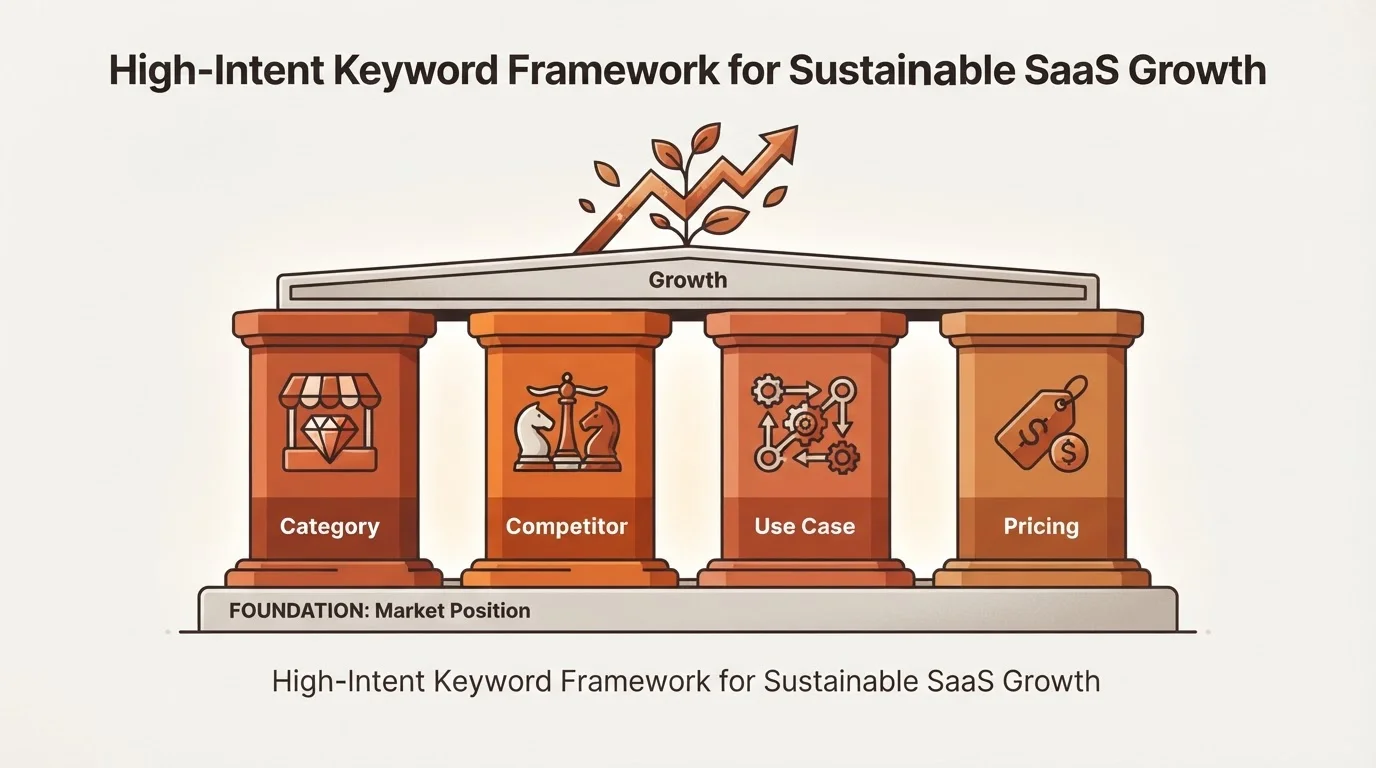
High-intent keywords are the lifeblood of sustainable SaaS growth. These search terms indicate that a user is actively seeking a solution or evaluating specific options. When you target these, your blog acts as a digital sales representative that works 24/7. By focusing on these specific terms, you can produce content that positions your product as the logical solution to the searcher's problem.
There are four primary categories of high-intent keywords for SaaS:
- Category Terms: "Project management software for architects" or "Cloud-based CRM."
- Competitor Comparisons: "[Competitor] vs [Your Product]" or "[Competitor] alternatives."
- Use Case Terms: "How to automate client onboarding" or "Remote team time tracking."
- Pricing and Evaluation: "Best affordable SEO tools" or "[Product Name] pricing."
To maintain this focus consistently, Blogged lets users build a durable SaaS content plan and publish on their own cadence. The Full Autopilot feature can then refill the topic queue with approved content directions that align with these high-intent categories, ensuring your blog never runs out of relevant material.
Mapping Keywords to the SaaS Buyer's Journey
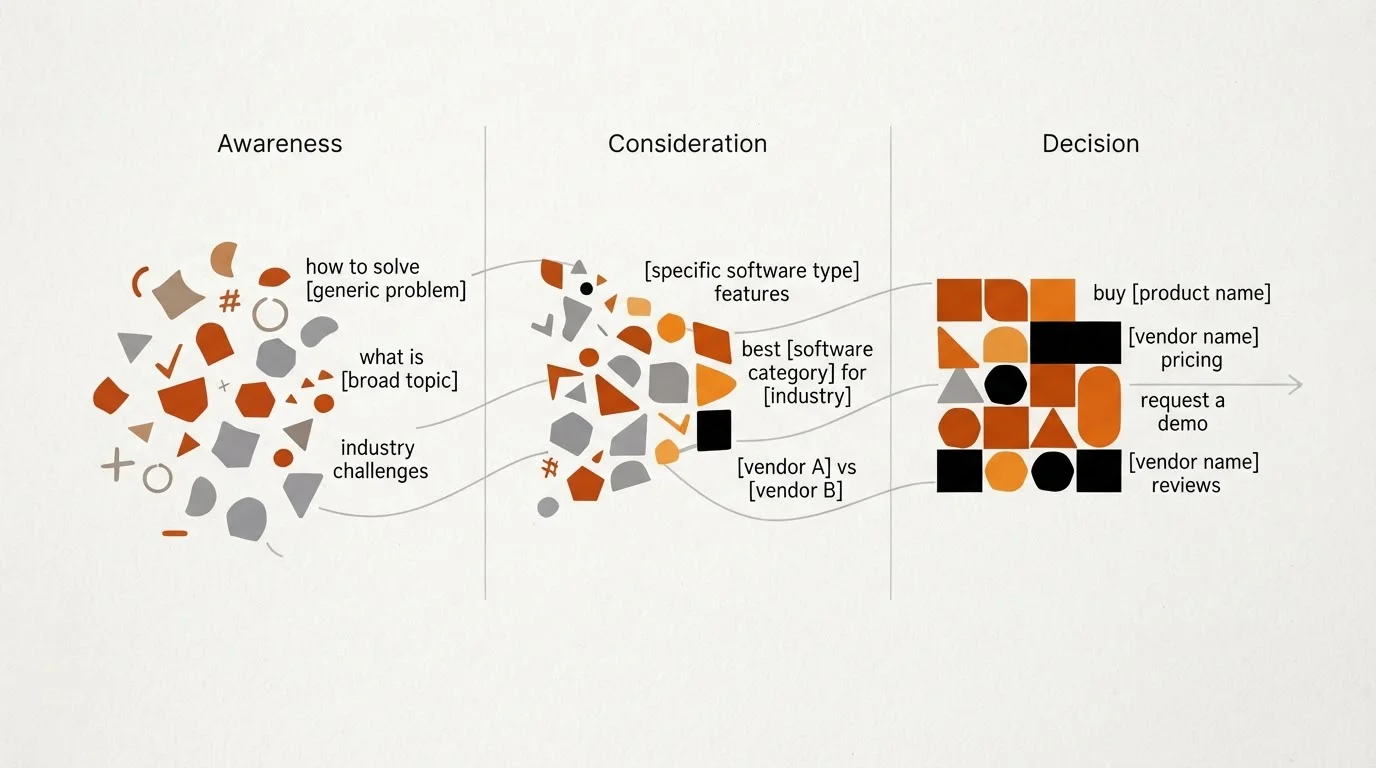
A common mistake is treating every keyword with the same priority. To maximize conversion, you must map your keywords to the specific mindset of the searcher. A user at the beginning of their journey needs education, while a user at the end needs proof and a clear path to trial.
The Awareness Stage: Identifying the Problem
At this stage, the user knows they have a problem but may not know a software category exists to solve it. They search for pain points and symptoms rather than solutions.
- Keywords: "Why is my churn rate so high?" or "common manual data entry errors."
- Goal: Educate the reader and introduce the concept of your solution. Do not lead with a hard sell; lead with value and diagnostic insight.
The Consideration Stage: Evaluating Solutions
The user now understands the solution category. They are looking for the best way to implement it and are comparing different tools side-by-side.
- Keywords: "Best customer success platforms" or "automation tools for HR teams."
- Goal: Position your product as the superior choice for their specific niche. Use feature walkthroughs to show, not just tell, how your software handles these tasks.
The Decision Stage: Final Selection
The user is ready to buy or start a trial. They are looking for final validation, pricing details, and specific feature capabilities to justify the purchase.
- Keywords: "[Your Product] reviews," "[Your Product] discount," or "[Your Product] integrations."
- Goal: Remove friction. Provide clear calls to action, pricing transparency, and social proof. To support this visual journey, Blogged lets users manage a private SaaS product asset library with review queues and visible approvals. This ensures every high-intent article is supported by verified screenshots of your actual product, which is critical for decision-stage buyers.
Long-Tail Keywords and Niche Opportunities
While it is tempting to rank for broad terms like "Marketing Software," the real growth for early-stage SaaS often lies in the long-tail. Long-tail keywords are longer, more specific phrases that have lower search volume but significantly higher conversion rates because they match a specific user requirement.
For example, instead of targeting "Inventory Management," you might target "Inventory management software for multi-warehouse Shopify sellers." The latter is significantly easier to rank for and attracts a visitor who is actively searching for the exact configuration your software provides.
To find these opportunities, look at your Search Console data for queries where you rank on page two or three that contain three or more words. Also, review customer support logs and sales call transcripts. What specific questions do users ask during onboarding? What are the exact phrases prospects use to describe their frustration? By building a repository of these specific context points, you can use Blogged to organize your product description, ICP, and positioning, allowing the platform to reuse this context across all your long-tail content automatically.
Tools and Techniques for Effective Research
Effective research requires a mix of data-driven tools and qualitative intuition. You need to know the numbers—volume and difficulty—but also the nuance of searcher intent. Standard tools like Ahrefs or Semrush are excellent for identifying competitor gaps. If a competitor is bidding on a term in PPC, it is likely a high-converting keyword worth investigating.
However, data tools often lag behind real-world language. Supplement your research by browsing communities where your audience resides, such as Reddit, Quora, or niche Slack groups. Look for the "status quo" solutions people are trying to replace.
Once you have your list, the challenge is execution. Blogged’s autonomous blog publishing allows you to automate the loop from keyword discovery to final publication. This removes the operational burden from the founder, ensuring your keyword strategy turns into live, rankable content without you having to manually write every post.
Frequently Asked Questions About SaaS Keyword Research
Q: What is the most important metric for SaaS keywords?
Intent is more important than volume. A keyword with 50 searches per month that implies a "ready to buy" mindset is worth more to your MRR than a keyword with 5,000 searches that is purely educational.
Q: How do I handle competitor keywords without looking desperate?
Create "Alternative to [Competitor]" pages that are objective and helpful. Highlight where your product excels for a specific use case that the competitor might overlook. This provides value to the user rather than just acting as a promotion.
Q: How often should I update my keyword list?
A deep dive every quarter is recommended. The SaaS market moves fast, and new competitors or technological shifts can change how users search for your solution overnight.
Q: Can I rank for high-competition keywords as a new SaaS?
Yes, by using a "Topic Cluster" strategy. Write 10–15 articles on specific, long-tail sub-topics related to a high-competition term and link them to a central pillar page to build topical authority.
Mastering SaaS keyword research is the difference between a blog that acts as a vanity project and a blog that serves as a growth engine. By focusing on high-intent terms, mapping them to the buyer's journey, and targeting the specific long-tail needs of your niche, you create a sustainable path for organic discovery.
The challenge for most founders is not the research itself, but the consistent execution required to stay competitive. Leveraging autonomous platforms like Blogged allows you to transform your product knowledge into discoverable, product-led content on autopilot. This lets you focus on what you do best: building a product that solves the problems people are searching for.