
On this page
The direct answer to scaling your SaaS blog isn't hiring more writers; it is structuring your product knowledge so autonomous systems can communicate your value for you. For most founders, product information is trapped in Jira tickets, Slack threads, or the founder's head. To move toward autonomous content creation, you must transform these scattered details into a machine-readable format.
Structuring product knowledge involves organizing features, user benefits, and technical specifications into a centralized, consistent taxonomy. When your product data is structured, AI-driven platforms can generate high-quality, product-led content that remains accurate as your software evolves. This guide provides the framework for building that knowledge infrastructure, allowing you to turn your product into a self-sustaining growth engine.
Why Structured Knowledge is the Bedrock of Product-Led Content
A product-led content strategy fails when it relies on manual research for every new article. If a writer or an AI has to "rediscover" how your API works or why your dashboard is unique every time they draft a post, you lose efficiency and consistency. Structured knowledge acts as a single source of truth, ensuring that every piece of content—from a top-of-funnel guide to a technical deep dive—is rooted in verified facts.
Without this structure, content becomes generic. Generic content doesn't rank well in a world where search engines and AI discovery tools reward specific, useful information. By organizing your product details, you enable autonomous tools to draw from a rich context, creating articles that demonstrate your product's specific solutions to real user problems. This precision is what drives product adoption and lowers your customer acquisition cost (CAC).
Step 1: Documenting Features Through the Benefit Lens
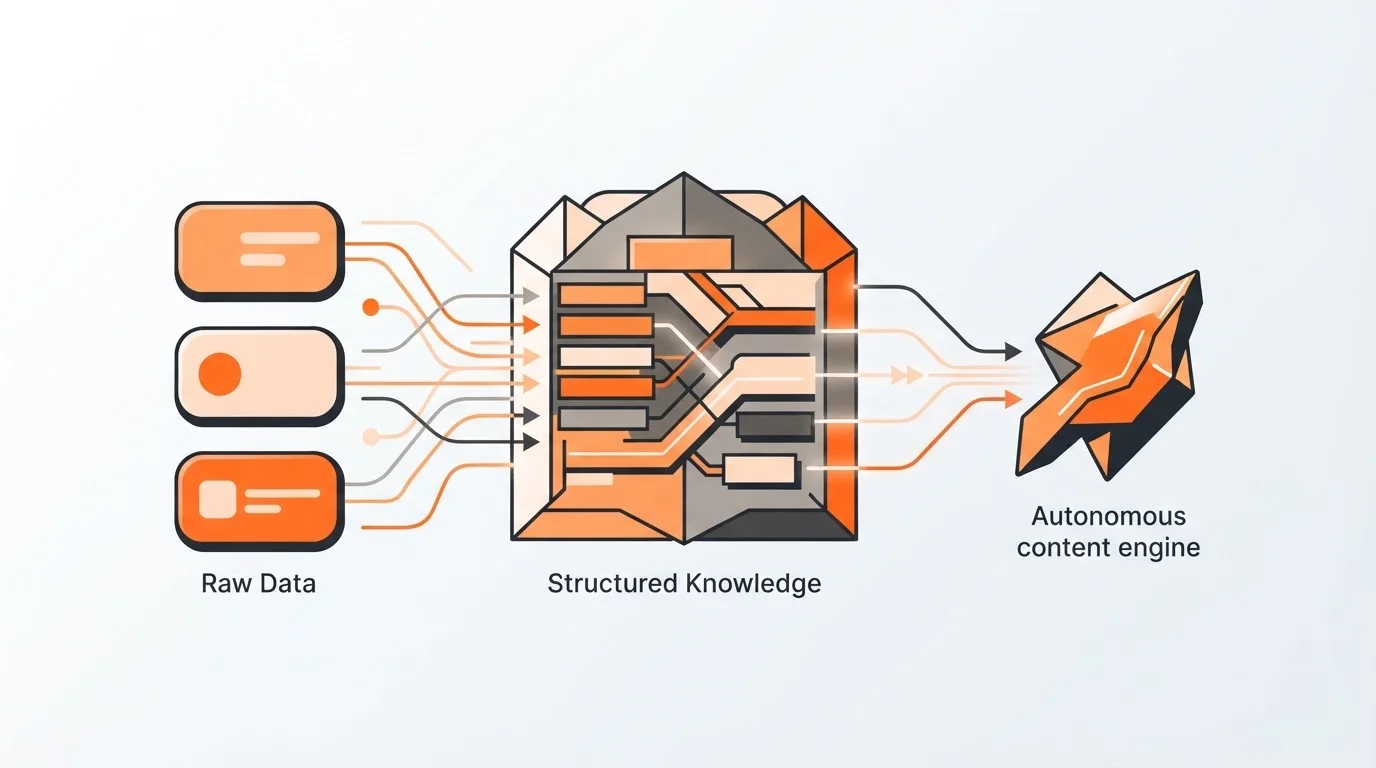
The first step is moving beyond a basic feature list. You must document every capability of your SaaS, translating technical specifications into clear, outcome-oriented benefits. This documentation should be granular, breaking down not just what a feature does, but the specific value it delivers to a particular user persona.
For each feature, your documentation should include:
- Feature Name and Technical Specs: The "what" and "how."
- Primary and Secondary Benefits: The specific value (e.g., "saves 10 hours a week" rather than just "increases efficiency").
- Target User Persona: Who specifically uses this? A CTO? A marketing manager?
- Use Cases: Concrete scenarios where this feature solves a problem.
Maintaining these assets is critical. Platforms like Blogged allow users to manage a private SaaS product asset library, which includes review queues, visible approvals, and safe archiving. This ensures that only the most current and approved feature descriptions and images are used in your autonomous content workflow, preventing outdated information from reaching your audience.
Step 2: Mapping Product Capabilities to Customer Pain Points
Effective content bridges the gap between what you built and what your customer needs. To do this, you must explicitly map your structured product knowledge to the questions your target audience is asking. This process identifies the "search intent" behind potential keywords and matches it to a specific product solution.
Start by analyzing your support tickets, sales calls, and community forums. Identify the recurring challenges your customers face. For every pain point, identify the feature—or combination of features—that provides the solution. If a customer searches for "how to reduce churn in a subscription model," and your product has a 'predictive churn analytics' feature, that is your primary content bridge.
Document these connections in a central repository. By linking pain points to features, you provide autonomous systems with the logical pathways needed to write helpful, conversion-oriented content. This mapping ensures that your blog isn't just a collection of keywords, but a library of solutions.
Step 3: Organizing Data for Autonomous Consumption
Once documented and mapped, your product knowledge must be organized in a way that AI and autonomous platforms can process. This often involves creating a Product Information Management (PIM) structure or a knowledge graph. Every piece of information should be tagged with metadata, including categories, target personas, and associated keywords.
Consistency in taxonomy is vital. Use standardized terms for your features across all platforms. If you call a feature a "Collaborative Workspace" in your docs, do not refer to it as a "Team Dashboard" in your marketing metadata. Ambiguity is the enemy of autonomous creation.
The goal is to create an interconnected network of information. When an autonomous system needs to write about "remote team productivity," it should be able to instantly pull all features, benefits, and use cases tagged with that theme. This allows for the dynamic generation of articles that are both technically accurate and contextually relevant.
Stay updated on autonomous blogging for SaaS
Get insights and strategies on transforming product knowledge into discoverable content. Learn how to drive organic growth for your SaaS.
Scaling Your Content with an Autonomous Knowledge Engine

With your knowledge structured, the final step is implementation. Scaling content manually is a bottleneck for founders who are still building the company. You need a system that can take your structured data and turn it into published growth.
Blogged’s Knowledge Engine for Autonomous SaaS Blogs is designed for this exact workflow. It allows you to provide public product sources, upload documents, or paste links, effectively feeding your structured knowledge base into an autonomous system. The engine learns your product’s nuances and uses that data to handle research, planning, and writing on your behalf.
Once the content is generated, the publishing process should be equally frictionless. Blogged integrates with existing stacks, such as the WordPress AI Blog Publishing integration or the Ghost AI Blog Publishing integration, allowing you to review articles in one place and deliver them directly to your site. This workflow transforms your structured product knowledge into a continuous stream of discoverable, product-led content.
Frequently Asked Questions
Q: What is the difference between generic content and product-led content?
Generic content focuses on broad topics to capture top-of-funnel traffic, while product-led content uses the product as the primary solution to a reader's problem. It demonstrates value by showing, not just telling, how a feature solves a specific pain point.
Q: How often should I update my structured knowledge base?
You should update it immediately following any product release, feature update, or major UI change. Ideally, your product team should have a workflow where updating the internal knowledge base is a standard part of the shipping process.
Q: Can I use existing documentation as a source for autonomous content?
Yes. Tools like Blogged can ingest existing public sources, uploaded documents, or pasted links to learn your product. However, ensuring that documentation is benefit-oriented will significantly improve the quality of the generated marketing content.
Q: Does autonomous content creation require human oversight?
Yes. While the system handles the heavy lifting of research, writing, and SEO, founders or editors should still review content for brand voice and strategic alignment. Blogged facilitates this with review queues and approval workflows.
Structuring your product knowledge is the highest-leverage activity a SaaS founder can undertake for organic growth. It moves content from a manual, recurring task to a scalable asset. By meticulously documenting features, mapping them to customer needs, and organizing data for autonomous platforms, you create a foundation for long-term discovery. With tools like Blogged, you can finally stop chasing content volume and start leveraging your product as a self-publishing engine that drives growth while you focus on building.