
On this page
For SaaS founders, the goal of a blog isn't just to rank—it is to convert. While high-volume SEO content can drive traffic, it often fails at the bottom of the funnel if it cannot accurately describe your software’s unique features, dependencies, and use cases. This is where the choice between a general AI writing assistant and a product-led autonomous platform becomes critical. Scalenut and Blogged both aim to automate the content lifecycle, yet they operate on fundamentally different philosophies. Scalenut focuses on SERP-driven optimization, helping you replicate the success of top-ranking competitors by analyzing search engine results. In contrast, Blogged is built around a proprietary Knowledge Engine that prioritizes your internal product data to ensure every article acts as a subject matter expert. This comparison breaks down which platform best serves SaaS teams that need to balance search visibility with technical accuracy.
The Strategic Shift: From Keyword-Led to Product-Led SEO
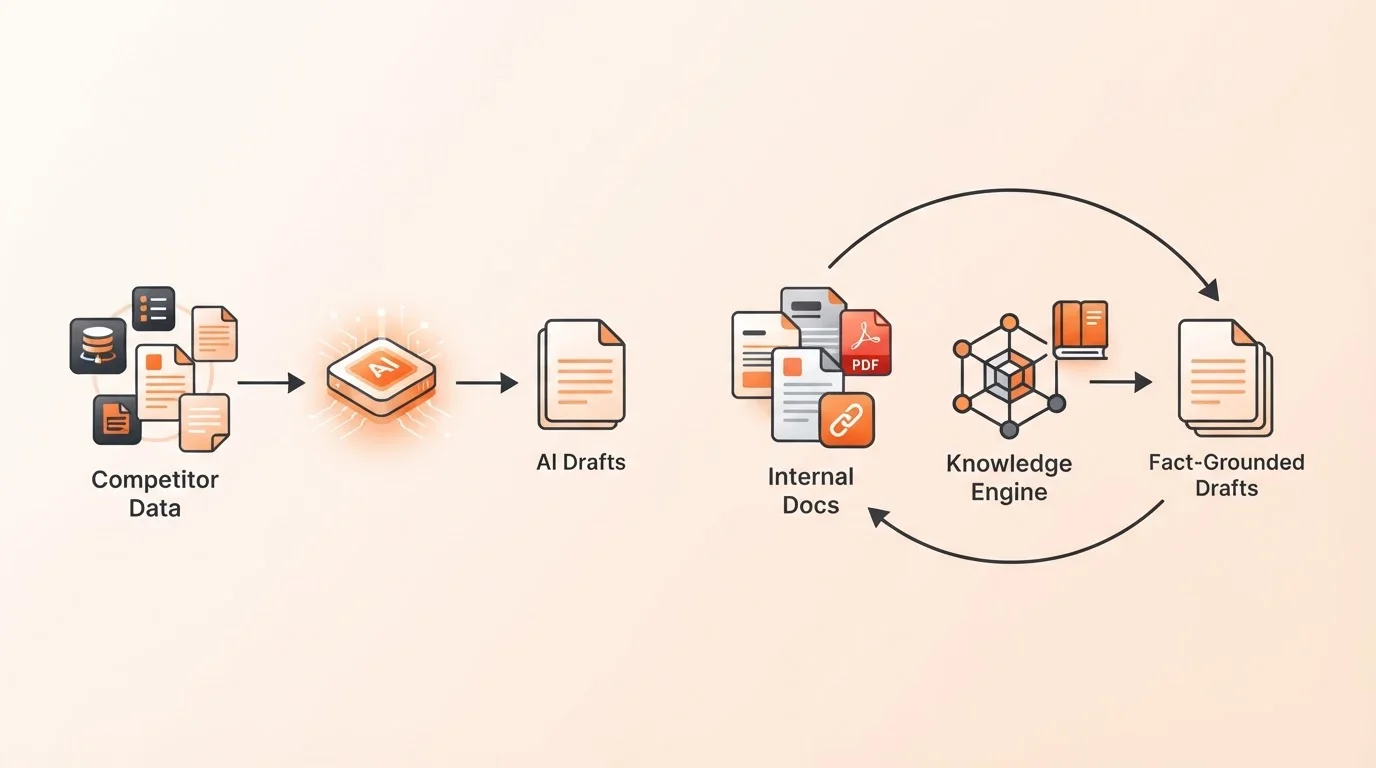
Most AI writing tools suffer from a factual gap when describing complex software. Because they are trained on broad internet data, they often miss the technical nuances that separate a niche SaaS from a market leader. To evaluate these platforms, founders must look at how each system ingests information and applies it to the writing process. Scalenut approaches content through its Cruise Mode, a guided workflow that relies heavily on keyword research and competitor analysis. It looks at what is already ranking and helps you build an outline that mirrors those top results. This is effective for broad SEO visibility but can be risky for technical SaaS products; if your competitors aren't covering a specific feature, the AI might not either. Blogged shifts the focus to your internal truth. Its Knowledge Engine allows you to feed public product sources, uploaded documents, or pasted links directly into the AI’s context. This ensures that the generated content is grounded in your specific technical specs rather than generic industry trends. For a SaaS founder, this means less time spent correcting factual errors and more time building the product.
Scalenut's Approach: Guided SEO and Competitive Intelligence
Scalenut is designed for marketers who want a high-performance SEO toolkit integrated with an AI writer. Its core strength lies in its ability to synthesize Search Engine Results Page (SERP) data into actionable content briefs. By analyzing Natural Language Processing (NLP) terms and writing themes from the top 10 competitors, Scalenut ensures your content fits the mold of what search engines currently reward. Key capabilities of Scalenut include Cruise Mode, a 5-step guided process that takes you from a keyword to a first draft by selecting headers suggested by the AI. It also features a native Backlinks Marketplace that helps users secure high-quality links directly from the platform to boost domain authority. Additionally, Scalenut has introduced a GEO Action Center designed to improve visibility in AI-driven search engines by tracking mentions and citations. While Scalenut offers AI templates for product descriptions, these are typically prompt-based. The system doesn't live in your product documentation the way a specialized SaaS engine does. This often requires human editors to manually inject technical precision after the draft is generated to ensure the software's capabilities are correctly represented.
Blogged’s Knowledge Engine: The Source of Truth for SaaS
Blogged is built specifically for the product-led content model, operating on the principle that your product’s unique value is its greatest SEO asset. Instead of just looking at what competitors are doing, Blogged uses your specific product knowledge to define the narrative. This is essential for founders who struggle to sustain research and publishing every week while building their company. This is achieved through document ingestion, where you can upload technical manuals, whitepapers, or landing page links to the Knowledge Engine. The AI uses this as its primary source, ensuring that feature dependencies and integration details are technically sound. Beyond traditional search, Blogged prepares content for Generative Engine Optimization (GEO), structuring data for AI models like Perplexity and ChatGPT. Furthermore, Blogged handles the entire content lifecycle autonomously. It researches, plans, writes, optimizes, and publishes product-led content that drives organic growth. By identifying autonomous interlinking opportunities, the system builds a cohesive content web that naturally moves readers from educational articles toward your product pages and conversions.
Integration and Publishing Ecosystem
A platform's value is often determined by how well it fits into your existing tech stack. SaaS founders generally prefer direct, API-driven workflows that eliminate the friction of managing a CMS. Scalenut provides a dedicated WordPress Publisher tool and a Shopify integration, allowing for scheduling and direct exports that save significant time on manual publishing. Blogged takes a deeper approach to modern SaaS stacks. It offers a Ghost AI Blog Publishing integration where users create a custom integration in Ghost, copy the Admin API key, and verify the connection. This allows Blogged to manage creation and review while Ghost handles the reader experience. For teams building on headless or custom architectures, the Next.js integration allows for collecting consented visits and conversions directly on verified articles. Blogged also supports Webflow and self-hosted WordPress through a dedicated publishing plugin and application passwords. This ecosystem is built to ensure that once the product knowledge is integrated, the publishing process remains hands-off. Founders can trust the system to maintain a consistent publishing cadence without manual intervention.
Comparison: Features and Pricing
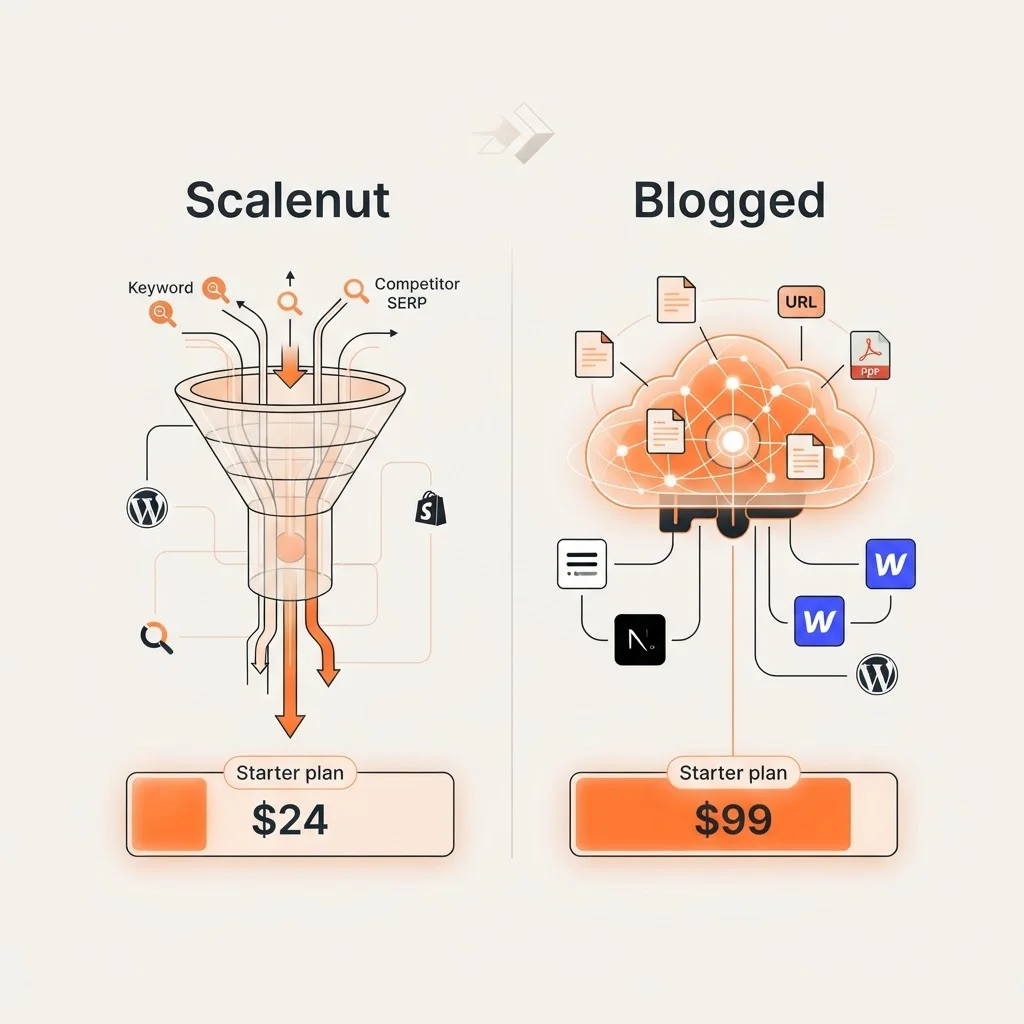
Choosing between these platforms involves balancing the level of manual control against the need for technical autonomy. Scalenut acts as a cost-effective toolkit for marketers who have the bandwidth to guide the AI, while Blogged serves as an autonomous growth engine for founders who need their content to be factually accurate out of the box. | Comparison Area | Scalenut | Blogged | | :--- | :--- | :--- | | Primary Methodology | SERP-led (Guided Workflow) | Product-led (Autonomous Knowledge Engine) | | Information Sourcing | Keyword data & Competitor SERPs | Docs, URLs, PDFs, & Product Descriptions | | Core SEO Focus | Traditional SEO & NLP Scoring | SEO + GEO (Generative Engine Optimization) | | SaaS Integrations | WordPress, Shopify | Ghost, Next.js, Webflow, WordPress | | Starter Plan | $24 per month | $99 per month |
Get practical updates on scalenut vs blogged product knowledge
Receive new articles and practical insights by email.
When to Choose Scalenut
Scalenut is the better fit if your primary goal is to build an SEO-optimized content library at a lower cost and you have the time to review drafts for technical accuracy. It is ideal for general marketing agencies or SaaS companies in broad niches where competitor-based research is sufficient to define the content strategy. The inclusion of a backlinks marketplace and Semrush integration makes it a powerful choice for those focused on traditional authority building.
When to Choose Blogged
Blogged is the superior choice for SaaS founders who need content on autopilot that remains technically accurate. If your software is complex or operates in a rapidly evolving market where generic AI advice would be detrimental, Blogged’s Knowledge Engine provides the necessary guardrails. It is also the preferred option for teams targeting AI Search (GEO) and those using modern publishing stacks like Ghost or Next.js to track actual conversion data.
Frequently Asked Questions
Q: Can Scalenut write technically accurate product tutorials?
Scalenut can generate drafts based on keywords, but because it primarily researches existing SERP content, it may lack the specific internal context of your software unless you manually provide detailed prompts in Cruise Mode.
Q: How does Blogged handle product updates?
You can update the Knowledge Engine by providing new links or documents reflecting your latest releases. The AI will then prioritize this new information for future autonomous content generation to keep your blog current.
Q: Which platform is better for building authority in the age of AI search?
Scalenut focuses on traditional authority through its Backlinks Marketplace. Blogged focuses on topical and generative authority by ensuring your product is the source of truth for AI answer engines through specialized GEO structuring.
Q: Do I still need to edit the content produced by these platforms?
While both platforms significantly reduce writing time, SaaS content always benefits from a final human check. However, Blogged’s factual grounding generally requires fewer corrections regarding product features compared to Scalenut’s SERP-based drafts.
Final Verdict: Accuracy vs. Optimization
Scalenut is a high-quality SEO content marketing platform that excels at helping teams rank by following the blueprint of existing search winners. It is an excellent choice for founders on a tighter budget who want a guided writing experience. By leveraging competitor data, it ensures your content meets the established standards of the market. However, for SaaS companies where product knowledge is the differentiator, Blogged offers a more sustainable path to growth. By anchoring its AI in your actual documentation, Blogged ensures that your blog isn't just a collection of keywords, but a discoverable extension of your product. The result is content that doesn't just bring in visitors—it earns the trust of technical users and converts them into customers.