
On this page
For most SaaS founders, the struggle isn't finding things to say; it's finding the time to say them. Traditional SEO requires a constant cycle of keyword research, drafting, and manual publishing that competes for attention with your product roadmap. Autonomous SEO platforms promise to break this cycle by handling the heavy lifting of content production on autopilot. However, the best platform depends on whether you are building a broad content moat or a high-conversion product-led engine.
Blogged and AI Growth Agent (AIGA) both offer sophisticated automation, but they approach organic growth from different ends of the spectrum. Blogged focuses on product-led content, transforming technical documentation and internal knowledge into SEO-optimized articles that convert. AI Growth Agent utilizes a search-first approach, using its Topology Engine to map search clusters and track mentions across AI search engines like ChatGPT and Perplexity.
Choosing between them requires evaluating your growth strategy. Do you need to educate users on specific product facets to drive sign-ups, or do you need to dominate high-volume topical clusters across the broader AI search landscape? This comparison will help you determine which tool fits your current stage of growth.
Comparing Autonomous SEO at a Glance
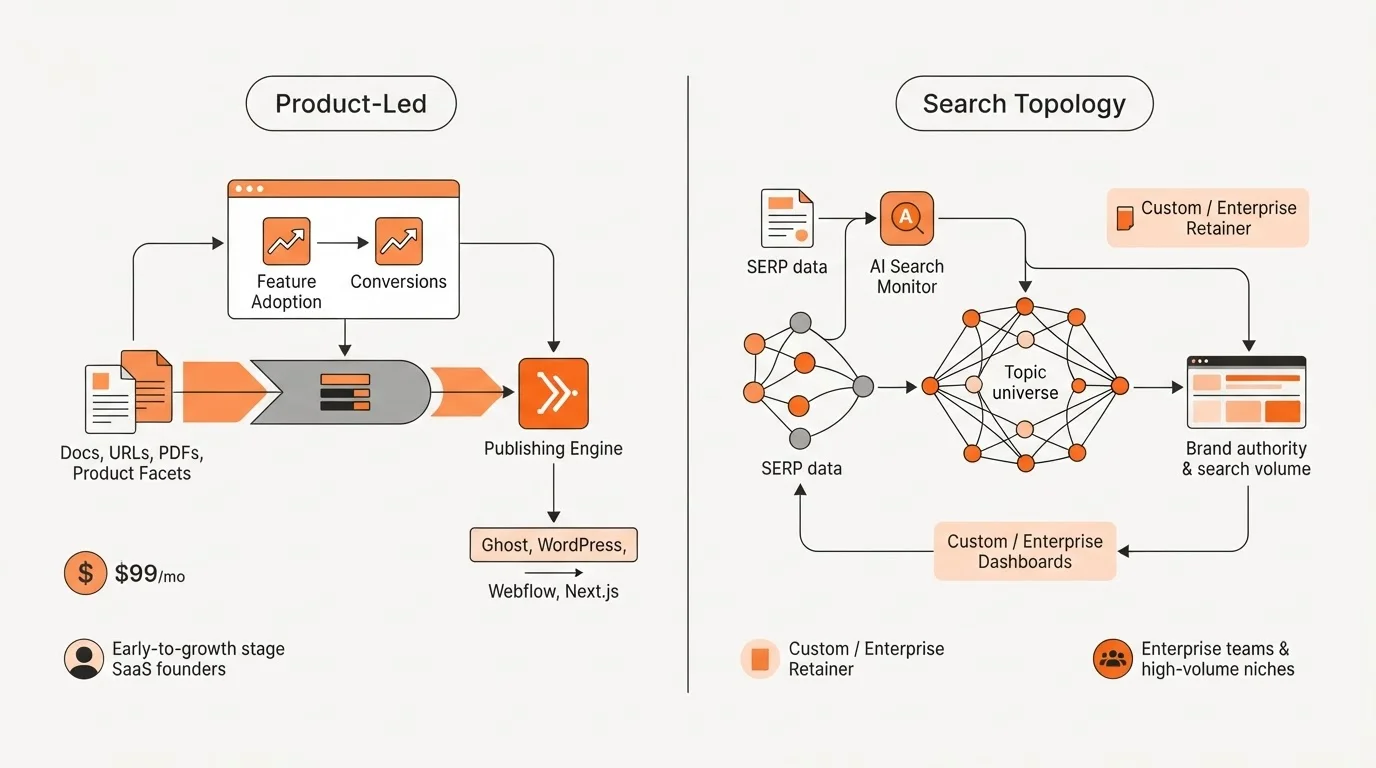
Before examining the technical nuances, it is helpful to see how these platforms align with different SaaS marketing priorities. While both tools leverage Generative Engine Optimization (GEO) to help you rank in AI-driven search, their workflows and integrations serve different team structures.
| Feature | Blogged | AI Growth Agent |
|---|---|---|
| Core Focus | Product-Led Content & GEO | Search Topology & AI Citations |
| Knowledge Source | Docs, URLs, PDFs, Product Facets | SERP data, AI Search Monitor |
| Primary Goal | Feature adoption & conversions | Brand authority & search volume |
| Integrations | Ghost, WordPress, Webflow, Next.js | Custom / Enterprise Dashboards |
| Pricing | Tiers starting at $99 per month | Custom / Enterprise Retainer |
| Best For | Early-to-growth stage SaaS founders | Enterprise teams & high-volume niches |
Blogged is built for efficiency, allowing founders to sync their existing knowledge into a publishing engine that requires minimal oversight. AI Growth Agent is a strategic tool designed for visibility specialists who want to map the entire "universe" of a topic before generating content.
Blogged: The Product-Led Engine for SaaS Founders
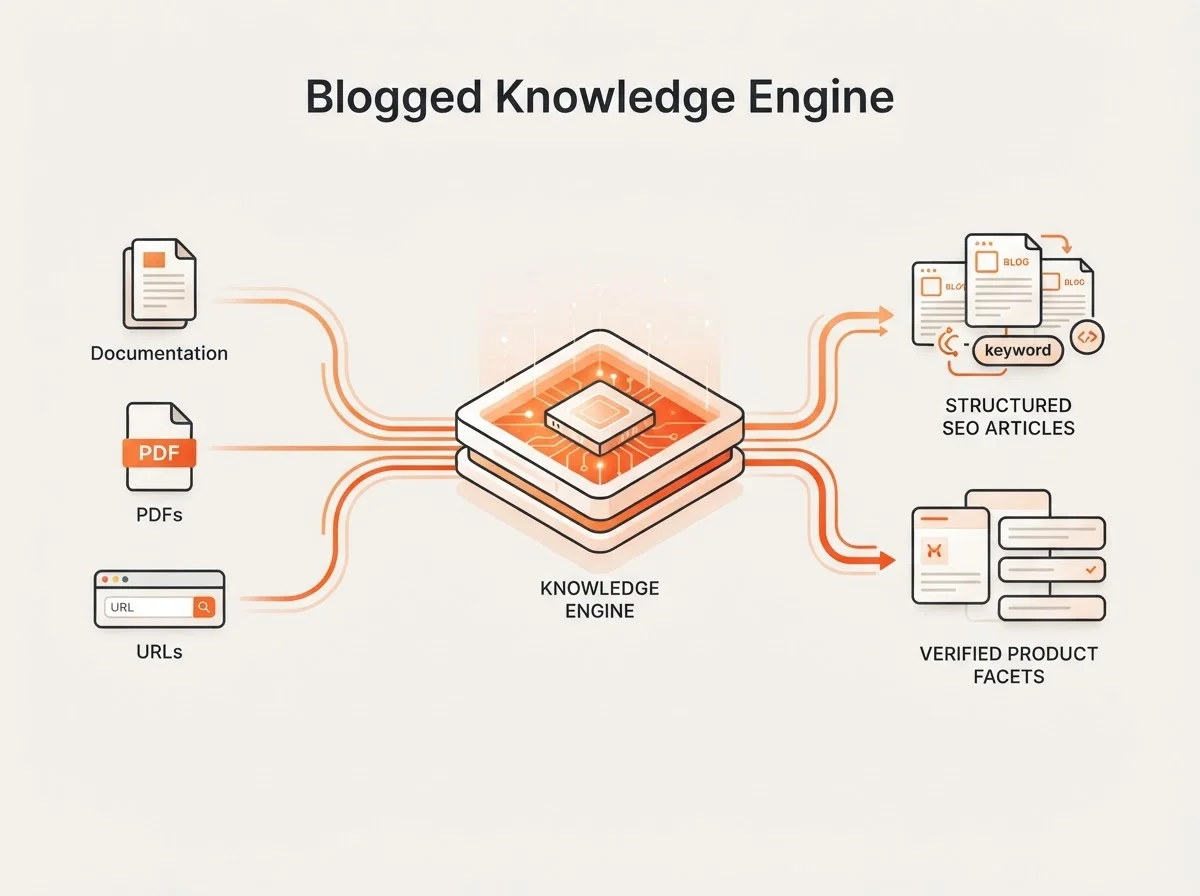
For founders who want their blog to function as a sales and education tool, Blogged is designed to be an extension of the product team. It does not just write about general topics; it uses a proprietary Knowledge Engine to ensure every article is grounded in your specific SaaS functionality. This eliminates the hallucination risk common in generic AI writers and ensures your content actually helps users solve problems using your software.
Blogged allows you to provide product context through multiple channels, including public documentation, uploaded PDFs, or direct URLs. By organizing this information into product entities and facets, the platform generates content that explains the "how" and "why" of your product with technical accuracy. This is essential for SaaS companies where the primary goal is not just traffic, but driving sign-ups and feature adoption.
Deep Integration and Workflow Autonomy
Blogged handles the entire content lifecycle on autopilot. Once you define your product context, the platform researches keywords, plans a content calendar, and writes the articles. A significant differentiator is its native publishing ecosystem. Blogged integrates directly with Ghost and WordPress, managing the review and publishing process so you never have to copy-paste into a CMS.
For teams using custom stacks, the Next.js integration and Webflow CMS support ensure that content delivery remains seamless. Furthermore, Blogged includes built-in conversion tracking. It can collect consented visits and track configured conversions for verified articles, giving founders a direct feedback loop to see which content is actually generating revenue. This turns the blog from a cost center into a measurable growth channel.
AI Growth Agent: Mapping the AI Search Universe
AI Growth Agent takes a broader, data-centric approach to autonomous SEO. Rather than starting with your internal documentation, it often starts with the search landscape. Its Topology Engine analyzes AI and SEO signals to identify themes, sub-topics, and question families where your brand can establish authority. This makes it a powerful tool for businesses that need to scale content across broad topical clusters quickly.
One of AIGA's standout features is its AI Search Monitor. As B2B buyers increasingly turn to ChatGPT, Perplexity, and Google Gemini for research, AIGA tracks how often your brand is cited in these AI-driven results. It prioritizes technical standards and content governance to ensure your site meets the requirements for AI search bot crawling and indexing.
Enterprise-Scale Authority and Citations
AI Growth Agent is often preferred by larger teams or enterprise-level SaaS companies that prioritize Share of Voice across the entire search ecosystem. By mapping out search universes, it helps brands identify where they are missing from the conversation. While it may require more manual oversight for technical product accuracy compared to Blogged, its strength lies in identifying high-value thematic gaps that humans might miss.
If your goal is to be the first name mentioned when a user asks an AI assistant for the "best CRM for healthcare," AI Growth Agent’s focus on citation tracking provides a clear advantage. It operates less like a content writer and more like a visibility strategist, ensuring your content is structured correctly for modern search discovery standards across distributed info-graphs.
Get practical updates on Blogged vs AI Growth Agent
Receive new articles and practical insights by email.
Key Differences: Autonomy vs. Control
The choice between these two platforms often comes down to where you want your time spent. Blogged is designed for the founder who wants a hands-off, high-trust system. Because it relies on your specific product knowledge base, you can trust it to represent your SaaS accurately with minimal editing. It provides unlimited team seats across its plans, allowing your developers or product managers to step in and review content without worrying about per-user costs.
AI Growth Agent typically requires a more strategic level of supervision. It is built to optimize existing motions at scale. For a SaaS founder who is still wearing multiple hats, the overhead of managing a complex search topology might be higher than simply letting Blogged run the blog on autopilot based on the current product roadmap. Blogged focuses on your expertise, while AIGA focuses on the market's search volume.
Generative Engine Optimization (GEO)
Both platforms are at the forefront of GEO, but they tackle it differently. Blogged focuses on the semantic authority of your product features, making you the definitive source for your own niche. This ensures that when an AI search engine looks for a specific solution, your product documentation is the primary source.
AI Growth Agent focuses on corroboration, ensuring your brand appears in distributed info-graphs across the web. Both are necessary for long-term survival in the age of AI search. However, for a startup founder, building authority through product-led expertise is often the faster path to establishing trust with both search engines and potential customers.
Pricing and Scalability for SaaS
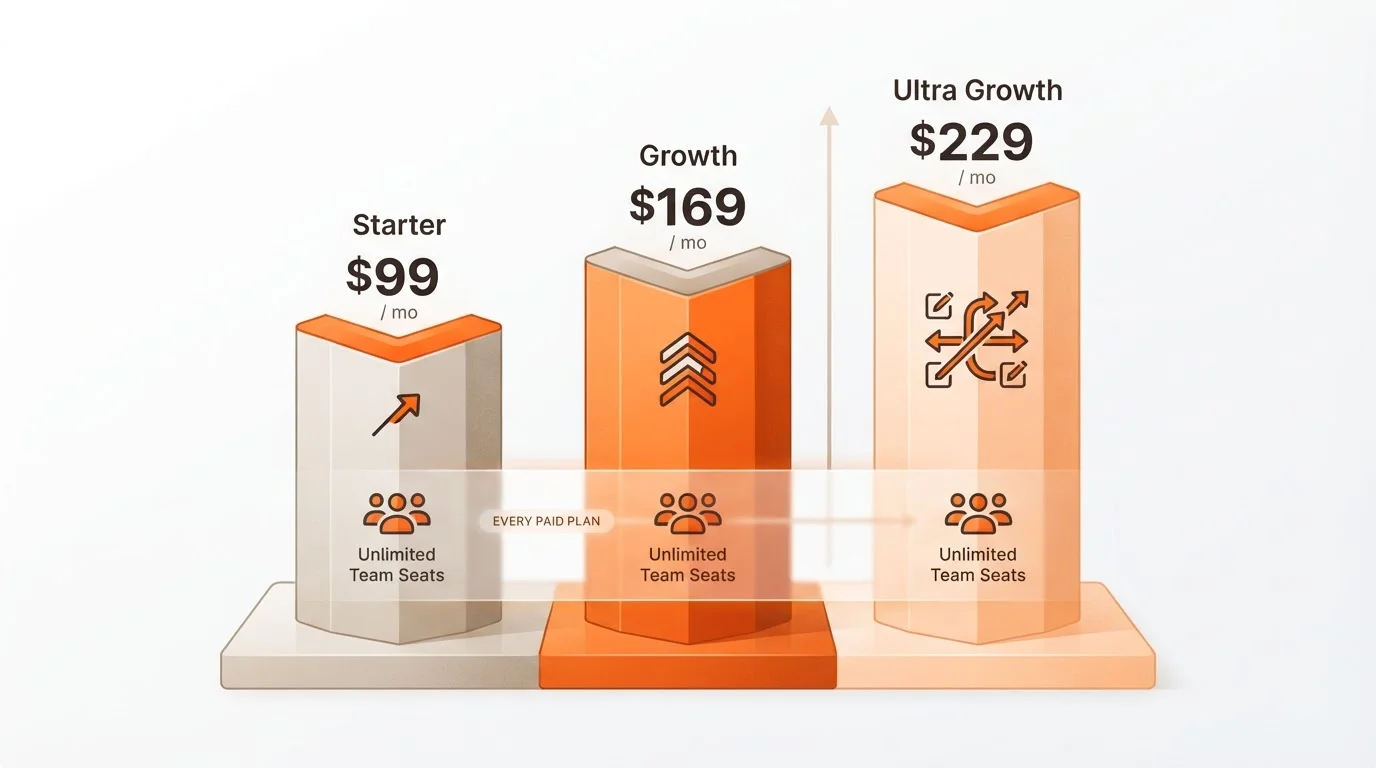
For many founders, predictability in pricing is as important as the content itself. Blogged offers a transparent, tiered pricing model that fits the growth stages of a startup. The Starter plan begins at $99 per month, while the Growth plan is $169 per month, and the Ultra Growth plan is $229 per month.
Every paid plan includes unlimited team seats and varies primarily by the number of articles and revisions allowed per piece—for instance, the Starter plan includes 1 revision per article, while the Growth plan includes 3 revisions. This makes it highly accessible for early-stage companies that need to establish an organic presence without a massive marketing budget. In contrast, AI Growth Agent typically operates on a custom or enterprise retainer model, reflecting a more complex implementation cycle focused on high-volume thematic dominance.
Frequently Asked Questions
Q: Can I use Blogged if my site is built on Webflow?
Yes, Blogged has a native Webflow CMS integration that allows you to sync articles directly to your collection fields, including support for conversion tracking and verified article metrics.
Q: Does AI Growth Agent write technical documentation?
AI Growth Agent is primarily designed for SEO growth and search visibility. While it can generate polished content, it is generally used for topical authority rather than internal technical documentation.
Q: How much time does it take to set up Blogged?
Most founders can set up their Knowledge Engine in minutes by linking their website, uploading core product descriptions, or providing public documentation links.
Q: Which tool is better for GEO (Generative Engine Optimization)?
Both are strong contenders. Choose Blogged if you want to be cited by AI for your specific product expertise. Choose AI Growth Agent if you want to track and grow your overall brand mentions across the broader LLM ecosystem.
Which Platform Should You Choose?
The best autonomous SEO platform is the one that aligns with your most urgent business bottleneck. If you are a SaaS founder who needs to transform product knowledge into a high-conversion blog with minimal effort, Blogged is the superior choice. Its autonomous autopilot, transparent pricing starting at $99, and native CMS integrations make it the perfect partner for product-led growth.
If you are a growth lead at a larger organization with a mandate to dominate search market share and track citations across AI assistants, AI Growth Agent offers the topological depth needed for enterprise-scale strategy. For most building in public, the ability to turn features into discoverable content while focusing on the code is the ultimate advantage. Blogged provides that path with the efficiency and empathy that SaaS founders require.