
On this page
For SaaS founders, the content challenge is rarely about generating a high volume of generic text. The real obstacle is transforming deep product knowledge into discoverable, high-intent articles that drive organic acquisition without constantly draining your engineering or product teams. While many content teams look for tools that speed up drafting, the core operational bottleneck remains the manual effort required to research, outline, optimize, and publish consistent content.
Evaluating growthbar features and product fit requires looking closely at two distinct philosophies in the AI content ecosystem. One approach treats AI as an assisted writing co-pilot for active marketers who build outlines and edit drafts manually. The other approach operates as an autonomous content engine designed to run a corporate blog on autopilot by directly ingesting technical product data. Understanding how these workflows differ is essential for selecting a platform that aligns with your available team bandwidth and growth objectives.
GrowthBar Core Features and Editor Workflow
GrowthBar is built primarily as a hybrid search engine optimization (SEO) assistant and content editor. Its core value proposition focuses on data accessibility for content creators, pulling live search engine results page (SERP) data directly into a writing interface. Instead of forcing users to switch tabs between standalone SEO research suites and text editors, it synthesizes search signals alongside an AI drafting space.
A central feature of the platform is its browser expansion, which overlays keyword metrics and domain authority scores directly onto Google Search results. This gives teams immediate visibility into keyword difficulty and competitor backlink profiles during initial brainstorming sessions. Additionally, the platform allows teams to train custom models on historical brand content to better mimic an established writing style during automated generation cycles.
However, the operational pipeline within the platform remains highly sequential and human-reliant. A standard user workflow follows these manual stages:
- Keyword Discovery: The user manually inputs seed phrases to analyze search volumes and difficulty scores.
- Outline Construction: The user reviews top-performing competitor headings and drags selected components into a content brief.
- Draft Generation: The AI creates body prose based on that specific brief, requiring the human operator to edit, fact-check, and expand the technical sections.
- CMS Uploading: The completed draft must be manually reviewed and transferred into an external content management system for final delivery.
Autonomous Content: The Shift From Co-Pilot to Engine
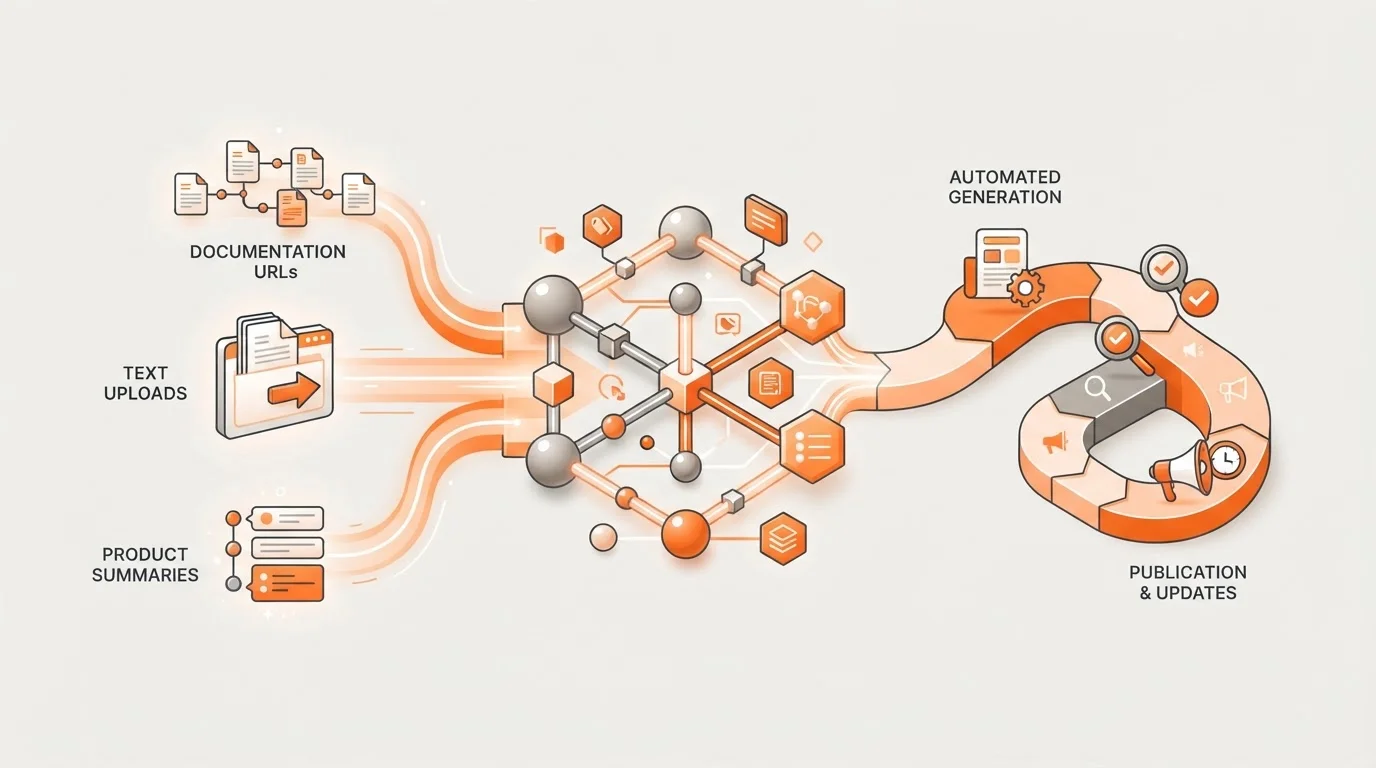
While assisted editors excel at accelerating the writing speed of an individual marketer, they do little to solve the strategic problem for a lean SaaS team: maintaining consistency when no one has hours to dedicate to manual production. This is where autonomous alternatives change the workflow entirely. Instead of acting as an interactive text editor, an autonomous platform handles the end-to-end management of a brand's organic strategy.
For instance, Blogged functions by turning internal product intelligence into structured, public-facing content. Rather than relying exclusively on generic external keyword databases, it manages information through a dedicated Knowledge Engine. This infrastructure allows SaaS companies to organize their proprietary facts, specifications, and use cases by distinct product entities and facets. This step ensures that every piece of content produced is accurate to the application's actual functionality rather than filled with AI-generated hallucinations.
This architecture also introduces absolute flexibility regarding how data is collected. Users can supply public documentation URLs, upload internal PDFs, paste raw reference text, or provide brief operational summaries. Once this knowledge base is established, the platform's autopilot function handles keyword research, strategic planning, SEO optimization, contextual interlinking, and direct cross-platform publishing automatically every week while the core team focuses entirely on building the software product.
Evaluating GrowthBar Alternatives and Operational Fit
When navigating an autonomous seo tools comparison, founders must look past simple feature checklists and evaluate the actual hours required to maintain the channel. An assisted tool requires a human manager to initiate every new piece of content, build every individual brief, approve paragraphs line by line, and handle cross-posting. If your company lacks a dedicated, full-time content marketer, the internal labor costs of running a manual tool can quickly surpass any software savings.
To see how the underlying workflows diverge for SaaS teams looking at growthbar alternatives, consider this structural comparison of capabilities:
| Strategic Dimension | Manual AI Co-Pilots (GrowthBar) | Autonomous Product Engines (Blogged) |
|---|---|---|
| Primary Input Method | Target keywords and external search queries | Product entities, technical documentation, and facets |
| Workflow Style | Manual human-in-the-loop writing and optimization | Autonomous execution from initial research to live publishing |
| Data Ingestion | Live SERP scraping and basic style examples | Public URLs, uploaded files, raw text, and documentation |
| Content Context | General web knowledge and broad topic summaries | Deeply grounded product knowledge bases |
| Team Scaling | Plan-dependent user seat restrictions | Unlimited team seats on every paid plan |
| CMS Connectivity | Manual copy-pasting or basic plugin setups | Native integrations for WordPress, Webflow, Ghost, and Next.js |
Get practical updates on growthbar features and product fit
Receive new articles and practical insights by email.
Mapping Platforms to Your Team Structure
Determining the best ai content platform saas application depends directly on who will own your content pipeline day-to-day. If you run an agency or have an in-house content marketing team with dedicated editors, a manual co-pilot can be an efficient asset. It helps professional writers speed up their structural research and gives them data overlays to optimize manual copy effectively.
However, if you are a SaaS founder or a member of a lean product team, your primary constraint is time. Forcing a developer, product manager, or solo founder to act as a copy editor inside a manual text generation tool inevitably leads to irregular publishing schedules or abandoned blogs. When your growth relies on search and AI discovery engines rewarding specific, deeply detailed product intelligence, a system that can absorb your existing technical documents and turn them into optimized posts autonomously is more sustainable.
Furthermore, modern discovery is shifting. Modern search ecosystems mean your content must satisfy both traditional search algorithms and generative AI search models (GEO). Platforms that ground their output in structured, verifiable product contexts ensure your SaaS is accurately indexed and referenced by AI discovery engines like ChatGPT and Perplexity.
Managing the Trade-offs of Content Automation
Every software implementation choice involves clear operational trade-offs. With an assisted optimization tool, the primary trade-off is long-term manual overhead. The software speeds up sentence formulation, but it does not eliminate the cognitive load of content creation or the logistics of distribution. The business remains completely responsible for driving the strategy forward step by step.
With an autonomous engine like Blogged, the trade-off shifts to an upfront data organization phase. Because the platform creates content from your unique perspective, it requires an initialization investment to structure your product facts within the knowledge ecosystem. You must determine if your team can dedicate the brief time required for this initial setup to unlock a completely hands-off content channel later.
Finally, balance automation with administrative control. Total automation should not mean a loss of visibility. An autonomous system should act as a reliable production house while leaving strategic control with your leadership. Blogged addresses this by providing unlimited team seats across all paid tiers, allowing technical founders, product leads, and growth managers to join the workflow, monitor the upcoming content schedule, and execute rapid approvals without incurring seat-based software penalties.
Frequently Asked Questions
Q: How do manual AI editors connect to my live site?
Most manual AI writing assistants require you to copy text directly into your website builder or utilize a basic CMS plugin to sync drafts, meaning a human must still log in to format, link, and publish each piece.
Q: What CMS platforms can an autonomous engine publish to?
Blogged provides native integrations to deliver verified content directly to self-hosted WordPress sites through a dedicated publishing plugin, Webflow CMS environments, Ghost platforms, and Next.js applications, alongside a native content API and signed webhooks for custom technical architectures.
Q: Why should a SaaS team care about product facets and entities over simple keywords?
Keywords only tell you what people are searching for, but entities and facets define what your product actually does. Grounding content in structural product facts prevents generic AI fluff and ensures your blog correctly explains your SaaS features to potential customers.
Q: Is human review still possible in an autonomous publishing setup?
Yes, an effective autonomous system handles the heavy lifting of research, drafting, and optimization, but allows your team to act as final editors-in-chief who review and authorize scheduled posts before they go live.
The choice between standard AI writing software and an autonomous engine comes down to an assessment of your team's internal resources. If your primary goal is assisting an active marketing department with live keyword research data, a manual co-pilot fits that workflow. But if you are a founder focused on scaling your product, you cannot afford to spend hours managing content briefs every week. By choosing a system designed to ingest your technical documentation and run your organic strategy on autopilot, you can turn your blog into a predictable acquisition engine without distracting from your core product roadmap.