
On this page
SaaS founders face a persistent trade-off: building a category-defining product requires absolute focus, yet driving sustainable customer acquisition requires consistent search visibility. Traditional content marketing pipelines frequently break down because technical teams do not have the bandwidth to draft deep technical articles, while external writing agencies often fail to capture the functional nuances of complex software features. Deploying a model centered on autonomous blogging organic discovery allows organizations to remain visible without hiring external writing networks. Shifting toward an autonomous product-led content strategy allows software companies to systematically unlock that internal engineering knowledge and convert it into structured organic visibility without draining core development speed.
The Strategic Bottleneck of Manual Content Production
SaaS growth strategies rely heavily on educating prospective users about technical workflows, use cases, API integrations, and feature capabilities. Managing this content loop manually requires an extraordinary investment of high-value human capital across keyword mapping, search intent analysis, draft writing, and factual verification. When software sprint deadlines approach or complex security patches must be deployed, manual content production is almost always delayed. This operational inconsistency ultimately limits long-term saas content visibility across search ecosystems.
Furthermore, non-technical writers often struggle to articulate the micro-mechanics of specialized business-to-business applications, creating superficial material that fails to convince discerning technical buyers. To build a resilient organic growth channel, software executives must decouple content synthesis from the limits of manual copywriting hours. Automating the operational pipeline allows organizations to maintain a predictable market presence while preserving developer focus for core product architecture.
Establishing a Product-Led Content Discovery Framework
An effective autonomous content strategy does not focus on spinning high-volume generic text, but on scaling authentic product information across digital networks. Modern search platforms and AI-driven discovery engines increasingly prioritize specific, verified, and context-rich answers to niche user problems over generic industry summaries. Successful organic discovery is not driven by sheer publishing volume, but by how effectively a company maps its product knowledge to real user search intent. Transitioning toward product-led content discovery positions your brand as an immediate authority right when prospects experience an operational pain point.
This framework shifts the internal marketing workflow from an exhausting continuous writing cycle into a high-level editorial curation process. This structure ensures that your SaaS brand remains highly visible across all major digital informational touchpoints without requiring continuous human writing effort. Founders can safely scale their organic market footprint while keeping their engineering and product management teams fully focused on shipping product iterations.
Grounding Automation with a Knowledge Engine
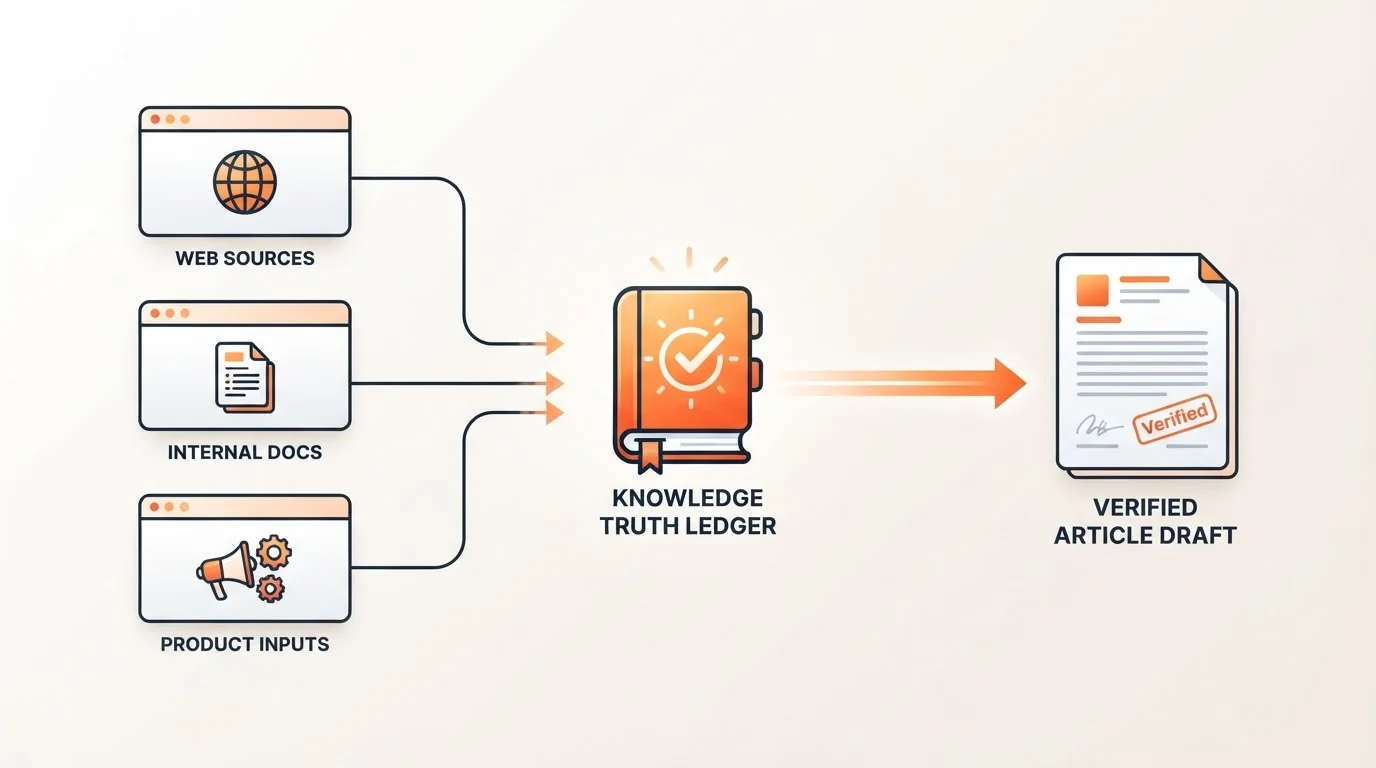
The foundation of successful content automation lies in strict factual grounding. Standard generic artificial intelligence tools lack specific, current information about proprietary platform updates and feature architectures, frequently leading to inaccurate summaries. To solve this problem, founders can utilize the Knowledge Engine for Autonomous SaaS Blogs to build a robust, verified repository of product truths. This platform allows your team to feed the system direct public product sources, crawled help center URLs, uploaded internal specs, pasted feature briefs, or direct brand-voice descriptions.
By organizing these facts systematically by product entity and facet, the generation engine can draw upon a reliable truth ledger for every draft. This approach ensures that every article produced reflects the real-world mechanics of your current software version, eliminating generic filler and providing actual technical utility to your target readers. Centralizing your technical truth into a single reusable matrix allows the system to generate highly tailored articles that speak directly to user pain points without needing repetitive human input.
Building a Durable SaaS Content Plan with Autopilot
Maintaining a disciplined publishing cadence requires shifting away from manual week-to-week editorial calendars. Blogged lets users build a durable SaaS content plan, publish on their cadence, and let Full Autopilot refill a short Topic queue from approved Content Directions. This mechanism eliminates the common friction point of creative block and administrative delay. It ensures that a steady pipeline of highly relevant technical content is researched, planned, and readied for production without requiring manual project management intervention.
The platform continuously maps your content output against market demands, maintaining topical coverage even when your team is entirely focused on a product launch. By establishing these parameters early, founders ensure that their blog remains an active growth asset rather than a neglected archive. This level of automation is essential for lean teams that cannot afford a dedicated full-time content manager but require the search presence of a much larger marketing organization.
Technical Execution: Native CMS Integrations
An autonomous content engine must connect natively to your production website to truly eliminate operational friction. Manually copying text, re-uploading images, formatting headers, and configuring meta descriptions across isolated platforms reintroduces the very operational drag that automation aims to fix. Modern autonomous platforms solve this by integrating directly with standard content management systems to streamline the review and publishing cycles. This direct technical connection creates a unified space where drafts are finalized, formatted, and published safely.
By automating the transport infrastructure of your content, you minimize technical configuration steps. This ensures that optimized articles enter the index without structural errors. Software founders can establish predefined governance rules so that content moves from generation to publication through a controlled staging process that preserves site integrity while maximizing speed.
Automating WordPress and Ghost Deployments
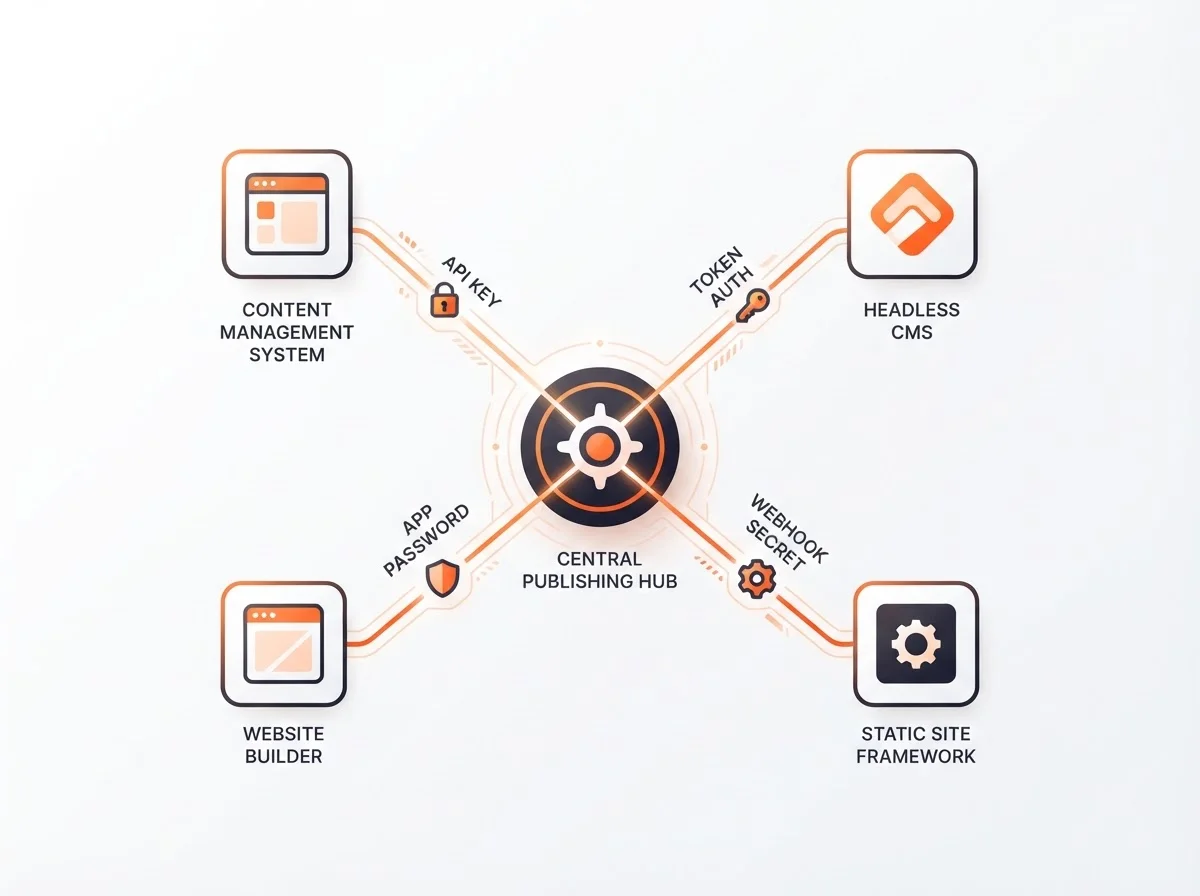
For software companies using traditional self-hosted setups, configuring a secure and automated delivery pipeline is straightforward. The WordPress AI Blog Publishing integration connects to self-hosted environments through the Blogged Publishing plugin and an application password. This secure handshake lets product teams generate, review, and fine-tune detailed articles directly inside the main platform dashboard before anything goes live. Once a post passes your internal editorial criteria, the integration automatically delivers the formatted text, image assets, internal structural links, and localized meta tags to your WordPress site.
Teams seeking a streamlined, modern publishing environment often rely on headless publishing architectures. The Ghost AI Blog Publishing integration manages content creation and review workflows within the automation platform, while Ghost renders the reader experience cleanly on the frontend. Users create a custom integration inside the Ghost administration area, copy its unique Admin API key, and verify their Ghost connection in Blogged. This setup populates clean frontends without human manual entry, protecting site speed while allowing content discovery assets to grow behind the scenes.
Webflow, Next.js, and Custom API Architectures
Enterprise SaaS applications and developers utilizing modern frontend frameworks often require complete layout customizability and static rendering. Dedicated options like the Webflow CMS AI Blog Publishing integration deliver fully structured JSON data models straight into Webflow’s native databases. Similarly, the Next.js AI Blog Publishing integration serves production teams operating component-driven static sites. For deeply customized, proprietary software architectures, a Signed Webhook and Content API provides the ultimate flexibility to deploy optimized content directly into custom repositories.
This programmatic accessibility guarantees that regardless of your specific engineering stack, your technical blog posts load perfectly. They look identical to your core app design and receive automatic updates. This engineering flexibility removes standard architectural constraints, allowing marketing text to live natively inside complex single-page apps without requiring developers to manually build new blog templates for every content update.
Optimizing Collaboration and Editorial Oversight
Transitioning to autonomous systems does not mean removing crucial human oversight or editorial guardrails. Instead, it elevates your team from exhausting execution roles into strategic editors who verify tone alignment and product accuracy. To support this collaborative dynamic, every paid plan includes unlimited team seats, allowing product managers, growth marketers, and engineering leads to participate in the review and approval process without additional costs. This open access model allows engineering experts to quickly check technical nuances while marketing teams manage high-level content directions.
Teams can easily manage internal feedback loops directly inside the workspace interface. This cooperative pipeline safeguards your brand's unique point of view while drastically accelerating your overall velocity. Removing seat-based price penalties encourages cross-departmental collaboration, ensuring that product, support, and marketing teams can align on content accuracy before it reaches your target buyers. This integrated approach ensures that content remains a strategic asset that accurately reflects the product's evolving value proposition.
Quantifying Success: Analytics and Conversions
Driving true business growth requires tracking performance indicators that connect directly to your bottom line rather than superficial traffic metrics. Modern autonomous systems let users track Search Console performance, homepage engagement, on-site searches, CTA and lead outcomes, lead growth, and reader feedback from a unified portal. By leveraging direct platform insights, founders can collect consented visits and configured conversions for verified articles across their connected properties. This explicit measurement infrastructure allows you to see exactly which product-led guides are turning casual searchers into registered trial users.
Tying organic discovery directly to downstream product growth actions gives founders clear evidence of content ROI. This methodology guides future product-led growth decisions with hard numbers. Understanding the exact relationship between an autonomous blog post and a software signup helps teams iterate on their knowledge base to target high-value user acquisitions continuously. By focusing on conversion data rather than just page views, founders can ensure their content efforts are directly contributing to the company's financial health.
Frequently Asked Questions
Q: How much control do founders retain over the automated content queue?
Founders and their teams maintain complete editorial authority. Every single draft generated by the system resides in a dedicated staging dashboard for human review, text editing, and structural modification prior to deployment, ensuring no content goes live without explicit permission.
Q: Can the platform accurately write about highly specialized, complex B2B features?
Yes, because the system relies entirely on your proprietary input data rather than broad public models. By connecting your technical help centers and uploading internal specs, the platform grounds its text directly in your software's specific feature mechanics.
Q: Which content management systems and application frameworks are supported?
The platform features native integrations for self-hosted WordPress environments, Ghost publication setups, Webflow CMS databases, and Next.js applications. For custom architectures, a secure Signed Webhook and Content API are available.
Q: Is it possible to scale production across multiple software products?
Yes, users can organize facts by product entity and facet within the Knowledge Engine. This allow each distinct product line or feature set to maintain its own unique technical context and guidelines within the automation pipeline.
Get practical updates on saas organic discovery case study
Receive new articles and practical insights by email.
Conclusion
The competitive landscape of the SaaS industry demands that founders maximize the efficiency of every internal resource. Spending valuable engineering hours or strategic marketing focus on the manual drafting of standard blog articles creates an operational bottleneck that slows down product development. Transitioning to an autonomous product-led blogging strategy turns your existing help documentation and feature specifications into a continuous discovery engine.
By utilizing a grounded knowledge engine, structured autopilot pipelines, and native CMS integrations, you can achieve continuous visibility across major search engines and generative answer platforms. Put your content distribution on autopilot so you can dedicate your full focus to building world-class software. Embracing this architectural approach removes human resource constraints from content distribution, transforming your product data into your most resilient marketing asset.