
On this page
Organic growth is the holy grail for B2B SaaS companies, but the path to achieving it is often blocked by a significant operational bottleneck: content velocity. Founders and early-stage teams possess the deep domain expertise required to write authoritative pieces, yet they rarely have the 20+ hours a week needed to research, draft, optimize, and publish consistent content. This resource competition between building the product and marketing it leads to a stagnant blog, missed indexing opportunities, and a slow erosion of organic lead generation. When your publishing cadence drops, search engine crawlers visit less frequently, and your competitors’ guides begin to outrank your product pages. To break this cycle, forward-thinking founders are decoupling their content output from their manual labor hours by adopting autonomous blogging platforms.
The SaaS Content Bottleneck: Quality vs. Velocity
In a competitive SaaS environment, volume alone is not a viable strategy. Search engines and modern generative AI discovery tools reward specific, useful content that demonstrates true authority. However, achieving high content velocity—the rate at which you publish high-quality, indexed content—manually is nearly impossible for small teams. The traditional manual writing cycle involves a multi-stage process: keyword research, competitor analysis, drafting, technical fact-checking, SEO optimization, internal link building, and final publishing. Each stage is a potential point of failure where the momentum can stall.
Founders often try to solve this by hiring generalist freelance writers, only to find themselves spending hours correcting technical inaccuracies or explaining product nuances that the writer missed. This "editing tax" often consumes as much time as writing the piece from scratch. The problem is not just writing; it is sustaining the research, optimization, and publishing every single week while you are still building the company. Without a consistent schedule, you lose the compounding effect of organic traffic, which is essential for lowering your customer acquisition cost (CAC) over time.
The Rise of Content Velocity as a Growth Metric
Content velocity is more than just a publishing frequency; it is a signal of authority to search engines. A higher velocity leads to faster indexing, broader keyword coverage, and more opportunities for internal linking. When a SaaS blog publishes three times a week rather than once a month, it creates three times as many entry points for potential customers to discover the product. This acceleration is particularly critical in the early stages of a SaaS company, where establishing a digital footprint is a race against time and burn rate.
However, the goal is not to produce "fluff" at scale. The current search environment, increasingly influenced by Generative Engine Optimization (GEO), requires content that is citeable and factually dense. This means your content must be grounded in actual product capabilities, pricing tiers, and specific user pain points. For a founder, the challenge is finding a way to triple their output while ensuring every piece of content remains technically accurate and aligned with their product roadmap.
The Shift to Autonomous SEO and GEO Blogging
Autonomous blogging platforms represent a fundamental shift in how SaaS content is produced. Unlike generic AI writing tools that require constant prompting and heavy manual editing to avoid hallucinations, autonomous systems like Blogged handle the entire lifecycle of content management. The platform is specifically designed for SaaS founders, transforming product insights into discoverable, product-led content on autopilot. This allows the team to focus on high-level strategy and building the product, while the content engine maintains a high-velocity publishing schedule.
One of the primary differentiators of an autonomous approach is the focus on GEO. As AI-powered search engines like Perplexity and SearchGPT become more prevalent, SaaS content must be structured to be easily understood and referenced by these generative engines. By automating research and planning, autonomous platforms ensure that your blog isn't just a collection of articles, but a structured knowledge base that serves both human readers and AI crawlers.
Building a Truth Foundation with the Knowledge Engine
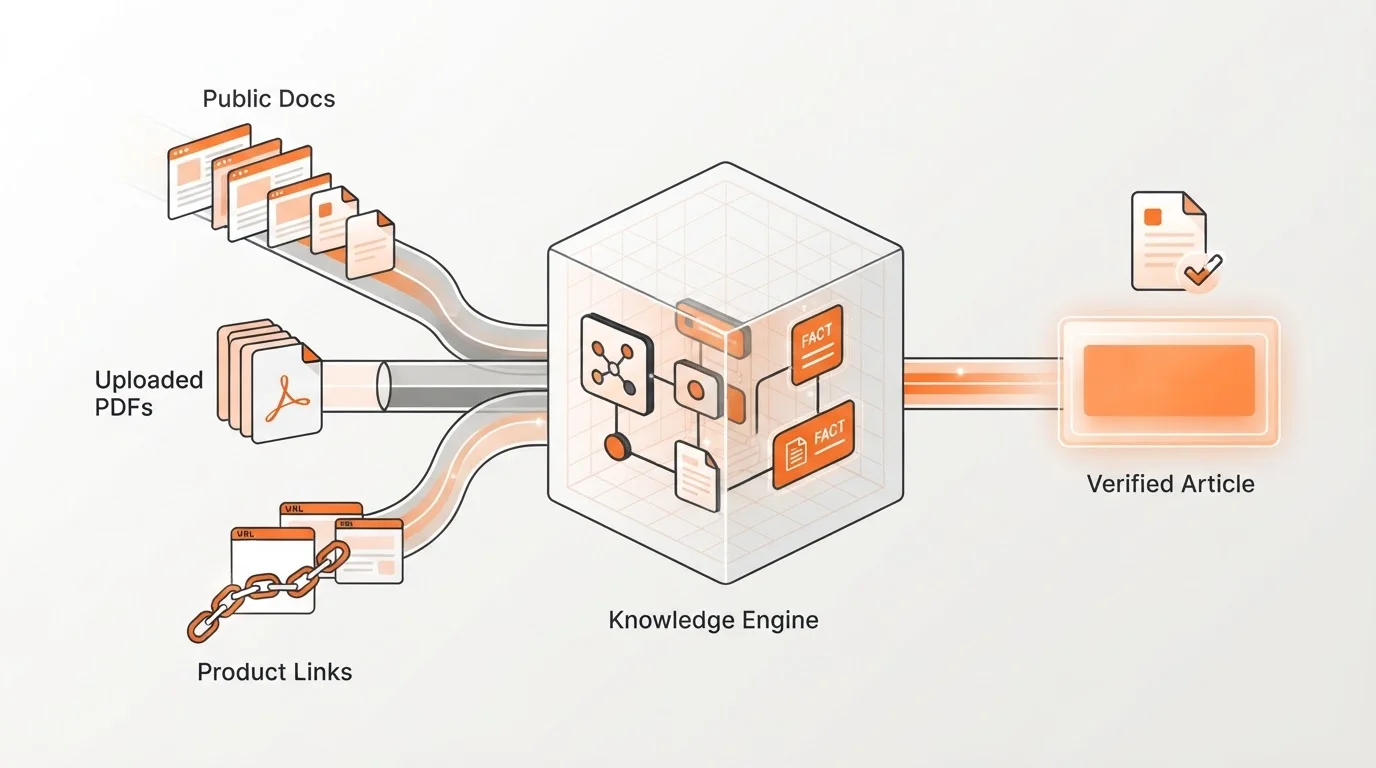
The secret to scaling content without losing quality lies in the Blogged Knowledge Engine. This feature serves as the "source of truth" for the autonomous system, organizing product descriptions, Ideal Customer Persona (ICP) data, positioning, specific facts, pricing, and feature limits. By feeding the platform your existing product documentation, you ensure that the AI doesn't have to guess what your product does or who it is for. Blogged lets users organize facts by product entity and facet, ensuring factual integrity across every post.
Users can populate the Knowledge Engine using various sources: public product pages, uploaded documents, pasted links, or written descriptions. This structured data allows the system to produce specific, product-led content that reflects actual product capabilities. For example, if your SaaS recently updated its pricing tiers or added a new technical limit, updating the Knowledge Engine ensures that every future article—and even existing ones through updates—remains accurate. This eliminates the "editing tax" and allows for a facts-first content engine.
Strategic Content Directions and Full Autopilot
High-velocity content requires a durable plan. Autonomous systems allow founders to define Content Directions—strategic paths that align with specific user problems or competitor comparisons. Instead of just picking keywords, you are defining the narrative paths your blog should take. The Full Autopilot feature then takes over, refilling a Topic queue from these approved directions and maintaining a consistent publishing cadence.
This system ensures that the blog remains active even during busy product launch weeks. By setting a cadence—such as three posts per week—the platform builds a durable SaaS content plan that keeps the organic engine running. The team only needs to perform a quick final review to ensure the tone is perfect. With higher-tier plans offering up to 3 revisions per article, founders can fine-tune the output until it perfectly matches their brand voice without having to write the first draft themselves.
Automating SEO Mechanics and Internal Linking

Beyond the writing, the manual labor of SEO is often what slows teams down. Internal linking is vital for building site authority and guiding users through the funnel, but it is incredibly tedious to manage at scale. Blogged’s internal linking tool verifies the destination, explains why a link fits a specific section, and allows the editor to insert or undo the link without leaving the post. This ensures that every new article strengthens the SEO value of your existing pages.
Furthermore, the platform handles the technical overhead of a blog site. Blogged includes a built-in blog site structure, managing the landing page and post pages so founders can start publishing immediately without needing to set up a separate CMS or manage plugins. This end-to-end automation includes handling Do Not Track, Global Privacy Control, and consent behavior for approved tags, ensuring the blog remains compliant with modern privacy standards while tracking essential metrics like homepage engagement and lead outcomes.
Get practical updates on saas content velocity case study
Receive new articles and practical insights by email.
Managing Product Assets and Screenshots
Generic AI content often lacks relevant visuals, making it feel disconnected from the product. To solve this, Blogged includes a SaaS product asset library. This feature allows users to manage a private repository of approved screenshots, diagrams, and brand assets with review queues and visible approvals. By centralizing these assets, the autonomous system can place relevant visuals into articles with accurate alt text, ensuring the content remains truly product-led. This provenance and safe archiving of assets mean that as your UI evolves, you can easily manage and update the visuals across your content library.
Quantifying the ROI: Time and Lead Growth
The primary return on investment for autonomous blogging is the reclamation of founder time. In a manual workflow, a founder might spend 12+ hours a month on content-related tasks. With an autonomous system running on Autopilot, this involvement can drop significantly, often to less than two hours a month for high-level strategy and final approvals. This shift allows leadership to focus on high-impact activities like product roadmap development, investor relations, and strategic partnerships.
Moreover, the increase in content velocity directly impacts lead growth. By covering more long-tail keywords and addressing a wider range of customer pain points, the blog becomes a more effective lead-generation tool. Because the platform allows for unlimited team seats on paid plans, marketing, product, and sales teams can all contribute insights to the Knowledge Engine, ensuring the content stays aligned with the needs of the entire organization without increasing overhead costs.
Transitioning to an Editor-in-Chief Mindset
Adopting autonomous blogging requires a shift in perspective. Founders must move from being the primary writers to becoming editors-in-chief and strategists. Success with these platforms depends on the quality of the "truth foundation" you provide. Investing time upfront to populate the Knowledge Engine and define clear Content Directions pays off in the form of a self-sustaining organic growth engine.
The future of SaaS content is autonomous and facts-driven. By leveraging systems that understand the nuances of product-led growth, founders can scale their organic presence while keeping their focus on building a world-class product. Decoupling content output from manual hours is no longer just an efficiency hack; it is a competitive necessity in an AI-driven search environment.
Frequently Asked Questions
Q: How does autonomous blogging avoid generic content?
Unlike generic LLMs, autonomous platforms like Blogged use a Knowledge Engine grounded in your specific product facts, documentation, and pricing. This ensures the output is product-led and specific to your SaaS, rather than drawing from general internet data.
Q: Can I control the publishing schedule?
Yes. You can set a specific publishing cadence and use the Full Autopilot feature to refill your topic queue from approved Content Directions, ensuring a consistent schedule that fits your growth goals.
Q: Is the blog SEO-optimized out of the box?
Yes. The platform handles research, planning, keyword optimization, and even internal linking. It also focuses on GEO (Generative Engine Optimization) to ensure your content is visible in AI-powered search engines.
Q: How do team members collaborate on the blog?
Blogged includes unlimited team seats on every paid plan. This allows your marketing, sales, and product teams to participate in the review and approval process, contributing their expertise without extra cost.
Scaling organic traffic through content doesn't have to be a resource drain. By adopting an autonomous blogging strategy, SaaS founders can overcome the content velocity bottleneck and build a compounding growth engine. With features like the Knowledge Engine, Autopilot publishing, and automated internal linking, platforms like Blogged allow you to transform product knowledge into discoverable content while reclaiming your time. The future of SaaS growth is autonomous, product-led, and designed to thrive in both traditional search and the new era of generative AI discovery.