
On this page
For many SaaS founders, the primary bottleneck to organic growth is the friction between product development and content execution. As engineering teams ship new features, marketing often struggles to keep pace, creating a visible feature-content gap where innovations remain invisible to search engines. This lag prevents potential customers from discovering your solution through specific, high-intent searches related to your newest capabilities. By shifting from manual drafting to an autonomous, product-led engine, founders can transform their blog from a secondary archive into a primary growth driver. This guide outlines how a hypothetical company, InnovateCo, might bridge this gap by achieving comprehensive content coverage for every release using structured product knowledge.
The Feature-Content Gap: Why SaaS Content Scaling Stalls
The core challenge for a rapidly evolving SaaS is maintaining a consistent content pipeline that reflects the current state of the software. When a new feature is released, the window for discovery is immediate. If no corresponding documentation or blog post exists, the feature essentially does not exist for the broader market. Manual content processes often fail because the time-to-publish is too high, with articles frequently going live weeks after a launch. This delay means missing the initial wave of user interest and the chance to rank for new, uncompetitive keywords.
Technical accuracy often suffers in traditional manual workflows as well. Writers rarely possess the deep product context held by the developers who built the feature, leading to superficial content that lacks value. Furthermore, founders frequently ignore long-tail SEO opportunities because they only have the bandwidth to cover major flagship updates. This leaves dozens of smaller but high-value technical improvements undocumented. The operational cost of scaling a manual writing team to match developer velocity is often prohibitive for early-stage and mid-market SaaS companies alike.
The Operational Cost of Undocumented Features
When features go undocumented, the burden shifts directly to customer support teams. Users who cannot find a guide or a 'how-to' article end up filing tickets for basic questions, which increases overhead. From an SEO perspective, each new feature represents a unique cluster of high-intent keywords that your competitors could easily claim. A systematic approach to content ensures that every line of code is discoverable and helpful to the end user. Bridging this gap requires moving away from one-off drafting toward a continuous, autonomous knowledge-sharing system.
Building a Product Knowledge Engine for Content
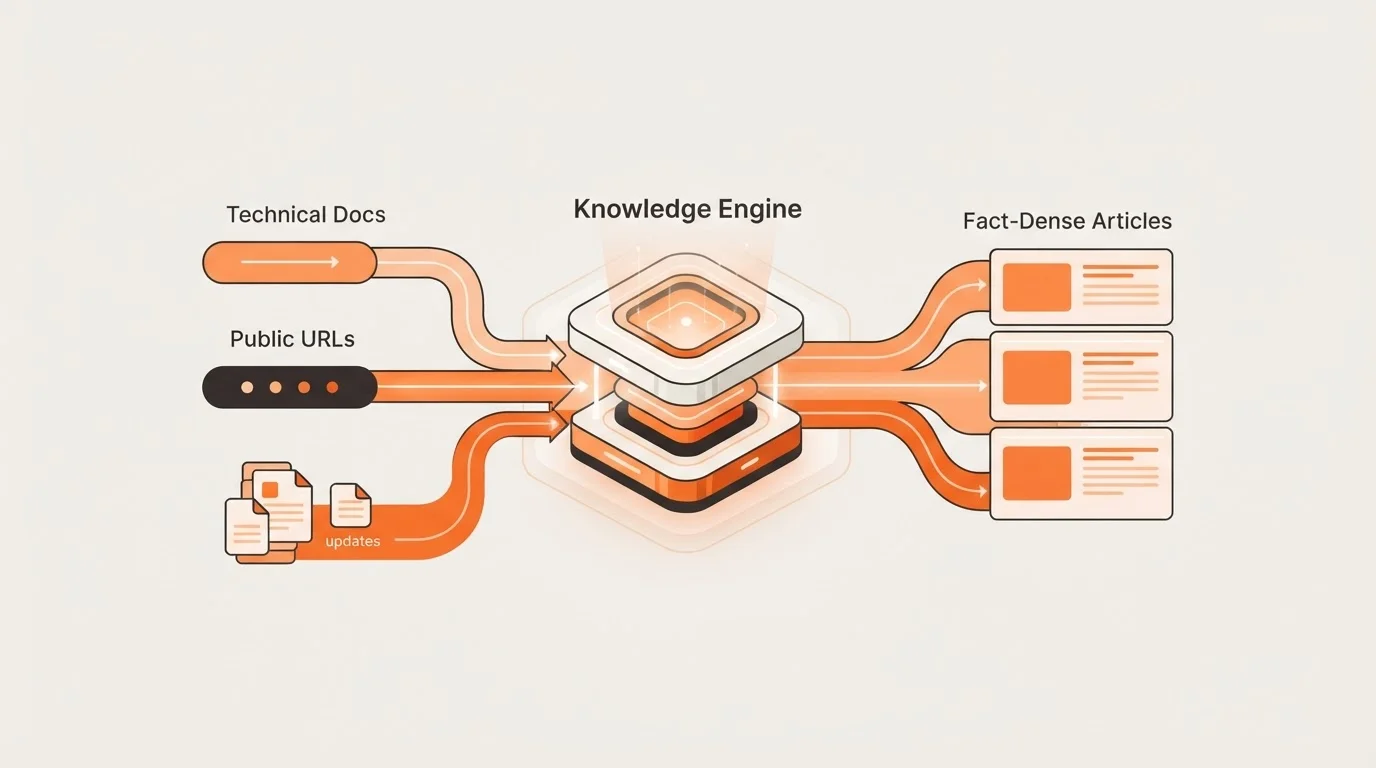
To overcome these hurdles, SaaS teams are integrating autonomous blogging platforms like Blogged into their development cycles. The goal is to automate research, writing, and publishing while maintaining human oversight. Unlike generic AI tools that rely on broad training data, an autonomous SaaS blog must be grounded in product-specific facts. This is where a dedicated Knowledge Engine becomes the foundation of the strategy.
By utilizing the Knowledge Engine for Autonomous SaaS Blogs, founders can feed the system direct product sources. This includes public URLs, technical documents, and pasted links or internal release notes. This ensures that every article is grounded in 'ground truth' data rather than hallucinations. The system learns the product's unique value proposition, technical specifications, and user benefits before the first draft is ever generated.
Organizing Facts by Entity and Facet
The Knowledge Engine allows you to organize facts by product entity and facet, creating a structured map of your software. You can define specific technical facets, target personas, and use cases for each individual feature. This structured approach allows the AI to generate highly specific content that addresses the exact pain points the new feature was designed to solve. Instead of vague marketing speak, the resulting content is fact-dense and logically organized, which is exactly what modern search engines and users require.
Centralizing the Product Asset Library
A technical blog post is only as effective as its visual context. One of the primary reasons manual blogging slows down is the back-and-forth required to obtain the right screenshots or diagrams. To scale effectively, founders should manage a private SaaS product asset library that centralizes brand-approved visuals. This library includes not only images but also technical specifications and alt text for accessibility.
Platforms that support review queues and visible approvals allow founders to maintain quality control without being bogged down in the details. You can review how an image or a specific technical claim is placed within an article and make bulk decisions or undo changes if needed. This human-in-the-loop approach ensures that even though drafting is autonomous, final oversight remains human-centric, preserving brand consistency across all published channels.
Workflow Optimization: Content as a Parallel Dev Track
Comprehensive coverage requires restructuring the workflow so that content generation happens in parallel with development. As soon as a feature reaches the 'beta' or 'release candidate' stage, technical notes should be fed into the knowledge engine. This allows the autonomous system to begin drafting guides and announcements before the feature even goes live. By the time the code is deployed, the content is ready for a final human review.
This shift moves the marketing team away from a reactive role and into a proactive one. Because the system handles the heavy lifting of research and structure, the team can focus on refining the strategic angle and ensuring the content aligns with the broader product roadmap. This level of efficiency allows a lean team to produce a volume of high-quality content that would typically require a much larger headcount.
Collaborative Reviews and Team Access
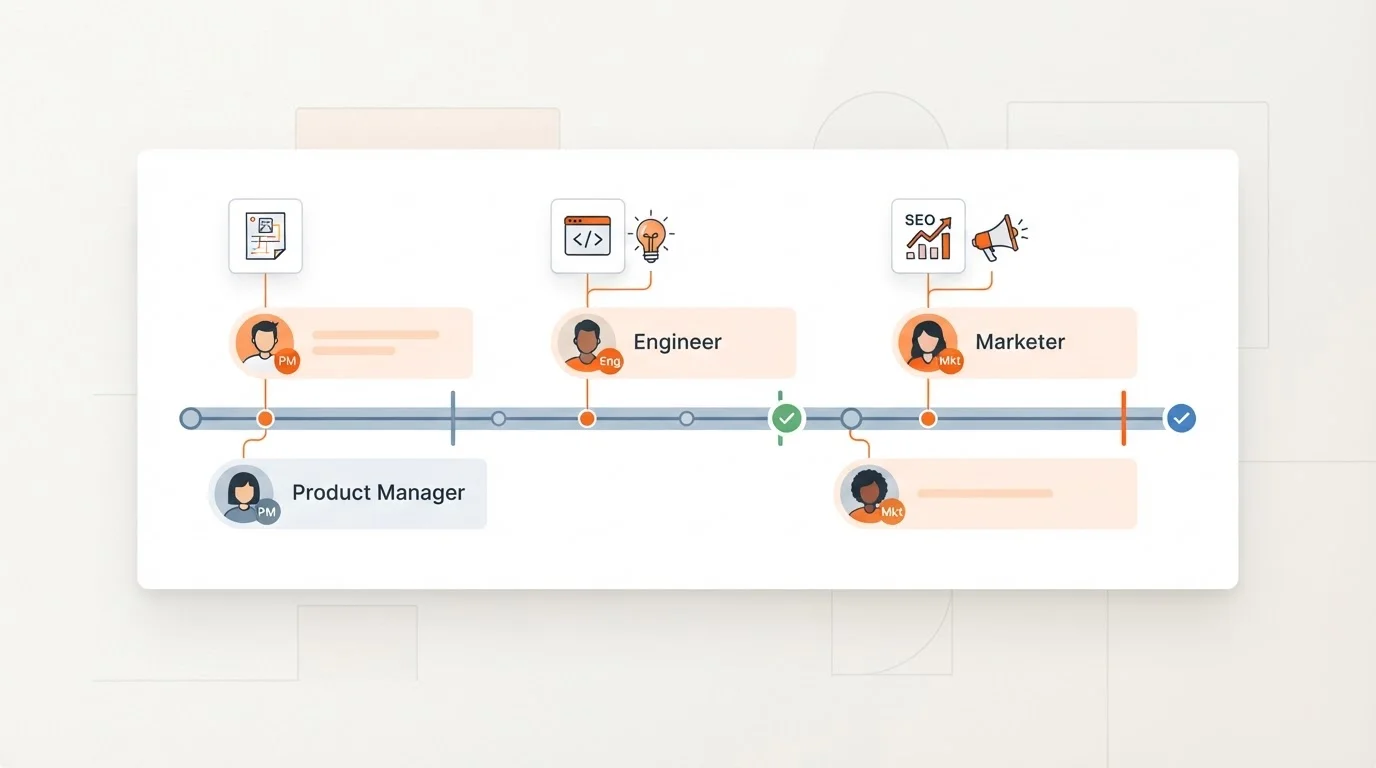
Scaling a content engine requires collaboration between product experts who know the technical details and marketers who understand the audience. A common friction point in many SaaS tools is the per-user cost, which discourages team-wide participation. To solve this, Blogged includes unlimited team seats on every paid plan. This allows the entire product team to participate in the knowledge-sharing process without additional costs. Product managers can drop in technical notes, and marketers can review the SEO strategy, creating a seamless hand-off that eliminates traditional silos.
Get practical updates on saas scale product content new features case study
Receive new articles and practical insights by email.
Optimizing for AI Discovery (GEO)
While traditional SEO remains vital, SaaS founders must now also optimize for Generative Engine Optimization (GEO). Modern users increasingly rely on AI-driven search tools and assistants to find product recommendations. These engines prioritize highly specific, fact-dense content that can be easily synthesized into answers. By producing articles that are rich in product facts and logically structured, your blog becomes a primary source for these AI tools.
Autonomous blogging platforms focusing on 'product-led' content are inherently better suited for GEO. Because the content is derived directly from your product's knowledge base, it provides the level of detail AI assistants need to cite your product as a solution. This expands your reach beyond traditional Google search results, capturing traffic from the growing segment of users who interact with LLM-based discovery tools.
Technical Implementation: Multi-Platform Publishing
A major operational hurdle for SaaS companies is the variety of platforms used for different content types. You might maintain a main blog on WordPress, a marketing site on Webflow, and a technical hub on Ghost. Managing these disparate systems manually often leads to inconsistency. A robust autonomous system should offer deep integrations with these platforms to ensure a unified content strategy.
For teams using the most popular CMS, the WordPress AI Blog Publishing integration allows for seamless delivery. By using a dedicated publishing plugin and an application password, you can deliver reviewed articles directly to your site. This integration manages the transition from a drafted state in your autonomous platform to a live post on your domain, ensuring all SEO meta-tags and internal links are preserved.
Syncing with Webflow and Ghost
For those prioritizing design and performance, the Webflow CMS AI Blog Publishing integration is essential. It allows you to collect consented visits and track configured conversions for your verified articles directly within the Webflow environment. Similarly, the Ghost AI Blog Publishing integration manages the content review process while Ghost handles the final rendering for the reader. These integrations ensure that no matter your tech stack, your autonomous content engine can publish at scale without manual copy-pasting.
Data-Driven Growth: Tracking Leads and Engagement

Scaling content is not just about volume; it is about outcomes. Founders need to know if their product-led content is actually driving user adoption and lead generation. An autonomous blogging platform should provide more than just basic traffic stats. It should integrate with the tools you already use to provide a full picture of the user journey.
With the right platform, you can track Search Console performance, lead outcomes, and reader feedback directly within your content dashboard. This allows you to see which feature-specific guides are driving the most engagement and which keywords are bringing in high-intent users. By monitoring lead growth and homepage engagement alongside your blog metrics, you can refine your content strategy to focus on the topics that move the needle for your business.
Key Strategic Steps for SaaS Founders
Moving from a manual blogging process to an autonomous engine is a strategic shift that reallocates human intelligence to strategy and product innovation. To replicate the success of companies that have bridged the feature-content gap, founders should follow a structured path to implementation.
First, establish a fact-first workflow. Instead of asking an AI to 'write a blog post,' focus on providing high-quality documentation and technical notes. Second, leverage integrated analytics to track not just traffic, but specific outcomes like lead growth for new feature keywords. Third, empower your whole team by using platforms that offer unlimited seats, encouraging engineers to contribute their expertise. Finally, optimize for AI discovery by ensuring your content is fact-rich and logically structured to win in the era of GEO.
Frequently Asked Questions
Q: How does autonomous blogging handle technical accuracy for complex SaaS features?
By using a Knowledge Engine, the AI draws only from provided product documentation, release notes, and specific URLs rather than general training data. This ensures technical precision while human reviewers perform the final quality check.
Q: Will AI-generated content be penalized by search engines?
Search engines like Google prioritize helpful, specific, and reliable content regardless of how it was produced. By focusing on 'product-led' content that provides actual value and facts, your blog stays aligned with quality guidelines.
Q: How much time does it take to set up the autonomous workflow?
Setup involves connecting your CMS and populating your initial product knowledge base. Once the integrations are verified, the system can begin generating drafts based on your development roadmap immediately.
Q: How many revisions are included in the process?
Depending on the plan selected, Blogged includes either 1 or 3 revisions per article to ensure the final output meets your standards.
Scaling product-led content is no longer a resource problem; it is a systems problem. By automating the heavy lifting of research and drafting, a SaaS company can achieve comprehensive feature coverage without exploding their marketing budget. Autonomous blogging allows founders to stop worrying about the 'blank page' and start focusing on the next innovation. By transforming product knowledge into discoverable content on autopilot, you ensure that every line of code your team writes is backed by a content strategy that drives adoption and SEO authority. If you are ready to bridge your feature-content gap, it is time to look beyond manual writing and embrace the efficiency of an autonomous engine.