
On this page
For the modern SaaS founder, scaling acquisition often feels like running on a treadmill that keeps accelerating. In the early stages, paid search and social ads provide the quick hit of traffic needed to validate a concept. However, as a product matures, the mathematical reality of paid acquisition becomes clear: the cost to acquire a customer often climbs faster than the revenue they generate. This situation creates a fragile dependency on capital rather than a compounding asset.
The alternative is organic growth, but the traditional content marketing model—hiring agencies and managing freelancers—creates a management bottleneck that most building-focused founders cannot sustain. Maintaining a high-quality blog requires deep technical knowledge and a publishing cadence that signals authority to search engines. For a lean team, spending twenty hours a week on editorial management is often impossible. This is where autonomous blogging introduces a structural shift in how SaaS companies build authority.
Autonomous content creation, specifically when grounded in a product-led framework, allows founders to decouple their growth from their daily schedule. By leveraging platforms like Blogged, SaaS teams can transform existing product documentation, technical specifications, and market signals into a high-frequency publishing engine. This approach creates a discoverable ecosystem that targets high-intent keywords across both traditional SEO and emerging Generative Engine Optimization (GEO). Moving from a high-overhead manual model to a high-efficiency autonomous model allows founders to establish a long-term organic engine that lowers blended Customer Acquisition Cost (CAC).
The SaaS Scaling Wall: Why Paid Acquisition Eventually Erodes Margins
The traditional SaaS growth playbook relies heavily on the predictable but expensive nature of paid search. While effective for initial traction, paid acquisition is fundamentally linear: if you want more leads, you must pay more money. As you attempt to scale, you eventually move past the most affordable, high-intent keywords and begin bidding on broader terms. This leads to a double-penalty: the Cost Per Click (CPC) increases while the conversion rate decreases.
For many SaaS companies, this results in a CAC payback period that stretches beyond eighteen months, putting immense pressure on cash flow and runway. Furthermore, paid acquisition lacks any residual value. The moment the budget is paused, the lead flow stops entirely. This creates a rented audience rather than an owned one, leaving the founder vulnerable to algorithm shifts or sudden competitive bidding wars.
Organic acquisition offers a different trajectory. Unlike the linear spend of ads, organic content creates a compounding return. An article published today can continue to generate leads for years, effectively driving the marginal cost of a new user toward zero over time. To break through the scaling wall, SaaS teams need a way to produce product-specific, expert-level content without the manual labor typically associated with B2B writing.
Case Study: InnovateCo’s Strategy for a 30% CAC Reduction
InnovateCo, a scaling SaaS provider, faced the common challenge of rising ad costs and a stagnant organic presence. Their strategy was built on three pillars: moving away from generic industry keywords, grounding content in actual product capabilities, and automating the high-volume publishing loop. By shifting their focus to product-led organic content, they sought to build a defensible moat that didn't require constant ad spend.
The core of the transformation was the implementation of an autonomous blogging engine. Instead of writing general advice, InnovateCo used their internal technical documentation to fuel their blog. This ensured that every article addressed specific user pain points and demonstrated how their software solved those problems. Over a measured period, this shift allowed InnovateCo to reduce customer acquisition costs by 30% by replacing expensive paid leads with high-intent organic traffic.
This success was not just about publishing more content; it was about publishing the right content. By targeting long-tail technical queries that competitors were ignoring, InnovateCo captured an audience ready to buy. The automation allowed them to maintain a daily publishing cadence without distracting their engineering team from product development, proving that organic scale is achievable for small teams.
The Rise of Autonomous Blogging for B2B SaaS
Autonomous blogging represents the next evolution of content marketing, moving beyond generic AI-generated text to product-grounded publishing. The primary failure of standard AI tools in the SaaS space is their lack of context. A generic large language model can write about project management tips, but it cannot write about how your specific software integrates with Jira to solve a unique bottleneck for engineering managers.
Lack of specificity is what makes generic content fail to convert. Autonomous blogging platforms like Blogged solve this by integrating directly with a company's internal knowledge base. By grounding the content in actual product facts, the platform produces articles that are not only search-optimized but also technically accurate and genuinely useful to a prospective buyer.
This shift to autonomy allows for a level of content velocity that was previously reserved for enterprise-level marketing budgets. In the SaaS world, topical authority is built through coverage. An autonomous system can research, plan, write, and publish clusters of content on autopilot, ensuring that every angle of a product’s value proposition is discoverable. The blog stops being a neglected page and starts being a 24/7 sales representative.
Grounding Content in Reality: The Knowledge Engine
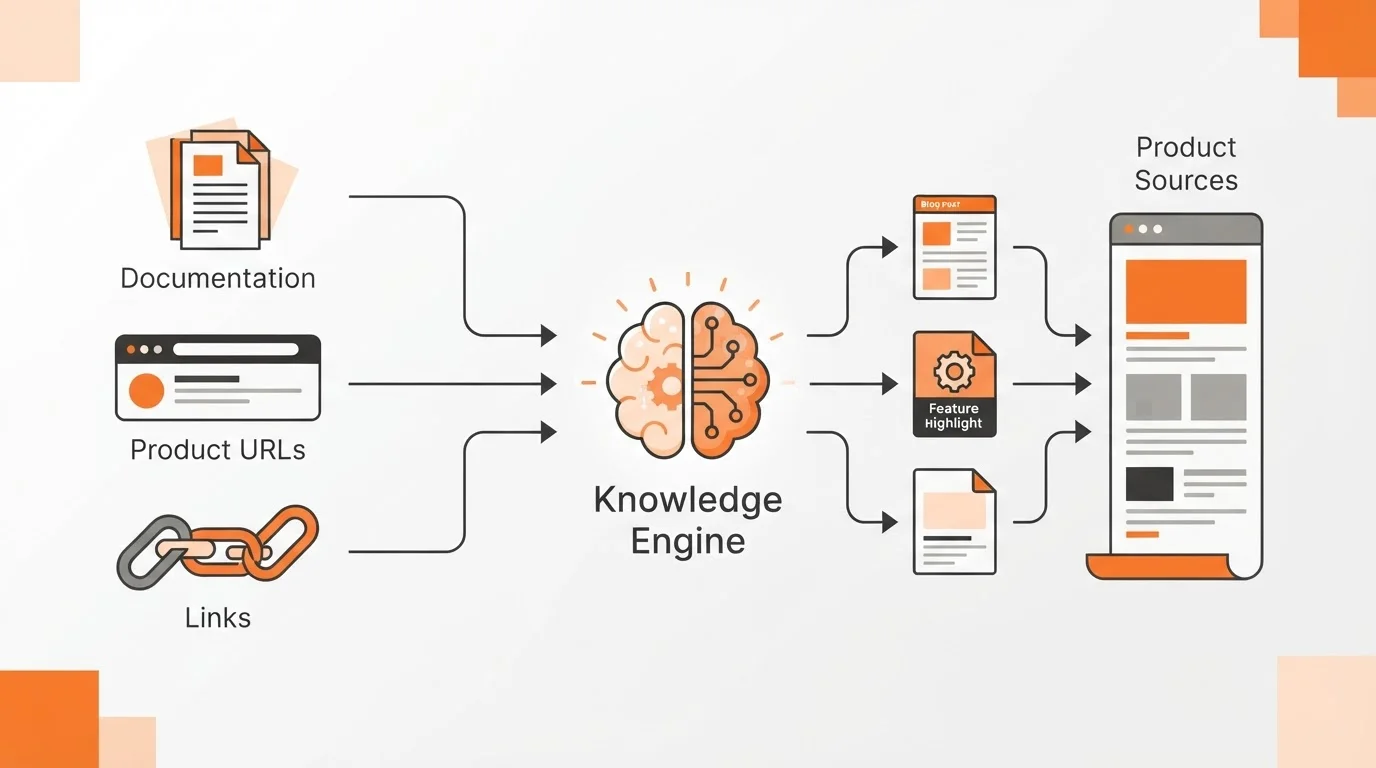
The competitive advantage of a SaaS product lies in its unique features and the specific problems it solves. If a blog only discusses industry trends, it fails to drive high-intent traffic. This is why the Knowledge Engine for Autonomous SaaS Blogs is critical. Instead of relying on general training data, this feature allows founders to provide public product sources, uploaded documents, pasted links, or a written product description to the platform.
This process grounds the autonomous writer in the reality of the software. When the platform writes an article, it references actual UI elements, specific integration capabilities, and documented workflows. This ensures the content resonates with technical buyers who are looking for concrete solutions rather than marketing fluff. Grounding is also essential for maintaining E-E-A-T (Experience, Expertise, Authoritativeness, and Trustworthiness).
By using verified product signals, autonomous blogging avoids the hallucinations common in standard AI. It creates a feedback loop where your technical documentation and customer success stories directly fuel your acquisition engine. A new feature release can be instantly converted into a series of how-to guides and comparison articles, ensuring your product is the first thing a user sees when searching for a solution.
Strategic Niche Targeting with Competitor Watch
In the crowded SaaS market, your competitors' content gaps are your biggest opportunities. Most founders don't have the time to manually audit every rival's blog to see what keywords they are winning or where they are failing to provide depth. Blogged’s Competitor Blog Watch automates this competitive intelligence by monitoring the publishing activity of your rivals.
The system identifies underserved topics and automatically adds them to your content queue. This data-driven approach ensures you are not just publishing for the sake of volume, but are actively reclaiming market share in organic search results. The Starter plan allows founders to track up to 7 rivals, while the Ultra Growth plan expands this to 25, providing a comprehensive view of the competitive landscape.
Technical Integration: Turning a Blog into a Conversion Engine

A blog is only as useful as its ability to capture and convert traffic. For SaaS teams, this means content must live on their own domain and integrate seamlessly with their existing tech stack. Blogged is designed to be hands-off not just in writing, but in publishing, offering native integrations with the most popular SaaS website frameworks.
The WordPress AI Blog Publishing integration connects to self-hosted sites through the Blogged Publishing plugin and an application password. This allows the platform to handle the research and writing while the WordPress site collects consented visits and tracks conversions for verified articles. For teams using specialized stacks, the Ghost AI Blog Publishing integration manages content creation in the Blogged dashboard while Ghost renders a clean reader experience via a custom Ghost Admin API key.
Webflow users can automatically deliver optimized posts to their collections, complete with conversion tracking to see exactly which articles are driving signups. Even for custom-built SaaS applications using Next.js, Blogged provides an integration that allows founders to collect consented visits and track performance directly. This technical infrastructure ensures that the blog isn't a siloed marketing asset but a fully integrated part of the product’s conversion funnel.
Get practical updates on saas reduce customer acquisition cost case study
Receive new articles and practical insights by email.
Evaluating the ROI: Choosing the Right Autonomous Plan
Moving to an autonomous content model requires choosing a plan that matches your current growth stage and content velocity needs. Unlike traditional agencies that charge thousands for a few articles, autonomous blogging offers a predictable monthly cost for high-volume, product-led publishing. The Starter plan at $99 per month is often the ideal entry point for early-stage founders looking to build their initial topical authority.
As a SaaS scales and needs to dominate multiple keyword clusters or monitor more competitors, the Growth and Ultra Growth plans provide the necessary scale without adding a single hour to the founder's workload. The following table breaks down the verified limits and capabilities of each tier to help you determine the best fit for your acquisition goals.
Blogged Plan Comparison
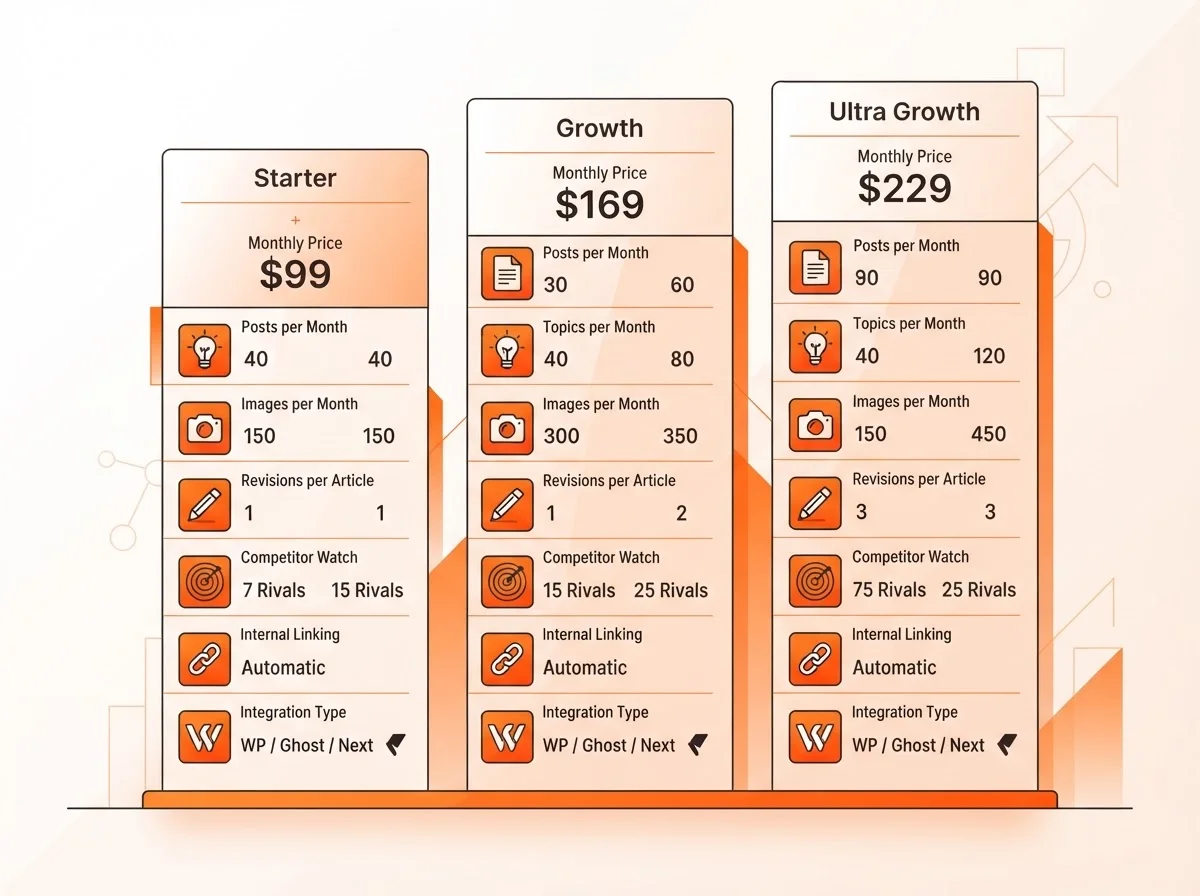
| Feature | Starter | Growth | Ultra Growth |
|---|---|---|---|
| Monthly Price | $99 | $169 | $229 |
| Posts per Month | 30 | 60 | 90 |
| Topics per Month | 40 | 80 | 120 |
| Images per Month | 150 | 300 | 450 |
| Revisions per Article | 1 | 2 | 3 |
| Competitor Watch | 7 Rivals | 15 Rivals | 25 Rivals |
| Internal Linking | Automatic | Automatic | Automatic |
| Integration Type | WP/Ghost/Next | WP/Ghost/Next | WP/Ghost/Next |
GEO and the Future of Search Discovery
The search landscape is undergoing a shift from traditional keyword-matching to Generative Engine Optimization (GEO). As AI-powered search engines like SearchGPT and Perplexity become more prevalent, the way users discover SaaS products is changing. These engines don't just provide a list of links; they provide summarized answers based on the most authoritative and specific content available.
If your blog consists of generic industry fluff, it will not be cited by these generative engines. However, by using the Knowledge Engine to ground your content in specific product facts, you increase the likelihood of your software being recommended as the definitive solution. Autonomous blogging is uniquely suited for this GEO-driven future because it can produce a high volume of specific, interconnected articles.
This interlinking—automatically handled by the Blogged platform—signals to both Google and AI search engines that your site is a deep source of expertise. By optimizing internal links and maintaining high-frequency publishing, you ensure that your product remains visible not just in traditional search results, but in the generative summaries that are increasingly defining the buyer's journey in the B2B SaaS space.
FAQ for SaaS Founders Considering Autonomous Blogging
Q: Will autonomous blogging content get penalized by search engines?
No. Search engine guidelines focus on the quality and usefulness of content, not the tools used to create it. By grounding content in actual product facts via the Knowledge Engine, Blogged ensures your blog provides the Expertise and Trustworthiness that modern search algorithms reward.
Q: How much management time does it actually require?
Once the Knowledge Engine is configured with your product details, the system runs on Autopilot. Most founders spend less than thirty minutes a week checking their content queue and performance metrics.
Q: Does the platform handle technical SEO like internal linking?
Yes. Blogged automatically optimizes internal links across all your blog posts. This is a critical signal for building topical authority, as it helps search engines understand the relationship between different features and use cases.
Q: Can I integrate this with my existing custom-built site?
Yes. Beyond standard integrations like WordPress and Webflow, Blogged offers a Next.js integration and a signed webhook Content API. This allows you to pull your autonomous content into any custom-built application while maintaining full control over the reader experience.
High Customer Acquisition Costs are not an inevitable tax on SaaS growth; they are often the result of an over-reliance on rented attention. By shifting toward an autonomous, product-led blogging strategy, founders can turn their unique expertise into a compounding acquisition engine. The ability to transform internal knowledge into discoverable content—without the overhead of a traditional marketing team—represents a fundamental shift in how small teams can compete for organic dominance.
If your current acquisition strategy is hitting a wall of diminishing returns, the path forward is through authority. With plans starting at $99 per month, the barrier to building a high-performance blog has been removed. By integrating your product knowledge with a system designed for high-velocity SEO and GEO, you can lower your acquisition costs and build a sustainable engine that grows alongside your product.