
On this page
For SaaS founders, building an organic marketing engine frequently introduces a frustrating trade-off between deployment velocity and technical precision. In the early stages of a software company, the founder or the core engineering team acts as the primary content creator. They ensure every guide, tutorial, and feature breakdown is technically precise because they live and breathe the code. However, as development cycles accelerate and the product evolves through weekly sprints, a dangerous gap opens between what the software actually executes and what the company blog claims it does. Traditional content production models struggle to keep pace with continuous deployment, leading to outdated documentation, brand misalignment, and missed conversion opportunities.
When a marketing team or a standard generative AI writing tool operates in isolation from the actual product state, the resulting material routinely suffers from superficial descriptions or factual errors. To solve this friction, forward-thinking software builders are shifting toward a framework centered on product-led content accuracy. By integrating internal product documentation, API specifications, and live feature parameters directly into an autonomous blogging pipeline, founders can transform specialized product knowledge into authoritative, discoverable content. This strategic breakdown examines how scaling software companies eliminate technical inaccuracies, minimize executive review bottlenecks, and leverage autonomous infrastructure to secure highly accurate search and discovery visibility.
The Scaling Bottleneck: Why Standard SaaS Content Inherently Fails at Technical Precision
The standard playbook for business-to-business software blogging relies heavily on production volume. Companies publish multiple articles per week to capture long-tail keywords and build topical authority within their market niche. While this volume-driven approach can generate raw traffic spikes, it introduces systemic quality risks when applied to complex, developer-facing, or highly specialized software platforms.
Without a direct link to engineering truth, standard content pipelines run into predictable operational roadblocks. The most common is the feature-lag dilemma. In a fast-moving startup, engineering teams ship UI updates, deprecate legacy endpoints, and adjust pricing models during rapid sprints. Because traditional content pipelines operate on separate editorial calendars, published articles often reference features that have already evolved or vanished from the live application. This creates a legacy of misinformation that can take months to manually audit and correct.
Furthermore, standard commercial artificial intelligence writing tools generate prose based on generalized historical internet data. While these models are proficient at crafting fluent sentences, they lack context regarding a specific proprietary codebase. Consequently, they routinely invent technical capabilities, configurations, or UI paths that the target software does not actually support. This phenomenon, often called hallucination, is lethal for B2B trust. To prevent these drafts from reaching the public, founders often require a senior product manager to perform manual fact-checking. This pattern burns through valuable technical hours, forcing developers to spend time editing blog paragraphs instead of shipping product code.
The Operational Cost of Inaccurate Marketing Assets
Inaccuracy within a software article is not merely a minor editorial misstep; it functions as an immediate operational drag. When a guide misrepresents how a platform processes data or handles API requests, it sets incorrect expectations for prospects. This gap ripples directly into the customer success pipeline. Users who register based on erroneous instructions often fail to configure the software properly, leading to early account abandonment or a sudden spike in high-touch technical support tickets.
Factual errors also undermine acquisition efficiency. When prospects discover that a highlighted feature does not function as advertised, the enterprise sales team must spend valuable minutes during demo calls actively correcting misconceptions rather than advancing the deal. Securing precise content alignment ensures that the traffic entering the funnel is qualified, informed, and primed for long-term retention. By treating accuracy as a core product requirement rather than a marketing afterthought, founders protect their brand's integrity and their team's time.
Architecture of a Knowledge Engine: Solving the Hallucination Problem
The solution to content inaccuracies in autonomous publishing involves shifting from ungrounded generative writing to a structured system rooted in verified records. Rather than allowing an automated platform to guess the parameters of an application, a modern autonomous blogging architecture utilizes a dedicated engine to ingest and enforce the specific technical rules of the software. This framework uses a localized approach to information retrieval, centralizing the product knowledge base to ensure writing layers are strictly constrained by verified boundaries.
If a planned article requires an explanation of an advanced workflow, the system references the internal knowledge base first. When specific details are absent from the provided source files, the system avoids generating speculative filler, remaining anchored within the parameters set by the technical team. This dynamic approach allows small software teams to sustain automated research, writing, optimization, and publishing cycles every week while dedicating their primary energy to refining their core software product. It effectively creates a 'digital twin' of the product's capabilities that the AI can reference with 100% fidelity.
The Four Elements of a Complete Digital Source of Truth
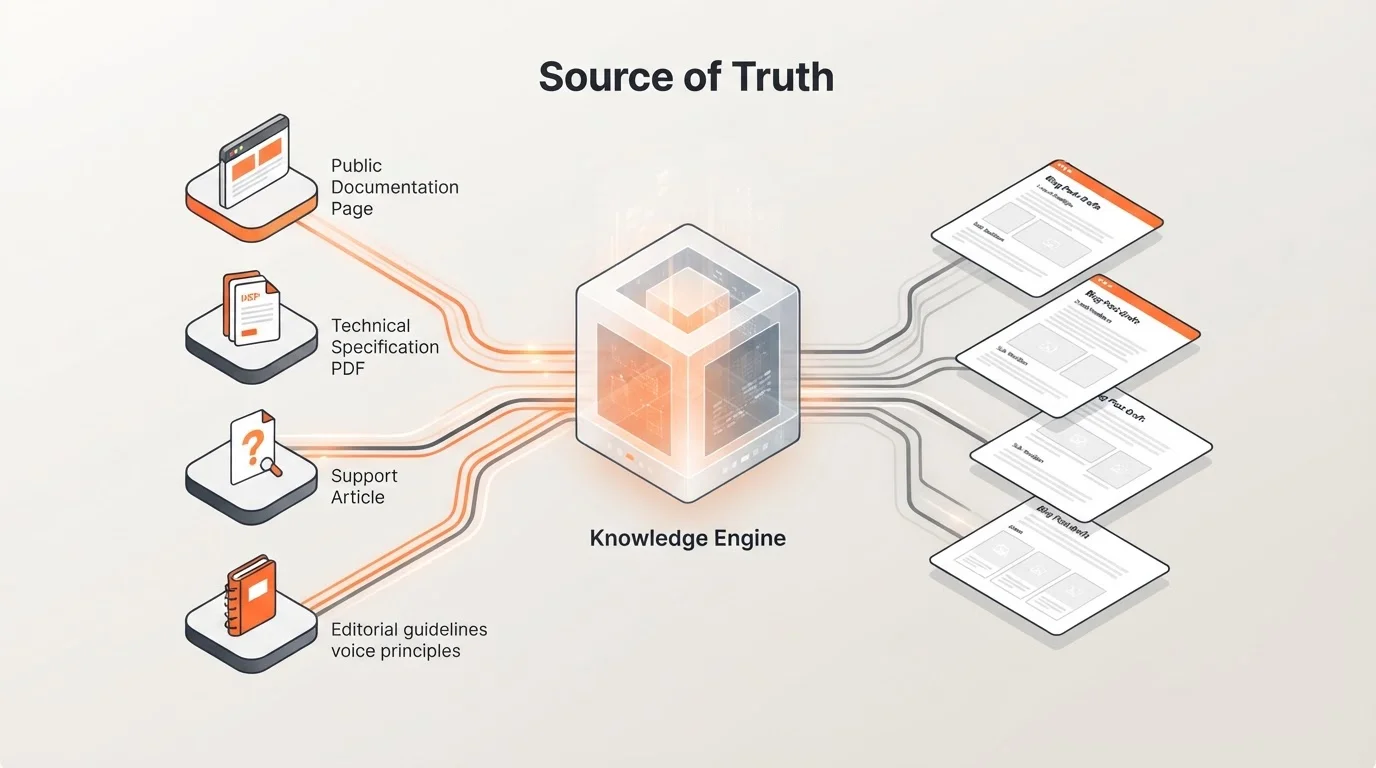
To construct an airtight foundation for autonomous content creation, a software team must feed diverse, authoritative inputs into their automation pipeline. An advanced platform like Blogged facilitates this through its Knowledge Engine for Autonomous SaaS Blogs. Founders can organize their technical details using four foundational content inputs:
- Public Product Sources: Connecting active external documentation pages and live user guides ensures the system maintains visibility over public-facing platform capabilities.
- Uploaded Technical Documents: Injecting internal files, such as product requirement briefs, user persona studies, and technical specification PDFs, provides context that is not accessible on the open web.
- Pasted Help Center Links: Syncing existing customer support repositories and FAQs helps translate complex engineering tasks into readable, customer-centric solutions.
- Written Product Descriptions: Providing explicit editorial overviews, core value positioning statements, and brand voice guardrails allows the system to mirror the tone of the founding team.
By unifying these individual streams into a single reference layer, the automation engine acquires a comprehensive structural understanding of the software that equals or exceeds the comprehension level of an external freelance writer.
The Evolution from Traditional SEO to Fact-Dense Generative Engine Optimization (GEO)
The mechanics of web discovery are undergoing a structural shift. For decades, SEO focused on standard ranking signals: placing exact keywords in headers, optimizing meta titles, and building backlink networks. While these methods remain relevant for structural visibility, the rise of AI-driven answer engines has introduced a new requirement: Generative Engine Optimization (GEO). Modern buyers increasingly rely on generative search utilities and interactive models like Perplexity, ChatGPT, and Google Gemini to research technical software solutions.
Instead of scrolling through lists of links, users ask highly specific questions, such as 'Which infrastructure management platform supports zero-downtime multi-region database migrations?' To earn visibility here, content must offer dense, verified facts rather than generic thematic summaries. AI answer engines prioritize and cite source material that contains unique data, explicit technical parameters, and clear, structured answers. An autonomous publishing framework grounded in a dedicated knowledge engine directly matches this requirement. By generating articles rich in verified software specifications, SaaS founders position their brand as the primary reference point cited by generative discovery engines.
The 3-Step Playbook for Deploying Product-Led Content Automation
Succeeding with an autonomous content program requires a deliberate implementation strategy. Software founders cannot simply activate an automated tool over a blank slate and expect authoritative results. By organizing internal documentation, mapping strategic keyword clusters, and utilizing efficient validation checkpoints, software teams build a self-sustaining growth loop. This ensures that every piece of content published serves as a reliable extension of the product itself.
Step 1: Unifying Internal Documentation and Structural Context
The deployment process begins by identifying the most accurate documentation available within the enterprise. For most technology startups, this includes API documentation, detailed feature maps, setup guides, and competitor comparison documents. Uploading these materials into the platform's knowledge base establishes a clear editorial boundary. Because a modern system allows for ongoing updates to this repository, the underlying model adapts immediately as new code deploys. This continuous alignment resolves the problem of stale content, ensuring every automated draft reflects the current state of the application repository.
Step 2: Designing High-Intent, Product-Led Topic Clusters
With the structural knowledge layer configured, the next objective involves mapping out targeted topic clusters. Rather than chasing high-volume, generic keywords that attract casual traffic, a product-led content strategy prioritizes high-intent search terms. These focus on practical how-to tutorials, complex ecosystem integrations, and direct problem-solution analyses. An autonomous engine scans the active knowledge base to identify distinct thematic clusters that directly feature the software's unique utility. This ensures that every generated article naturally positions the product as the optimal solution to the reader's operational problem.
Step 3: Executing a High-Efficiency Review Cycle
Although the automated engine handles keyword research, topic planning, long-form drafting, and search optimization, maintaining human oversight remains essential for brand validation. Using an intuitive editing workspace like the built-in Blogged Editor, a founder or product manager can perform a rapid, focused scan of each article prior to formal publication. Because the knowledge base guarantees technical accuracy from the first draft, reviewers do not have to spend hours correcting technical errors. Instead, they can devote a few minutes to adding personal anecdotes or unique industry perspectives that deepen the human connection with the reader.
Technical Deep Dive: Secure Publishing and Conversion Tracking
A frequent barrier to adopting automated marketing infrastructure is the fear of engineering overhead. Founders are protective of their software stacks and hesitant to implement tools that demand complex maintenance. Modern autonomous content platforms solve this by providing native, secure integrations that connect directly to standard website architectures without requiring deep code changes. This allows marketing and engineering to operate in parallel without conflicting interests.
WordPress and Ghost Deployment Workflows

For software companies operating their primary marketing presence on established content management systems, deep integrations allow for frictionless publishing. When managing a self-hosted WordPress site, the Blogged WordPress AI Blog Publishing integration enables teams to compose, optimize, and review articles directly inside the platform before delivering them seamlessly to the live web. This connection relies on the secure Blogged Publishing plugin alongside an application password, ensuring a stable, authenticated link.
For teams that prefer a dedicated developer portal or a lightweight publishing alternative, the Blogged Ghost AI Blog Publishing integration manages the full content cycle while allowing Ghost to render the final reading experience. Setting up this link is highly secure: administrators create a custom integration inside their Ghost configuration area, copy the generated Admin API key, and verify the connection directly within the Blogged dashboard. This architectural decoupling keeps the production engine isolated from the frontend presentation layer.
Headless Infrastructures: Next.js, Webflow, and Conversion Data Capture
For software teams utilizing modern headless frontends or custom landing page tools, advanced integrations offer comprehensive flexibility. By utilizing specialized Next.js and Webflow CMS configurations, software companies maintain precise control over page performance and styling libraries. Beyond basic text delivery, these integration paths feature built-in conversion tracking.
Through secure, signed webhooks and the core Content API, marketing teams can easily collect consented visits and configured conversions for verified articles. This data collection mechanism allows founders to monitor exactly which blog posts generate sign-ups and trace user journeys from organic discovery to account creation. It provides a clear view of ROI without needing to deploy heavy, third-party user tracking networks that could compromise site performance or privacy standards.
The Internal ROI of Fact-Grounded Content
Transitioning to a knowledge-grounded content strategy produces returns across multiple departments. While organic customer acquisition is the primary goal, the internal efficiencies gained by removing manual content creation tasks are equally impactful. By offloading long-form writing to a reliable autonomous system, the product team reclaims critical engineering hours previously lost to drafting marketing material. Concurrently, the support department experiences fewer baseline inquiries because the corporate blog functions as an accurate, up-to-date documentation extension.
Furthermore, because every paid Blogged plan includes unlimited team seats, software companies can easily invite cross-functional stakeholders—including product managers, sales engineers, and growth marketers—to participate in the final validation process without incurring incremental user fees. This open collaboration ensures the entire enterprise retains visibility over the organic growth engine without expanding the corporate overhead budget. It fosters a culture of accuracy where everyone can contribute to the product's public narrative.
Frequently Asked Questions
Q: How long does it take to populate the platform's knowledge base?
Setting up the knowledge infrastructure typically requires less than fifteen minutes. Founders can link existing documentation pages, upload technical PDFs, or paste direct URLs from their customer support portals to establish core technical boundaries.
Q: Does an autonomous blogging platform support custom headless websites?
Yes. In addition to native integrations for platforms like WordPress, Ghost, and Webflow, advanced platforms provide a Content API and signed webhooks for Next.js and custom codebases.
Q: How does fact-dense content improve visibility in AI search engines?
Modern conversational search tools prioritize fact-density and technical specifications over vague keyword repetition. By providing explicit, referenceable data, you enable generative answer systems to cite your platform as a top recommendation.
Q: Can multiple team members review automated drafts before they go live?
Yes. Because every paid Blogged subscription includes unlimited team seats, you can add product managers and marketing editors to your shared workspace to collaborate on the final verification step.
Sustaining a high-performing organic marketing presence does not require SaaS founders to sacrifice development focus or settle for inaccurate marketing copy. By establishing an autonomous content pipeline anchored to a centralized product knowledge repository, software companies produce deep, authoritative, product-led articles at scale. This framework ensures every published guide and tutorial is fully aligned with the active state of the application.
As conversational discovery interfaces and generative search tools alter the mechanics of user acquisition, the ultimate competitive advantage belongs to software organizations that treat content accuracy as a core product feature. Moving your marketing operations to a structured, autonomous workflow allows your company to build sustained topical authority, protect engineering resources, and turn technical expertise into a discoverable organic growth asset. It is time to free your team from manual editing bottlenecks, put your technical blog on Autopilot, and let your verified product knowledge lead your user acquisition strategy.
Get practical updates on saas founder product knowledge content accuracy case study
Receive new articles and practical insights by email.