
On this page
For most SaaS founders, organic traffic is the ultimate sustainable growth engine, yet it remains one of the most difficult to build. The manual complexity of content creation—researching keywords, writing deep technical guides, and managing a consistent publishing schedule—frequently creates a bottleneck that limits scaling. When growth plateaus, it is rarely due to a lack of product value; it is usually a failure of content velocity and search visibility.
Building a high-performance blog requires more than just occasional writing. It demands a rigorous cycle of fact-checking, technical SEO optimization, and strategic internal linking. For a founder focused on engineering and customer success, these tasks are often the first to be neglected. This guide examines the strategic shift from manual SEO to autonomous blogging, breaking down how founders can leverage systems to transform product knowledge into discoverable assets.
The SaaS Founder's Content Deficit: Why Manual SEO Fails to Scale
The standard approach to SaaS SEO—hiring freelance writers or trying to write every post yourself—is fundamentally unscalable for early and growth-stage companies. Founders often find themselves caught in a "content deficit," where the time required to maintain quality and frequency conflicts with the need to build the product. When you are the primary subject matter expert, outsourcing your voice often leads to generic, surface-level content that fail to convert sophisticated B2B buyers.
Traditional SEO models fail for three primary reasons. First, content velocity is too low; publishing once or twice a month is insufficient to establish topical authority in a competitive vertical. Second, external writers often lack the deep product expertise needed to write high-converting, product-led content. Finally, the manual labor of internal linking, technical optimization, and performance tracking consumes hours that should be spent on core business operations.
To identify if your current strategy is a bottleneck, evaluate these core areas:
- Publishing Cadence: Is your blog updated weekly, or is it sporadic?
- Product Integration: Does your content solve user problems using your specific product features, or is it generic advice?
- Manual Overhead: How much time is spent on non-writing tasks like SEO formatting and internal linking?
By moving away from manual production, founders can shift their focus toward defining the strategy and approving facts, while an autonomous system handles the recurring lifecycle of research, writing, and optimization.
The Blueprint for Autonomous SaaS Content Strategy
Achieving significant traffic growth requires moving from a "manual blog" to an "autonomous content engine." The goal is to transform existing product knowledge into a high-frequency publishing machine that captures search intent across the entire funnel. An autonomous blogging platform for SaaS founders should handle research, planning, writing, optimization, interlinking, and publishing of product-led content.
The core of this blueprint rests on three pillars: Autonomous SEO & GEO, Product-Led Knowledge, and Full Autopilot. By automating the research and publishing loop, the system ensures that every piece of content is factually accurate and optimized for both search engines (SEO) and the emerging world of AI-driven Generative Engine Optimization (GEO). This approach allows the blog to function as a 24/7 acquisition channel without requiring daily management.
Transforming Product Facts into Discoverable Assets

A critical advantage in scaling is the use of a Knowledge Engine for Autonomous SaaS Blogs. Unlike generic AI tools that may hallucinate or provide surface-level information, a dedicated Knowledge Engine organizes product, competitor, and keyword knowledge into bounded facts. This system maintains provenance and verification states, ensuring that every article reflects the latest product updates and positioning.
Founders can feed the Knowledge Engine through various sources to ensure accuracy:
- Public Product Sources: Syncing existing documentation or live URLs.
- Uploaded Documents: Providing deep-dive technical specs or white papers.
- Product Descriptions: Direct input of the SaaS value proposition and ICP details.
This factual foundation allows the autonomous writer to produce content that isn't just "filler." Instead, it serves as a bridge between a user's problem and the product's specific solution, using verified product context, pricing, and limits as the ground truth for all writing.
Implementing the Autopilot Workflow
Consistency is non-negotiable for organic growth. An Autonomous Blog Publishing feature allows founders to build a durable content plan and set a specific publishing cadence. The Full Autopilot mode automatically refills a topic queue based on approved Content Directions, removing the need for weekly brainstorming sessions or editorial calendars.
This workflow allows for a high-velocity output without sacrificing quality. For every article, the system handles the heavy lifting, though it remains editor-friendly. Blogged includes 1 revision per article, allowing founders to refine the tone or specific calls-to-action before a post goes live. This ensures the final output meets the founder's standards while the system manages the complexity of research and SEO formatting. By automating the loop, founders can maintain a professional publishing schedule that builds authority with search engines and readers alike.
Driving Conversion with Product-Led SEO and Internal Linking
Traffic alone is a vanity metric; for a SaaS founder, the true goal is lead generation and user acquisition. A key part of growth is ensuring that new visitors are guided toward the product through strategic internal linking and product-led narratives. High-quality content should naturally demonstrate how the product solves the reader's pain point.
Strategic internal linking simplifies this process. An effective tool verifies potential link destinations and demonstrates why a specific link fits a section, allowing for seamless insertion or removal without leaving the post. This distributes page authority effectively and moves readers from informational "how-to" guides toward high-intent pages or sign-up forms.
Furthermore, modern content must focus on GEO (Generative Engine Optimization). As search evolves toward AI summaries, content must be structured to be cited by LLMs. By using bounded facts and clear entity relationships within a Knowledge Engine, SaaS content is positioned to capture visibility in both traditional search results and AI-driven discovery engines. This dual-optimization strategy ensures the content remains relevant as search behaviors shift.
Measuring the Impact: SEO and Lead Growth Analytics
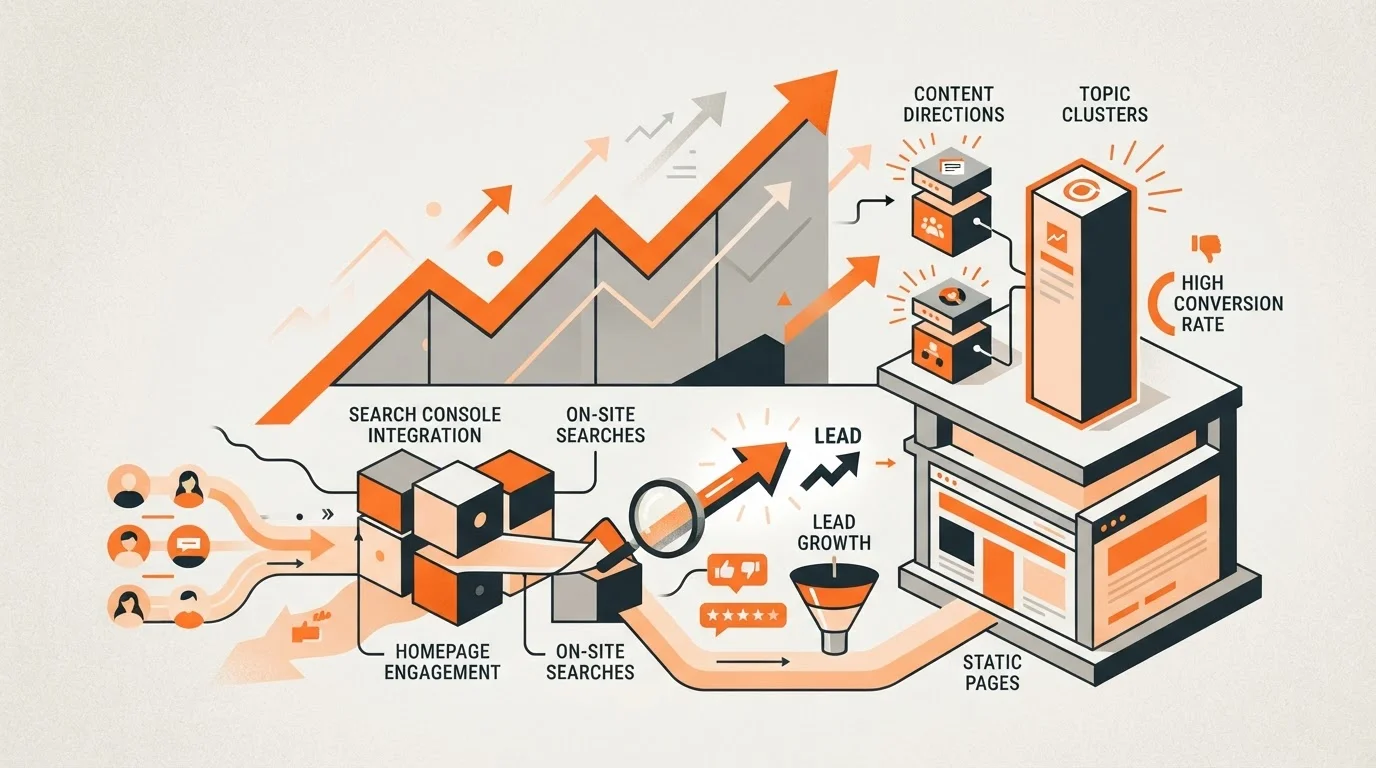
To sustain growth, you must measure what works. Founders should utilize platforms that integrate directly with Search Console to track performance, but metrics must go deeper than just impressions. You need to monitor homepage engagement, on-site searches, and specific CTA outcomes to understand the true ROI of your content.
By tracking lead growth and reader feedback directly, founders can see which topic clusters are driving sign-ups and which are merely attracting window shoppers. This data-driven feedback loop allows you to adjust your "Content Directions" in your Autopilot settings, doubling down on the content pillars that yield the highest conversion rates.
Beyond blog posts, a comprehensive platform also supports the creation of static pages, which can be used for critical landing pages or "About Us" sections. This ensures the entire blog site—including its themes and SEO-optimized architecture—remains cohesive and on-brand, providing a professional experience that builds trust with prospective customers.
Frequently Asked Questions
Q: How much involvement is required from the founder?
The system is designed for Autopilot, but founders should spend time initially setting up the Knowledge Engine and approving Content Directions. Once the loop is automated, the primary task is reviewing drafts and monitoring lead growth analytics.
Q: How does the system ensure the content is factual?
A dedicated Knowledge Engine organizes your product description, ICP, positioning, and facts with freshness and conflict controls. It uses your provided sources—links, documents, or descriptions—as the ground truth for all writing.
Q: Can I collaborate with my team?
Yes, plans often include unlimited team seats, allowing product managers, marketers, and editors to participate in the review and approval process at no additional cost.
Q: Does the platform handle the technical side of the blog?
Yes, autonomous platforms typically provide an on-brand blog site with themes optimized for SEO and GEO, handling everything from sitemaps to consent management behavior.
Get practical updates on saas organic traffic growth case study
Receive new articles and practical insights by email.
Building a Compound Growth Engine
Success in modern SaaS marketing requires recognizing that manual processes are the enemy of scale. By adopting an autonomous blogging strategy, you can break through traffic plateaus and build a product-led acquisition channel that compounds over time without draining your engineering resources.
With a Knowledge Engine ensuring factual accuracy and Autopilot maintaining a consistent cadence, you can stop struggling with the weekly "what do we write about?" and start focusing on building a world-class product. If you're ready to transform your product knowledge into sustainable organic growth, it is time to leverage the power of autonomous SEO and GEO blogging.