
On this page
For most SaaS founders, content marketing feels like a zero-sum game. Every hour spent researching keywords or drafting articles is an hour taken away from product development, customer success, or closing deals. This creates a "content ceiling" where organic growth stalls because the team simply cannot produce high-quality, product-led content fast enough to compete in modern search and AI discovery engines.
To break through this ceiling, growing startups are moving away from manual drafting toward a strategy of high-frequency, autonomous production. A saas content velocity boost isn't just about publishing more; it's about shifting from the role of a writer to the role of a content architect. By leveraging autonomous systems to handle the heavy lifting of research, SEO, and publishing, you transform your blog from a neglected chore into a high-performance lead generation engine.
This guide explores how to build a scalable content engine that works in parallel with your code. We will examine the mechanics of transforming internal documentation into public-facing authority and how to eliminate the technical friction that typically kills content momentum.
The Anatomy of the SaaS Content Bottleneck
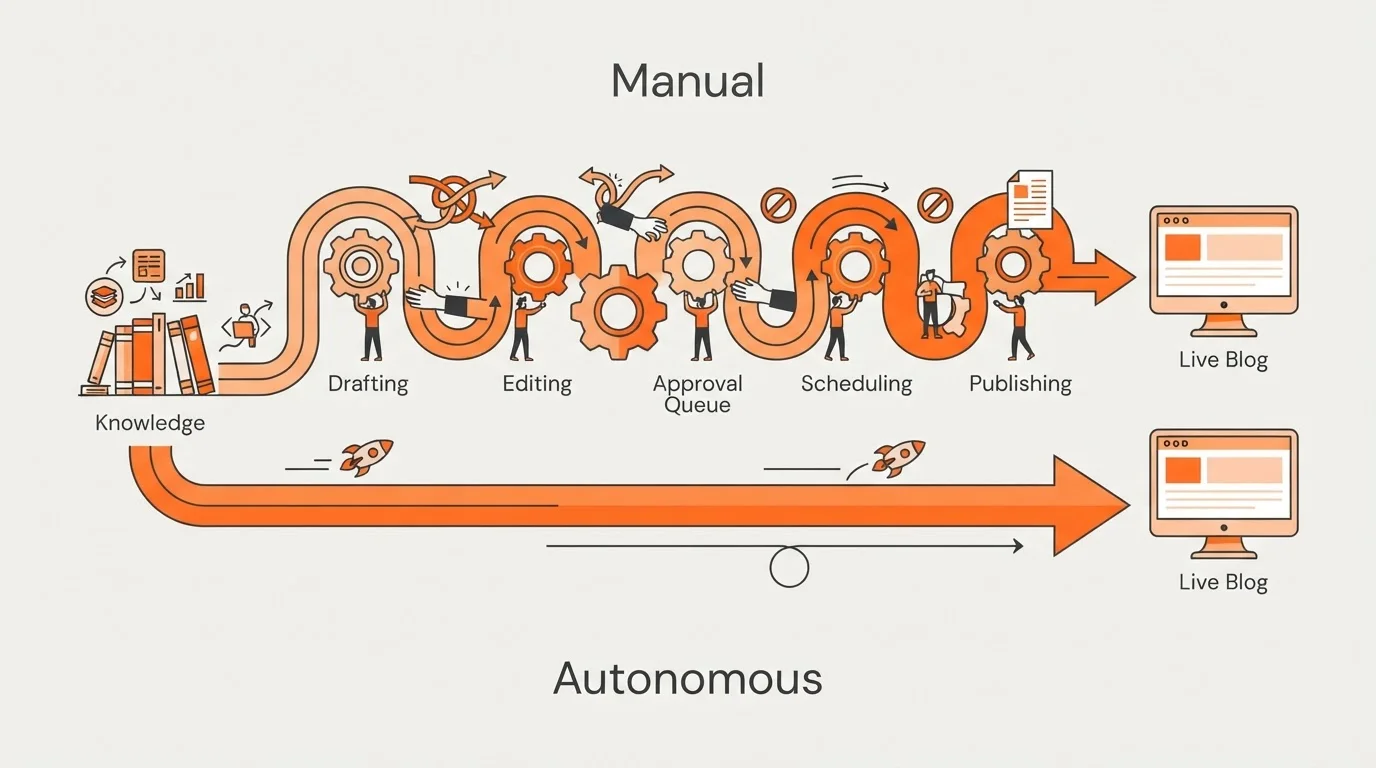
The traditional content workflow is inherently linear and slow. It usually involves a founder providing technical context, a writer drafting the content, and an SEO specialist attempting to optimize it after the fact. Each step introduces friction, and the more people involved, the slower the process becomes.
Most founders identify four specific areas where their velocity dies:
- Context Acquisition: External writers often struggle to grasp technical nuances, leading to generic content that lacks authority.
- SEO and GEO Optimization: Manually identifying keywords and preparing content for Generative Engine Optimization (GEO) requires specialized skills that small teams often lack.
- Interlinking and Maintenance: As a blog grows, keeping track of internal links and ensuring older posts remain relevant becomes an administrative nightmare.
- Publishing Logistics: Moving content from a Google Doc into a CMS involves formatting, image tagging, and technical setup that eats up hours every week.
To achieve a meaningful saas content velocity boost, you must remove the human-in-the-loop for these repetitive tasks. The goal is to move from "writing" to "reviewing," which is significantly faster and more scalable.
The Knowledge Engine: Turning Product Data into Authority
The secret to high-quality autonomous content isn't better AI prompts; it's better data. Most SaaS companies are already sitting on a goldmine of information—API documentation, product guides, sales decks, and customer support logs. The challenge is converting that raw knowledge into discoverable, search-optimized articles.
Modern platforms use a centralized Knowledge Engine to anchor content in reality. Instead of the system guessing what your software does, you provide it with public product sources, uploaded documents, pasted links, or written descriptions. This technical grounding ensures that every article maintains a consistent brand voice and technical accuracy.
By feeding the system your actual documentation, you ensure the output is product-led. This is critical for SaaS growth because modern search engines—and the new wave of AI discovery tools—reward specific, useful expertise over generic high-volume filler.
Eliminating Friction with Native Integrations
Velocity is not just about writing speed; it is about how quickly you can get content in front of readers. Technical friction in the publishing process is the most common reason blogs are abandoned. An autonomous strategy requires a seamless path from the editor to the live site.
Founders should look for solutions that integrate directly with their existing stack. For those using WordPress for AI publishing, the system should allow you to review and approve articles within one platform and deliver them instantly to your self-hosted site via a dedicated plugin and application password.
For technical blogs using Ghost, the workflow is similarly streamlined. By using an Admin API key, the autonomous engine can manage the creation and review process while Ghost handles the reader experience. By automating the upload, formatting, and internal linking processes, you reduce the time-to-publish for a single article from days to minutes.
Generative Engine Optimization (GEO) for SaaS
The search landscape is changing. Users are increasingly turning to AI-powered discovery engines like Perplexity, Gemini, and Search Generative Experience (SGE) for answers. To stay visible, SaaS content must be optimized for these generative models—a practice known as Generative Engine Optimization (GEO).
GEO focuses on making your content easily "crawlable" and "citable" by AI. This means using structured data, clear headers, and, most importantly, factual evidence sourced from your product documentation. Autonomous blogging platforms are specifically designed to format content for these new discovery methods, ensuring your product is the one cited when a user asks, "What is the best tool for [Your Category]?"
Scaling your content velocity allows you to cover more long-tail queries and technical edge cases, increasing the surface area for AI engines to discover and recommend your brand.
Get practical updates on saas content velocity boost
Receive new articles and practical insights by email.
The Workflow Shift: From Writer to Architect

Adopting an autonomous approach changes how you manage your team. Instead of spending your budget on drafting, you can focus on strategic refinement. Because paid plans often include unlimited team seats, your entire product or marketing team can participate in the review process without additional costs.
In this new model, a founder or product manager spends 15 minutes reviewing an article for strategic nuance rather than hours drafting it from scratch. Most platforms allow for 1 or 3 revisions per article depending on the plan, giving you the flexibility to refine the tone while the machine handles the SEO heavy lifting.
This shift allows you to maintain a high publishing cadence—moving from one article per week to daily updates—without needing a large content team. You are no longer limited by how much you can write, but by how much you can review.
Measuring ROI: Traffic vs. Conversion Tracking
A boost in content velocity is only valuable if it drives business outcomes. For SaaS, this means tracking how many readers eventually sign up for a trial or demo. Modern autonomous systems integrate with frameworks like Next.js or Webflow to collect consented visits and track configured conversions.
This level of visibility allows you to see which articles are acting as entry points for your most valuable customers. When you can prove that an autonomous article is driving trial sign-ups, the decision to scale output becomes a simple matter of ROI calculation. You are building an asset that compounds over time, driving organic growth while you focus on building your product.
Frequently Asked Questions
Q: Will autonomous blogging hurt my SEO rankings?
No. Search engines reward high-quality, relevant content. By grounding your blog in real product data through a Knowledge Engine, you avoid the repetitive, generic patterns associated with low-quality AI content.
Q: How do I handle internal linking at scale?
Autonomous platforms automatically analyze your existing library to suggest and implement internal links. This ensures that new content helps boost the authority of your older posts and vice versa.
Q: Can I use this with a headless CMS?
Yes. Many platforms provide a Signed Webhook and Content API, allowing you to deliver autonomous content to custom stacks or headless implementations seamlessly.
Q: Does this replace the need for a marketer?
It changes the marketer's role. Instead of spending their time on the manual labor of writing and formatting, they can focus on content strategy, conversion optimization, and brand voice.
The era of the founder-as-writer is ending. To remain competitive in a saturated SaaS market, you must scale your organic presence without letting it consume your time. By leveraging your existing product knowledge and automating the technical hurdles of SEO and publishing, you can build a content engine that grows alongside your code.
The tools to achieve a sustainable saas content velocity boost are available now. By shifting to an autonomous blogging model, you ensure that your blog remains a growth-driving asset rather than an operational liability. Start transforming your documentation into discoverable authority today.