
On this page
For SaaS founders, the content treadmill is a persistent operational bottleneck. You know that high-quality, product-led content is the primary driver of sustainable organic growth and user acquisition. However, the continuous cycle of research, drafting, and optimization clashes with the daily demands of shipping code and supporting customers. Sustaining a high-volume publishing cadence every week while scaling a lean team is a challenge that often leads to marketing burnout or stagnant visibility.
This friction forces founders to choose between a blog that hasn't been updated in six months and hiring expensive agencies that lack native technical insight. When publishing stops, organic visibility stalls, and competitors who maintain a consistent cadence capture the highest-intent keywords. To illustrate a scalable solution, this case study examines the hypothetical roadmap of InnovateCo, a B2B SaaS organization navigating these exact scaling hurdles. By refactoring their marketing engine, they moved away from manual workflows toward a systemic, autonomous growth strategy.
By transitioning to an automated framework, they protected their domain against search performance degradation. This evolution demonstrates how lean software organizations can establish a system that updates existing material while publishing deeply authoritative, product-led posts. For any founder evaluating an autonomous content approach, this workflow offers a pragmatic validation of scaling search presence without expanding administrative overhead. The following sections outline the precise steps, integrations, and strategic frameworks that make this level of growth possible.
The SaaS Content Trap and the Reality of Content Decay
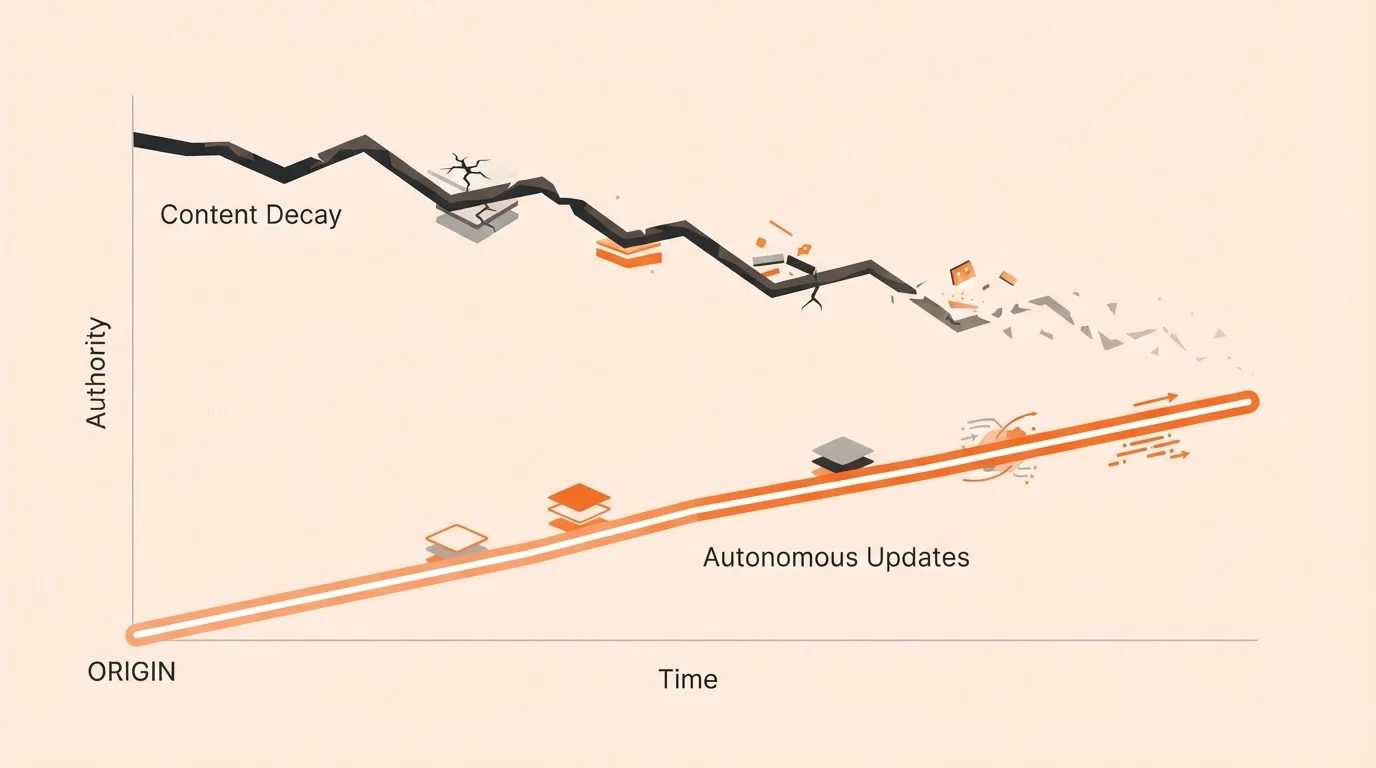
The traditional SaaS marketing playbook focused heavily on sheer publication volume to capture wide top-of-funnel audiences. However, this strategy often ignores a critical operational liability known as content decay. In the software world, products evolve rapidly, making technical guides and tutorials obsolete within months. When a platform changes its interface, deprecates an API, or updates a core feature, its existing public content immediately begins losing technical accuracy.
Content decay prevention requires structural monitoring that most lean product teams cannot support due to limited resource availability. Search crawlers track drops in user engagement, high bounce rates, and mismatched technical facts to determine which pages no longer provide value. This silent deterioration often goes unnoticed until a major core update significantly impacts the entire domain's positioning. Once a site loses momentum, the cost of recovery is significantly higher than the cost of maintenance.
As older articles slip from the first page of search results, the entire domain loses historical authority. Marketing teams then spend hours manually revising old posts just to maintain baseline visibility, leaving no bandwidth for new initiatives. Founders find themselves acting as editor-in-chief, correcting technical errors in marketing drafts instead of focusing on their product roadmap. This creates an organizational bottleneck that prevents the company from reaching its full organic potential.
InnovateCo found themselves trapped in this cycle, dedicating technical hours each week to rescuing fading assets. They realized that sustainable growth demanded a system that automatically synchronized public resources with internal product engineering cycles. By moving away from arbitrary keyword production toward a systemic framework, they aimed to eliminate the manual overhead of content preservation. This shift allowed them to reallocate internal resources back toward core product development without sacrificing their organic customer acquisition channel.
Why Search Systems Prioritize Content Freshness
Modern search engines evaluate domain performance through algorithmic signals that measure both structural quality and content freshness. Search mechanisms rely on components like Query Deserves Freshness (QDF) to determine when a user needs the most up-to-date documentation. In the SaaS sector, where deployment cycles occur daily, almost every query regarding product tooling or API structures triggers these freshness metrics. Providing outdated data signals to search systems that your site may no longer be a primary resource.
Merely modifying the publishing date in your CMS metadata does not satisfy these evaluation parameters. Search engine crawlers cross-examine semantic changes, verified source references, and updated structural frameworks to confirm genuine value. If a blog post detailing third-party integrations references deprecated endpoints, search crawlers will flag the material as obsolete. Your content must reflect the live reality of the market to retain its competitive edge and ranking stability.
This creates a severe discrepancy between internal engineering documentation and external marketing collateral, which directly harms brand authority. Lean SaaS founders struggle to bridge this gap because product updates often live in internal knowledge bases, rarely reaching the public blog in real-time. When a prospective customer finds a tutorial that doesn't match the live application interface, trust drops instantly. This misalignment damages conversion rates and nullifies the value of the initial organic click.
To maintain visibility across competitive keywords, software companies require a programmatic method to ensure every published asset reflects live product capabilities. Content must be treated as a living extension of the software itself rather than a collection of static marketing text. By automating the extraction of internal updates and translating them into public-facing optimizations, companies can continuously satisfy QDF metrics. This structural synchronization is the foundation of sustained domain visibility and search market leadership.
Developing an Evergreen Content Strategy for SaaS
Developing an effective evergreen content strategy for SaaS demands a shift away from trend-chasing toward resilient content architectures. An enduring architecture does not mean publishing static essays; it means building a matrix of product-led topics that remain relevant over time. This approach organizes content into structured topical clusters that demonstrate deep domain expertise to both users and search engines. By establishing these foundations, your marketing assets remain relevant across multiple product development cycles.
Each cluster centers around a high-level pillar asset that integrates with secondary, hyper-specific product guides to create a logical network of internal links. When your software introduces a new feature, the system updates the relevant nodes within this cluster to keep the network algorithmically current. This matrix approach ensures that search crawlers view the domain as a comprehensive authority on specific technical workflows. Proper internal link distribution ensures that authority flows smoothly from established pages to newly launched guides.
Furthermore, an evergreen framework focuses on solving core user pain points that persist regardless of minor feature iterations. While specific interface layouts may change, the fundamental business challenges your software solves usually remain constant. By targeting these foundational workflows, your articles retain their baseline utility over long horizons. The challenge is keeping the execution steps within those articles accurate as the underlying platform matures.
For InnovateCo, shifting to this architecture meant mapping their core software utilities directly to the search intents of their ideal user personas. Instead of writing superficial listicles, they focused on deep, product-guided resolutions to complex operational problems. By anchoring their search strategy to actual product mechanics, they ensured that every organic click brought visitors to their software's primary value proposition. This methodology transformed their blog from a marketing outpost into an integrated customer onboarding tool.
Establishing a Resilient Topical Architecture
A resilient architecture begins with a technical audit of the current product knowledge base to identify evergreen pillars. These pillars represent the 'how-to' foundations of your software—the essential workflows that every user must master to achieve success. Once these pillars are identified, the focus shifts to creating supportive content that addresses specific edge cases, integrations, and advanced configurations. This creates a dense web of information that search engines recognize as high-authority documentation.
To maintain this architecture, InnovateCo utilized autonomous systems to monitor for gaps in their topical coverage. As new software updates were released, the system identified which pillars needed technical expansion or which new supportive articles were required. This proactive approach prevents the 'hollow blog' syndrome, where a site has many articles but fails to cover the core technical depth users expect. A well-maintained topical architecture serves as a perpetual lead generation engine that requires less maintenance over time.
Scaling with the Blogged Knowledge Engine
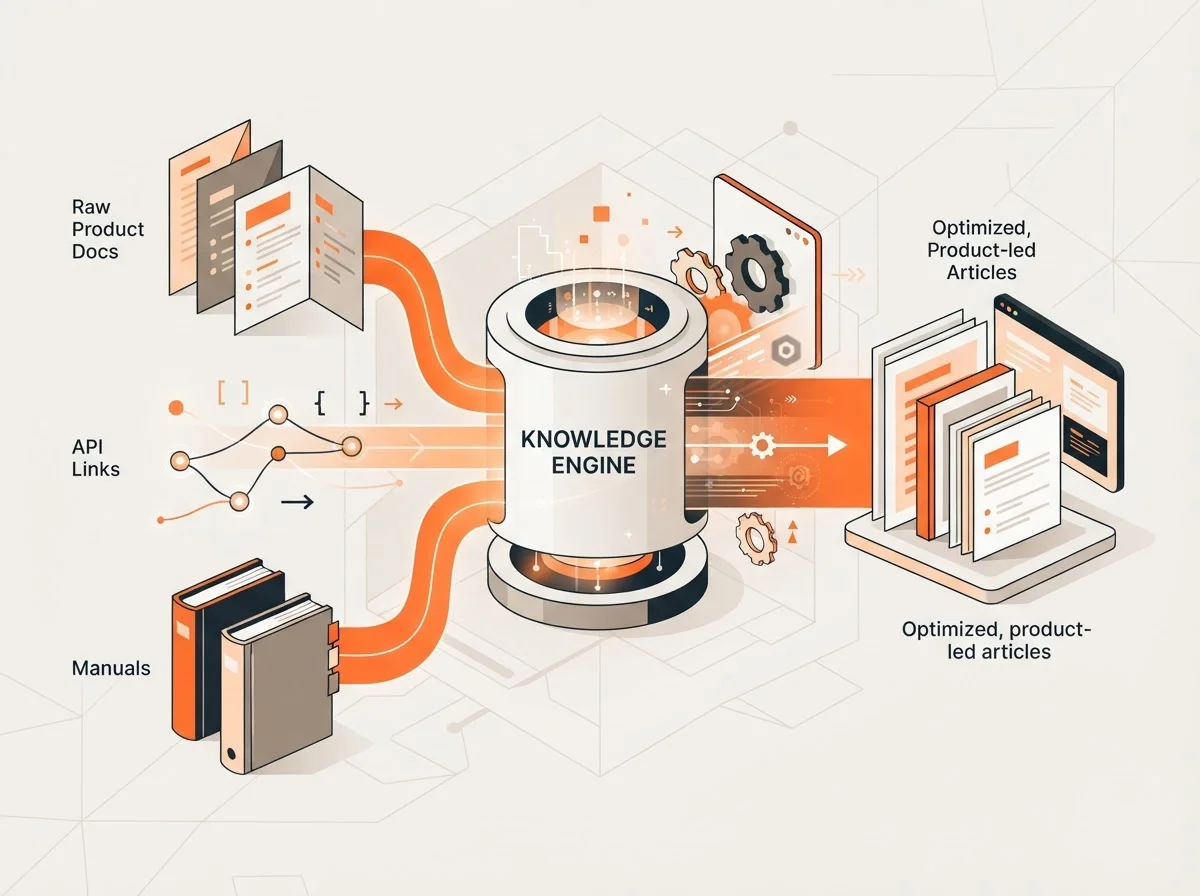
To break free from manual execution, software teams are increasingly deploying autonomous content updates to manage their digital footprint. InnovateCo achieved this by adopting Blogged, an autonomous SEO and GEO blogging platform designed to translate product architecture into searchable assets. The foundation of this system is the Knowledge Engine, which ingests complex proprietary data and synthesizes it into authoritative content. This allows lean companies to compete with enterprise marketing departments without increasing headcount.
Through the Knowledge Engine, founders provide primary data inputs to serve as the absolute source of truth for the autonomous writer. The platform allows users to provide public product sources, uploaded documents, pasted links, or written product descriptions. This ingestion capability ensures the system works with accurate, specialized technical details rather than generic information. The platform continuously reviews these inputs to construct a comprehensive understanding of your software's features and utility.
By grounding the writing engine in these first-party technical documents, the platform builds content that matches the product's actual mechanics. This eliminates the accuracy gap often seen when hiring freelance copywriters who struggle to understand complex SaaS backends or enterprise workflows. The platform handles research, structural planning, and SEO, enabling the development team to remain focused on core software architecture. Founders no longer need to spend weekends correcting technical errors in marketing drafts.
Additionally, this centralized data grounding ensures that any updates made to your documentation automatically influence future articles. When you upload a new API spec or a feature guide, the system updates its internal reference model instantly. This means that subsequent content pieces inherit the latest technical context seamlessly. By establishing this automated loop, the platform ensures that your scaling content program remains perfectly synchronized with your engineering velocity.
Eliminating the Technical Accuracy Gap
The 'Technical Accuracy Gap' is the primary reason SaaS founders distrust automated or outsourced content. Freelance writers often lack the deep product context needed to write credible tutorials, leading to generic advice that frustrates expert users. By using the Knowledge Engine to ground content in actual product specs, Blogged ensures that every article is technically sound. This creates a high level of trust with the reader, who perceives the brand as a true authority in their niche.
InnovateCo used this capability to translate their internal developer documentation into user-friendly blog posts. The autonomous engine took the raw technical data and reframed it for different personas, such as project managers and CTOs. This allowed them to communicate their software's value across the entire buying committee without manual rewriting. The result was a library of content that was both technically precise and highly persuasive.
Get practical updates on saas content freshness authority case study
Receive new articles and practical insights by email.
Seamless CMS Integrations for Modern Tech Stacks
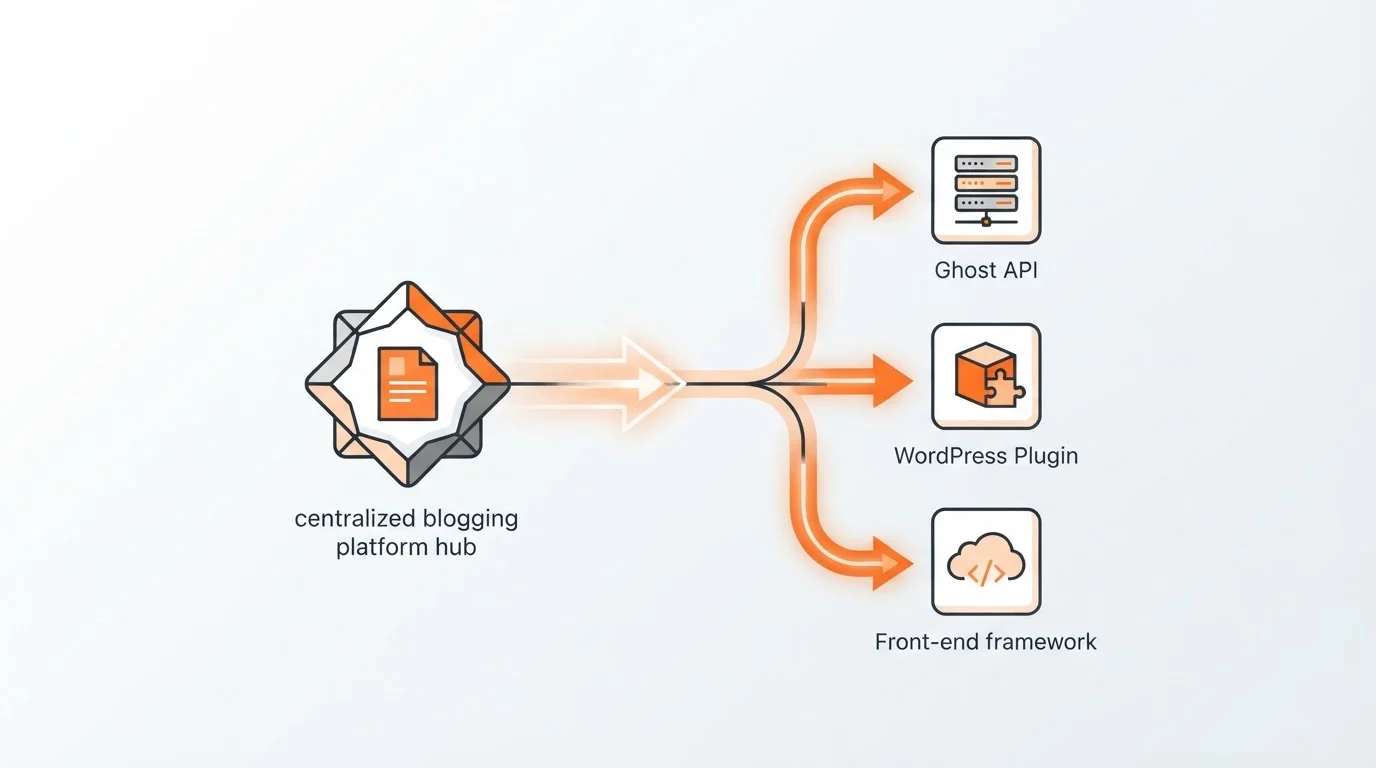
A critical requirement for any automated system is its ability to interface directly with existing website frameworks without introducing security vulnerabilities. Blogged achieves this through native integrations built for the modern SaaS stack, allowing seamless deployment from creation to publishing. These connections ensure that text, structure, and metadata transfer perfectly without manual copying and pasting. This reduces the time between draft completion and search engine indexing to near zero.
When utilizing the Ghost AI Blog Publishing integration, the platform manages content creation and review while Ghost renders the reader experience. The setup is straightforward: users create a custom integration in Ghost, copy its Admin API key, and verify their Ghost connection in Blogged. This allows the system to stage drafts and manage internal links without forcing the founder to access the CMS daily. It creates an isolated pipeline that preserves the security of your main publishing platform.
For companies running hybrid setups or self-hosted sites, the WordPress AI Blog Publishing integration offers equal flexibility. Users can create and review articles in Blogged, then deliver them to their WordPress website seamlessly. The platform connects to self-hosted WordPress through the Blogged Publishing plugin and an application password, ensuring a secure and encrypted pipeline. This means you can distribute content across multiple digital properties from a single management dashboard without manual friction.
Furthermore, across these integrations—including configurations for Webflow and Next.js—the platform lets users collect consented visits and configured conversions for verified articles. Growth teams can instantly identify which specific articles are driving high-value user actions, such as trial signups or documentation views. This analytical grounding removes the guesswork from organic marketing operations. By pairing automated publishing with robust conversion tracking, the platform provides a complete growth loop for data-driven founders.
Headless Deployment for Next.js and Webflow
Many modern SaaS companies prefer headless or custom frontends like Next.js for better performance and developer control. The Next.js AI Blog Publishing integration connects securely via dedicated webhooks and the platform's Content API. This allows developers to maintain their custom site architecture while benefiting from an autonomous content pipeline. The system delivers structured JSON content that can be rendered to match any brand design perfectly.
Similarly, for those using Webflow, the integration allows for the automatic population of CMS collections. This is particularly useful for teams that want a high-end design without the maintenance overhead of traditional servers. By automating the delivery of optimized content to these platforms, founders can ensure their blog remains fast, secure, and always up to date. This level of technical flexibility is essential for scaling startups that don't want to be locked into a single ecosystem.
The Operational Scaling Playbook for Founders
Implementing an autonomous blogging strategy requires a structured plan to ensure content matches organizational goals and brand voice. During the initial phase, founders should upload all core engineering documents, API guides, and setup manuals into the system's centralized knowledge repository. This builds a data baseline that allows the autonomous engine to map out missing search opportunities and identify topical gaps in the blog archive. A well-organized initial data ingestion accelerates the timeline to achieving search value.
As the system generates content and updates historical assets, the review process remains collaborative across functional teams. Because every paid plan on Blogged includes unlimited team seats, product managers, engineers, and marketers can participate in the review process without added fees. This collaborative environment ensures that technical stakeholders can verify code snippets or feature explanations before anything goes live. It breaks down the traditional silos that separate engineering knowledge from marketing execution.
Maintaining editorial control is further supported by the platform's flexible content revision options. Depending on the plan tier, Blogged includes up to 3 revisions per article, enabling teams to refine semantic focus and adjust tone. This workflow ensures that every piece of autonomous content undergoes quality verification while operating on an automated schedule. Teams can easily request adjustments to match specific branding guidelines or seasonal narrative styles.
Over a 90-day horizon, this playbook establishes a self-reinforcing loop of domain authority and search visibility. The system continuously schedules new pieces based on topical relevance while periodically reassessing historical posts against the updated Knowledge Engine. This dual-action mechanism ensures your site expands its keyword reach while reinforcing its existing search rankings. The resulting efficiency allows a lean startup to maintain a content footprint equivalent to an enterprise competitor.
Future-Proofing Growth through Generative Engine Optimization (GEO)
The search ecosystem is shifting as users move toward conversational AI interfaces and generative answer systems. Platforms like Perplexity, ChatGPT, and Google Gemini clarify user intent and synthesize data from across the web to answer prompts directly. To stay visible, software companies must practice Generative Engine Optimization (GEO). This discipline focuses on making content easily extractable and highly quotable by AI models, marking a new era in organic discovery.
Generative models prioritize content that features explicit factual precision, structured tables, first-party data, and definitive product insights. Stale, generic copy that merely rephrases public tutorials is routinely ignored by these systems, whereas structured, product-led articles are indexed as authoritative sources. By maintaining an autonomous loop that constantly refreshes content to reflect actual software capabilities, your site remains optimized for these AI discovery mechanisms. This factual grounding directly influences whether your platform appears in automated software recommendations.
When an enterprise buyer asks an AI assistant to evaluate tools for specific workflow challenges, your platform is much more likely to be cited if your content contains verified technical metrics. This citation authority is the foundation of modern B2B SaaS lead acquisition. Shifting to an autonomous updating framework ensures your documentation remains technically flawless and algorithmically visible. It turns your public blog into a high-quality knowledge base that AI models can easily consume and recommend.
Ultimately, the future of SaaS discoverability belongs to teams that treat content as dynamic data infrastructure rather than static brochures. As generative search engines place greater emphasis on verified sources, the value of unmaintained, legacy blogs will continue to drop. Implementing an autonomous strategy ensures your platform is permanently positioned to capture this emerging search traffic. By preparing for GEO today, founders can secure long-term organic leverage that survives major algorithmic shifts.
Frequently Asked Questions
Q: Does transitioning to an autonomous blogging framework mean we lose control over our brand voice?
No, you retain complete editorial oversight. The platform uses your documentation and written notes as its source of truth, and every draft is held in a review state. You can verify technical details and adjust voice parameters before publishing. Paid plans also provide up to 3 revisions per article to ensure the output matches your standards.
Q: How does autonomous updating directly resolve content decay?
The platform continuously analyzes your existing library against the updated information in your Knowledge Engine. When product features shift or APIs change, the platform identifies which older posts require a refresh. This ensures your entire library remains aligned with search engine freshness signals without requiring manual audits.
Q: Can this autonomous platform connect with custom frontends like Next.js?
Yes, Blogged features native integrations for Next.js, Webflow, Ghost, and WordPress. The Next.js integration connects via webhooks and the Content API, allowing you to generate content inside Blogged while delivering it safely to your custom frontend framework.
Q: How do we track if this automated content drives actual signups?
The integrations are built to collect consented visits and track configured conversions directly within your architecture. This gives your growth team precise data on user interactions and product signups originating from specific articles, allowing you to monitor your exact organic return on investment.
Transforming the Blog into a Self-Sustaining Growth Engine
The operational roadmap of InnovateCo highlights that scaling organic growth does not require a massive marketing department or sacrificing product focus. The real strategic choice for SaaS founders is between struggling against content decay manually or deploying an autonomous platform that manages research, optimization, and publishing on autopilot. By grounding your strategy in a unified Knowledge Engine and utilizing direct CMS connections, you turn your blog into a self-sustaining asset.
In a search market that increasingly favors technical accuracy and real-time freshness, relying on outdated manual processes is a significant operational liability. Autonomous content strategies provide the leverage necessary to remain visible across both traditional search engines and new generative AI tools. Embracing product-led automation allows your team to focus on building exceptional software while your content engine autonomously establishes market authority and drives consistent organic acquisition.