
On this page
The most expensive mistake a SaaS founder can make is dedicating months of engineering time to a feature that no one actually wants. While traditional validation methods like user surveys and focus groups are common, they often move too slowly or provide data reflecting user interest rather than genuine market intent. To solve this, forward-thinking teams are treating their blogs as proactive research engines to saas validate new features market feedback long before the first line of code is written.
By generating targeted, product-led content that introduces conceptual features and solicit user input, founders can create a continuous feedback loop. This approach involves transforming internal product knowledge into discoverable content that measures real-world demand. Instead of guessing which integration or workflow to prioritize, a company can use search volume and engagement data to drive their roadmap.
Autonomous blogging platforms like Blogged allow lean teams to sustain this high-cadence research without diverting technical talent. By automating the research, writing, and optimization process, a founder can test multiple product hypotheses simultaneously. This ensures engineering resources are only committed to features with proven market pull, transforming the blog from a marketing expense into a strategic validation tool.
The Feedback Loop Dilemma: Building vs. Knowing
SaaS founders often grapple with the dilemma of building what they believe users want versus what the market is actually willing to pay for. Traditional product discovery—involving stakeholder interviews, journey mapping, and wireframing—can take weeks per feature. While essential, these manual methods become a bottleneck when a founder needs to validate a wide range of ideas at scale.
Consider the hypothetical journey of ProductFlow, a project management SaaS. The team had three potential directions: an AI-driven resource forecaster, a new CRM integration, or a client portal. Building even a MVP (Minimum Viable Product) for all three would have taken months. They needed a scalable way to gauge early interest and quantify engagement without pulling lead engineers away from the core platform to write technical guides or educational articles.
In this high-stakes environment, the company blog is often the most underutilized asset. Most founders view the blog as a place for simple announcements or generic SEO keywords. However, when used as a validation engine, the blog becomes a high-fidelity testing ground. Organic intent—revealed by what users are actually searching for to solve their pain points—provides a much clearer signal than a hypothetical survey response.
Why Traditional Validation Stalls
Surveys and interviews frequently suffer from social desirability bias. Users often say they want a feature because it sounds useful in theory, but their actual behavior—the willingness to click, sign up, or change their current workflow—tells a different story. Direct market feedback through content bypasses this bias by measuring organic intent.
Furthermore, manual content creation is a massive drain on limited startup resources. For a lean SaaS team, writing a detailed 2,000-word "smoke test" article for three different feature ideas could easily consume a week of a founder's time. This is time better spent on high-level strategy and core development, making a strong case for an autonomous solution that maintains quality without manual labor.
Autonomous Blogging as a Validation Smoke Test
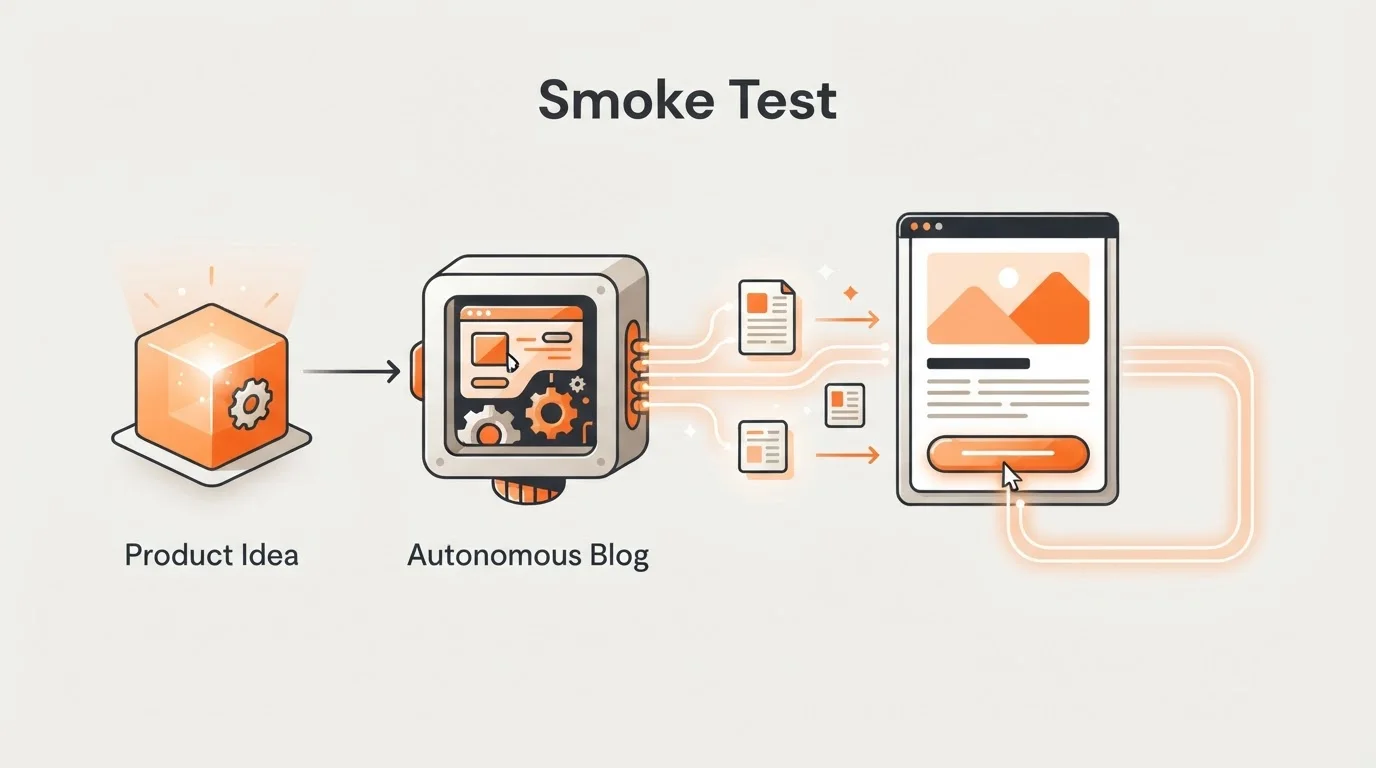
To bridge the gap between hypothesis and reality, ProductFlow integrated Blogged, an autonomous SEO and GEO blogging platform designed specifically for SaaS founders. The platform handles the entire content lifecycle—from research and planning to writing, optimization, and publishing. This allowed ProductFlow to transform their technical specifications into discoverable content that measured market demand in real-time.
By leveraging autonomous blogging product validation, the team could publish content about features that did not exist yet. This "smoke testing" through content provides a low-cost, high-signal way to see if potential users are searching for a specific solution. If an article about a conceptual integration generates significant organic traffic and click-throughs to a "Join the Waitlist" button, the founder has quantitative proof of demand.
This method allows a startup to move from "I think people want this" to "I know 500 people searched for this problem and 50 signed up for the beta this week." It shifts the conversation from subjective opinion to objective data, ensuring that the engineering team is always working on the highest-impact tasks.
Instrumenting Product Knowledge with the Knowledge Engine
The foundation of this validation strategy is the Knowledge Engine. ProductFlow fed their product descriptions, ideal customer profiles (ICPs), and positioning statements into the system. This ensured that every article generated was factually accurate and aligned with their specific vision rather than being generic AI filler.
By providing raw data about potential new integrations or workflow automations to the Knowledge Engine, the AI produced content that spoke directly to their audience's pain points. This prevents the common pitfall of hallucination by grounding the output in the founder's unique product expertise. The resulting content feels like it was written by a product manager who deeply understands the user's struggle.
Harnessing SEO and GEO for Discoverability
Modern search discovery rewards useful, specific content. Blogged’s platform optimizes not just for traditional Search Engine Optimization (SEO) but also for Generative Engine Optimization (GEO). This is crucial for SaaS founders in an era where AI-driven search engines and LLMs like Perplexity and ChatGPT are becoming primary discovery tools.
By generating content that answers specific user queries about potential solutions, ProductFlow ensured their feature concepts were discoverable by the exact audience they were trying to validate. This approach allows a startup to occupy the "zero-click" search result space and AI summaries. If an AI search engine recommends your hypothetical feature as a solution to a user's problem, you have successfully validated that your product vision aligns with the market's evolving needs.
The ProductFlow Blueprint: A Step-by-Step Validation Workflow
ProductFlow implemented a structured workflow to move from assumption to evidence. Instead of writing about features that were already live, they began creating content about concepts in the alpha or conceptual phase. This allowed them to treat their blog as a high-fidelity testing ground for the product roadmap without writing a single line of backend code.
This workflow requires zero engineering overhead once the initial connection is made. The founder identifies a potential feature, inputs the core value proposition into the platform, and lets the autonomous system handle the distribution. The resulting data then dictates the engineering priorities for the following sprint, creating a direct link between market feedback and development.
Step 1: Connecting the CMS Ecosystem
ProductFlow integrated Blogged with their existing tech stack to ensure seamless delivery. For their main site, they utilized the Ghost AI Blog Publishing integration. This allowed them to create a custom integration in Ghost, copy the Admin API key, and verify the connection in Blogged quickly.
This setup managed content creation and review within Blogged while Ghost rendered the reader experience. For other internal projects, they leveraged the WordPress AI Blog Publishing integration, using the Blogged Publishing plugin and an application password to deliver articles directly to their WordPress site. This flexibility is vital for teams running multiple microsites or landing pages for different market segments.
Get practical updates on saas validate new features market feedback
Receive new articles and practical insights by email.
Step 2: Collaborative Review and Refinement
Validation is a team effort, not a siloed task. ProductFlow took advantage of the fact that Blogged includes unlimited team seats on its paid plans. This allowed product managers, marketers, and lead developers to participate in the review and approval process without additional licensing costs.
The platform’s revision system was also vital. Depending on the plan, founders have access to revisions per article, allowing them to refine technical nuances based on emerging market signals. This ensures that even autonomous content meets the high bar required for a professional SaaS brand, maintaining the trust of potential customers who are reading about conceptual features.
Step 3: Measuring Intent with Conversion Tracking
Content without data is just noise. ProductFlow used Blogged to track critical performance indicators, including Search Console performance, homepage engagement, and lead growth. The platform’s integrations for Ghost, Webflow, and Next.js allow users to collect consented visits and configured conversions for verified articles.
By monitoring which "feature concept" posts led to the highest number of newsletter sign-ups or waitlist joins, ProductFlow gained a quantitative measure of market intent. If a post about "Automated Resource Forecasting" received significantly more traffic and conversions than "Custom Dashboard Themes," the engineering priority became immediately clear. This is the essence of product-led content feature testing.
Tangible Results: Reducing Risk and Accelerating PMF
The implementation of autonomous blogging for feature validation yielded significant operational advantages for the team at ProductFlow. By proactively publishing content about upcoming features, they transformed their blog into a dynamic feedback mechanism that informed every sprint. This reduced the risk of project failure and accelerated their path to product-market fit (PMF).
Key outcomes of this strategy include:
- Reduced Development Waste: By identifying features that generate zero organic interest, founders can shelve low-value ideas before they ever reach the development stage.
- Faster Time-to-Market: For features that show high engagement, the development team can move forward with high confidence, knowing the market is already actively searching for the solution.
- Organic Growth as a Byproduct: While validating features, the platform simultaneously builds a long-term organic growth asset, establishing the brand as a thought leader in its niche.
- Data-Driven Roadmaps: Product managers can use hard engagement data rather than gut feel to defend roadmap decisions to stakeholders and investors.
Strategic ROI: Scaling Without Engineering Overhead

For many SaaS founders, the cost of Blogged—starting at $99 per month—is a fraction of the cost of a single day of a senior developer's time. This starter investment allows a founder to test dozens of keyword clusters and product hypotheses simultaneously, effectively acting as an automated research department that never sleeps.
By automating the research, writing, and optimization, founders can focus on building the core product while the validation engine runs on autopilot. This strategic shift transforms the blog from a marketing cost center into an essential part of the product development ecosystem. It allows lean teams to out-content larger competitors by being more responsive to emerging search trends and user needs without increasing their burn rate.
Frequently Asked Questions
Q: Can AI-generated content really capture the nuances of my complex SaaS?
Yes, when driven by a Knowledge Engine. Blogged uses your specific product descriptions, ICP, and positioning to ensure content is factually grounded and technically accurate rather than generic.
Q: How do I know if a feature is validated through a blog post?
Look for specific intent signals. High search volume for the problem your feature solves, significant time-on-page for the solution post, and a high conversion rate on "Join the Beta" CTAs are strong indicators of market fit.
Q: Does autonomous blogging hurt my SEO?
On the contrary, search and AI discovery reward useful, specific, and consistent content. Blogged focuses on SEO and GEO (Generative Engine Optimization) to ensure your content is discoverable by both traditional search engines and new AI discovery tools.
Q: What CMS platforms can I use with Blogged?
Blogged offers native integrations for Ghost, WordPress, Webflow, and Next.js, along with a content API and signed webhooks for custom tech stacks.
ProductFlow's journey demonstrates that product validation doesn't have to be a slow, manual process. By treating your blog as an autonomous feedback loop, you can gather high-fidelity market signals while you focus on building your core product. When SaaS founders stop writing and start instrumenting their content strategy, the path to product-market fit becomes a data-driven journey rather than a guessing game.
Leveraging an autonomous platform like Blogged ensures that your product knowledge is constantly being transformed into discoverable assets. This not only drives organic growth but provides the evidence-based confidence required to build a world-class SaaS product. Stop guessing what your users want and start measuring what they search for to build a roadmap that truly resonates with the market.