
On this page
For SaaS founders, the most expensive mistake isn't a slow launch; it is building a feature that nobody wants. Traditional validation methods—like customer interviews or building Minimum Viable Products (MVPs)—often take weeks of coordination and engineering time. This creates a validation gap where innovation slows down because the cost of testing a new idea is too high.
This article examines how InnovateCo, a hypothetical SaaS company, bypassed this bottleneck by using autonomous blogging to test product hypotheses. By transforming raw feature concepts into discoverable, data-rich content, they turned their blog into a proactive feedback engine.
Instead of guessing which roadmap items would move the needle, InnovateCo used content to measure market demand before writing a single line of production code. This approach demonstrates how autonomous SEO and GEO content can serve as a strategic tool for product-market fit discovery and agile development.
The Validation Gap: Why Traditional SaaS Feedback Loops Stall
InnovateCo faced a common scaling problem: a growing backlog of high-potential features but limited engineering resources to build them. Their product team relied on two primary methods for validation, both of which had significant drawbacks.
First, qualitative interviews provided deep insights but were hard to scale and often suffered from social desirability bias, where users say they want a feature they won't actually pay for. Second, building lightweight MVPs was technically thorough but diverted developers from core product maintenance and stabilized growth.
They realized that to maintain a competitive edge, they needed a way to test the value hypothesis of a feature—whether it solves a real problem—without the heavy lifting of development. The goal was to find a "pre-MVP" validation layer that could provide quantifiable signals of interest from both current users and the broader market.
Turning Content into a Validation Engine
InnovateCo shifted its strategy to content-led validation. The premise was simple: if a detailed article describing a feature’s benefits and use cases couldn't generate clicks or sign-ups, the feature itself likely wouldn't drive adoption.
To execute this without adding more work to their already busy marketing team, they leveraged Blogged, an autonomous blogging platform. This allowed them to move from "idea" to "published article" in a fraction of the time it took to coordinate manual content production.
By treating every blog post as a mini-proposal, they could test multiple feature angles simultaneously. This high-velocity approach allowed them to identify which pain points resonated most strongly with their target audience, providing a data-driven foundation for their engineering roadmap.
From Raw Ideas to Market-Ready Articles

The process began in the Knowledge Engine. InnovateCo’s product managers didn't need to write 2,000-word essays; they simply provided the platform with their raw materials.
Blogged's Knowledge Engine for Autonomous SaaS Blogs allows users to input public product sources, uploaded documents, pasted links, or a simple written description. For InnovateCo, this meant feeding the engine their internal PRDs (Product Requirement Documents) and competitor feature comparisons.
The platform then autonomously researched and wrote product-led content that explained how the proposed feature would solve specific user problems. This ensured that the content was not just filler, but a high-intent explanation of the product's evolving value proposition.
Deploying Content Across Platforms
Validation requires reaching the audience where they already live. InnovateCo used Blogged’s deep integrations to distribute these "feature proposal" articles across their primary and experimental channels.
For their main site, the WordPress AI Blog Publishing integration allowed them to review articles in the Blogged dashboard and deliver them directly to their WordPress website. For more experimental ideas targeting new niches, they used the Ghost integration, which manages content creation while Ghost handles the reader experience.
This multi-channel approach ensured they were gathering feedback from both their existing user base and potential new customers who were searching for solutions to the very problems the new features aimed to fix.
Measuring Success: Actionable Metrics vs. Vanity Stats
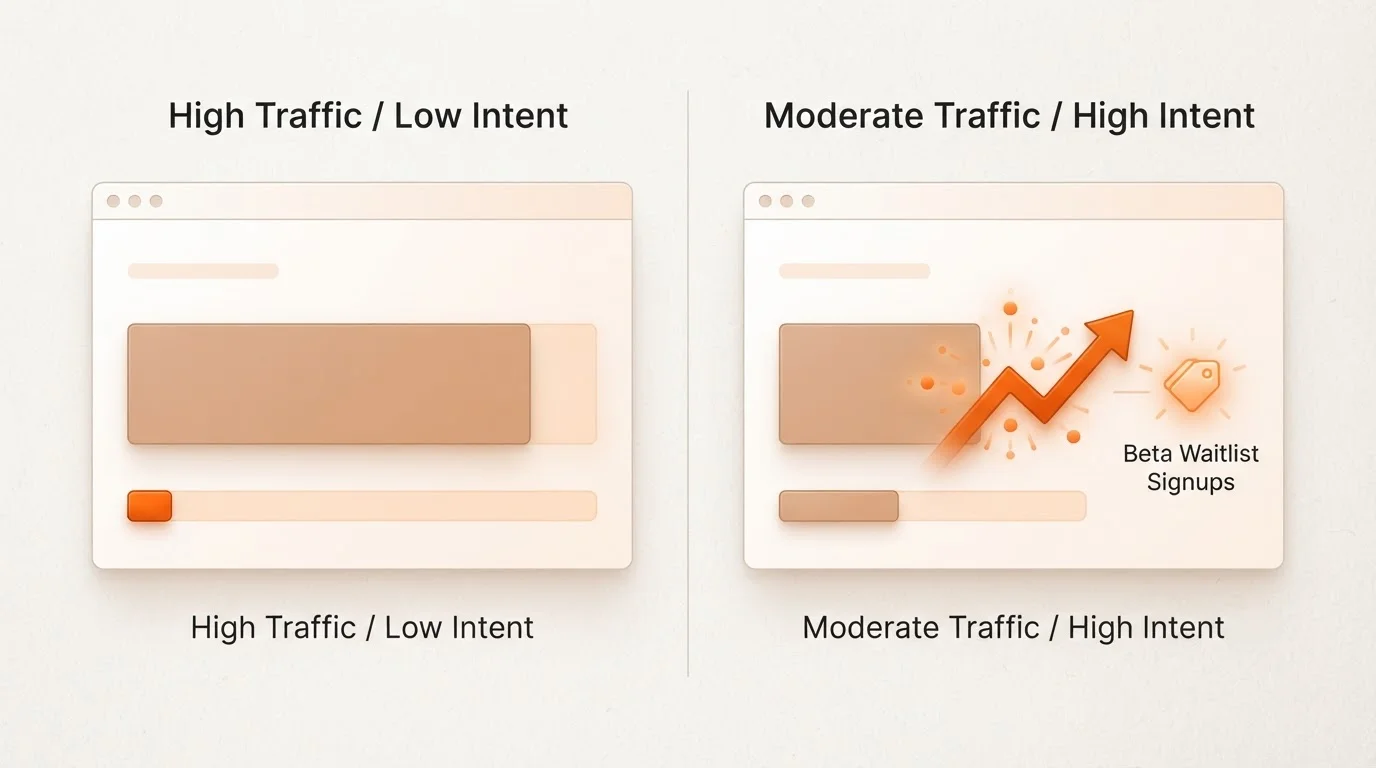
The core of InnovateCo’s success was moving beyond "page views" as a metric. To validate a feature, they needed to know if readers were willing to take an action that indicated real intent.
Using Blogged’s integration capabilities, they were able to collect consented visits and configured conversions for every article. Each post included a clear Call to Action (CTA), such as "Join the Beta Waitlist" or "Vote for this Feature."
By tracking these conversions, the product team could compare features side-by-side. A feature that generated high traffic but zero conversions was flagged as a "low-intent" interest, whereas a feature with modest traffic but a high rate of waitlist sign-ups was identified as a priority. This data made it clear which feature had a higher commercial intent and deserved priority.
Get practical updates on saas product feature validation case study
Receive new articles and practical insights by email.
The Workflow: How to Implement Content-Driven Validation
Founders looking to replicate InnovateCo’s success can follow this structured five-step workflow to integrate autonomous content into their product development cycle:
- Define the Hypothesis: Identify a specific problem you believe a new feature will solve and who it is for.
- Brief the Knowledge Engine: Upload your rough notes or feature specs into Blogged to generate a product-led article.
- Embed Intent Signals: Ensure every article has a trackable conversion goal (e.g., a newsletter sign-up specifically for that feature's updates).
- Promote and Distribute: Use the WordPress or Ghost integrations to publish the content and share it via social and email.
- Analyze and Decide: Review the conversion data after a testing period. If the signal is strong, move to development; if weak, pivot the concept or deprioritize it.
This loop allows a SaaS team to validate roadmap ideas significantly faster, reducing the risk of technical debt and wasted capital.
Results: Quantifiable ROI for the Product Team
By the end of their pilot period, InnovateCo saw a dramatic shift in their efficiency. They moved from months of deliberation to weeks of data gathering, providing the team with a clear mandate for development.
More importantly, they avoided building two major features that had been high on their internal list but failed to generate any significant interest during the content-testing phase. This saved hundreds of hours of engineering time, which was redirected to refining their core platform.
The transparency of the data also improved internal alignment. Because the product team had hard evidence of user interest, they could present a clear case to stakeholders for why certain features were being prioritized. This created a culture of evidence-based innovation rather than one driven by the loudest voice in the room.
Frequently Asked Questions
Q: Can autonomous blogging really replace user interviews?
It doesn't replace them, but it acts as a filter. Use autonomous blogging to identify which ideas have high market demand, then use interviews to go deep on the "why" behind that demand.
Q: How much time does it take to set up this validation system?
Using a platform like Blogged, you can set up your knowledge base and integrations quickly. The time-to-value is almost immediate as you start generating articles from existing PRDs.
Q: What if our blog traffic is low?
That is where SEO and GEO (Generative Engine Optimization) come in. Blogged optimizes content to be discoverable by both traditional search engines and AI assistants, helping you reach new audiences who are actively searching for the problems your feature solves.
Q: Is this strategy only for new features?
No. You can use it to validate new pricing models, expansion into new industries, or even potential integration partners by gauging interest through targeted content.
Content is often viewed as a top-of-funnel marketing activity, but for the modern SaaS founder, it is a powerful diagnostic tool. InnovateCo’s success proves that autonomous blogging can bridge the gap between product intuition and market reality.
By leveraging tools like Blogged to handle the research, writing, and optimization, founders can focus on what they do best: building great software. Instead of spending months building an MVP for a feature that might fail, you can publish a validated proposal in days. In a market where speed and efficiency are the ultimate advantages, content-driven validation isn't just a marketing tactic—it's a competitive necessity.