
On this page
For SaaS founders, the content marketing treadmill is often a race toward burnout. You need a blog to drive organic growth, but the hours required for research, writing, and SEO optimization are hours stolen from building your core product. Many founders fall into the trap of hiring generalist freelancers or using generic AI tools, only to find that even if traffic grows, signups remain flat. This disconnect happens because most content lacks the deep product context required to guide a reader from a technical problem to your specific software solution.
Scaling your content conversion rate requires a fundamental shift from manual, generic writing to autonomous, product-led content. By leveraging platforms like Blogged, founders can automate the entire lifecycle—from keyword research to publishing—while ensuring every article is rooted in their product’s unique value proposition. This approach doesn't just save time; it aligns your blog with the way modern buyers discover software through both traditional search and AI-driven discovery engines.
This guide breaks down the framework for building an autonomous content engine that converts. We will explore how to feed your product knowledge into an autonomous agent, how to optimize for the next generation of discovery, and how to integrate these workflows directly into your existing SaaS stack for measurable ROI.
The Intent Gap: Why Traditional SaaS Blogging Fails to Convert
The primary reason SaaS blogs fail to drive trials is the Intent Gap. Traditional content strategies often prioritize high-volume keywords with broad informational intent. While these articles might bring in thousands of visitors, those visitors are often looking for a quick answer to a general question, leading to high bounce rates and negligible conversion.
Managing a consistent publishing schedule manually is also a significant operational burden. Between managing writers, editing drafts, and checking internal links, founders can spend over 20 hours a month on content overhead. This manual process is not only slow but often results in "fluff" content that lacks technical accuracy. When an article fails to demonstrate how your product solves a specific pain point, the reader has no reason to click your call-to-action.
To bridge this gap, your content must be product-led. This means the article doesn't just talk about a topic; it shows how your SaaS solves the problem within that topic. Autonomous blogging platforms solve this by using your actual product documentation to inform every word, ensuring the content is technically sound and relevant to your buyer's journey.
The Knowledge Engine: Solving the Product-Context Problem

The most effective way to achieve conversion at scale is through a dedicated Knowledge Engine. Instead of relying on an AI to guess what your product does, you provide it with a source of truth that it uses for every article. This prevents the generic "hallucinations" that plague standard AI writing and ensures your blog sounds like it was written by your own product team.
With Blogged, founders can populate their Knowledge Engine using public product sources, uploaded documents, pasted links, or a written product description. This ensures the autonomous agent understands your specific features, use cases, and competitive advantages. When the system has access to your actual documentation, it can write with the authority of a subject matter expert rather than a generalist writer.
Training the AI with Your Own Documentation
Effective training involves more than just a URL. High-converting SaaS blogs feed the Knowledge Engine their most detailed assets, such as API documentation, customer success stories, and feature deep-dives. By providing these specific inputs, you ensure that the autonomous agent can handle internal linking and product mentions naturally.
This level of specificity is what allows the blog to function as a sales tool. When a reader finds an article about a problem they are facing, the Knowledge Engine ensures the text provides a clear, accurate path to how your product provides the solution. This technical density builds trust and significantly increases the likelihood of a trial signup.
Operational Efficiency: Collaboration Without Bottlenecks
Automation should not mean a total loss of oversight. A key factor in maintaining high conversion rates is ensuring technical accuracy through cross-functional review. High-performing SaaS teams use unlimited team seats to invite product managers and sales leads into the content workflow without incurring extra costs.
This collaborative approach allows the people who know the customers best to provide quick feedback on automated drafts. By involving the sales team, you ensure the final published piece is perfectly aligned with the current sales narrative. This prevents the common problem where marketing content and sales reality are out of sync, which often confuses prospects and hurts conversion.
Managing Technical Accuracy Through Expert Reviews
Quality is non-negotiable for SaaS brands. Most autonomous workflows include a structured revision process to ensure the final output is polished. Depending on your chosen plan, Blogged includes 1 to 3 revisions per article. This allows you to fine-tune the output, ensuring the tone and technical specifications are exactly right before the post goes live.
Because the AI learns from your Knowledge Engine, the need for extensive revisions typically decreases over time as the system aligns with your brand voice. This allows founders to move from "editor-in-chief" to a final reviewer, reclaiming dozens of hours each month while maintaining a high publishing frequency.
The Technical Stack: Integrating Autopilot into Your CMS
A content engine is only effective if it lives where your users are. For SaaS teams, this means integrating the autonomous platform directly with a CMS like WordPress, Ghost, Webflow, or Next.js. A seamless connection eliminates the friction of manual copy-pasting, which is where many content strategies lose momentum.
These technical handshakes allow for Autopilot publishing. Verified articles move from draft to live status automatically once they meet your quality standards. This ensures your blog stays active even when your team is focused on a major product launch or sprint. The consistency provided by Autopilot is a major driver of long-term organic growth and domain authority.
Connecting WordPress, Ghost, and Webflow
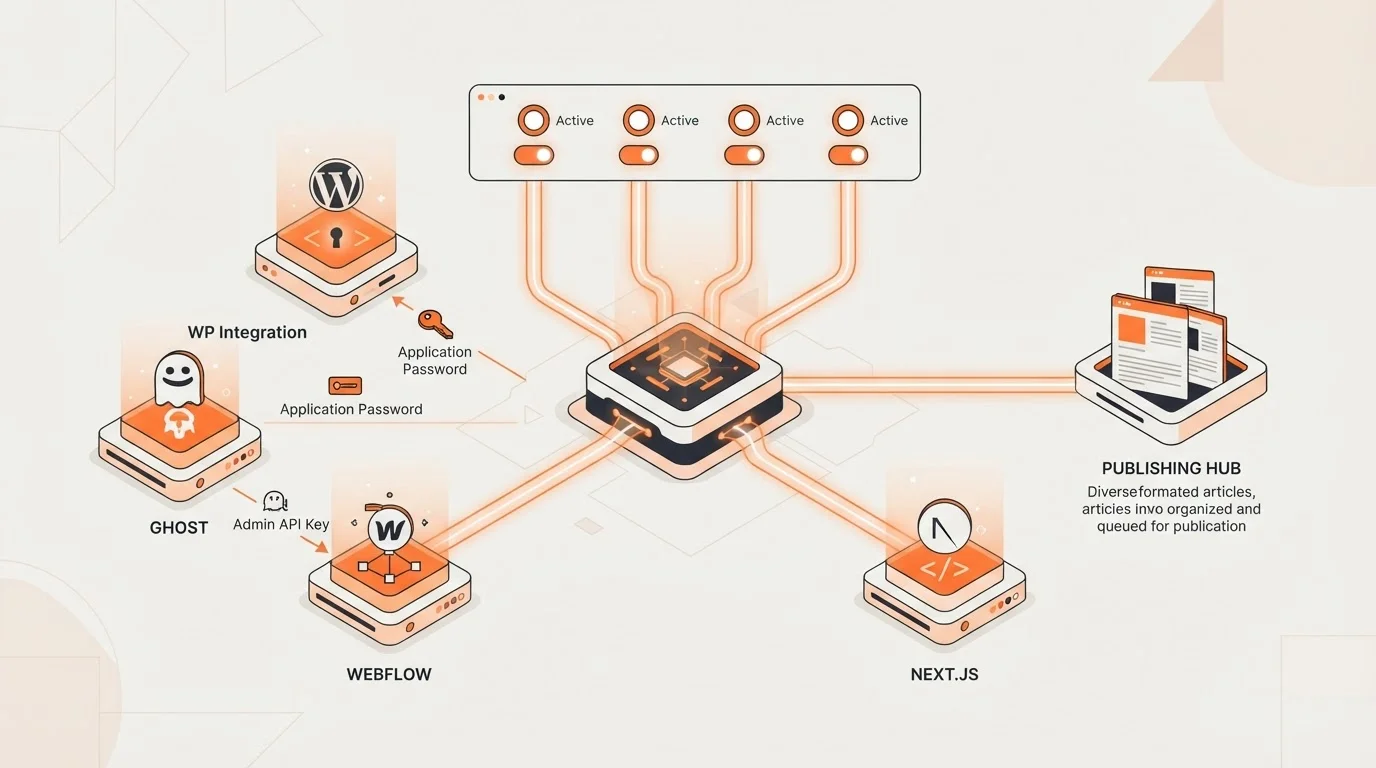
Integration is designed to be straightforward for technical and non-technical founders alike. For those using WordPress, the integration typically involves the Blogged Publishing plugin and an application password for secure communication. This allows the platform to push formatted articles directly into your WordPress dashboard as drafts or live posts.
If your site runs on Ghost, you can create a custom integration, copy the Admin API key, and verify the connection within the Blogged platform. Similar native integrations exist for Webflow and Next.js, ensuring that your autonomous blog matches the performance and design standards of your main site without requiring custom development time.
Measuring What Matters: Conversion Tracking for Content
The ultimate goal of autonomous blogging is to turn your blog into a profit center. To do this, you must move beyond "vanity metrics" like page views and focus on conversion tracking. You need to know exactly how many visitors are moving from a blog post to a signup or demo request.
Modern autonomous platforms provide built-in tools to collect consented visits and configured conversions for verified articles. This data allows founders to see the direct ROI of their content efforts. By identifying which topics and keywords drive the most trials, you can refine your Knowledge Engine settings to double down on what works, creating a virtuous cycle of organic growth.
Frequently Asked Questions
Q: How much time does it take to set up an autonomous blog?
Most founders can complete the initial setup, including connecting their CMS and populating the Knowledge Engine, in under an hour. Once the first few articles are reviewed, the system can run on Autopilot with minimal weekly oversight.
Q: Does this replace the need for an SEO specialist?
It replaces the repetitive, tactical tasks like keyword research and draft writing. This allows your marketing team to focus on high-level strategy and conversion optimization rather than getting bogged down in production.
Q: How does the platform handle internal linking?
The platform autonomously analyzes your existing content library to create relevant internal links. This is crucial for distributing domain authority and guiding readers toward other relevant pages or product features.
Q: Can I use this for a highly technical SaaS product?
Yes. Because you can feed the platform your specific technical documentation and links, the system is able to produce more accurate technical content than a generalist freelance writer who lacks your domain expertise.
Get practical updates on saas content conversion rate case study
Receive new articles and practical insights by email.
Scaling a SaaS requires extreme focus, and manual blogging is often a distraction that yields poor conversion results. By shifting to a product-led, autonomous strategy, founders can reclaim dozens of hours each month while building a blog that actually drives signups. By prioritizing the Knowledge Engine, embracing modern SEO and GEO signals, and leveraging seamless CMS integrations, you can transform your blog into a dynamic growth engine. Start by feeding your product knowledge into an autonomous system today and watch your organic conversion rates climb.