
On this page
For SaaS founders, the path to organic growth is often blocked by an exhausting paradox: you need high-quality content to attract customers, but every hour spent writing is an hour stolen from building your product. Identifying and dominating niche keywords—the specific, high-intent terms your competitors have overlooked—is the most effective way to break through, yet manual research and execution are rarely sustainable for lean teams. InnovateCo, a hypothetical but representative SaaS player, exemplifies how startups can shift from reactive writing to an autonomous 'competitor blog watch' strategy.
By leveraging an autonomous blogging platform, founders can move beyond the 'publish and pray' model. Instead of competing for broad, expensive keywords, a market-driven intelligence system pinpoints gaps in competitor content and fills them with product-led articles on autopilot. This approach does not just save time; it transforms a blog into a self-optimizing lead generation engine. This guide explores the workflow required to achieve market penetration and visibility by automating the most tedious parts of the SEO lifecycle.
The SaaS Founder's Paradox: Why Content Production Stalls Growth
Most SaaS startups understand that content marketing is their best bet for long-term customer acquisition, but initial efforts frequently hit a wall. Small marketing teams or solo founders find themselves stretched thin, trying to balance feature development with a consistent publishing schedule. The result is often the 'content treadmill'—consistent effort with stagnant results. They find themselves competing for broad, high-volume terms where they are outranked by industry giants with decades of domain authority.
The primary hurdle is the lack of strategic visibility. Traditional keyword research tools provide raw data, but translating that data into a coherent niche strategy requires time founders simply don't have. Many teams guess what their audience wants based on general industry trends rather than concrete evidence of what their competitors are missing. This reactive stance leads to content that, while well-written, fails to attract qualified leads or generate meaningful organic traffic.
Furthermore, even when perfect niche keywords are identified, the operational cost of production is prohibitive. Researching a specific use case, writing technical copy, optimizing for search and generative engines (GEO), and managing internal links across dozens of posts requires significant manual labor each week. For a founder focused on shipping features, this is an unsustainable diversion of resources. A solution is needed that not only generates content but also intelligently determines what to create based on real-time market signals.
Strategic Niche Dominance: The Competitor Blog Watch Workflow
The core of the InnovateCo strategy lies in the 'competitor blog watch'—a proactive mechanism that identifies content gaps by analyzing what rivals are writing and, more importantly, what they are ignoring. Instead of manual sifting, an autonomous system ingests specific product knowledge and matches it against these market gaps. This allows a SaaS to offload the repetitive tasks of production while ensuring every article remains deeply rooted in the unique value proposition of the software.
This workflow focuses on transforming internal documentation and product updates into discoverable content. The blog functions as both an SEO asset and a product education tool. By monitoring direct rivals and adjacent market players, the system identifies where their coverage is thin or outdated. For a SaaS founder, this means the software is constantly looking for 'cracks in the armor' of competitors—topics where a specialized product can offer a more detailed or relevant solution than a generalist competitor.
Identifying these underserved niches is critical because long-tail terms often have lower competition but significantly higher purchase intent. A user searching for a specific technical integration is much closer to a buying decision than one searching for a general industry definition. By automating the discovery of these terms, a startup can build a fortress of niche authority before larger competitors even realize the segment is being contested.
The Knowledge Engine: How Blogged Solves the AI Fluff Problem

One of the greatest fears founders have regarding AI content is 'fluff'—generic, shallow writing that fails to capture the technical nuance of their SaaS. To solve this, Blogged utilizes a Knowledge Engine for Autonomous SaaS Blogs. This feature allows users to provide public product sources, upload technical documents, paste links to feature releases, or provide a written product description. This ensures the AI isn't hallucinating; it is writing with the authority of the team that built the product.
The Knowledge Engine ensures that every post is product-led. Instead of writing generic 'how-to' guides that could apply to any software, the autonomous system generates solution-oriented guides that showcase specific product features as the answer to user pain points. This alignment is what drives conversions. When a reader sees a technically accurate solution to their problem that directly references the SaaS functionality, the trust barrier is lowered significantly.
Accuracy is maintained through a structured review process. Founders can review and edit every article within the platform before it goes live. Most plans include at least one to three revisions per article to ensure perfect alignment with brand voice. This hybrid approach combines the speed of automation with the necessary oversight of the founder, ensuring that high-volume publishing never comes at the expense of technical integrity.
GEO: Preparing for the Era of Generative Search
The search landscape is shifting from traditional search engine results pages (SERPs) to AI-driven discovery engines like Perplexity, ChatGPT, and Google’s Search Generative Experience. This shift requires a new discipline: Generative Engine Optimization (GEO). Blogged optimizes content specifically for this new reality, ensuring your product is cited as the solution when users ask AI tools for software recommendations.
GEO relies on providing clear, authoritative, and well-structured answers to complex questions. Because the autonomous platform uses the Knowledge Engine to ground its writing in factual product data, the resulting content is highly 'citable' for LLMs. The system automatically handles the structured data and contextual interlinking necessary to signal authority to these generative engines. This means that as more users shift their discovery habits away from Google and toward AI assistants, your SaaS remains visible.
Furthermore, automated contextual interlinking builds topical authority across your entire blog. By linking related posts together based on technical relevance, the system helps search engines and discovery engines understand the depth of your expertise in a specific niche. This is a task that is often neglected in manual blogging due to its tedious nature, but it is one of the most powerful signals for organic ranking.
Technical Implementation: Integrating Blogged with Your SaaS Stack
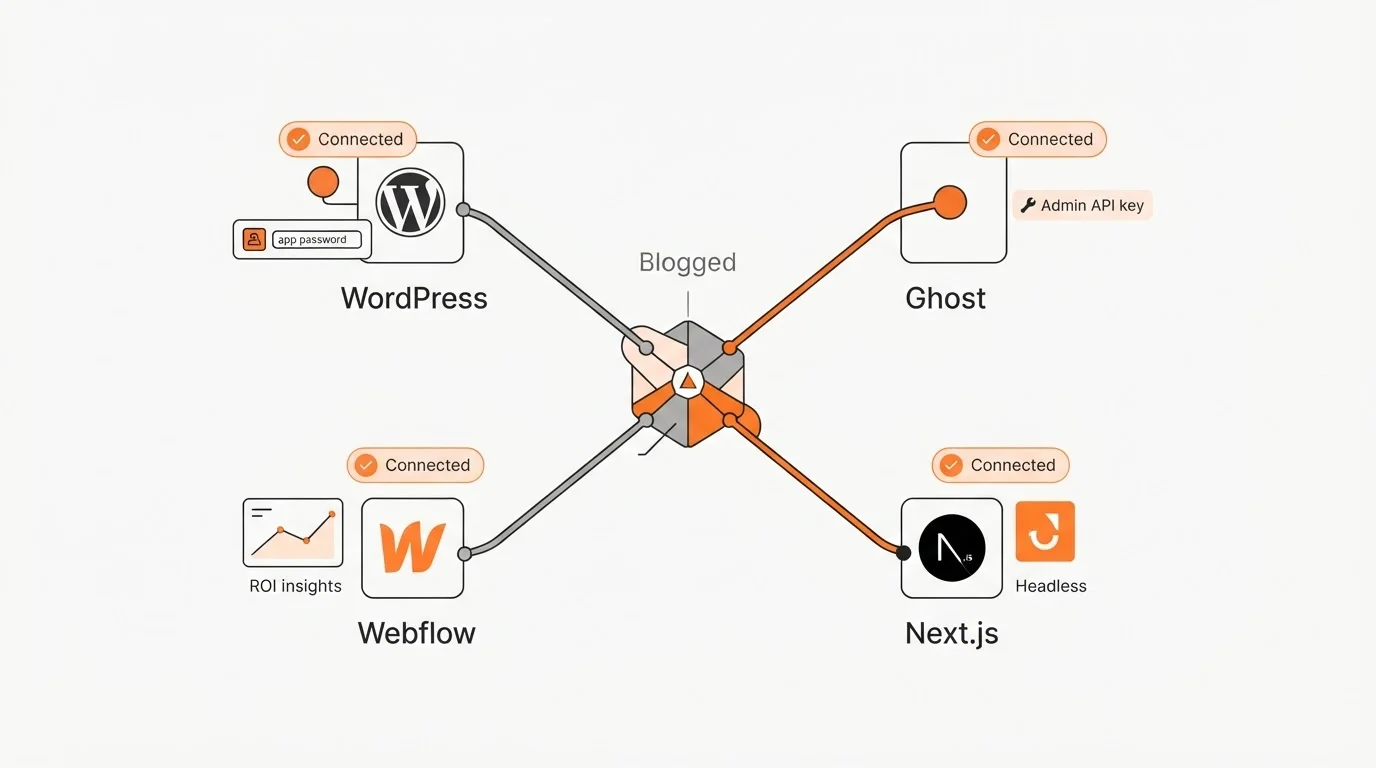
For an autonomous strategy to be truly effective, it must integrate seamlessly with existing infrastructure. Blogged offers native publishing integrations for the most common SaaS content stacks, including WordPress, Ghost, Webflow, and Next.js. These connections eliminate the need for manual copy-pasting, allowing the team to maintain a professional publishing workflow with zero friction.
For WordPress users, the integration connects to self-hosted sites through the Blogged Publishing plugin and an application password. This allows users to create and review articles within Blogged and deliver them directly to their website. The Webflow CMS AI Blog Publishing integration goes a step further, letting users collect consented visits and track configured conversions for verified articles, providing direct insight into the ROI of their content efforts.
Ghost users can implement a custom integration by copying an Admin API key into the platform, allowing Blogged to manage content creation while Ghost handles the reader experience. For more technical teams, the Next.js integration and signed webhooks provide the flexibility to publish content to headless environments. These integrations ensure that regardless of the underlying technology, the founder’s focus remains on the strategy rather than the mechanics of the CMS.
Stay updated on autonomous blogging for SaaS
Get insights and strategies on transforming product knowledge into discoverable content. Learn how to drive organic growth for your SaaS.
Autonomous Blogging vs. Traditional Content Creation: A Comparison
For most SaaS founders, the choice isn't just about 'AI vs. Human,' but about 'Scale vs. Manual Oversight.' While manual blogging offers high control, the opportunity cost for a startup is often prohibitive. Generic AI tools bridge the gap but often fail on technical accuracy and distribution. An autonomous platform provides product-led accuracy with zero operational overhead. The following table highlights the differences in a standard SaaS workflow.
Comparison Table: SaaS Content Strategies
| Feature | Traditional Manual Blogging | Generic AI Assistants | Blogged (Autonomous SEO/GEO) |
|---|---|---|---|
| Market Research | Manual keyword tools | Prompt-based (manual) | Autonomous Competitor Watch |
| Product Context | High (Requires founder/PM time) | Low (Prone to hallucinations) | Deep (Knowledge Engine Sync) |
| SEO/GEO Optimization | Manual & often missed | Basic (If prompted) | Automated & Built-in |
| Internal Linking | Manual & inconsistent | None | Automated Contextual Links |
| Publishing | Manual copy-pasting | Manual copy-pasting | Native Direct CMS Integration |
| Pricing | High (Agency/Freelancer) | Low (Subscription) | $99/month (Starting) |
| Team Access | Per-seat cost usually | Per-seat cost | Unlimited team seats |
Strategic Decision Guidance for SaaS Founders
Is an autonomous blogging platform the right move for your startup? While every team is different, founders who fit the following criteria typically see the highest ROI:
If you are a 'Team of One' or a Lean Marketing Crew, content creation often falls to the bottom of your to-do list. Automation ensures your organic growth doesn't stall while you're in a development sprint. Similarly, if your product is technical, a platform with a Knowledge Engine that can ingest your docs is essential for maintaining the accuracy that generalist freelancers struggle to provide.
Budget-conscious founders also benefit from the predictable cost structure. Starting at $99 per month, the platform provides a level of output that would otherwise require multiple hires or agency retainers. The goal isn't just to write more; it is to use automation to find the cracks in your competitors' armor and fill them with content that only your product can provide. This market-driven approach ensures that every article published is a strategic asset, not just noise in the digital landscape.
Frequently Asked Questions
Q: How does the platform ensure content quality and technical accuracy?
By using the Knowledge Engine, the platform limits its writing to the specific facts provided in your documentation, product descriptions, and links. This prevents the 'generic AI fluff' often seen in other tools.
Q: Does autonomous blogging help with AI-driven search (GEO)?
Yes. The platform optimizes content specifically for Generative Engine Optimization, making it more likely that your product is cited as the solution when users ask AI tools like ChatGPT or Perplexity for software recommendations.
Q: Can I review the articles before they go live?
Absolutely. You can review and edit every article within the platform. Most plans include one to three revisions per article to ensure perfect alignment with your brand voice.
Q: What integrations are supported for publishing?
Blogged offers native integrations for WordPress (via a plugin), Ghost (via Admin API), Webflow (for CMS and conversion tracking), and Next.js.
Q: How many team members can access the platform?
Every paid plan includes unlimited team seats, allowing your entire product and marketing team to collaborate on content reviews and strategy.
The strategic model demonstrated by InnovateCo proves that SaaS founders no longer have to choose between building a great product and maintaining a high-performance blog. By embracing autonomous blogging, they can move from a reactive, resource-drained content strategy to a proactive, market-driven engine that dominates niche keywords. This shift doesn't just boost organic rankings; it allows teams to capture high-intent market segments while remaining focused on innovation.
For any founder struggling to find the time for SEO, this workflow serves as a roadmap. The combination of product-led knowledge and autonomous execution is the new standard for organic growth. With pricing starting at $99 per month, the barrier to dominating your niche has never been lower. It is time to take your blog off manual and put your growth on autopilot.