
On this page
For many SaaS founders, the cost of customer acquisition through paid advertising is a primary barrier to sustainable scaling. This creates a reliance on rented attention, where the moment you stop spending, your lead flow vanishes. This cycle, often called the paid ad hamster wheel, forces growth teams to bid in increasingly expensive auctions rather than building a permanent marketing asset. To break this cycle, founders must pivot from high-spend acquisition toward a compounding organic engine powered by their own product expertise.
Autonomous blogging platforms allow lean teams to bridge the gap between building a product and marketing it. By automating research, planning, and optimization, these tools transform internal product knowledge into discoverable content without the overhead of a full marketing department. This strategic shift turns your documentation and feature releases into a lead-generation machine that operates independently of ad budgets.
The Economics of the SaaS Ad Trap
Building a SaaS on a foundation of paid ads is often necessary for early validation, but it rarely scales efficiently over the long term. As your market becomes more crowded, you are not just bidding against direct competitors; you are bidding against every company targeting the same high-intent audience. This drives up customer acquisition costs (CAC) to levels that can erode your margins and extend your payback period to unsustainable lengths. Unlike organic search, paid channels represent a linear investment where doubling your leads typically requires doubling your spend.
There is no compounding interest in a social media ad account. Once the budget is exhausted, the visibility disappears instantly. For a founder, this means you are constantly running to stand still, rather than building a marketing infrastructure that gains momentum on its own. Furthermore, the quality of paid leads can often be lower than organic leads. Users who find your product through an article solving a technical problem are demonstrating higher intent than those clicking a sponsored banner while browsing unrelated topics.
Transitioning to Product-Led Content
Most SaaS blogs struggle because they prioritize high-volume generic topics over product-led value. They publish broad industry trends that drive traffic but fail to convert visitors into users. Product-led content is different; it starts with the product's capabilities and works backward to the user's specific problems. It is not just about ranking for a keyword; it is about demonstrating how your software solves a pain point during the search experience.
Consider a hypothetical workflow for a project management SaaS. Instead of writing a generic post about team productivity, a product-led approach focuses on a guide titled "How to Automate Sprint Planning in 10 Minutes." This topic attracts a user with a specific technical need that the software is uniquely qualified to solve. This type of content serves as a product demo and a search result simultaneously, positioning your SaaS as the obvious choice for the reader.
Solving the Blank Page Problem
The biggest hurdle to consistent blogging for founders is finding the time to structure their knowledge for search engines. Founders have the knowledge but often lack the hours to research keywords and format long-form articles. Autonomous platforms solve this by using your existing product data as the foundation for every piece of content. This ensures that every article published is a true reflection of your product's value proposition rather than generic AI-generated filler.
The Knowledge Engine: Turning Docs into Discovery

For a content engine to be effective, it must be grounded in reality. Autonomous blogging systems avoid "AI fluff" by connecting directly to your product’s existing knowledge base. Using a centralized Knowledge Engine, you can provide public product sources, uploaded documents, pasted links, or even a simple written product description. This data informs the autonomous system, ensuring the generated content is technically accurate and specific to your features.
When you feed a system your internal whitepapers, customer support tickets, or feature release notes, the resulting articles are rooted in your specific intellectual property. This is the only sustainable way to build true authority in a competitive niche. Once this knowledge is ingested, the system can autonomously plan a content calendar that targets the entire user journey, from high-level category guides to deep-dive technical tutorials for power users.
Generative Engine Optimization (GEO): The New Search Frontier
The search environment is changing with the rise of AI-driven discovery tools like Perplexity, ChatGPT, and Google’s AI Overviews. Traditional SEO is no longer sufficient; founders must now optimize for Generative Engine Optimization (GEO). GEO is the practice of ensuring your content is clear, authoritative, and structured so AI models can easily cite and summarize it for their users.
When a user asks an AI for a recommendation, the model looks for reputable, specific sources to generate its answer. If your blog contains detailed, product-led articles on that exact topic, your product is far more likely to be mentioned as the recommended solution. This "zero-click" discovery is becoming a massive driver of high-intent traffic. Autonomous platforms are uniquely positioned to handle GEO because they structure data in the specific ways AI models prefer, using clear headings and direct problem-solution frameworks.
Technical Execution and Integration
For a content engine to be truly autonomous, it must integrate seamlessly with your existing technology stack. You should not have to manually manage formatting or copy-paste content between tools. Modern autonomous blogging solutions offer native integrations that handle the final steps of publishing and performance tracking.
Get practical updates on saas reduce paid ads case study
Receive new articles and practical insights by email.
WordPress and Ghost Integrations
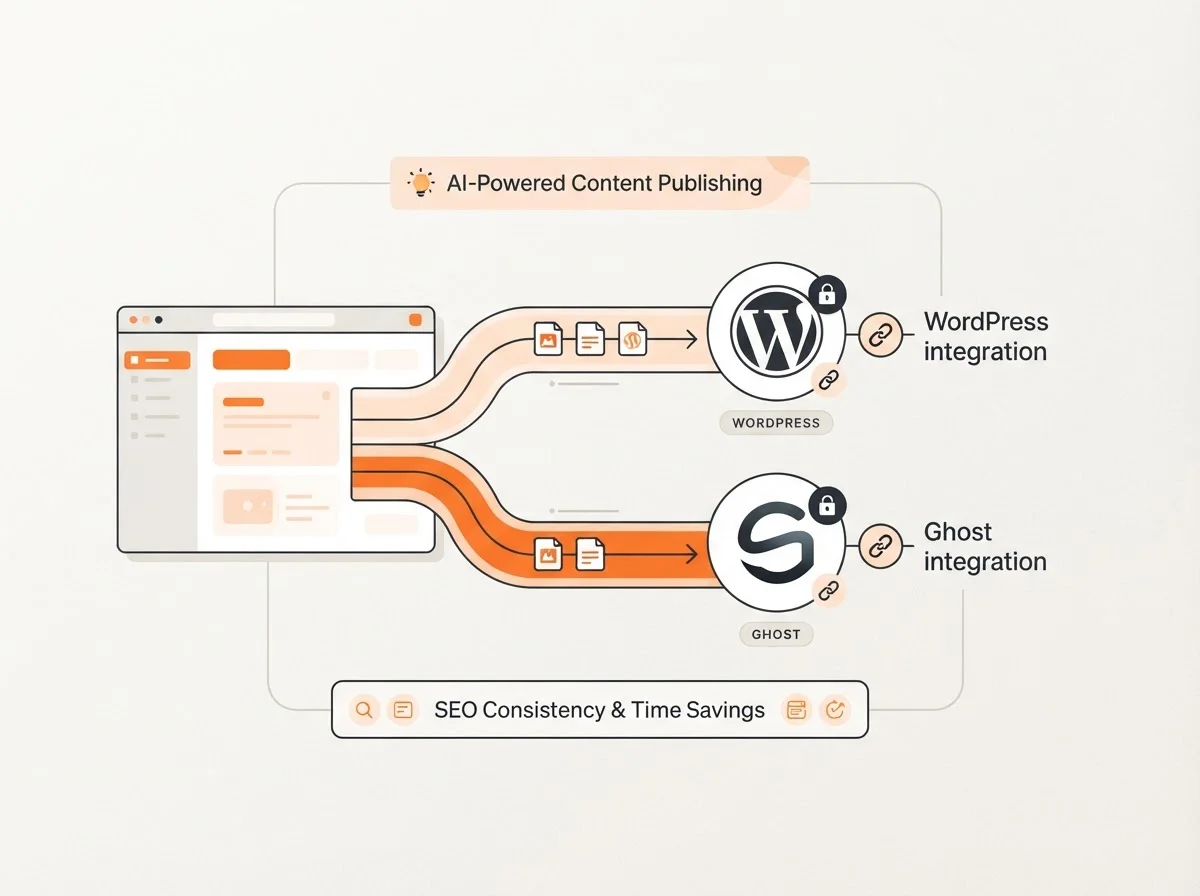
For teams using traditional CMS platforms, integration is straightforward. Blogged's WordPress AI Blog Publishing integration lets users create and review articles in the platform and then deliver them to their WordPress website. This connection is maintained through the Blogged Publishing plugin and an application password, ensuring secure and automated updates.
Similarly, the Ghost AI Blog Publishing integration manages content creation and review while Ghost renders the reader experience. Users create a custom integration in Ghost, copy the Admin API key, and verify their Ghost connection. These integrations don't just save time; they ensure consistency in technical SEO elements like interlinking and metadata optimization, which are critical for building site authority.
Next.js and Webflow CMS Data
For more modern or headless setups, the Next.js AI Blog Publishing integration and dedicated APIs allow teams to collect consented visits and configured conversions for verified articles. This level of tracking provides the data needed to prove ROI and understand which content is actually driving product signups. The Webflow CMS AI Blog Publishing integration provides similar capabilities, allowing founders to see exactly how their autonomous blog contributes to the bottom line.
Scaling Your Organic Presence
As you move away from paid ads, your content strategy needs to scale with your ambitions. The cost of manual content creation is often a barrier, but autonomous pricing makes it a predictable expense. For founders starting their journey, Blogged Starter is listed at $99 per month, providing a low-risk entry point into organic acquisition. As the blog begins to generate leads and save founder time, scaling to more robust plans becomes a logical step.
For teams looking for higher frequency, Blogged Growth is listed at $169 per month, while Blogged Ultra Growth is listed at $229 per month. These plans provide a high-volume content engine that would otherwise require multiple full-time writers. The savings in both capital and time can be reinvested directly into product development, creating a virtuous cycle where a better product fuels better content.
Managing Revisions and Quality Control
While autonomy is the goal, founders still need editorial oversight to ensure brand consistency. Different service tiers allow for varying levels of control. For example, Blogged includes 1 revision per article on standard plans, while Blogged Ultra Growth includes 3 revisions per article. This flexibility allows you to fine-tune high-stakes articles while letting the engine handle the heavy lifting for educational pieces. The review process typically takes minutes, allowing you to act as an editor-in-chief rather than a writer.
Frequently Asked Questions
Q: How does autonomous blogging handle technical product updates?
By using the Knowledge Engine, you can update your product documentation or provide a new description, and the autonomous system will incorporate these changes into future content. This ensures your blog stays in sync with your product roadmap.
Q: Is autonomous content as good as human-written content?
When grounded in your actual product data and documentation, autonomous content often exceeds the quality of generalist human writers because it focuses on technical accuracy and specific user problems rather than generic industry filler.
Q: How much time will I need to spend on this as a founder?
The goal is to reduce your commitment to a few minutes per week. You provide the initial knowledge base and then spend a short amount of time reviewing and approving the autonomous drafts before they go live.
Q: Will this improve my search rankings?
Yes. By maintaining a consistent publishing schedule and optimizing for both SEO and GEO, you build the topical authority that search engines reward with higher rankings and more frequent AI citations.
Reducing your reliance on paid ads is not just about saving money; it is about building a sustainable foundation for your SaaS. By embracing autonomous, product-led content, you transform your internal expertise into a discoverable asset that drives high-quality leads on autopilot. Platforms like Blogged provide the technical infrastructure and content intelligence needed to compete in the modern search and AI discovery environment, freeing you to focus on building the best possible product for your users. The transition from renting an audience to owning one is a significant competitive advantage for any growing software company.