
On this page
For most SaaS founders, content marketing is a paradox. You know that high-quality, product-led content is the most sustainable engine for organic growth, yet the labor required to produce it consistently is at direct odds with your primary goal: building the product. As volume increases, quality typically falls off a cliff. Freelancers often miss the technical nuances of your API, and internal subject matter experts are too busy shipping code to spend ten hours a week drafting blog posts.
Consider the experience of a rapidly growing software provider we will call InnovateCo. They needed to scale their search footprint to compete in a crowded market, but every attempt to increase publishing frequency resulted in a diluted brand voice and mounting technical errors. This SaaS consistent content quality case study explores how they broke the cycle by adopting Blogged, an autonomous blogging platform, to transform their internal product knowledge into a scalable content engine. By leveraging a grounded Knowledge Engine and automated CMS integrations, they achieved what many founders deem impossible: consistent, expert-level content quality at scale.
The Scaling Paradox: Why Quality Fails When SaaS Blogs Grow
The 'Quality Cliff' in SaaS content isn't a failure of intent; it is a structural failure of traditional workflows. When a startup operates with a small, internal team, quality is easy to manage. The founder or a lead engineer can review every word, ensuring that the product's unique value proposition is accurately represented.
However, the friction points become universal as you aim for 20+ or 30+ posts per month to capture long-tail SEO opportunities. First, there is the Technical Knowledge Gap. Generalist writers struggle to grasp the 'why' behind complex software features. For InnovateCo, this meant articles frequently misinterpreted how their integrations worked, leading to a loss of trust with their technical audience.
Second, the Review Bottleneck creates a massive drain on high-value resources. Because drafts are often technically shallow, product managers spend hours 'fixing' content, making the production process more expensive than if they had simply written the posts themselves. Finally, Brand Voice Drift occurs as multiple contributors cause the blog to sound like a collection of disjointed voices rather than a single, authoritative brand. To grow, founders need a system that can codify their product knowledge and use it to drive autonomous production.
The Solution: Grounding Content in a Knowledge Engine
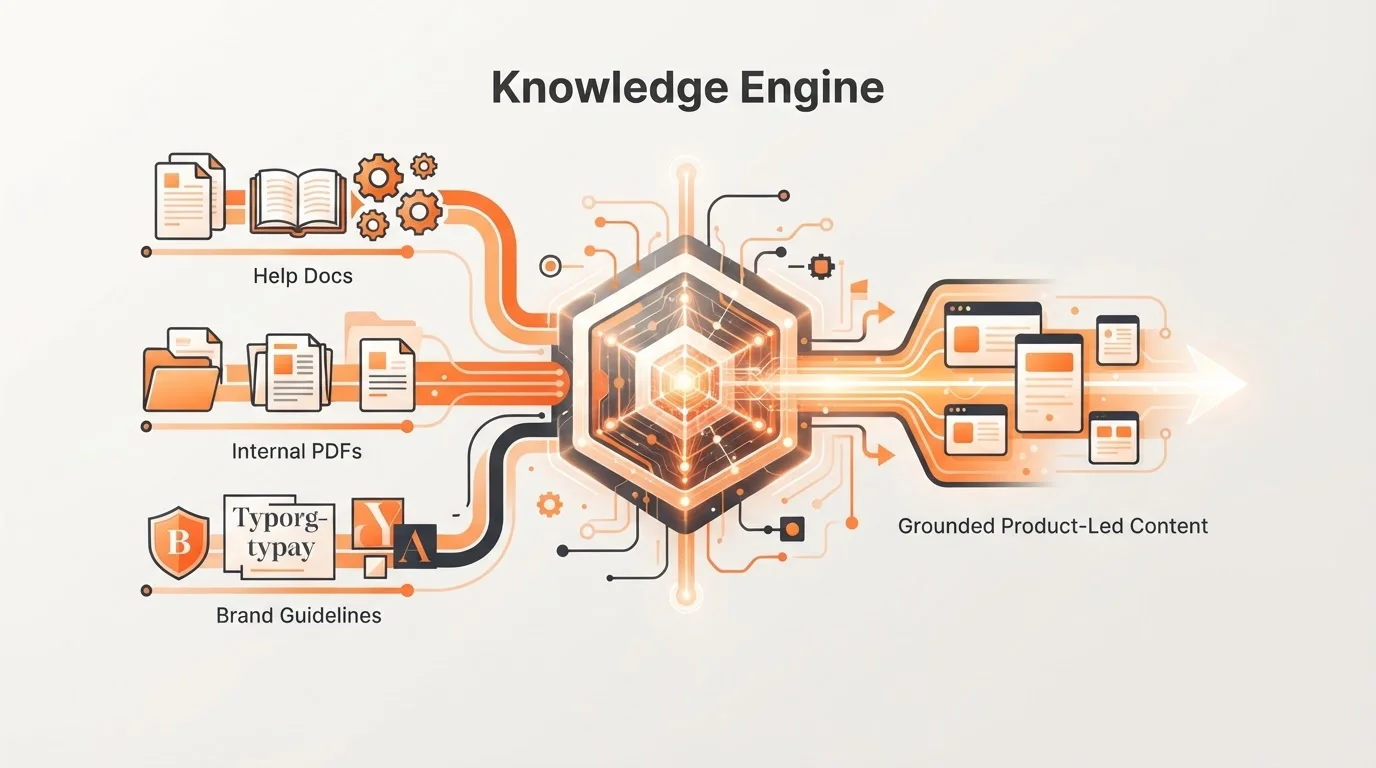
The breakthrough for many founders comes when they shift from 'AI writing tools' to an autonomous blogging platform. The core difference lies in the Knowledge Engine. Unlike standard generative AI that relies on general training data—which is often outdated or generic—Blogged’s Knowledge Engine for Autonomous SaaS Blogs allows founders to provide specific, verified product sources.
By feeding the system public documentation, internal one-pagers, and high-performing customer success stories, you create a 'source of truth' that the platform uses for every article. Because the platform draws from these inputs, it eliminates the hallucinations typical of generic AI. If a feature isn't in the documentation, the system doesn't invent it.
This grounding ensures that every piece of content is product-led. Instead of just talking about industry trends, the blog posts naturally weave in how specific features solve user pain points, backed by the factual accuracy found in your technical docs. This approach turns your blog from a generic news feed into a discoverable extension of your product documentation.
Bridging the Technical Gap with Multi-Source Inputs
Implementing a Knowledge Engine is not a one-time upload but a strategic integration of your intellectual property. Effective autonomous blogging utilizes four primary input methods:
- Public Product Sources: Crawling your existing marketing site and help docs to establish baseline terminology.
- Uploaded Documents: Providing private whitepapers and Markdown files that contain deep-dive technical specs.
- Pasted Links: Using specific competitor comparison pages and industry research to inform a 'competitive watch' angle.
- Written Descriptions: Explicitly defining your brand tone (e.g., 'professional yet approachable') and your Ideal Customer Profile (ICP).
By organizing these into a structured library, you ensure that the autonomous system has a more comprehensive understanding of the product than a new freelance writer would after months of onboarding.
Operational Excellence: Integrating with WordPress and Ghost

Scaling quality is meaningless if the publishing process remains manual. Marketing teams often spend hours every week reformatting drafts, optimizing images, and checking meta descriptions. Using Blogged’s WordPress AI Blog Publishing integration, teams can create and review articles within a centralized dashboard and deliver them directly to a self-hosted WordPress site.
The connection is handled securely via the Blogged Publishing plugin and an application password, ensuring you do not have to manage complex API scripts or manual copy-pasting. For specialized developer documentation or blogs hosted on Ghost, the platform manages content creation and review while Ghost handles the reader experience. This is achieved by creating a custom integration in Ghost, copying its Admin API key, and verifying the connection in Blogged.
Furthermore, because paid plans include unlimited team seats, product managers can pop into the editor, leave a quick note, or approve a technical point without the friction of license management. This collaborative environment ensures that technical accuracy is verified without overwhelming the product team.
The Hybrid Workflow: Autopilot with Human Oversight
A successful autonomous content strategy uses a hybrid model that maximizes both speed and quality. While the platform handles the heavy lifting—researching, planning, writing, and interlinking—the human team maintains strategic control through a four-step cycle:
- Topic Selection: Identify high-potential keywords and topics that align with upcoming product launches.
- Autonomous Drafting: The platform generates a full, product-led draft grounded in the Knowledge Engine.
- The Strategic Review: Every article includes 1 revision (scaling up on higher plans), allowing the team to request specific adjustments to the tone or call-to-action.
- One-Click Publishing: Once approved, the post is pushed to WordPress, Ghost, Webflow, or Next.js, complete with SEO metadata and internal links.
Get practical updates on saas consistent content quality case study
Receive new articles and practical insights by email.
Tangible Results: SEO Authority and Generative Engine Optimization (GEO)
When a SaaS company moves to an autonomous workflow, the most significant result isn't just traffic—it is quality and relevance. Articles begin appearing as citations in AI-powered search engines like Perplexity, ChatGPT, and Google’s AI Overviews. This is the result of GEO (Generative Engine Optimization). By producing factual, source-bound content rather than generic fluff, you make it easier for LLMs to identify your product as an authoritative solution to user queries.
The operational impact is equally stark. The team no longer spends time brainstorming or outlining, resulting in zero 'blank page' time. Because the AI is grounded in the Knowledge Engine, technical errors become rare, which reduces the manual review cycle for product managers significantly. Instead of deep editing, they perform a quick 10-minute strategic check. Furthermore, high-quality content helps lower bounce rates, signaling to search engines that the site is a valuable resource.
A Framework for SaaS Founders: How to Scale Without the Stress

If you are struggling with content consistency, you can follow this roadmap to transition toward an autonomous model. Scaling isn't about working harder; it’s about building a better infrastructure for your knowledge.
Step 1: Perform a Content Quality Audit. Look at your last 10 blog posts. Do they sound like they were written by someone who truly understands your product? If you spent hours editing them, you have a scaling bottleneck.
Step 2: Centralize Your Knowledge. Consolidate your core value propositions, technical specs, and brand voice guidelines into a format that can be ingested by a Knowledge Engine. Stop leaving expertise scattered across Slack and Notion.
Step 3: Automate Low-Value Tasks. Writing the first draft, researching keywords, and formatting for a CMS are low-value tasks for a founder. Automate these so you can focus on strategy and unique product insights.
Step 4: Measure Conversion-Centric Metrics. Don't just track page views. Use Blogged’s built-in analytics to track consented visits and configured conversions for your verified articles. This allows you to see which product-led posts are actually driving signups.
Frequently Asked Questions
Q: How does the platform stay updated as my product changes?
The Knowledge Engine is designed for freshness. You can update your sources at any time, and the platform’s monitoring helps identify when a fact in your library might be going stale based on your website updates.
Q: Do I lose control over my brand voice with autonomous blogging?
No. You define the brand guidelines in the Knowledge Engine. The hybrid review workflow ensures that no post goes live without your final approval, transitioning you from a writer to an editor-in-chief.
Q: Does this work with custom-built SaaS sites?
Yes. While Blogged has native integrations for WordPress, Ghost, Webflow, and Next.js, it also offers a signed Webhook and Content API, allowing you to deliver content to any custom stack.
Q: Can I collaborate with my marketing agency using this tool?
Absolutely. Every paid plan includes unlimited team seats, so you can invite your agency, your product managers, and your editors to collaborate in one centralized workspace without additional costs.
The Future of SaaS Growth is Autonomous
The era of the 'human-only' content treadmill is ending for SaaS companies. As search engines shift toward rewarded utility and technical accuracy, the winners will be those who can transform their internal expertise into discoverable content at scale. You can stop being a bottleneck for your own marketing by leveraging autonomous blogging.
By adopting a system grounded in your own product knowledge, you ensure that every article published is a high-quality asset that drives organic growth through SEO and GEO. Focus on building the future of your SaaS, and let Autopilot handle the growth.