
On this page
Product-led content for user acquisition is a strategy where your product is the primary vehicle for solving a reader's problem within your marketing materials. Unlike traditional content marketing, which often provides broad industry advice, product-led content (PLC) demonstrates exactly how your software executes the solution. This approach attracts high-intent users who are searching for specific outcomes your product provides.
For SaaS founders, the challenge isn't a lack of knowledge—it is the time required to translate that expertise into a consistent publishing schedule. By treating your product features as a source of truth, you can create a content engine that drives organic growth through Search Engine Optimization (SEO) and Generative Engine Optimization (GEO). The goal is to move the user from discovery to adoption by making the value of your product undeniable.
The Shift from Generic Marketing to Product-Led Content
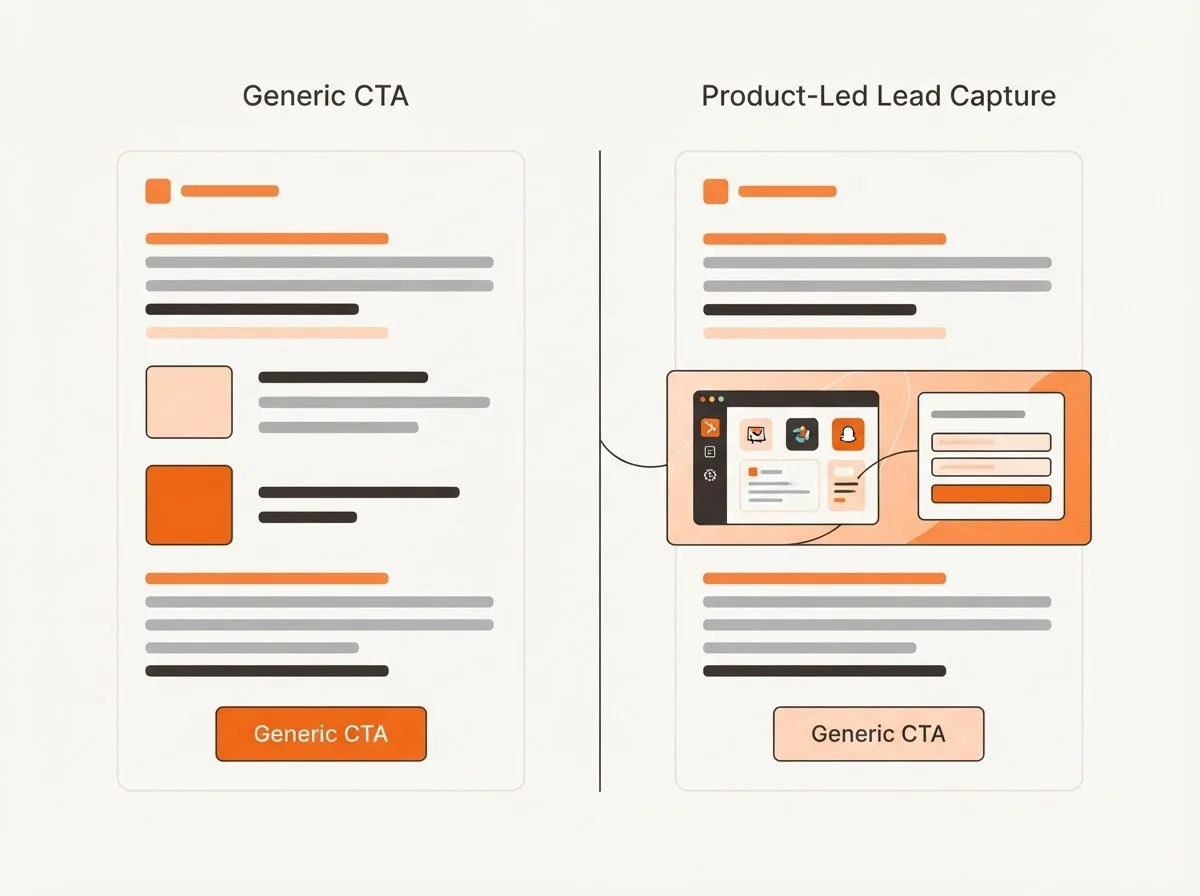
Traditional content marketing often feels like a bait-and-switch. A reader clicks on an article titled "How to Improve Team Efficiency," reads 1,000 words of generic advice, and then sees a disconnected CTA to sign up for a project management tool. Product-led content reverses this flow. It identifies a friction point—such as "How to automate weekly sprint reports"—and uses the product to show the step-by-step resolution.
This shift is essential because search engines and AI discovery platforms now prioritize specific, useful content over high-volume generic posts. To start, founders must organize their internal product knowledge. This includes documenting the core product description, ideal customer profile (ICP), and specific positioning. When these facts are centralized, they become the building blocks for every article you publish.
Why Context Matters for Organic Growth
Context is the differentiator in a crowded SaaS market. If your content lacks specific details about your pricing, limits, and technical capabilities, it will fail to convert. Blogged allows founders to organize product descriptions, ICP, and facts so the platform can reuse this specific context across all content. This ensures that every piece of writing remains factually accurate and aligned with your actual software capabilities, which is critical for building trust with sophisticated B2B buyers.
Mapping Product Features to User Pain Points
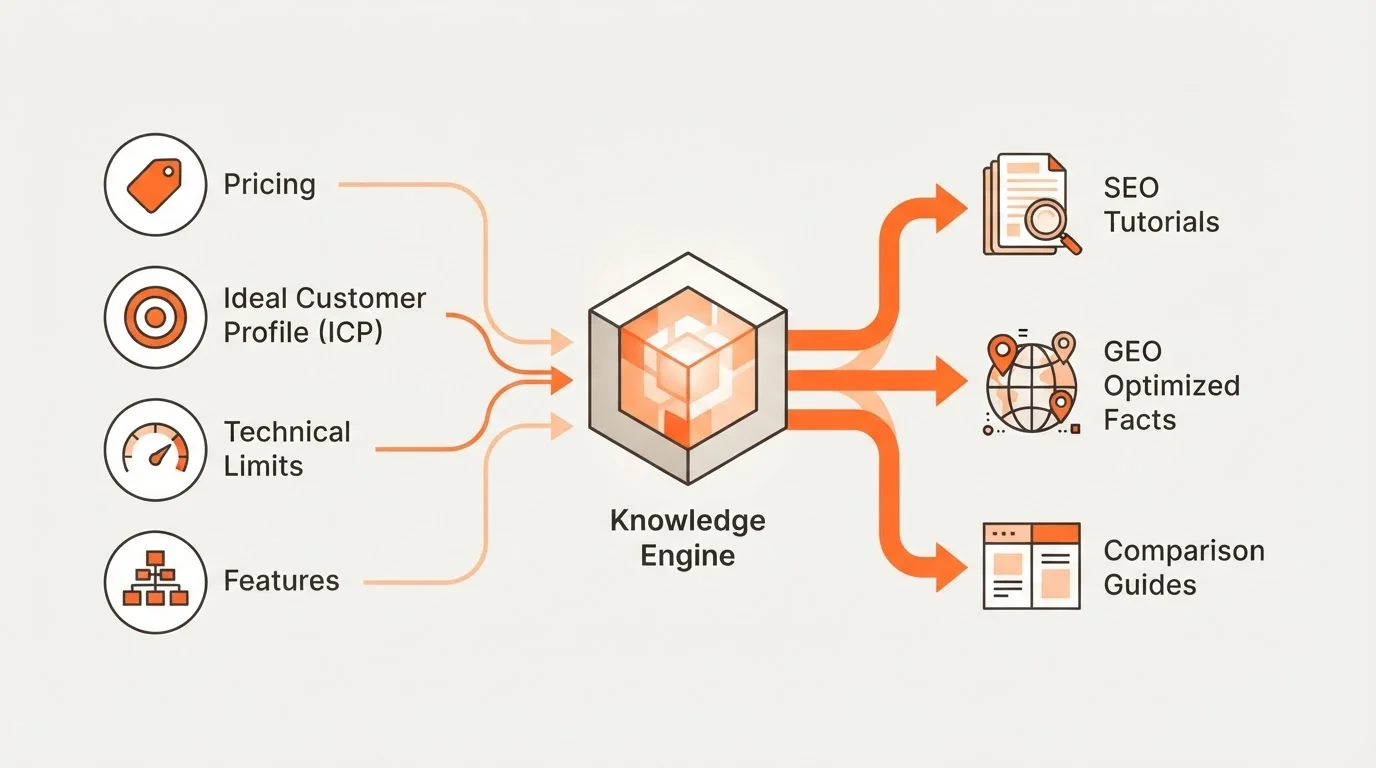
A successful product-led strategy begins with a technical audit of your own features. You cannot rely on broad keywords; you must target the specific intersections where a user's problem meets your feature's functionality. For example, if you sell an API monitoring tool, your content shouldn't just target "API management." Instead, target "debugging slow 500 errors in real-time."
To do this effectively, categorize your information into entities and facets. Blogged lets users organize facts by product entity and facet, making it easier to retrieve and apply specific product details to different content topics. This structured approach prevents "hallucinations" or inaccuracies in your marketing copy and ensures that when a reader looks for a solution, they find your product exactly where it belongs.
The Feature-Problem-Solution Framework
Create a simple matrix for your content team or autonomous system. List every feature in column A, the immediate problem it solves in column B, and the measurable outcome in column C. This framework ensures that your content focuses on solving rather than just describing. This mapping should be a living document, updated every time you push a new feature or pivot your pricing strategy to reflect current realities.
Crafting Discoverable Content from Your Knowledge Base
Once your knowledge base is organized, you need to transform it into discoverable assets. This involves identifying key topics that demonstrate core product utility. These topics generally fall into three categories: tutorials ("How to"), comparisons ("Vs."), and use cases ("X for Y Industry"). Each of these should be rooted in bounded facts rather than marketing fluff.
Blogged's Knowledge Engine for Autonomous SaaS Blogs organizes product, competitor, and keyword knowledge into bounded facts with provenance and verification controls. This ensures that when you compare your product to a competitor, the data is verified and fresh. It allows founders to scale their output without worrying about the quality or accuracy of the technical claims being made.
Optimizing for SEO and AI Discovery (GEO)
Search behavior is evolving. While traditional SEO focuses on keywords, Generative Engine Optimization (GEO) focuses on the relationships between entities and facts. To rank in AI-driven search results, your content must be authoritative, cited, and factually dense. This means your blog shouldn't just exist to host keywords; it should serve as a verified knowledge source.
Internal linking is a major component of this strategy. By connecting related articles and product pages, you build a topical authority map that search engines can easily crawl. Blogged's internal linking tool verifies the destination, explains why it fits a specific section, and allows editors to manage links without leaving the post. This keeps readers in your ecosystem longer, increasing the likelihood of a conversion.
Stay updated on autonomous blogging for SaaS
Get insights and strategies on transforming product knowledge into discoverable content. Learn how to drive organic growth for your SaaS.
Converting Organic Traffic into Users
Traffic is a vanity metric if it doesn't lead to sign-ups. In a product-led content strategy, the call to action (CTA) must feel like the next logical step in the reader's journey. If they just learned how to solve a problem using your tool, the CTA should be a direct invitation to try that exact feature.
Effective conversion requires precision in both placement and wording. Blogged lets editors approve both the destination and promise wording for CTAs. You can configure lead forms, preview placements, and ensure privacy language is attached to the capture experience. This level of control allows you to transform a standard blog post into a high-converting landing page for your SaaS.
Tracking Impact and ROI
You cannot optimize what you do not measure. For product-led content, focus on conversion rates for specific articles rather than just total page views. Blogged’s Ghost and Next.js integrations allow users to collect consented visits and track configured conversions for verified articles. This data tells you which product features are the biggest draws for new users, allowing you to double down on what works.
Automating the Content Engine
The primary barrier to product-led growth is consistency. Founders often start strong but stop publishing as the demands of product development grow. Automation is the only way to sustain a high-frequency, high-quality blog. However, automation must be grounded in your specific product knowledge to avoid generic, low-value AI output.
By using a system that allows you to provide public sources, uploaded documents, or pasted links, you ensure the AI is writing about your product, not just a generic version of your industry. Blogged includes unlimited team seats on its plans, which means your product managers and marketers can participate in the review process. This collaborative, autonomous approach ensures that the blog runs on autopilot while still maintaining the founder’s high standards for technical accuracy.
Useful frequently asked questions
Q: What makes content "product-led" exactly?
Content is product-led when the product is integrated into the narrative as the primary solution to a problem. It moves away from generic advice and uses specific product features to demonstrate value.
Q: How much time does a founder need to spend on this?
With an autonomous system like Blogged, a founder's involvement is primarily in the initial knowledge setup and final approval. The system handles the research, writing, and optimization, reducing the weekly time commitment significantly.
Q: Does product-led content work for early-stage SaaS?
Yes, it is particularly effective for early-stage startups because it builds authority in a specific niche and attracts users who are looking for exactly what you've built, often leading to a lower Customer Acquisition Cost (CAC).
Q: How do I handle competitor comparisons without being biased?
Use a fact-based approach. By organizing competitor intelligence into verified facts, you can create objective comparisons that highlight your product's unique strengths without relying on misleading claims.
Product-led content is not just a marketing tactic; it is a fundamental shift in how SaaS founders acquire users. By turning your product knowledge into an autonomous content engine, you solve for both organic discoverability and user conversion simultaneously. This strategy allows you to build a sustainable acquisition channel that grows in value over time, freeing you to focus on what you do best: building a world-class product.