
On this page
Content mapping for SaaS is the strategic process of connecting your product's technical capabilities with the specific problems your audience is trying to solve. For a founder, your product knowledge is your most valuable asset, yet it often remains locked inside technical documentation or internal roadmaps. By systematically aligning what your product offers with what potential customers search for, you create content that doesn't just attract visitors—it converts them into users.
Most SaaS content fails because it is either too generic to rank or too technical to resonate with a buyer at the awareness stage. Content mapping ensures every article serves a dual purpose: answering a user's question while demonstrating a specific product solution. When your blog addresses a searcher's problem using your product's unique features, you shift from traditional marketing to a product-led growth (PLG) model where your content becomes a functional extension of your software.
Why Content Mapping is the Foundation of SaaS SEO
For SaaS companies, SEO is not merely about traffic volume; it is about reaching users with high intent. Without a content map, your publishing efforts become disjointed, often failing to highlight the features that differentiate you from competitors. A structured mapping strategy allows you to build topical authority by covering every angle of a user's challenge, from high-level awareness to deep-funnel decision-making.
When your content answers the specific 'how-to' or 'why' questions that lead users to your category, search engines recognize your expertise. More importantly, this approach aligns your marketing and product teams around a single source of truth. Maintaining this consistency is critical as you scale. Blogged simplifies this by allowing users to manage a private SaaS product asset library with review queues and visible approvals, ensuring that every piece of product-led content uses the most accurate, up-to-date materials.
Step 1: The Feature Inventory—Translating Specs into Value
The first step in content mapping is documenting your core product features, but not as a simple technical list. You must translate every 'specification' into a 'user outcome.' Start by compiling a comprehensive list of every capability your SaaS offers, then define the specific 'job' it performs for the end-user.
Ask yourself: What task does this enable? What pain persists if the user lacks this feature? This helps you prioritize which features deserve the most SEO weight. For example, an 'Automated Reporting' feature is not just a checkbox; it is a solution for 'manual data entry errors' or 'hours wasted on weekly summaries.' Data-driven prioritization is essential here. Blogged helps founders track Search Console performance and on-site searches to identify which features or topics are generating the most curiosity. If you see high engagement on articles related to a specific workflow, it is a clear signal to map more content to those related features.
Step 2: Decoding User Search Intent and Pain Points
Effective SaaS SEO planning requires deep empathy for the searcher's journey. You need to identify the exact keywords and phrases your audience uses when they are frustrated, curious, or ready to switch tools. Categorize your research by intent to ensure you are meeting the reader where they are. 'Informational' queries require educational content that introduces your product as a helper, while 'Commercial' queries require comparison guides where your features go head-to-head with the market.
To find these pain points, look beyond standard keyword tools. Scour support tickets, review sites, and competitor forums to see where users feel stuck. Collaboration is key during this research phase. Blogged supports this by including unlimited team seats on every paid plan, allowing your customer success and sales teams to contribute their knowledge and review drafts. This ensures your content is not just SEO-optimized, but accurately reflects the real-world problems your users face daily.
Step 3: Building the Content Mapping Matrix
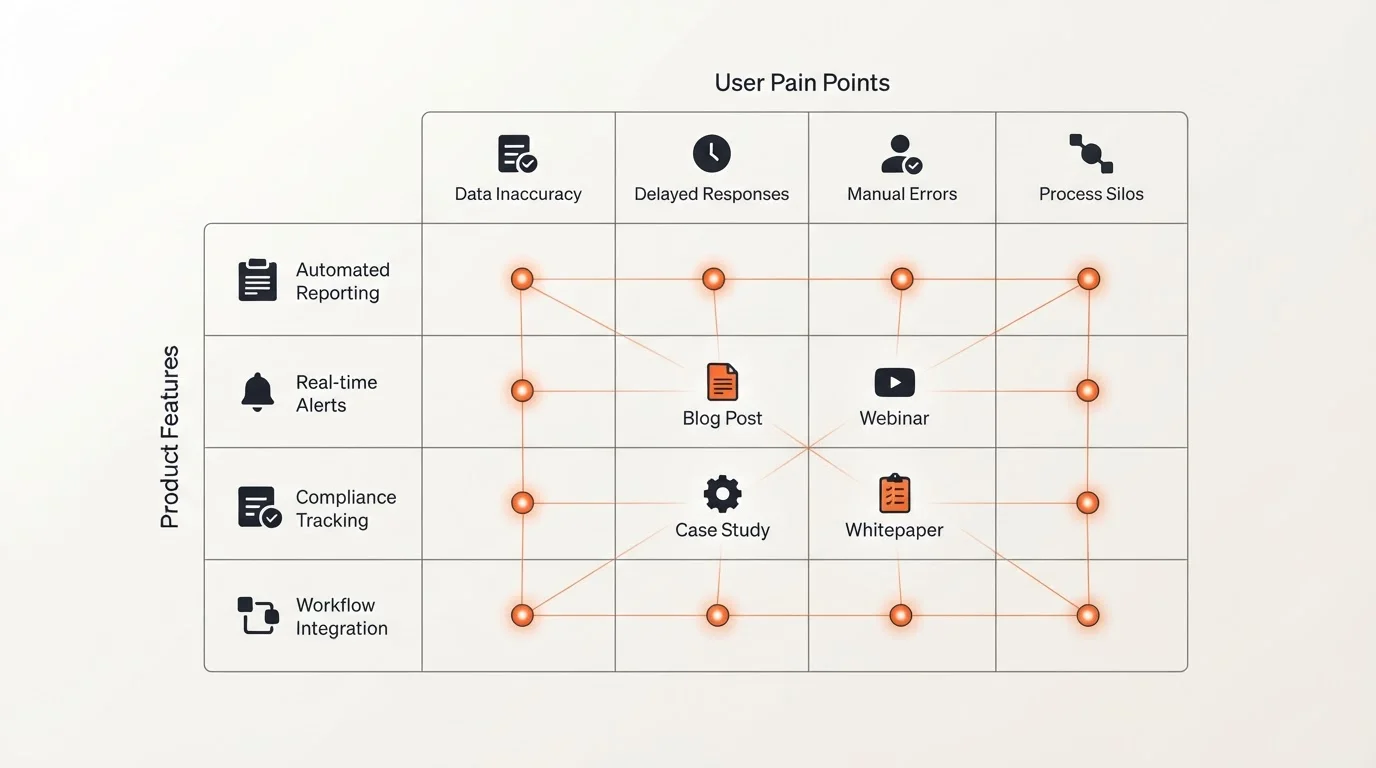
The matrix is where strategic alignment happens. On one axis, list your core product features. On the other, list the primary user pain points and their associated keywords. Where these two intersect, you have a high-value content opportunity. This bridge ensures your product knowledge content is always rooted in a discoverable need.
For each intersection, define the content type. If a feature solves a complex technical problem, a tutorial or deep-dive guide is appropriate. If it is a unique differentiator that competitors lack, a 'versus' page or a case study might be better. Assign one primary keyword and several secondary keywords to each piece to ensure it covers the semantic breadth of the topic. Effective mapping also considers scale. Some topics require a brief overview, while others need a comprehensive pillar page. Whether you need a short update or a detailed 2,000-word guide, your map should dictate the depth based on the complexity of the feature.
Stay updated on autonomous blogging for SaaS
Get insights and strategies on transforming product knowledge into discoverable content. Learn how to drive organic growth for your SaaS.
Leveraging a Knowledge Engine to Scale Your Strategy
The biggest bottleneck for founders is the consistent production of the content they have mapped. You know your product, but finding the time to write is nearly impossible. This is where autonomous systems transform the process. A content map is only as good as the knowledge it is built on. Blogged’s Knowledge Engine for Autonomous SaaS Blogs allows you to feed the platform your existing product documentation, public sources, or even raw text descriptions.
This ensures that the AI writing your content is using your actual feature set as the source of truth. By grounding the content in your specific product knowledge, the resulting articles are authoritative and highly relevant to your brand. This system allows you to turn a simple product roadmap into a long-term SEO-driven content strategy. Instead of explaining your features to a freelance writer every week, you provide the knowledge once, and the autonomous system handles the planning, writing, and interlinking according to your map.
Automating the Pipeline: From Research to Publishing
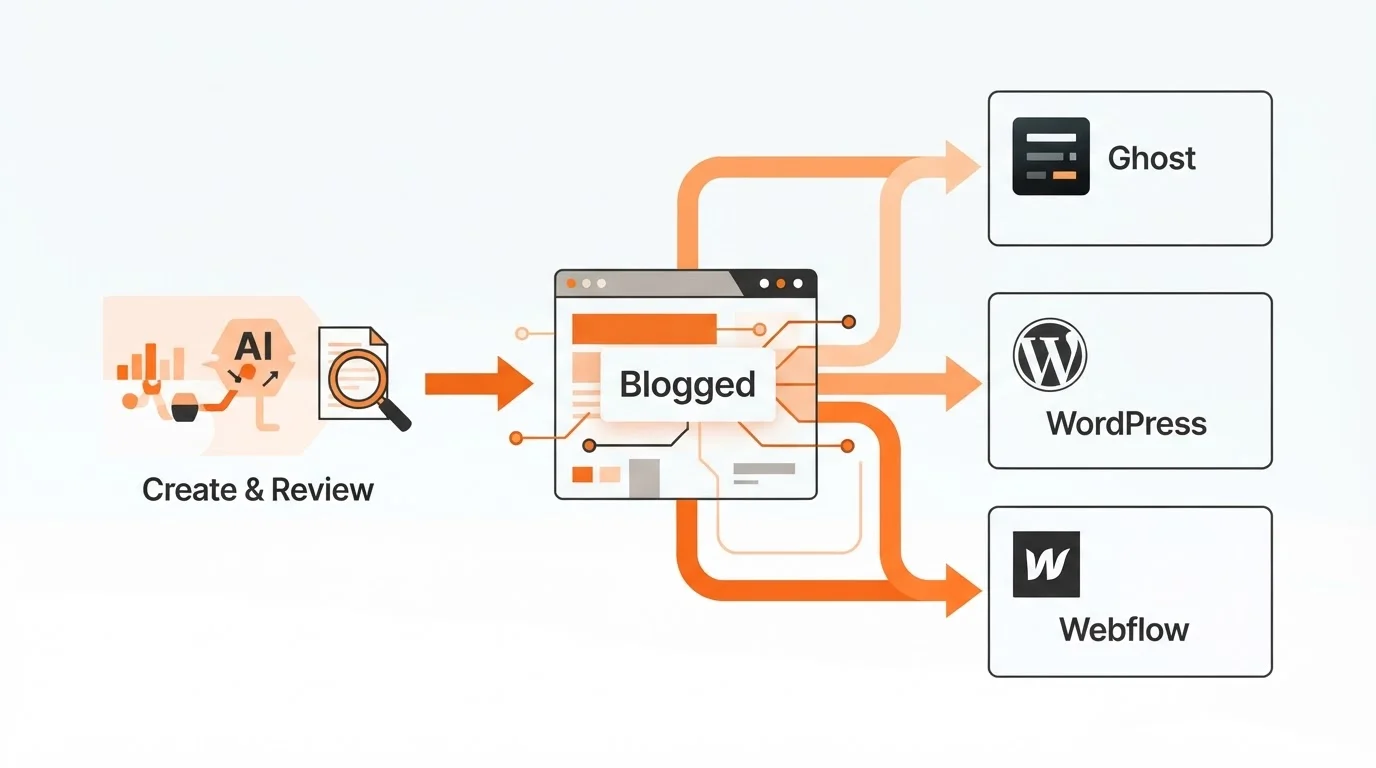
For a SaaS founder, the goal of content mapping is to create a predictable growth engine. Manual execution is labor-intensive and prone to inconsistency. Automation bridges this gap by handling the repetitive tasks of keyword analysis, internal linking, and formatting. Blogged integrates directly with popular CMS platforms to streamline this.
For example, the Ghost AI Blog Publishing integration manages the entire creation and review process inside Blogged while Ghost renders the reader experience. Similar integrations exist for WordPress, Webflow, and Next.js, allowing you to deliver verified articles to your site without manual copy-pasting. Starting this journey is accessible, with the Blogged Starter plan priced at $99 per month. This plan includes 1 revision per article, making it an ideal entry point for founders. As you scale, higher tiers offer up to 3 revisions per article, ensuring you can fine-tune your message as your product evolves.
Frequently Asked Questions About Content Mapping
Q: How do I know which product features to map first?
Focus on the features that solve the highest-pain problems for your customers. These are typically the features mentioned most often in support tickets or those that differentiate you most clearly from your competitors.
Q: Can I use content mapping for transactional pages only?
No, content mapping is essential for the entire funnel. Map informational keywords to educational blog posts to build trust, and map transactional keywords to feature pages or comparison guides to drive sign-ups.
Q: How often should I update my content map?
Your content map should be a living document. Review it at least once a quarter or whenever you launch a major new feature to ensure your strategy keeps pace with product development.
Q: Does content mapping work for AI-driven search (GEO)?
Yes. Generative Engine Optimization rewards content that is specific, authoritative, and structured. By mapping your content to specific features, you make it easier for AI models to summarize your product as a solution.
Content mapping is the key to moving from random acts of content to a strategic, product-led growth engine. By aligning your product's unique features with the real-world needs of your users, you create a blog that builds authority and drives conversions. With tools like Blogged, you can automate this entire cycle, from extracting product knowledge to publishing SEO-optimized articles, allowing you to focus on building your SaaS. Start mapping your features today and turn your product knowledge into your most powerful organic growth channel.