
On this page
Organic growth is often the most misunderstood lever in a SaaS founder's toolkit. In the early stages of building a company, the pressure to generate traffic frequently leads to the 'Head Term Trap'—a strategic error where lean teams attempt to compete for high-volume, broad keywords against established industry giants. This approach typically results in high bounce rates, low conversion, and an exhausted marketing budget. The reality of modern search is that dominance is no longer about who has the loudest voice, but who provides the most specific, helpful answer to a user's exact problem.
Success in today's search environment requires a pivot from broad visibility to niche keyword dominance. By focusing on long-tail, high-intent queries, a SaaS can attract users who are not just browsing, but are actively seeking a solution for a specific workflow or pain point. This strategy, powered by autonomous blogging, allows founders to maintain a consistent, high-quality content schedule without diverting their focus from product development. This guide outlines the framework for scaling organic growth by transforming internal product knowledge into a discoverable content engine that ranks in both traditional search engines and new AI discovery tools.
The Strategic Shift: Why Niche Keywords Win for SaaS Startups
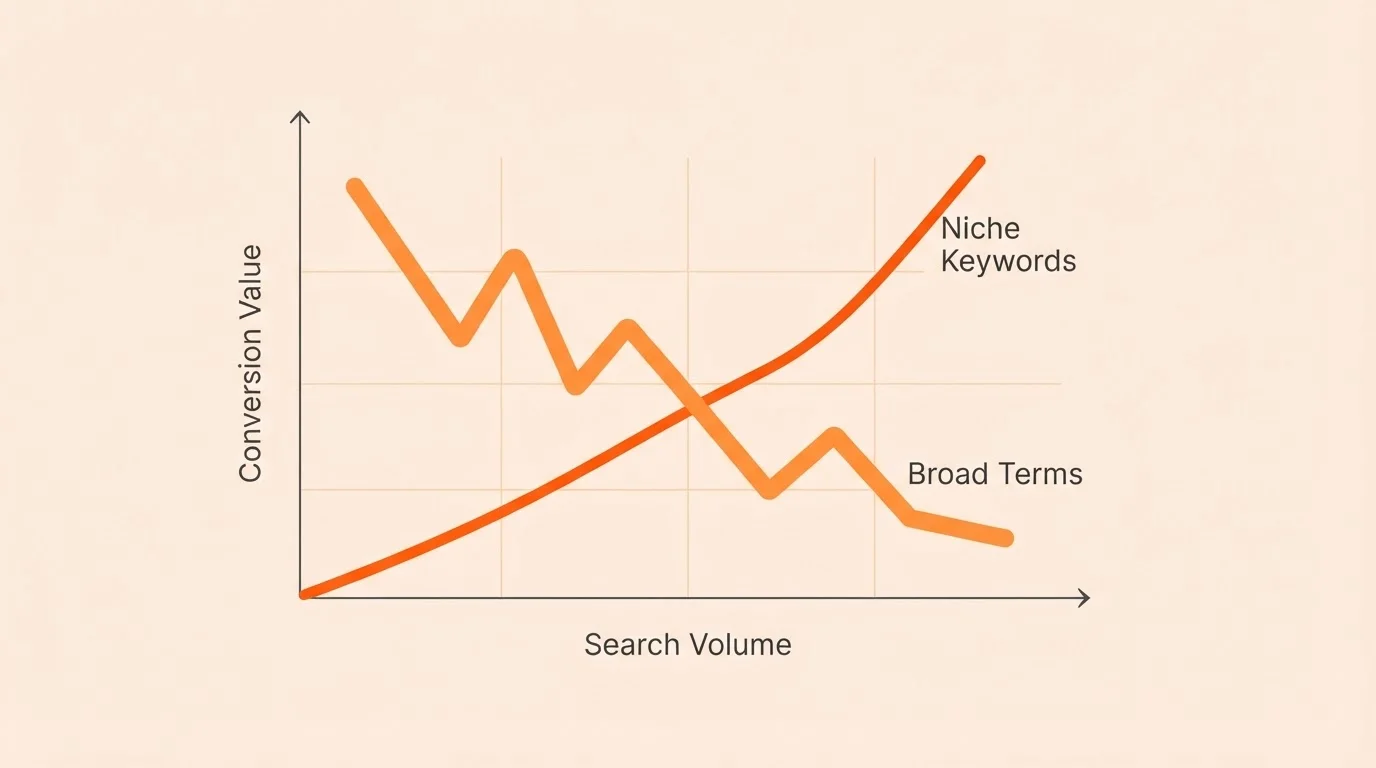
The traditional SEO playbook suggests chasing keywords with the highest search volume. For a startup, this is a recipe for stagnation. If you are building a new project management tool, ranking for 'project management software' on a fresh domain is nearly impossible due to the sheer domain authority of incumbents. More importantly, even if you did rank, the traffic is often too generic. A user searching for a broad term is usually in the research phase, not the buying phase.
Niche keywords represent the 'long tail' of search. These are specific phrases like 'automated resource scheduling for boutique design agencies' or 'real-time lead scoring for B2B SaaS.' While these terms have lower monthly search volumes, their commercial intent is significantly higher. The person searching for these terms has a specific job-to-be-done. By becoming the definitive authority on these narrow topics, a founder can build a pipeline of highly qualified leads who are primed to start a trial the moment they finish reading.
Topical Authority and the Snowball Effect
Search engines prioritize websites that demonstrate deep expertise in a specific subject area. By dominating a series of related niche keywords, you build Topical Authority. This creates a snowball effect: as you rank for more long-tail terms within a specific category, search engines begin to view your domain as a primary source of truth for that entire niche. This authority eventually makes it easier to rank for more competitive terms over time. An autonomous blogging strategy ensures that this authority is built systematically, covering every relevant angle of your product's utility without manual intervention.
Bridging the Gap: Transforming Product Knowledge into Discovery
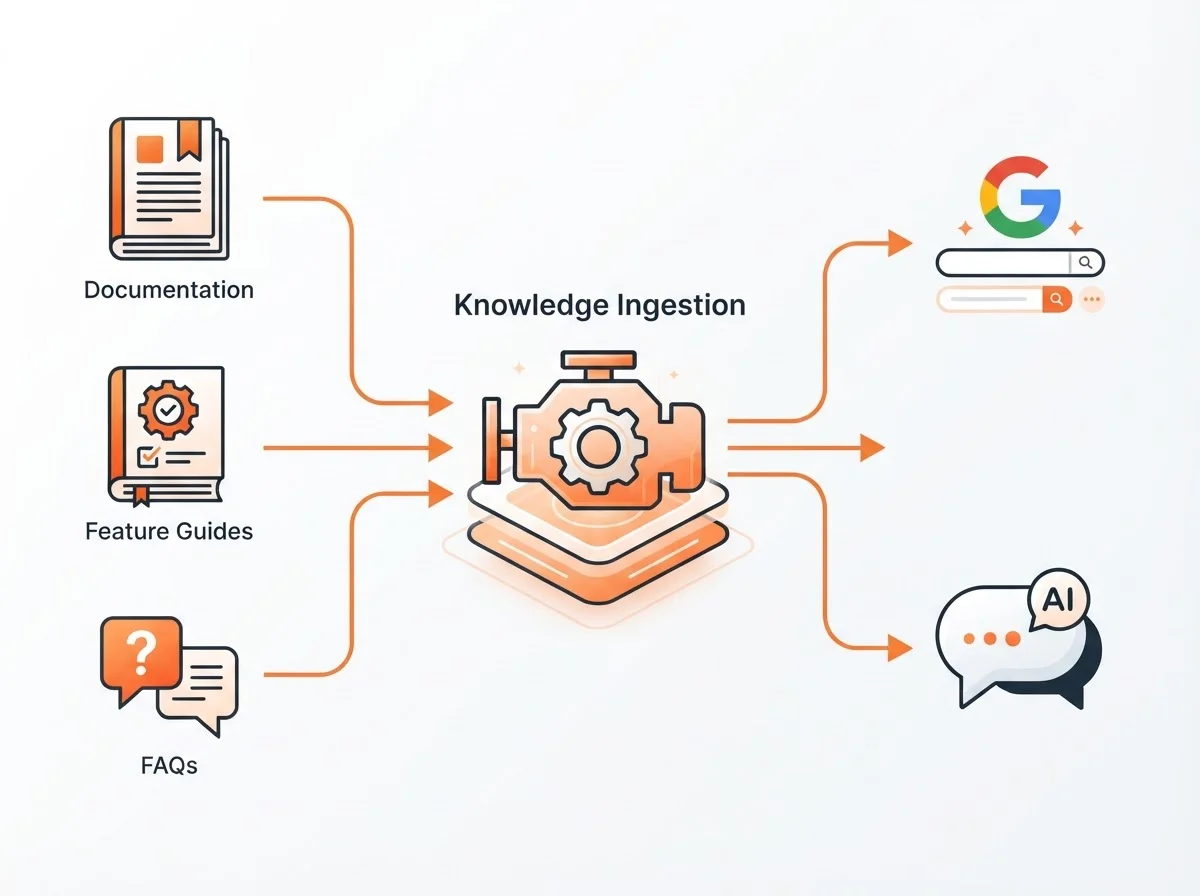
The greatest asset a SaaS founder possesses is deep product knowledge. However, that knowledge is often trapped in internal documentation, Slack threads, and FAQ pages where search engines cannot find it. The challenge is extracting this information and formatting it into product-led content that solves user problems. This is where Blogged functions as an autonomous SEO and GEO engine, bridging the gap between what your product does and what your future customers are searching for.
Through a process of Knowledge Ingestion, the platform analyzes your existing documentation and feature guides to understand the nuances of your software. It doesn't just write about 'industry trends'; it writes about how your specific tool solves specific problems. This ensures that every article is inherently product-led, moving the reader further down the funnel by demonstrating your value proposition in every paragraph.
Generative Engine Optimization (GEO): The Next Frontier
Search is evolving beyond the list of blue links. With the rise of AI assistants like ChatGPT, Claude, and Perplexity, founders must optimize for Generative Engine Optimization (GEO). These AI engines cite sources that provide clear, structured, and factual information. By producing high-quality, niche-focused content on autopilot, you increase the likelihood that your SaaS becomes the recommended solution when a user asks an AI, 'What is the best tool for managing remote design approvals?' Blogged automatically optimizes every post for both Google’s algorithms and these emerging generative discovery tools.
Autonomous Research and Competitor Watch
Finding the right niches to target is a full-time job. Most founders rely on gut feeling or expensive SEO consultants. An autonomous approach uses data to identify the 'gaps' in the market. Platforms like Blogged utilize a Competitor Watch feature to monitor what other blogs in your space are publishing. By identifying the high-intent keywords your competitors are ignoring, you can claim those niches before they become crowded.
This proactive research allows you to 'zig' where others 'zag.' If every competitor is writing about 'How to increase productivity,' you can focus your autonomous engine on 'Automated productivity reporting for distributed engineering teams.' This level of specificity is what wins in a saturated market, as it speaks directly to the user’s unique environment.
The Workflow: Maintaining Quality with Autonomous Systems
The primary fear founders have regarding automation is the loss of quality or brand voice. However, a well-implemented autonomous system doesn't remove the human from the loop; it removes the repetitive labor. The workflow should focus on high-level oversight and strategic alignment rather than word-smithing individual sentences.
Modern platforms support this by providing unlimited team seats on all paid plans. This allows your product managers and marketers to participate in the review process. By utilizing the built-in revision process—which includes one revision per article on the base plan—your team can ensure that every piece of content perfectly reflects your brand’s tone and technical accuracy before it goes live. This collaborative model ensures you get the volume of an automated system with the precision of a human editor.
Get practical updates on saas founder niche keyword organic growth case study
Receive new articles and practical insights by email.
Technical Implementation: Connecting Your Blog to Your Growth Stack
For an autonomous content strategy to be effective, it must be technically invisible. Founders do not have the time to copy-paste articles, fix broken images, or manually link related posts. The infrastructure must handle the entire lifecycle from draft to publication. Blogged is designed to integrate directly with the tools most SaaS teams already use, ensuring that your blog is a living, breathing part of your domain.
Whether you are using a standard CMS or a custom-built frontend, the integration process is streamlined to prioritize both performance and tracking. For a starting price of $99 per month, founders can access these deep integrations, ensuring their content is not just published, but is also tracking the conversions that matter to the business.
WordPress and Ghost Integrations
For teams on WordPress, the integration uses a dedicated publishing plugin and an application password. This allows Blogged to deliver articles directly to your site, managing internal links and metadata automatically. Critically, this integration allows you to collect consented visits and track configured conversions for every article, giving you a clear ROI on your content efforts.
Similarly, for those using Ghost, the connection is established via a custom integration using an Admin API key. While Blogged manages the heavy lifting of research, writing, and SEO, Ghost continues to handle the frontend rendering. This ensures that your blog always matches your brand's aesthetic while being powered by an autonomous engine.
Modern Frameworks: Webflow and Next.js
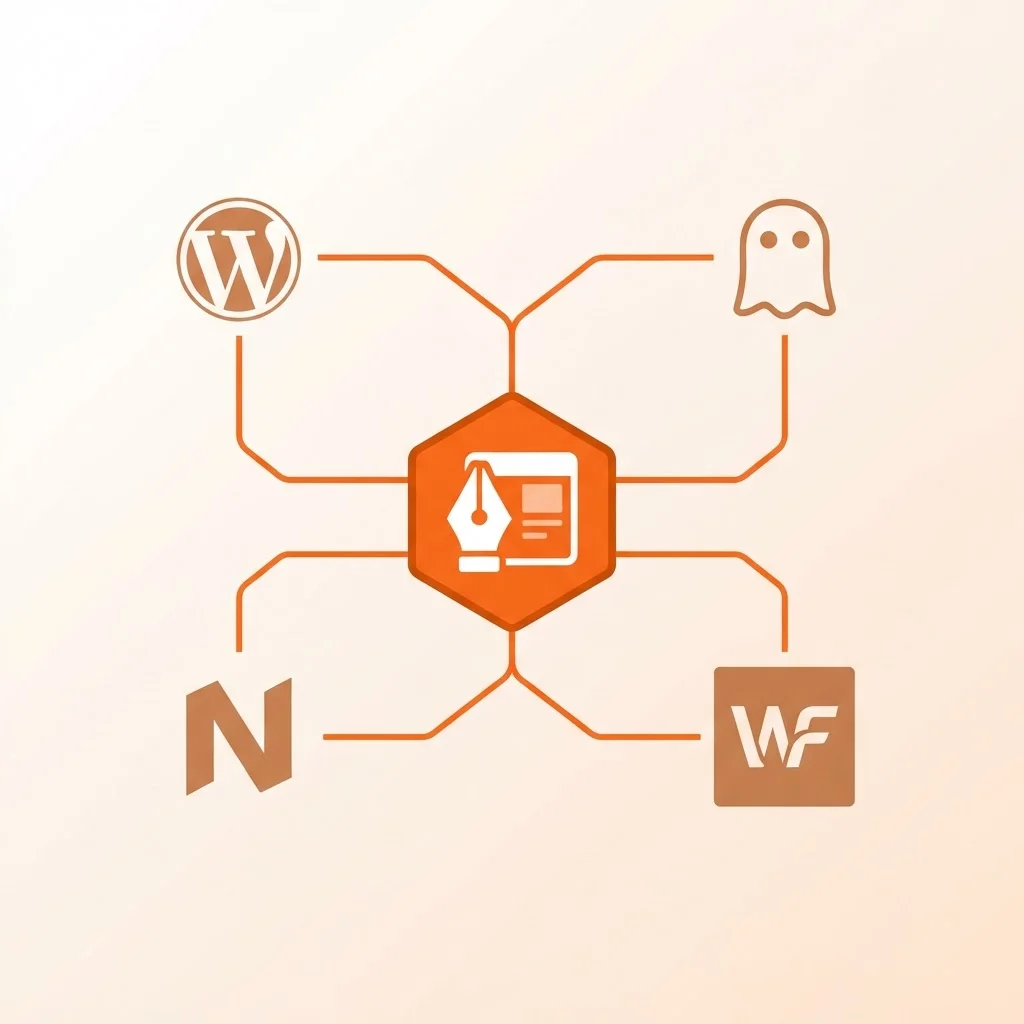
If your SaaS is built on a modern stack like Next.js or a design-heavy platform like Webflow, you aren't limited to manual updates. The Webflow CMS integration allows for the same conversion tracking and visit collection as the WordPress plugin. For teams with highly custom requirements, the Blogged API and signed webhooks allow you to programmatically pull content and performance data into your own dashboard, ensuring your blog remains a native part of your application’s ecosystem.
Common Questions About Autonomous SaaS Growth
Q: How do niche keywords actually drive sales?
Niche keywords attract users with specific problems. Because your content addresses that exact problem and demonstrates how your product solves it, the conversion rate from reader to trial user is significantly higher than with broad, educational traffic.
Q: Does AI-generated content rank well in Google?
Search engines reward helpful, reliable, and product-led content. By using Knowledge Ingestion to fuel the AI, you are producing content that is more factual and useful than generic human-written SEO fluff, which search engines prioritize.
Q: How much time does a founder need to spend on the blog?
With an autonomous platform like Blogged, the founder's role shifts to a 10-minute weekly review. The platform handles the research, writing, and publishing, while you simply approve the drafts.
Q: What is the cost of starting a niche dominance strategy?
Blogged starts at $99 per month. This includes the core Autopilot features, SEO/GEO optimization, and full integration with your existing website.
Dominating niche keywords is the most sustainable way for a SaaS founder to build an organic growth engine. By moving away from the 'Head Term Trap' and toward high-intent long-tail queries, you create a pipeline of qualified leads who are ready to buy. Implementing an autonomous system like Blogged removes the operational burden of content creation, allowing you to turn your product knowledge into a discoverable asset on autopilot.
With pricing starting at $99 per month and support for everything from WordPress to Next.js, the barrier to scaling your blog is gone. Start leveraging autonomous blogging today so you can focus on building your product while your content works to build your audience.