
On this page
For many SaaS founders, the most powerful marketing asset is currently locked inside technical documentation, private wikis, or your own mental map of the product. You understand exactly how your API solves legacy friction and why your specific architecture outpaces competitors. Yet, translating that internal expertise into high-ranking, lead-generating content is often where the growth engine stalls. The challenge is no longer just publishing volume; search engines and AI discovery tools now reward specific, product-led insights that help users solve real problems. This guide provides a blueprint for overcoming the content bottleneck by systematically transforming internal knowledge into discoverable content. By leveraging Blogged, an autonomous SEO and GEO blogging platform, founders can turn their feature descriptions into a self-sustaining organic machine.
The SaaS Content Gap: Why Expertise Stays Hidden
The primary hurdle for SaaS companies is not a lack of things to say, but the friction of saying them at a consistent scale. Most founders experience the 'content burst' cycle: a brilliant technical deep-dive followed by three months of silence during a development sprint. This inconsistency is a primary killer of domain authority, as search algorithms prioritize fresh, internally linked clusters of information. Maintaining this heartbeat manually while building a product is nearly impossible for small teams. Beyond consistency, there is the technical translation gap. Product managers speak the language of features, but customers search for solutions to pain points. Bridging this requires specialized skills in keyword research, semantic optimization, and search intent mapping that most lean teams lack.
The Opportunity Cost of Manual Content
Before adopting autonomous systems, founders typically choose between three inefficient paths. Hiring a full-time content marketer adds significant overhead and requires long onboarding to learn the software's nuances. Outsourcing to generic agencies often results in shallow articles that miss the product's technical value proposition. The third path—founders writing it themselves—is the most expensive when measured in opportunity cost. Every hour spent drafting a blog post is an hour stolen from the product roadmap or high-level strategy. Without a system to automate the research, writing, and optimization phases, organic growth remains a luxury rather than a predictable utility.
Turning Product Knowledge into Discovery with Blogged
Scaling organic traffic requires moving away from reactive posting toward an autonomous system built for the software lifecycle. Blogged is an autonomous SEO and GEO blogging platform designed to ingest raw product knowledge and output structured, high-intent content. It handles the planning and interlinking that typically consume hours of manual labor. This approach ensures that every visitor landing on your site is not just a reader, but a potential customer looking for the specific solutions your software provides. By integrating with your existing documentation, the platform creates a bridge between what the product does and what the user is searching for in their daily workflow.
How the Knowledge Engine Protects Accuracy
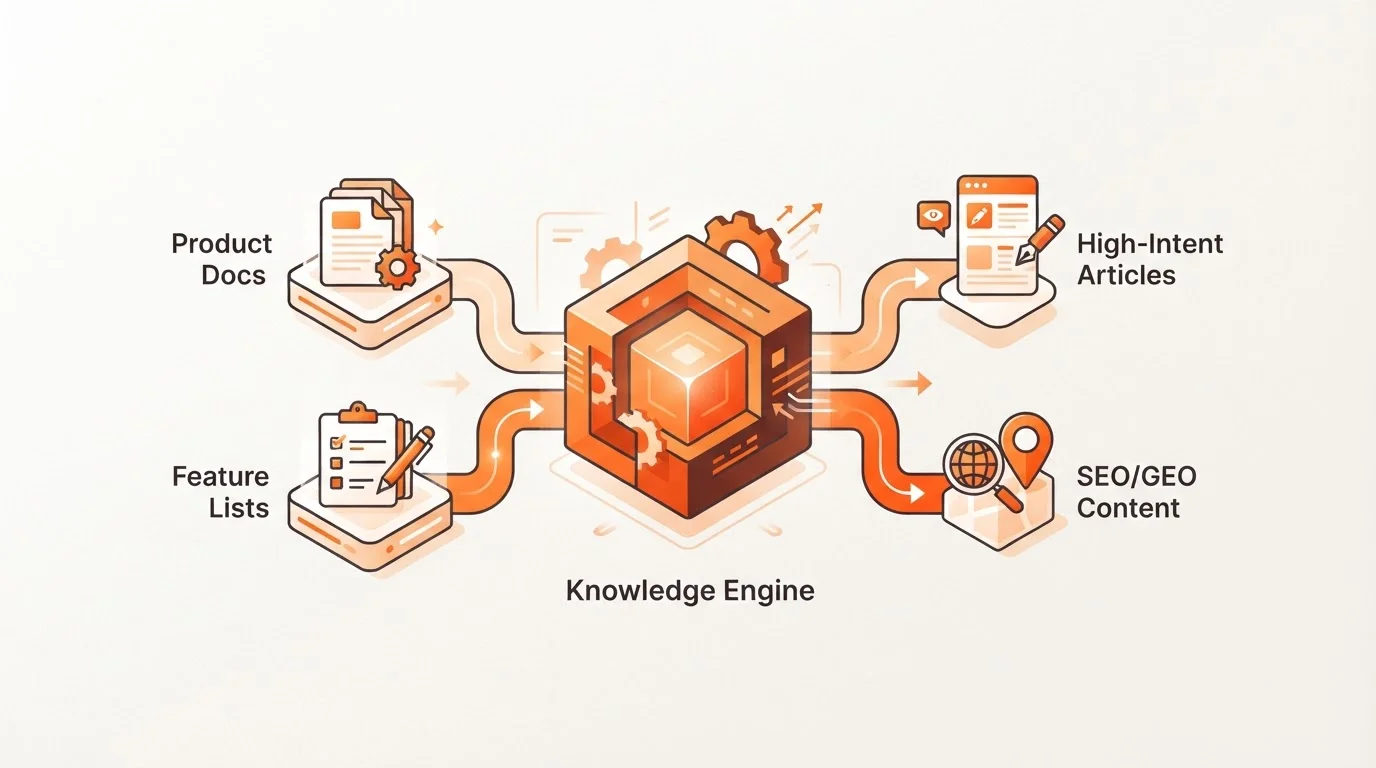
The Knowledge Engine serves as the foundation of the platform, ensuring technical accuracy without constant oversight. Implementation begins by feeding the system your product URLs and detailed feature descriptions. This grounding ensures the AI uses actual facts—such as your integrations, pricing tiers, and unique selling points—as the basis for every post. Because Blogged is built on an autonomous framework, it identifies gaps in your current content and automatically plans posts to fill them. This creates comprehensive coverage across the buyer's journey, from early-stage education to bottom-of-funnel comparisons, all while maintaining a technical level that generic AI tools cannot replicate.
The Evolution from SEO to GEO (Generative Engine Optimization)
Modern SaaS discovery is shifting from traditional keyword rankings to GEO. As AI-powered search engines like Perplexity and Google’s Search Generative Experience (SGE) provide direct answers, your content must be structured for AI extraction. Blogged optimizes your articles to be authoritative sources that AI models can cite when a user asks for tool recommendations. This dual-focus approach ensures your product remains visible regardless of how users choose to search. By providing structured, product-led answers, you position your software as the primary solution during the AI's answer-generation phase.
Compounding Authority with Autonomous Interlinking
Organic growth is not just about isolated posts; it is about how those posts connect to form a web of authority. Blogged includes an autonomous interlinking feature that connects new content to older, high-authority pages on your site. This passes link juice throughout the blog and helps search engines understand the semantic relationship between different topics. Over time, this makes it significantly harder for competitors to displace your rankings. It also keeps readers on your site longer, moving them from general education to specific product use cases and eventually to a signup page.
Technical Integration for the Modern SaaS Stack
A common objection for founders is the potential technical debt of adding new marketing tools. Blogged addresses this by providing deep integrations with popular CMS platforms and modern frameworks. Whether you use WordPress, Ghost, or a headless setup like Next.js, the publishing process is designed to be frictionless. This allows you to maintain a professional blog without manual formatting, header management, or image uploads. Everything flows directly from the platform to your live site, ensuring your organic strategy doesn't distract from your core engineering goals.
Get practical updates on saas founder product knowledge organic growth
Receive new articles and practical insights by email.
WordPress and Ghost Publishing
For teams using standard CMS platforms, setup is straightforward and secure. The WordPress AI Blog Publishing integration allows users to create and review articles in Blogged, then deliver them directly to their site via the Blogged Publishing plugin and an application password. If you prefer the minimalism of Ghost, the integration is equally robust. Users can create a custom integration in Ghost, copy the Admin API key, and verify the connection in Blogged. This allows the autonomous engine to manage the logic while Ghost handles the reader experience, ensuring a seamless delivery of product-led content.
Webflow and Next.js: Tracking and Conversions
Many modern startups choose Webflow for design flexibility or Next.js for performance. Blogged supports these environments by providing more than just text delivery. The Webflow CMS AI Blog Publishing integration lets users collect consented visits and configured conversions for verified articles. Similarly, the Next.js AI Blog Publishing integration provides the same level of tracking for custom-built React applications. This visibility is crucial for founders who need to justify marketing efforts with hard data and clear conversion metrics.
The Economics of Autonomous Content

Traditional SEO often requires paying for research and writing today while hoping for results months later. Blogged is listed at $99 per month, making it accessible for early-stage companies looking to build a compounding asset. Unlike many SaaS platforms that charge per user, every paid plan includes unlimited team seats. This allows your product managers, engineers, and marketers to participate in the review process without increasing your software bill. By reducing the cost per post and eliminating manual labor, your blog becomes a low-overhead utility that lowers your blended Customer Acquisition Cost (CAC) over time.
Maintaining Brand Voice Through Revisions
Founders often worry that automation might dilute their unique brand voice. Blogged addresses this through a structured revision system. Depending on the plan, the platform includes 1 revision per article or up to 3 revisions per article. Because the content is grounded in your Knowledge Engine, the initial drafts are already technically superior to generic AI output. This allows your team to focus on the final 10% of polishing—adding original insights that only your developers or founders possess—rather than the grinding labor of writing a 2,000-word post from scratch.
5-Step Framework to Unlock Your Growth Engine
- Audit Your Assets: Gather internal feature wikis, technical docs, and customer FAQs to serve as raw material. 2. Configure the Knowledge Base: Feed your product URLs into Blogged to ground the AI in your specific software facts. 3. Define Content Pillars: Identify core problem areas your SaaS solves and use Blogged to plan clusters around them. 4. Set the Autopilot: Choose a consistent publishing cadence, as search engines prioritize reliable schedules over erratic megaposts. 5. Review and Refine: Use your revision credits to inject your unique founder perspective, ensuring the content is both discoverable and deeply personal to your brand.
Frequently Asked Questions
Q: How does Blogged differ from general-purpose AI writers?
General AI lacks the Knowledge Engine and autonomous workflow. Blogged handles keyword research, semantic SEO, internal linking, and direct publishing while grounding everything in your specific product data for technical accuracy.
Q: Is autonomous blogging safe for my site's SEO reputation?
Yes. Blogged follows SEO best practices and focuses on helpful, product-led content. You can review and approve every draft before it goes live to ensure it meets quality standards.
Q: How much does the platform cost?
Blogged is listed at $99 per month, which includes the full suite of autonomous features for SaaS growth.
Q: Can my whole team collaborate on the blog?
Yes, every paid plan includes unlimited team seats, allowing product and marketing teams to collaborate on reviews without additional costs.
Q: What if I want to change a generated article?
The platform includes a revision system. Depending on your plan, you get 1 revision per article or up to 3 revisions per article to fine-tune the tone and accuracy.
Building a Self-Sustaining Knowledge Asset
Organic growth is not a mystery; it is a system of consistency and specificity. For SaaS founders, the path to scaling traffic doesn't require becoming a professional editor or managing an expensive agency. It requires unlocking the product knowledge you already possess and making it discoverable for the users who need it most. By moving to an autonomous blogging model, you stop competing on volume and start winning on value. In a crowded market, the companies that thrive are those that make their expertise accessible to the world. Start building your discoverable knowledge base today and turn your blog into your most effective sales representative.