
On this page
SaaS founders often face a frustrating paradox: the faster you ship product updates, the more your marketing content falls behind. This phenomenon is known as content drift. It occurs when your blog articles, tutorials, and landing pages describe features that no longer exist or work differently than they did at launch. For a high-velocity startup, this lag doesn't just look unprofessional; it actively erodes user trust and kills SEO relevance.
Traditional content cycles rely on manual audits where a founder or marketer must remember to update every relevant post whenever a UI changes or a new API endpoint is released. This is rarely sustainable. As your library grows, the manual labor required to maintain accuracy becomes a tax on your most creative people. To solve this, agile companies are moving away from manual writing cycles toward autonomous content management.
In this guide, we will examine how SaaS teams can implement an autonomous blogging system to keep pace with rapid release cycles. By automating the research, update, and synchronization process, founders can ensure that every new feature is searchable and accurately documented without the weeks of lag typical of manual editorial calendars. This shift transforms your blog from a static archive into a dynamic extension of your product.
The High Cost of Content Drift in Rapid Iteration
In a competitive SaaS niche, feature parity can change overnight. While your engineering team moves at light speed, a traditional content strategy often remains stuck in a manual bottleneck. Every time your team pushes a code update, your public-facing knowledge becomes slightly more obsolete. If left unmanaged, content drift creates three specific strategic failures that can stall growth.
First, it leads to increased support friction. When users find a tutorial on your blog that no longer matches the current dashboard, they don't blame the blog; they get frustrated with the product. This results in support tickets for features that are technically documented but functionally incorrect. Second, it causes SEO stagnation. Search engines prioritize accuracy and freshness. If your content remains static while user search queries evolve toward new feature names or specific use cases, your rankings will inevitably slide.
Finally, content drift creates a messaging bottleneck. Product managers may hesitate to launch impactful minor features because they know the marketing and documentation pipeline is already backlogged. This creates a strategic drag where the content team effectively slows down the product roadmap. Moving to an autonomous model removes this friction by allowing the content to evolve alongside the codebase.
Identifying the Manual Audit Problem
Before adopting an autonomous solution, a typical SaaS lead might spend dozens of hours every month checking existing posts against the live application. This is purely defensive work. It doesn't generate new leads or improve the product; it simply prevents the blog from becoming an embarrassment. For many founders, this is a hidden cost of scaling.
The larger your blog becomes, the more expensive it is to maintain manually. To reach hundreds of articles without a massive editorial team, you need a system that can intelligently identify what needs to change. By leveraging a platform that understands your product's current state, you can prepare updates as a standard part of your release cycle rather than a delayed afterthought.
Building an Autonomous Content Pipeline
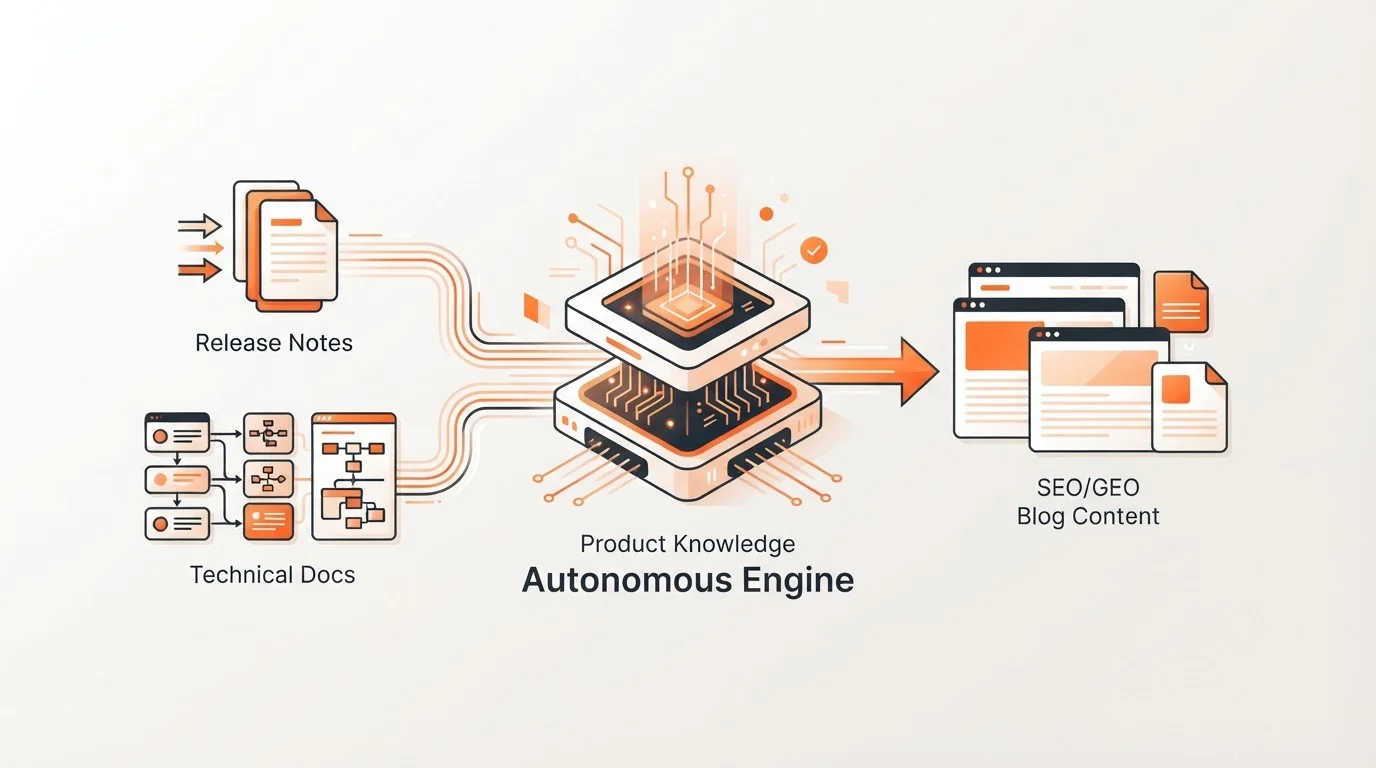
Autonomous platforms like Blogged handle the heavy lifting of content maintenance and product-led generation. The goal is to move from a reactive model—fixing things after they break—to a proactive model where the blog evolves in tandem with your software. This requires a shift in how you view your blog: not as a collection of static files, but as an API-driven asset.
By leveraging an autonomous platform, founders can treat their blog as a reflection of their Product Knowledge Engine. The platform ingests your technical documentation, release notes, and product specifications to generate content that is factually grounded. This ensures that even as you pivot or iterate, your marketing remains aligned with the actual user experience. This level of automation allows lean teams to focus on high-level positioning while the engine handles the repetitive research and drafting for a predictable flat fee of $99 per month.
Harnessing SEO and GEO for Discoverability
Modern search is no longer just about Google. With the rise of AI-driven search engines, founders must optimize for both Search Engine Optimization (SEO) and Generative Engine Optimization (GEO). Autonomous platforms are uniquely suited for this because they can generate the specific, technical, and data-rich content that AI models use to provide answers to users.
When your blog is updated autonomously with specific product knowledge, it becomes a primary source for AI crawlers. This increases your chances of being cited in AI-generated overviews and conversational search results. By maintaining a high volume of accurate, product-led content, you establish an authoritative footprint that manual teams simply cannot match in terms of speed and consistency.
Technical Implementation: Ghost and WordPress
A successful autonomous content stack requires a seamless handoff between the generation engine and the reader experience. You shouldn't have to copy-paste articles between windows. Instead, your autonomous engine should publish directly to your CMS of choice, ensuring that updates are live as soon as they are approved.
For founders using Ghost, the Ghost AI Blog Publishing integration allows teams to manage content creation and review within the autonomous platform while Ghost handles the frontend rendering. This is achieved by creating a custom integration in Ghost and using the Admin API key to verify the connection. This setup also allows you to collect consented visits and track conversions directly on your verified articles, closing the loop between content and revenue.
Integrating with Self-Hosted WordPress
For teams on WordPress, the process is equally streamlined. Blogged connects to self-hosted WordPress through a dedicated publishing plugin and an application password. This ensures that even with complex, custom-themed sites, the autonomous engine delivers articles and updates directly to the CMS. This integration allows users to create and review articles within the Blogged dashboard and then push them to their website with a single click, maintaining the integrity of the site's design while automating the production of the words themselves.
Get practical updates on saas founder faster content updates product changes case study
Receive new articles and practical insights by email.
Maintaining Brand Voice with Human-in-the-Loop
One of the primary concerns for SaaS founders is maintaining a consistent brand voice. While automation handles the research and drafting, the human element remains vital for final approval and tone adjustment. Autonomous blogging should be seen as a "human-in-the-loop" workflow rather than a "set and forget" black box.
Teams can utilize revision and review features to ensure every autonomously generated update meets editorial standards. On the standard $99 per month plan, users can review articles and request up to 3 revisions per article. This allows founders to fine-tune the tone, add specific nuances, or emphasize certain value propositions before the content goes live. It eliminates the "blank page" problem, turning the founder from a writer into an editor.
Scaling Through Team Collaboration

Content updates should not be the sole responsibility of a single person. In a fast-moving SaaS, input from product managers, developers, and support leads is invaluable for ensuring accuracy. Most traditional blogging tools charge per seat, which creates a barrier to collaboration. To solve this, Blogged includes unlimited team seats on all paid plans.
This allows your entire team to participate in the review and approval process without additional costs. A developer can quickly check a technical description for accuracy, while a marketer refines the call to action. By democratizing the content review process, you ensure that the blog is a true cross-functional asset that reflects the collective expertise of your company.
Key Takeaways for SaaS Founders
If you are struggling to keep your content aligned with your product development, consider these actionable steps to modernize your workflow:
- Eliminate Manual Auditing: Shift your perspective from "writing articles" to "managing a knowledge base." Use an autonomous system to monitor your content for drift and suggest updates based on your latest product changes.
- Centralize Your Knowledge: Your blog shouldn't live in a vacuum. Feed your autonomous platform with your primary product data sources—documentation, release notes, and API specs—so it learns as you build.
- Optimize for Speed-to-Market: In SaaS SEO, the first company to publish high-quality, accurate content about a new feature or industry shift usually captures the bulk of the organic traffic. Automation is your tool for winning that race.
- Leverage Unlimited Collaboration: Don't silo your blog. Use platforms that offer unlimited team seats so that everyone from the founder to the support lead can contribute to the content review process without increasing your software overhead.
By moving to an autonomous model, you aren't just saving on writing costs; you are building a marketing engine that is as agile as your code. For $99 per month, founders can replace the overhead of managing multiple freelancers and hundreds of hours of manual labor with a streamlined, product-led growth machine.
Frequently Asked Questions
Q: How much does an autonomous blogging platform like Blogged cost?
Blogged is listed at $99 per month, which includes the core features needed to automate research, writing, and publishing.
Q: Does this replace the need for a marketing manager?
No. It replaces the repetitive tasks of research, drafting, and manual SEO optimization. Your marketing lead can then focus on strategy, positioning, and conversion optimization rather than just managing a content calendar.
Q: Can the autonomous system handle technical UI changes?
The system uses its Knowledge Engine to update feature descriptions and workflows based on the data you provide. While you may still want to upload custom screenshots, the text-based descriptions and SEO metadata are updated automatically.
Q: How many team members can I add to the review process?
Every paid plan on Blogged includes unlimited team seats, allowing your entire product and marketing team to collaborate on content reviews without extra fees.
Modern SaaS development moves too fast for traditional blogging workflows. By embracing autonomous blogging, founders can turn their content strategy into a high-speed engine that matches their development pace. This means more time spent building the product and less time worrying about whether the blog is telling the right story. If your product is evolving every week, your content should too—automatically.