
On this page
The speed of SaaS development often leaves marketing content in the dust. You ship a new feature on Monday, but your main product guide was written six months ago and still references the legacy UI. This freshness gap does more than confuse users; it signals to search engines that your site is stagnant, eroding your authority in both traditional Search Engine Optimization (SEO) and the emerging world of Generative Engine Optimization (GEO). While autonomous SEO platforms promise to solve the consistency problem, they handle the inevitable reality of product changes very differently. Choosing between On Page and Blogged depends on whether you want a reporting-heavy tool to guide your manual updates or an autonomous engine that syncs directly with your product's source of truth.
The SaaS Freshness Crisis: Why Manual Content Maintenance Fails
In the SaaS world, content is your product's front door. When a founder is focused on building, the blog is usually the first thing to suffer. Traditional content workflows require a human to notice a product change, find all relevant blog posts, and manually rewrite sections to ensure accuracy. This is rarely sustainable as you scale.
Outdated content creates two major risks for SaaS businesses. First, it increases support overhead as users find old tutorials that no longer work. Second, it hurts rankings because search engines like Google and AI discovery engines like Perplexity prioritize content that reflects the current state of a topic. If your competitors are updating their feature comparisons and you aren't, you lose visibility in the search results.
Autonomous platforms aim to bridge this gap. However, the methodology—how they 'know' your product has changed—is the critical differentiator between a tool that helps you work and a system that works for you. Understanding the mechanics of these updates is essential for maintaining product-led content updates.
On Page: Optimization Through Analytical Reporting
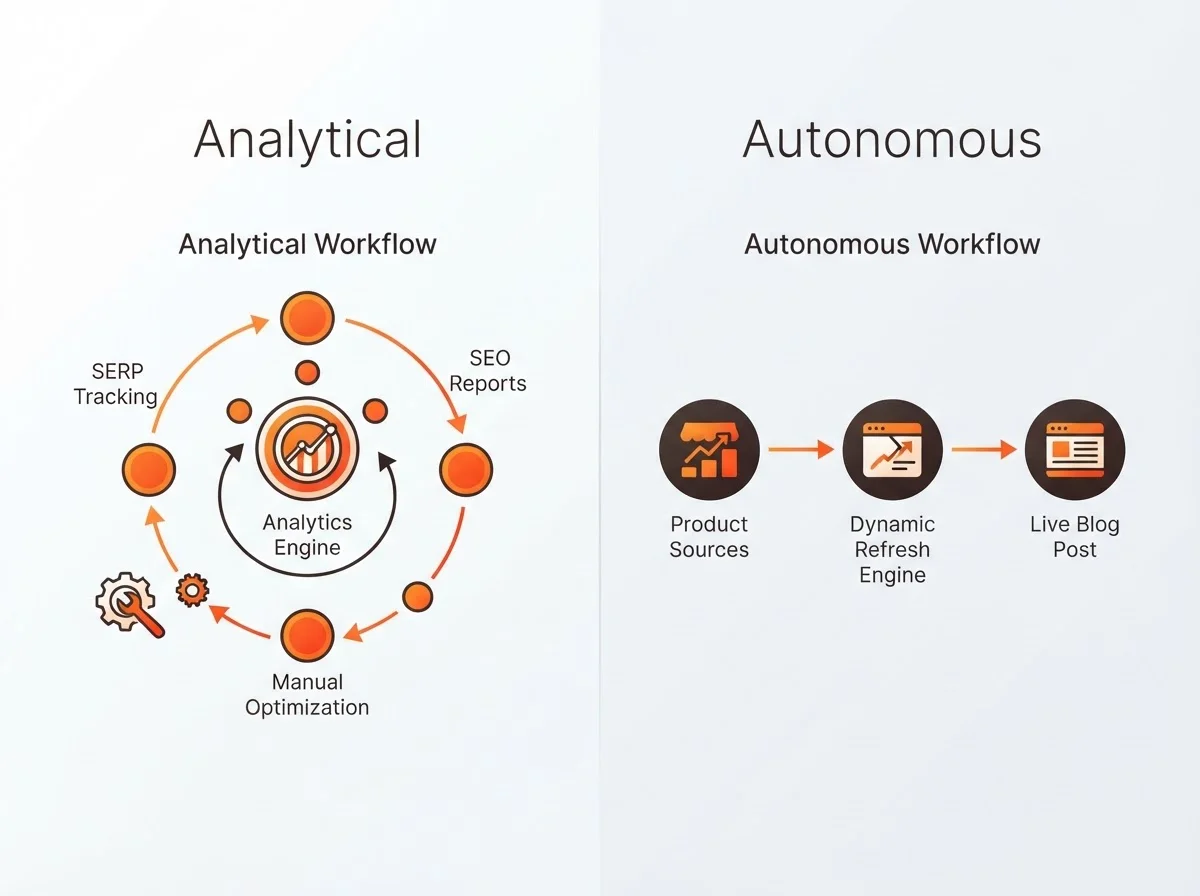
On Page (On-Page.ai) approaches the content update problem through the lens of sophisticated data and auditing. It is built for the user who wants high-level visibility into how their content is performing and where it needs to be adjusted. It doesn't just write; it analyzes the search environment to tell you what needs to change based on current SERP trends.
For SaaS founders, the platform's strength lies in its transparency. On Page provides a detailed audit trail within its reports, documenting the specific changes made to content over time. This is invaluable for teams that need to maintain strict version control or those who want to see exactly how an optimization pass affected their search engine presence. It ensures that every tweak made by the AI is recorded for review.
Data-Driven Visibility with the On Page API
On Page offers deep technical integrations that allow founders to build their own reporting pipelines. Using the On Page API, users can automate SEO and GEO reports, tracking not just standard keyword rankings but also competitor overlap and presence in AI Overviews. This means you can detect when a competitor's product update has started to displace your content in AI-generated answers.
The platform also offers an agency reporting pipeline that combines several SEO datasets. This makes it a powerful choice for founders who manage multiple sub-brands or who work with external SEO consultants. However, while On Page provides the data needed to identify that an update is necessary, the actual adaptation of content to reflect a new product feature often requires the user to initiate the rewrite based on those generated insights.
Blogged: The Autonomous Knowledge Engine Approach
Blogged is designed specifically for SaaS founders who want to move from manual content management to full autopilot. Its core differentiator is the Knowledge Engine, a system that transforms product documentation and raw technical data into discoverable, product-led content. Instead of waiting for you to tell it what changed based on a report, Blogged allows you to provide the sources that the AI uses as its ground truth.
This approach shifts the focus from SEO auditing to product synchronization. By connecting your technical assets directly to the content generation process, you ensure that every blog post remains technically accurate without requiring a marketing manager to cross-reference the latest software release notes.
Dynamic Grounding for Real-Time Updates
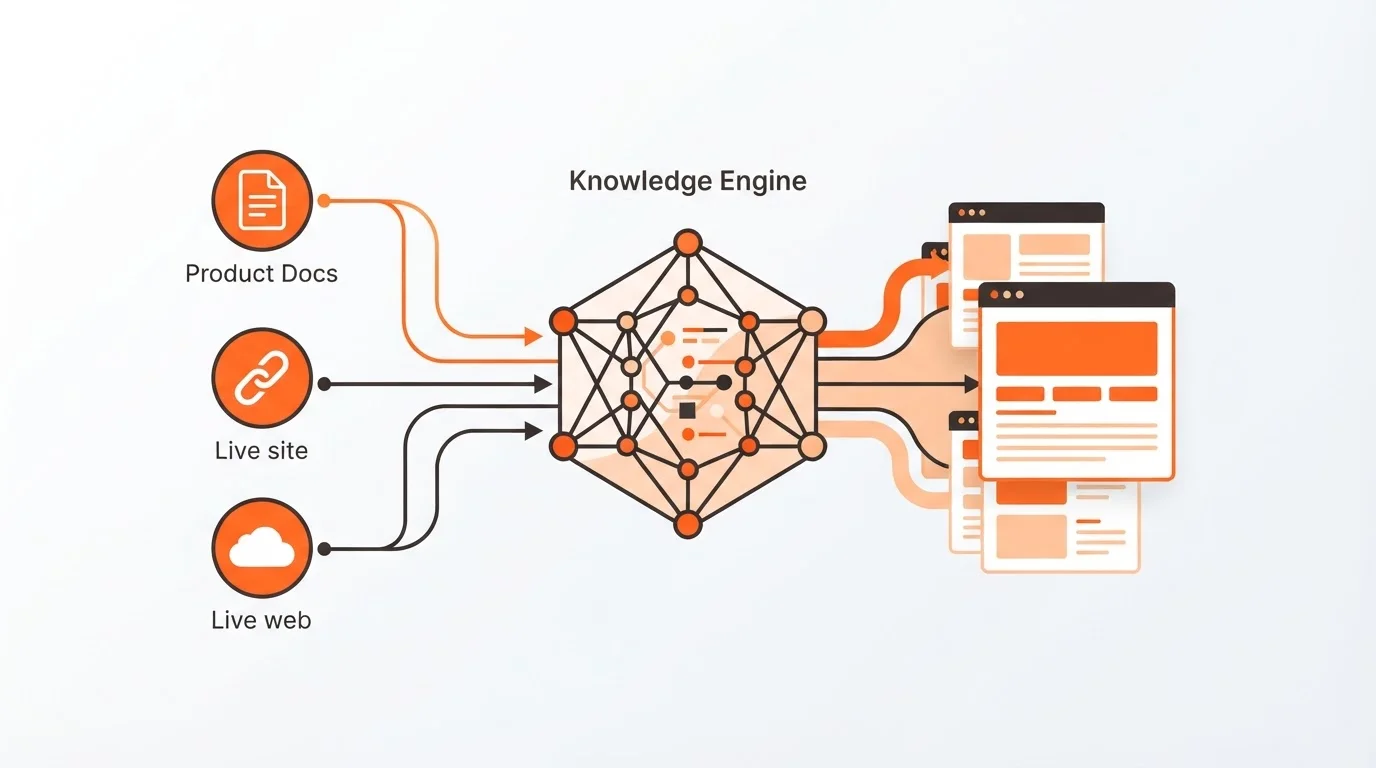
The Blogged Knowledge Engine allows users to connect various sources, including public product documentation, uploaded technical documents, pasted links, or even a simple written description of a new feature. This grounding ensures the platform understands the product at a deep level before it ever writes a word. It effectively acts as a repository for your SaaS's intellectual property.
When your product changes—for example, if you release a new integration or update your pricing—you simply update the Knowledge Engine source. The platform then uses this updated knowledge to refresh existing blog posts and generate new content that accurately reflects the current state of your SaaS. This creates a direct link between your development roadmap and your search visibility, preventing the AI from hallucinating features that no longer exist.
Full-Stack Autonomy: From Research to Publishing
While On Page focuses on the optimization and reporting side, Blogged manages the entire content lifecycle. It handles research, planning, internal linking, and publishing on your behalf. For a founder building on WordPress or Webflow, Blogged offers native integrations that simplify the distribution of content.
The Webflow CMS integration, for instance, even allows users to collect data on consented visits and configured conversions for verified articles. This closes the loop between content creation and business results. By automating the publishing step, the platform ensures that updated information reaches your audience as soon as the Knowledge Engine is refreshed, rather than waiting for a manual export.
Side-by-Side Comparison: Workflow and Pricing
To choose between these platforms, you must consider your team's bandwidth. On Page is a powerful tool for those who want to drive the machine; Blogged is the autonomous driver. The pricing models and features reflect these different target audiences and their specific operational needs.
Get practical updates on on page vs blogged content updates product changes
Receive new articles and practical insights by email.
| Comparison Area | On Page | Blogged |
|---|---|---|
| Update Mechanism | Report-based audit trails and manual optimization passes. | Dynamic refresh via the Knowledge Engine. |
| Primary Logic | Analytical: SERP tracking and SEO/GEO reports. | Product-Led: Grounding AI in your actual product docs. |
| Entry Pricing | $229/month (Well Researched Only). | Accessible Starter tiers available. |
| Growth Pricing | $499/month (Growth). | Scalable Growth tiers available. |
| Integrations | API, Google Sheets, n8n, Make, Zapier. | WordPress, Webflow, Knowledge Engine Sources. |
| GEO Focus | Tracks AI Overview presence via API. | Purpose-built for SEO and AI discovery (GEO). |
| Usage Limits | Includes 5,000 credits for reporting and writing. | Unlimited Knowledge Engine grounding sources. |
Strategic Choice: Which Platform Fits Your SaaS?
Deciding between On Page and Blogged often comes down to the frequency of your product iterations and the size of your marketing team. If you are a solo founder or leading a lean team, the administrative cost of checking reports and manually initiating updates can be prohibitive to growth.
Choose On Page if...
You have a dedicated SEO manager or agency partner who thrives on data and technical auditing. The ability to use the On Page API to track SERP features and AI Overview presence is a significant advantage for power users who want to build custom reporting dashboards. If you need 5,000 credits to run massive reporting pipelines and want a meticulous audit trail for every single tweak, On Page's more granular approach is a strong fit.
Choose Blogged if...
You want your blog to be a mirror of your product documentation without constant manual oversight. If you are shipping updates weekly, Blogged’s Knowledge Engine is a strategic asset that prevents content decay by grounding the AI in your latest technical documents. It is specifically designed for early-stage SaaS founders who need to build organic search and AI-discovery authority while spending the majority of their energy on product development.
Frequently Asked Questions
Q: How do these platforms handle the risk of AI hallucinations?
Blogged uses grounding via its Knowledge Engine, meaning it only writes based on the documents and links you provide. On Page uses an audit trail and reporting system so you can review and verify every change made by the AI.
Q: Can I use both platforms together?
While possible, they serve different primary functions. On Page is excellent for technical SEO auditing and ranking data, while Blogged is a complete autonomous publishing house. Most SaaS founders find that Blogged's all-in-one approach is more efficient for growth.
Q: Does product-led content really help with SEO?
Yes. Search engines now prioritize content that demonstrates experience and expertise. Content that accurately reflects your product's specific features and use cases ranks better than generic, AI-generated filler because it provides genuine value to the reader.
Q: Is it difficult to switch from manual blogging to these platforms?
Blogged is designed for a quick start; you can connect your documentation and have a content plan generated in minutes. On Page may require more setup time if you are building custom reporting pipelines through their API or connecting various data sources like Google Sheets or Zapier.
In the race to dominate SaaS search and AI discovery, content freshness is no longer optional. On Page provides the analytical tools and reporting depth required for data-driven SEO teams who want to keep a close eye on their audit trails and AI presence. However, for founders who need to transform their product knowledge into discoverable content without adding 'Content Manager' to their job description, Blogged offers a superior autonomous solution. By grounding your blog in your actual product documentation via the Knowledge Engine, Blogged ensures your marketing stays as current as your code, allowing you to focus on building while the platform focuses on organic growth.