
On this page
For a SaaS founder, the definition of "search presence" has undergone a radical shift. In previous years, organic growth was measured by a simple list of blue links on a Google results page. Today, potential customers are asking ChatGPT for product recommendations, querying Perplexity for feature comparisons, and reading Google AI Overviews to solve technical problems. This shift has created a new requirement for every growth stack: AI search presence tracking. Choosing between On Page and Blogged for this task involves a choice between two distinct philosophies. On Page is a high-control, data-intensive platform designed for those who want to monitor every mention and citation across the AI ecosystem via API. Blogged, by contrast, is an autonomous growth engine that focuses on Generative Engine Optimization (GEO). It grounds your AI search presence in your actual product knowledge so that Large Language Models (LLMs) cite your brand as the definitive authority.
The Core Differences in Autonomous SEO
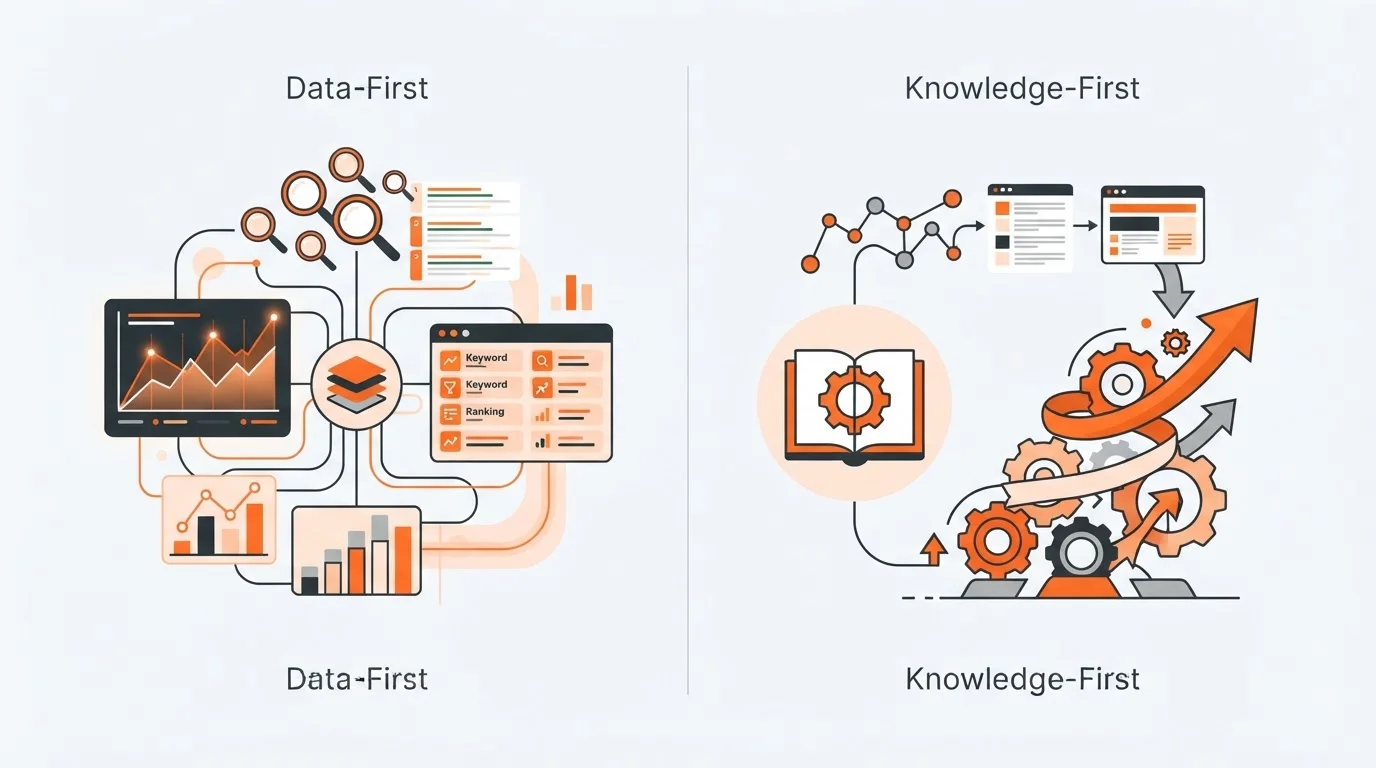
Before examining tracking specifics, it is essential to understand how these platforms define autonomy. Traditional SEO tools require a human to interpret data, draft a brief, and then write the content. Autonomous platforms aim to close this loop by using AI to handle the heavy lifting. However, they approach the "Knowledge" problem differently. On Page focuses on SERP data and competitor scans. It looks at what is currently ranking and attempts to replicate or exceed the structural and keyword-density signals found in those results. This is a data-first approach that prioritizes mathematical relevance to existing search results. Blogged utilizes a Knowledge Engine approach. It prioritizes your specific product facts—such as features, technical documentation, and unique selling points—to generate content. This ensures that the resulting articles are not just SEO-friendly, but technically accurate and product-led. For a SaaS founder, this distinction is critical for maintaining brand integrity while scaling organic traffic.
Platform Feature Comparison
| Comparison Area | On Page | Blogged |
|---|---|---|
| Primary Strategy | Ranking Analytics & NLP Density | Product-Led Content & GEO |
| Tracking Focus | AI Mentions, Citations, & Rankings | AI Citation Authority & GEO Efficiency |
| Autonomy Level | High Control / Manual Iteration | Full Autopilot / Autonomous Loop |
| Source Grounding | Competitor Pages & SERP Data | Product Docs, Links, & Manual Facts |
| CMS Support | WordPress Plugin | WordPress, Ghost, Webflow, Next.js |
| Best For | SEO Specialists & Agencies | SaaS Founders & Small Product Teams |
| Data Integration | Zapier, Make, n8n, Google Sheets | Direct CMS Sync & Knowledge Engine |
On Page: Precision Tracking and API-First Analytics
On Page is built for the user who wants to see the math behind their visibility. Its suite of tools is designed to monitor brand mentions and recommendations across major LLM platforms, including ChatGPT, Gemini, and Perplexity. This provides SaaS teams with a clear view of their Visibility Score, a metric that benchmarks presence in AI-generated answers over time. A standout feature is the On Page API. This allows technical teams to automate SEO and GEO reports for clients or internal stakeholders, pulling data into custom dashboards. The API also supports tracking keyword rankings and competitor overlap, which is useful for businesses in hyper-competitive niches where market share is contested daily. On Page's API also has integrations for Google Sheets, n8n, Make, Postman, Zapier, and a DataForSEO MCP, making it a robust choice for teams with existing automated reporting pipelines.
Transparency Through Audit Trails
One of the platform's practical advantages is the ability to maintain an Audit Trail. Within its reports, On Page allows users to see a history of the changes made to specific optimization profiles. This transparency is vital for teams that need to correlate tactical tweaks—like adjusting keyword density or structural headers—with actual shifts in search presence. For a SaaS company with a dedicated SEO manager, this level of documentation provides a safety net. It ensures that the rationale behind every optimization is recorded, making it easier to refine long-term strategies without losing track of past experiments. However, this high-control approach naturally requires more human oversight than a fully autonomous system.
Blogged: Dominating AI Search via Product Grounding
Blogged treats AI search presence not just as something to track, but as something to engineer from the ground up. The platform’s philosophy is rooted in Generative Engine Optimization (GEO). The goal is to ensure that when an AI engine searches for a solution in your niche, your product is the most authoritative and easiest-to-cite source available. The core of this strategy is the Knowledge Engine. Blogged allows you to provide public product sources, uploaded documents, pasted links, or written product descriptions. The platform uses these facts to ground the AI, preventing the generic hallucinations often associated with standard AI writing tools. This ensures that every article published reflects the technical reality of your SaaS product and provides the exact detail LLMs need to recommend you to users.
Get practical updates on on page vs blogged ai search presence tracking
Receive new articles and practical insights by email.
Full Autopilot for Product-Led Growth
For founders, the biggest barrier to organic growth is the operational drag of consistent content production. Blogged’s Full Autopilot mode handles the entire lifecycle: research, planning, writing, optimization, internal linking, and publishing. By automating these steps, the platform allows founders to maintain a high-quality blog that builds authority in AI search engines while they focus on shipping code. The platform integrates natively with WordPress, Ghost, Webflow, and Next.js. You can create and review articles within the Blogged interface and sync them directly to your CMS. This reduces the time-to-value for content marketing, ensuring that your search presence grows at the same pace as your feature releases without needing to hire a full content team.
Pricing Comparison for SaaS Teams

SaaS founders must weigh the cost of these tools against the potential time savings and growth ROI. On Page pricing starts at $229 per month for the Well Researched Only plan, with a Growth tier at $499 per month and a Scale tier at $999 per month. For those needing the WordPress Import functionality, plans are also listed at $499 per month, reflecting a premium positioned for agencies and high-volume data users. Blogged offers a more accessible entry point for builders. The Starter plan is listed at $99 per month, providing a cost-effective way for early-stage founders to establish an organic presence. The Growth plan is $169 per month, and the Ultra Growth plan is $229 per month. While On Page is a significant investment for teams that view SEO as a primary technical lever requiring thousands of credits for data scans, Blogged is priced to scale alongside a growing SaaS blog.
Best-Fit Decision Guidance
To choose the right platform, evaluate your team's current capacity and your primary objective for organic growth. Choose On Page if you have a dedicated SEO manager who needs to manually iterate on content density and structural signals using deep NLP data. It is the ideal choice if you require an API-driven solution to build custom visibility dashboards or agency reporting pipelines for thousands of keywords. Choose Blogged if you are a SaaS founder who needs to sustain a high-quality blog while focusing on building your product. It is the superior choice if your product is technical and you need AI content that is grounded in your specific product facts to ensure accuracy. If your goal is to dominate AI search and GEO by becoming the primary source of truth for your niche using an autonomous, product-led loop, Blogged provides the most streamlined path to results.
Frequently Asked Questions
Q: Can I use both platforms together?
While possible, it is often redundant for small teams. On Page is best for those who want to micro-manage search data, while Blogged is designed to be an autonomous replacement for manual SEO workflows.
Q: Does Blogged track traditional Google rankings?
Yes. While Blogged emphasizes GEO and AI search presence, it generates SEO-optimized content designed to rank in traditional search results and provides the necessary internal linking and technical structure for organic growth.
Q: How does On Page's Audit Trail work?
The Audit Trail allows users to see a history of changes made to an optimization profile. This is useful for teams that need to explain performance shifts by pointing to specific tactical changes made over time.
Q: What is the Knowledge Engine in Blogged?
The Knowledge Engine is a centralized repository where you store product descriptions, documentation, and competitive facts. The AI uses these bounded facts to ensure every article it writes is technically accurate and uniquely tied to your SaaS product.
Final Verdict: Tracking Data vs. Building Authority
In the race for AI search presence, the winner isn't necessarily the company with the most data, but the company that provides the most authoritative answers. On Page provides the radar. It tells you exactly where you are, who is overlapping with your territory, and how your visibility score is trending across the AI ecosystem. It is an essential tool for the data-hungry marketer who wants to measure the search environment with scientific precision. Blogged provides the engine. It transforms your internal product knowledge into the very content that AI search engines crave. By automating the research-to-publishing loop and grounding every post in your unique product facets, Blogged allows SaaS founders to build a durable moat of authority. For most founders, the ability to scale organic growth on autopilot—without sacrificing technical accuracy—makes Blogged the superior strategic fit for product-led growth.