
On this page
The content bottleneck is a standard challenge for growing software companies. SaaS founders understand that high-fidelity technical content attracts the most qualified customer segments. Yet, the deep engineering knowledge required to write these articles creates an operational compromise. You must either divert software engineers from building product features or hire external writers who lack deep technical context.
This trade-off creates an inconsistent publishing cadence that harms long-term search performance. Traditional content outsourcing often fails because standard marketing teams cannot grasp complex logic flows, API patterns, or intricate database relationships. Consequently, software blogs often become empty repositories or collections of superficial marketing articles that fail to engage sophisticated B2B buyers.
To resolve this issue, software teams are shifting away from manual production pipelines. Instead of treating every article as an isolated project, founders are utilizing engineering documentation, feature logs, and technical specification files as programmatic data inputs. By implementing Blogged, an autonomous SEO and GEO blogging platform, companies decouple organic growth from manual drafting hours.
This detailed guide provides an actionable architecture for constructing an autonomous, knowledge-backed organic search distribution loop. We will examine how automated content engines transform structured software context into high-conversion assets. The goal is to turn product expertise into visible search results while allowing engineering teams to remain focused on product development.
The Structural Disconnect in SaaS Content Generation
The primary operational obstacle in corporate content creation is the severe allocation of specialized talent. Product-led growth strategies depend on explaining technical concepts clearly to prospective users. However, the individuals with the deepest domain knowledge—such as system architects, product owners, and technical founders—possess the least amount of operational bandwidth for writing long-form prose.
When technical leaders delegate content production to standard marketing agencies, the results often lack the required technical authority. A writer without systems experience struggles to accurately convey how an event-driven automation framework or a specific multi-tenant data architecture operates. This knowledge deficit yields superficial content that fails to capture high-intent buyers who need precise answers to implementation challenges.
To compensate for poor external drafts, technical team members must spend considerable time editing, refactoring, and correcting technical inaccuracies. This review loop undermines the initial cost savings of outsourcing, transforming product executives into expensive editorial managers. The cost of this friction is measured not just in marketing spend, but in delayed feature releases and product roadmap slippage.
Furthermore, organic visibility requires strict publishing regularity to establish topical authority within modern indexers. An interrupted publishing cadence prevents domain growth and reduces competitive advantage. Overcoming this bottleneck requires moving away from manual drafting toward a technical framework capable of automating research, generation, and distribution.
Defining Product-Led Content and Its ROI Dynamics
Product-led content differs fundamentally from standard inbound marketing text because it integrates the software platform directly into the solution of a user problem. It avoids broad educational topics and focuses on technical challenges that your software is uniquely designed to solve. The core purpose is to educate the searcher while demonstrating the explicit utility of your software interface.
When an article describes an API setup, a specific database migration, or an automated reporting workflow, it attracts a highly targeted audience. These readers are not looking for superficial definitions; they are looking for specific operational answers. By presenting clear code solutions alongside the product's UI capabilities, you naturally guide the reader from an informational query to a trial registration.
To understand the return on investment of this approach, we must contrast different execution models. The following comparison table outlines how traditional creation, isolated generative tools, and fully autonomous knowledge-driven content systems differ across critical engineering and growth dimensions:
| Dimension | Traditional Manual Content | Standard LLM Tools | Autonomous Knowledge Engines |
|---|---|---|---|
| Source Context | Manual engineering interviews | Generic public training datasets | Structured product documentation & links |
| Founder Input Time | 4 to 8 hours per article | 1 to 2 hours of manual prompting | Under 30 minutes weekly for queue review |
| Technical Fidelity | High, but expensive to scale | Low; prone to logical hallucinations | High; strictly bounded by product facts |
| Publishing Cadence | Irregular due to resource constraints | High volume, but manual staging required | Automated on custom scheduled intervals |
| SEO & GEO Readiness | Standard metadata optimization only | Lacks advanced entity structuring | Native structured schemas for AI discovery |
As shown, autonomous knowledge engines provide a balanced solution by maintaining technical fidelity while eliminating the manual labor associated with traditional production.
Evaluating Content Costs vs. Lifetime Value
To build a sustainable product-led content ROI case study, a software company must measure the total cost of acquisition against long-term user value. Manual content pipelines incur compounding operational expenses. When factoring in the hourly cost of product experts, specialized copywriters, search engine optimization experts, and webmaster staging hours, a single expert-level technical article can require significant capital.
Conversely, an autonomous architecture alters these unit economics by eliminating manual drafting labor entirely. By deploying automated software to manage research, synthesis, semantic structure, and direct platform publishing, the cost per asset decreases dramatically. This cost reduction allows software startups to pursue long-tail keywords that were previously cost-prohibitive to target manually.
The true efficiency gain becomes clear when evaluating conversion quality. Readers who find a blog post that addresses an explicit feature capability exhibit a significantly higher conversion rate into active product trials. Because the content addresses product-aware intent, the captured traffic translates directly into trial registrations and paying customers, maximizing long-term lifetime value.
The Blueprint for a Knowledge-Driven Content Engine
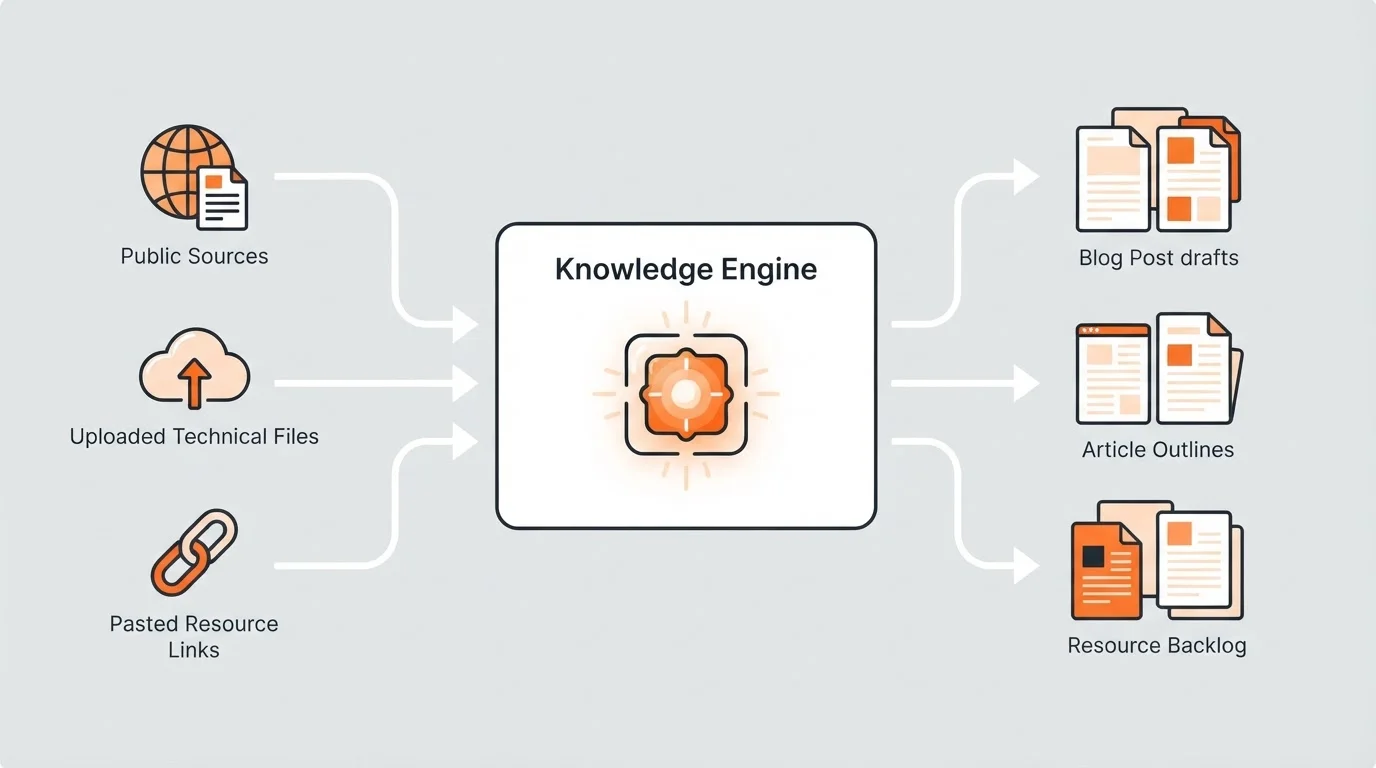
The foundational component of a high-return automated blogging strategy is the systematic ingestion of product truth. Standard text generation systems often produce superficial information because they operate without proprietary context. To achieve acceptable commercial authority, an autonomous engine must build its text directly from your actual product specifications.
The Blogged platform handles this requirement through its integrated Knowledge Engine for Autonomous SaaS Blogs. This mechanism enables software teams to supply public product documentation, uploaded technical files, pasted resource links, or custom written summaries as the core factual framework for all asset generation. The platform does not synthesize unverified claims; it builds context from your specific technical reality.
This architectural design prevents the text hallucinations common in ungrounded language systems. When the automated engine references an integration pattern, a configuration variable, or a user interface step, it extracts that information directly from your provided data sources. This ensures every piece of published content remains accurate, informative, and authoritative.
By transforming static user manuals, code documentation, and internal wikis into active data streams, you extract maximum value from existing engineering work. Your product documentation ceases to be an isolated help desk resource. Instead, it serves as the underlying intelligence source for an organic customer acquisition system.
Structuring Context via Product Entities and Facets
To maintain an organized structure over multiple publishing cycles, the ingestion system categorizes technical knowledge systematically. Blogged enables development teams to organize facts by product entity and facet, creating a clear data ontology of the application. An entity represents a core platform feature, while facets define its properties, limitations, setup steps, and explicit business benefits.
For instance, a developer platform might define its webhook system as a primary product entity. The associated facets would cover authentication protocols, payload constraints, retry schedules, and debugging interfaces. This semantic categorization allows the content engine to analyze the product deeply, discovering distinct angles for separate articles without repeating identical points across different posts.
This structured alignment forms the foundation of a durable SaaS content plan. Rather than relying on generic keyword lists, the platform builds an optimization roadmap based on the architectural layout of your software. The resulting content matches the specific ways technical buyers search for operational capabilities, building substantial topical depth across your primary features.
Transitioning from Manual Production to Autonomous Workflows
Moving to an autonomous content strategy alters the operational role of the founder and the growth team. Instead of drafting content, formatting paragraphs, or tracking internal links, your primary responsibility becomes strategic calibration. Operators transition from manual execution to high-level system editors, defining the core topics, parameters, and guardrails.
This shift removes the creative friction that often delays corporate marketing programs. Instead of beginning with an empty editor screen, you input high-level content requirements and let the platform manage the underlying development mechanics. This operational separation allows software founders to maintain full control over the messaging without consuming critical engineering hours.
To support collaborative operations across scaling software organizations, Blogged provides unlimited team seats on its plans. This capability allows technical writers, product managers, and growth marketers to participate in the oversight process without escalating software subscription fees. A marketing professional can manage search engine parameters while an engineering lead verifies code syntax within a single workspace.
This shared infrastructure simplifies the validation pipeline. Team members can easily comment on, modify, or approve text assets before they go live on the external site. By eliminating seat-based user friction, the platform ensures that cross-functional validation remains fast, clear, and highly scalable.
How Full Autopilot Manages Topic Supply
Sustaining organic growth requires a consistent publishing cadence, which can be difficult to maintain during intense software product cycles. When a product launch or a critical code deployment requires your full attention, content marketing efforts often stop. Blogged solves this vulnerability by using its Full Autopilot system to automatically refill a short Topic queue based on your approved Content Directions.
You establish the target themes, semantic focal points, and core product entities you want to emphasize. The automated engine then continuously updates your content backlog with relevant, search-optimized subject entries. This process guarantees an uninterrupted supply of approved article drafts, keeping your marketing calendar active even during busy engineering sprints.
This continuous automation prevents the common stop-and-start cycles that limit corporate blog growth. The system operates autonomously in the background, continuously preparing contextually grounded text variants for review. Founders can dedicate less than 30 minutes a week to checking the queue, ensuring a high-velocity organic channel with minimal operational friction.
Get practical updates on product-led content ROI case study
Receive new articles and practical insights by email.
SEO vs. GEO: Optimizing for AI-Driven Discovery
Traditional search engine optimization frameworks are changing due to the rise of generative search platforms. While ranking in standard search results remains important, software companies must also optimize for generative engines like Google AI Overviews, Perplexity, and OpenAI's search capabilities. This new paradigm is called Generative Engine Optimization (GEO).
Generative search systems do not simply present a list of links; they synthesize complex direct answers and cite authoritative digital sources. To ensure your product is featured in these generative summaries, your articles must contain structured, fact-grounded product definitions that AI crawlers can easily parse. Superficial, fluff-heavy marketing articles are typically ignored by these advanced synthesis models.
Blogged structures content to satisfy both traditional SEO metrics and advanced GEO discovery criteria simultaneously. By producing deeply detailed, entity-centric articles anchored by verified product data, the platform positions your blog as an authoritative source for AI engines. This dual optimization strategy helps secure visibility within AI summaries when buyers ask for software recommendations.
Optimizing for AI discovery provides a distinct competitive advantage for early-stage software companies. When an answer engine extracts data from your technical guides to answer a user's implementation question, you gain highly qualified, high-intent traffic. Embracing this evolution ensures your organic reach remains resilient as user search behavior changes.
Native CMS Integrations and Data-Driven Attribution Pipelines
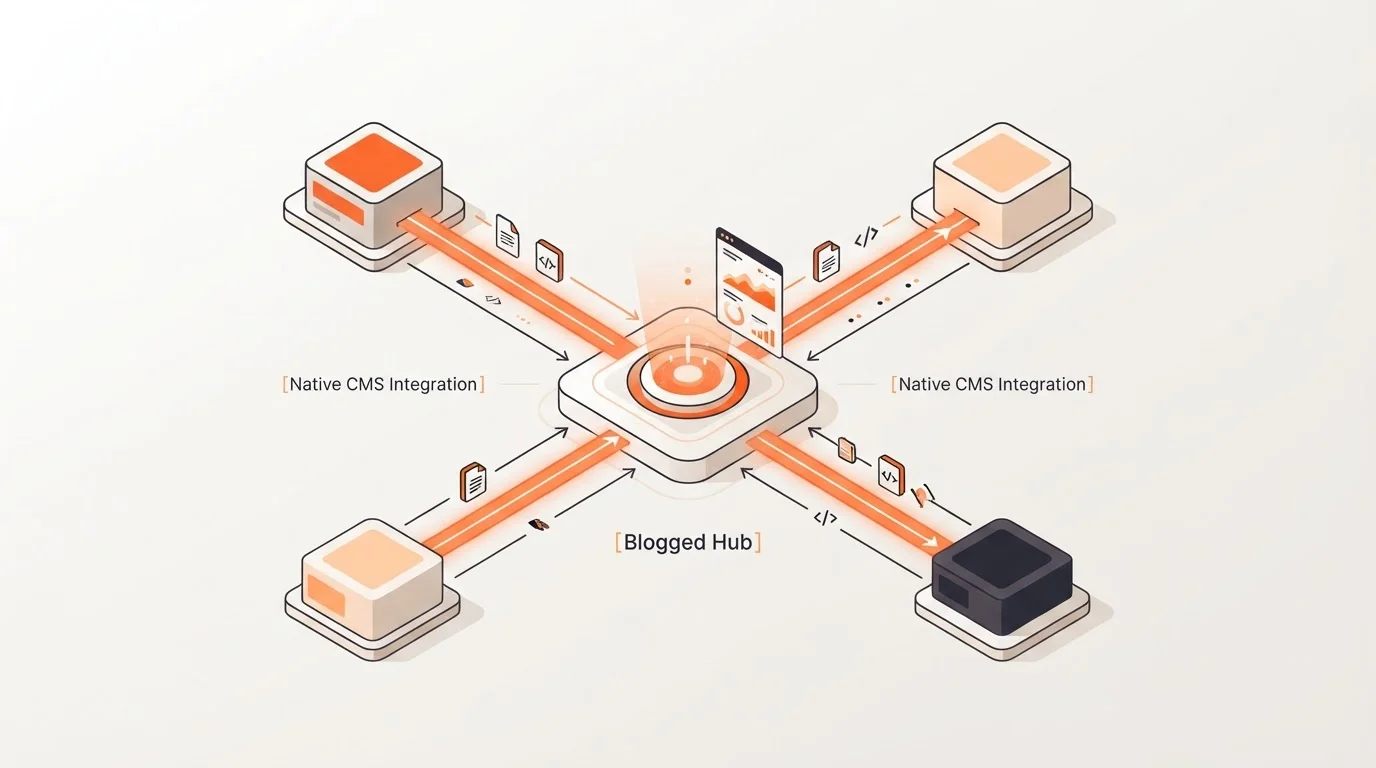
The performance of an automated content operation depends heavily on the efficiency of its publishing infrastructure. Manually copying text, formatting code blocks, and uploading image media between disconnected applications introduces unnecessary friction that slows down growth. To maximize operational velocity, your autonomous engine must integrate directly with your core web publishing stack.
Blogged features native publishing integrations for leading web content management platforms, including WordPress, Ghost, Webflow, and Next.js, alongside a dedicated Content API and signed webhooks for custom web frameworks. These native channels remove manual steps from the process, moving fully validated drafts to your live production environment automatically without requiring custom coding.
These native links do more than just push text; they establish structured tracking connections. Platforms such as the Webflow CMS, Next.js, and Ghost integrations allow teams to collect consented visits and track configured conversions for verified articles. This analytics telemetry connects your search traffic directly to actual product trial registrations.
By establishing this closed-loop tracking system, growth operators can view real-time performance analytics across the entire user acquisition journey. You can track user progression from the initial search entry to the explicit CTA completion. This granular visibility removes guesswork, allowing you to optimize your content strategy based on real signup data.
Platform-Specific Deployment Technicalities
Each web hosting architecture requires specific setup procedures to maintain optimal security and site performance. For teams using self-hosted content environments, Blogged connects to self-hosted WordPress through the Blogged Publishing plugin and an application password. This secure configuration allows the automated drafting engine to safely stage posts without exposing master administrative credentials.
For companies utilizing specialized writing platforms, the Ghost AI Blog Publishing integration manages content creation and review while Ghost renders the reader experience. Setting up this deployment is straightforward: users create a custom integration inside their Ghost administration panel, copy the generated Admin API key, and verify their Ghost connection within the Blogged dashboard. This setup maintains fast page loading speeds while automating the back-end content pipeline.
Teams building with decoupled front-end frameworks like Next.js can leverage the dedicated Content API or signed webhooks to fetch content programmatically. This approach allows developers to retain complete design freedom over the user experience while using Blogged's autonomous platform to handle keyword research, internal linking structures, and automated drafting mechanics.
A Framework for Analyzing Your Product-Led Content ROI Case Study
When designing a modern saas content ROI analysis, founders should look past surface-level traffic metrics like pageviews and focus on deep product acquisition data. True programmatic efficiency is determined by tracking how effectively automated, product-focused content converts cold search traffic into active trial users. An effective evaluation framework relies on clear, structured metrics:
- Customer Acquisition Cost (CAC) Reduction: Contrast the total operational cost of the autonomous system against the estimated cost of hiring traditional agency copywriters or using internal developer resources.
- Organic Search Authority Gain: Monitor index rankings across core product entities and technical features using direct integration data.
- Conversion and Attribution Telemetry: Use Blogged's capacity to track Search Console performance, homepage engagement, on-site searches, CTA and lead outcomes, lead growth, and reader feedback.
Evaluating these core performance dimensions helps technical founders transform their content initiatives from a marketing expense into a predictable, measurable engine for user growth. Grounding your organic marketing strategy in verifiable product capabilities ensures you attract high-intent users who understand the explicit value of your software.
Frequently Asked Questions
Q: How does autonomous product-led content maintain technical accuracy for complex software products?
Accuracy is maintained because the system relies directly on your provided documentation rather than generic public datasets. The platform uses the Knowledge Engine to ground all text in your uploaded files, links, and product summaries, ensuring that every article reflects your software's actual functionality.
Q: What specific data metrics can be monitored within the main dashboard?
The analytics suite allows users to track Search Console performance, homepage engagement, on-site searches, CTA and lead outcomes, lead growth, and reader feedback to provide clear attribution.
Q: How does the platform connect with an existing self-hosted WordPress site?
Connection is established securely using the dedicated Blogged Publishing plugin combined with an application password, keeping your main administrator credentials safe.
Q: Is there an extra subscription fee for adding multiple product managers or editors to the platform?
No, every paid subscription tier includes unlimited team seats to facilitate collaboration without increasing your monthly software overhead.
Q: What content management platforms are natively supported for automatic publishing?
The system provides direct native integrations for WordPress, Webflow, Ghost, and Next.js, as well as an open Content API and signed webhooks for custom development environments.
Transforming Engineering Knowledge into Sustainable Distribution
Building a successful organic acquisition engine does not require technical founders to sacrifice product development hours to write blog posts. The secret to scaling traffic lies in building a structured workflow that transforms existing technical data into discoverable online content. By using an automated infrastructure like Blogged, your team can turn static documentation into a reliable source for user acquisition.
Automating the research, writing, semantic interlinking, and CMS staging loops allows you to maintain a consistent publishing schedule without manual effort. This approach ensures your product remains highly visible both in traditional search listings and emerging AI discovery engines. Your internal feature documentation becomes a powerful marketing asset, working continuously to acquire new users.
The path to higher content efficiency begins by shifting your focus from manual content creation to strategic system oversight. By automating the mechanical writing process, you free your engineering team to focus entirely on building outstanding software. Put your content engine on autopilot today, and let your product's technical features drive your organic customer acquisition.