
On this page
For a scaling SaaS company, content decay is the hidden tax on growth. When your engineering team ships a major UI overhaul, rebrands a core feature, or introduces a new integration, every existing blog post and tutorial effectively becomes a liability. Outdated content confuses trial users, erodes trust, and forces your support team to manually bridge the gap between what the software actually does and what your blog claims.
Autonomous SEO platforms promise to solve this by handling the heavy lifting of research and writing. However, for a founder, the real test of an AI agent is not just how it writes the first draft, but how it maintains accuracy as the product evolves. Blogged and AI Growth Agent both offer sophisticated automation, but they approach the problem of content freshness from opposite ends of the spectrum.
While AI Growth Agent focuses on scaling research and monitoring brand visibility across AI search engines, Blogged utilizes a specialized Knowledge Engine to ground every article in your latest product truths. This fundamental difference determines whether your blog serves as a broad visibility moat or a high-converting extension of your technical roadmap. For founders who ship fast, the mechanism of the update is as important as the quality of the prose.
The Challenge of Stale Content Debt in High-Growth SaaS
SaaS companies operate in a permanent state of change. In an agile environment, a feature mentioned in a popular blog post might be renamed, moved, or deprecated within months. This creates "stale content debt"—the cumulative cost of maintaining public-facing information that no longer matches the current product state.
Traditional SEO workflows are fundamentally mismatched with this pace. A manual update cycle involving research, drafting, and multiple rounds of editing often takes days. By the time an article is updated, the product might have shifted again. For a founder, manually auditing a library of dozens or hundreds of articles after every release is an impossible drain on resources.
An effective autonomous SEO platform must do more than just generate volume. It must provide a mechanism to identify and implement updates based on specific feature changes. Without this, your blog becomes a collection of legacy artifacts rather than a high-converting growth engine. The primary differentiator between Blogged and AI Growth Agent lies in how they anchor their content to your reality and how they trigger the update cycle.
AI Growth Agent: Monitoring Visibility in the AI Search Era
AI Growth Agent (AIGA) positions itself as an AI Search Platform designed primarily for agencies and growth teams looking to scale visibility across the emerging "Answer Engine" ecosystem. Its workflow centers on a Topology Engine that maps search clusters and identifies where your brand is mentioned across AI engines like ChatGPT, Claude, and Perplexity.
Regarding content updates and freshness, AI Growth Agent relies on its ability to track AI mentions and organic ranking performance over time. This monitoring allows teams to see when their brand visibility fluctuates across different AI search models. It is built to automate the end-to-end workflow so that research scales without manual effort, focusing heavily on brand perception and search dominance.
However, AIGA's approach is inherently research-centric. Because it is designed to monitor and scale visibility across a wide range of external AI platforms, it is a powerful tool for maintaining a broad content moat. For a SaaS founder, this means the platform is excellent for tracking how search bots see your brand, but it may require more manual intervention to ensure that granular, technical "how-to" guides reflect the exact button names or API endpoints updated in your last sprint. Its Standard plan at $189/mo and Pro plan at $989/mo reflect this enterprise-level focus on visibility monitoring.
Blogged: The Knowledge Engine for Synchronized Content Updates
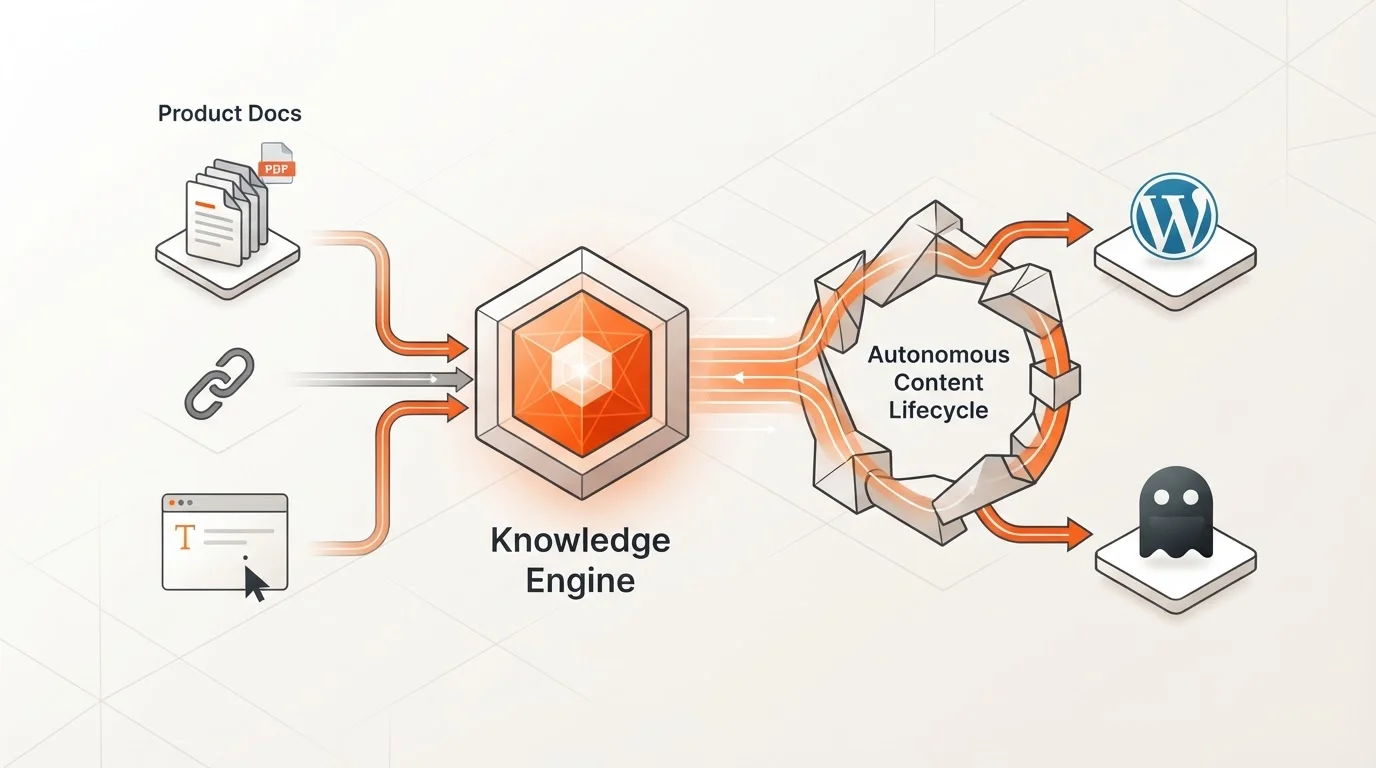
Blogged is built specifically for SaaS founders who want their blog to be an autonomous mirror of their product documentation. Its core differentiator is the Knowledge Engine, a centralized repository that acts as the "ground truth" for all AI-generated content. Instead of the AI relying on general training data or broad web research, Blogged grounds its writing in the specific assets you provide.
According to its product specifications, users can connect public product documentation, upload technical PDFs, paste links to existing features, or write a short description of a new release. This ensures that the AI understands your software's technical limitations, pricing, and Ideal Customer Profile (ICP) before it writes a single word.
When your product changes, you do not need to rewrite your articles manually. You simply update the source material in the Knowledge Engine. Blogged then utilizes this updated "source of truth" to refresh existing content through its Autonomous Content Lifecycle. This shifts the focus from tedious content auditing to product synchronization, allowing you to ship features and marketing updates in tandem. At $99 per month, Blogged provides a more direct path for founders to turn technical documentation into growth.
Turning Technical Documentation into Marketing Growth
The Knowledge Engine allows a founder to transform technical knowledge into discoverable, product-led content. Because the platform understands your specific product assets, it can generate useful, specific content rather than generic blog posts. This is critical for SEO and GEO (Generative Engine Optimization), where search engines and AI discovery tools reward accuracy and technical depth.
By treating content like code—something that can be version-controlled via a single source of truth—Blogged eliminates the manual oversight usually required to keep a SaaS blog accurate. This is particularly beneficial for early-stage and growth-stage founders who need to focus on building their product while their blog runs on autopilot to drive organic growth. The system ensures that if your API changes, your blog follows suit without a dedicated content manager.
Deep Integration for Autonomous Publishing
Blogged further simplifies the update process through deep publishing integrations. It connects to self-hosted WordPress via a dedicated plugin and application password, as well as Ghost, Webflow, and Next.js. For teams with custom stacks, it offers a Content API and signed webhooks.
This means that once the Knowledge Engine processes a product update, the platform can deliver those changes directly to your live site. The Ghost integration, for example, allows users to create a custom integration, copy the Admin API key, and manage the entire creation and review process in Blogged while Ghost handles the reader experience. This end-to-end automation ensures that your blog remains a reliable driver of software adoption without constant manual intervention.
Get practical updates on AI Growth Agent vs Blogged content updates product changes
Receive new articles and practical insights by email.
Comparison: AI Growth Agent vs. Blogged
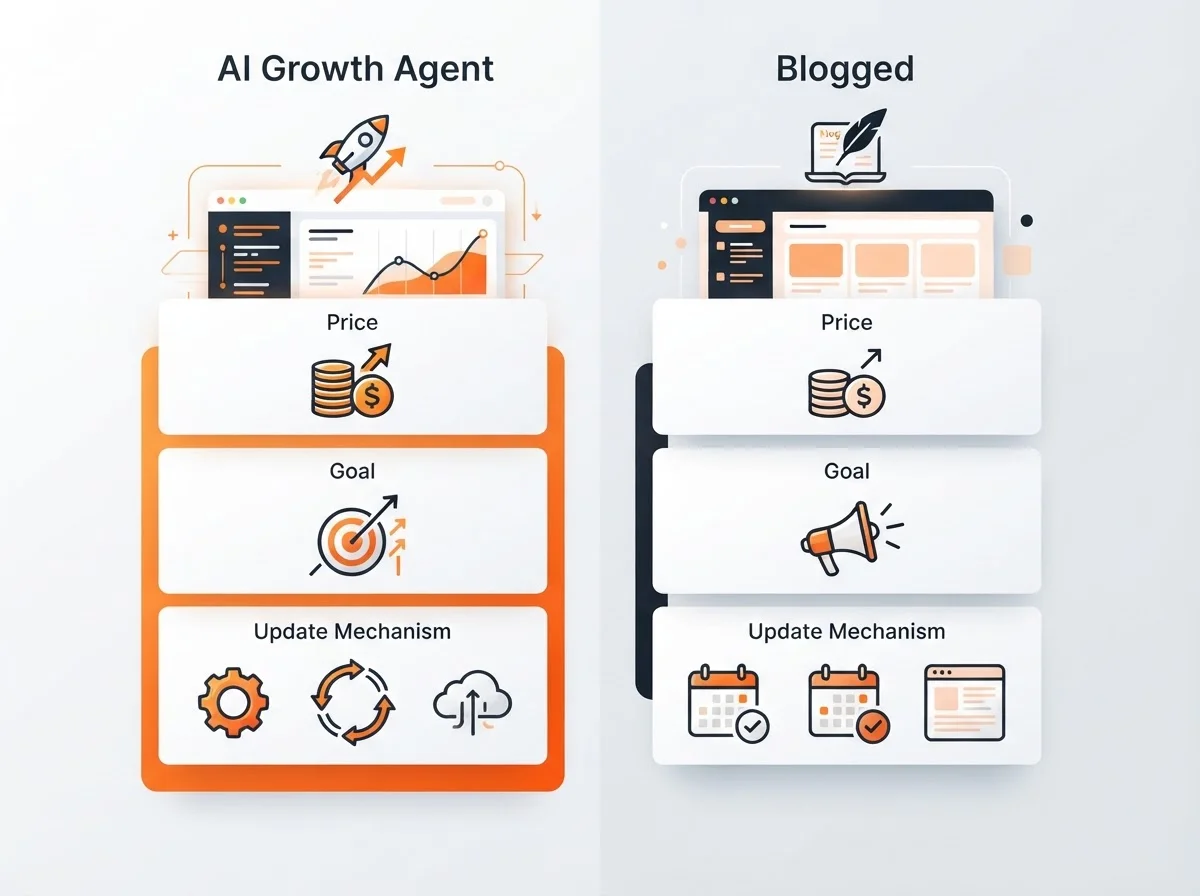
The choice between these two platforms often comes down to your primary bottleneck: are you struggling to build a broad visibility moat, or are you struggling to keep your product-led guides accurate? Below is a breakdown of how they compare across critical SaaS growth dimensions.
| Comparison Area | AI Growth Agent | Blogged |
|---|---|---|
| Primary Goal | Scaling research & AI search visibility | Product-led content & accurate growth |
| Starting Price | $189/mo (Standard) | $99/mo (Starter) |
| Enterprise Price | $989/mo (Pro) | Custom plans available |
| Update Mechanism | Performance & mention monitoring | Source-driven via Knowledge Engine |
| Grounding Source | Search topology & web data | Product docs, PDFs, links, & text |
| SaaS Fit | Agencies & Enterprise growth teams | SaaS Founders & Product teams |
| CMS Integrations | Custom tracking focus | WordPress, Ghost, Webflow, Next.js |
| Team Model | Per-user / Seat-based | Unlimited team seats on paid plans |
Strategic Decision: Which Engine Fits Your Growth Stage?
SaaS founders must evaluate their choice based on how frequently their product evolves and the technical depth required by their audience. If your primary goal is to dominate brand market share across a wide range of B2B topics and you have a team capable of monitoring visibility reports to trigger broad research updates, AI Growth Agent offers the topological depth needed for high-level visibility strategy.
However, if you are a founder who needs to transform technical product knowledge into a high-conversion blog with minimal intervention, Blogged is designed for your workflow. By automating the entire lifecycle—from research and internal linking to continuous source-driven updates—Blogged ensures that your blog remains an accurate representation of your product rather than a collection of outdated posts.
When making your final decision, consider these three factors:
- Update Frequency: If your core features change weekly, Blogged's Knowledge Engine handles high-velocity technical updates more efficiently by using your documentation as the primary source.
- Manual Overhead: AI Growth Agent tracks how bots see your brand, which is useful for PR and brand share, but Blogged updates your content automatically when you update your documentation, which is better for product-led growth.
- Budget and Scaling: Blogged offers a more accessible entry point at $99/mo and includes unlimited team seats on paid plans, making it ideal for founders who want to involve their entire product team in the content lifecycle without extra costs.
Frequently Asked Questions
Q: How often should I update my Knowledge Engine in Blogged?
You should update your Knowledge Engine whenever you release a major feature, change your pricing, or pivot your ICP. This ensures that all future articles and autonomous refreshes use the most current facts.
Q: Does AI Growth Agent help with technical SEO monitoring?
Yes, AI Growth Agent tracks AI mentions and organic ranking performance, providing data on how search bots and AI models perceive your brand across the web.
Q: Can I use Blogged if I have a custom-built Next.js site?
Yes. Blogged offers a dedicated Next.js integration as well as a Content API and signed webhooks for founders who use custom stacks but want an autonomous publishing workflow.
Q: What happens if the AI makes a technical error during an update?
Both platforms include controls for human oversight. In Blogged, paid plans include 1 to 3 revisions per article, allowing you to review any autonomously drafted update before it is finalized.
Choosing the Right Growth Engine
In the race for organic growth, volume is no longer the only metric that matters. Search engines and AI discovery tools now reward useful, specific, and accurate content. For a SaaS founder, the ability to ship features and marketing updates in the same sprint is a massive competitive advantage.
AI Growth Agent provides a powerful window into the AI search ecosystem, making it ideal for those focused on brand tracking and broad visibility. But for the founder who wants their blog to act as an autonomous, high-converting extension of their product, Blogged offers the specialized Knowledge Engine and automated lifecycle required to turn a technical roadmap into a growth machine. By grounding content in your unique product assets, Blogged ensures your marketing stays as current as your code.