On this page
For a SaaS founder, the bottleneck to organic growth is rarely a lack of ideas. It is a lack of time. Sustaining a blog that researches, writes, optimizes, and publishes every week while you are building a product is an operational nightmare. The market has responded with autonomous SEO platforms, but choosing between leaders like Scalenut and Blogged requires understanding a fundamental strategic shift: the move from keyword-led to product-led SEO.
While both platforms leverage AI to scale content, they operate on different philosophies. Scalenut functions as a sophisticated cockpit, providing a suite of tools for content managers to manually navigate search results with AI assistance. Blogged, by contrast, operates as an autonomous engine specifically designed to transform internal product knowledge into discoverable content on autopilot. For founders evaluating these tools, the decision hinges on whether you need a faster way to write or a system that removes the writing task from your plate entirely.
The Core Philosophy: AI-Assisted Cockpit vs. Autonomous Engine
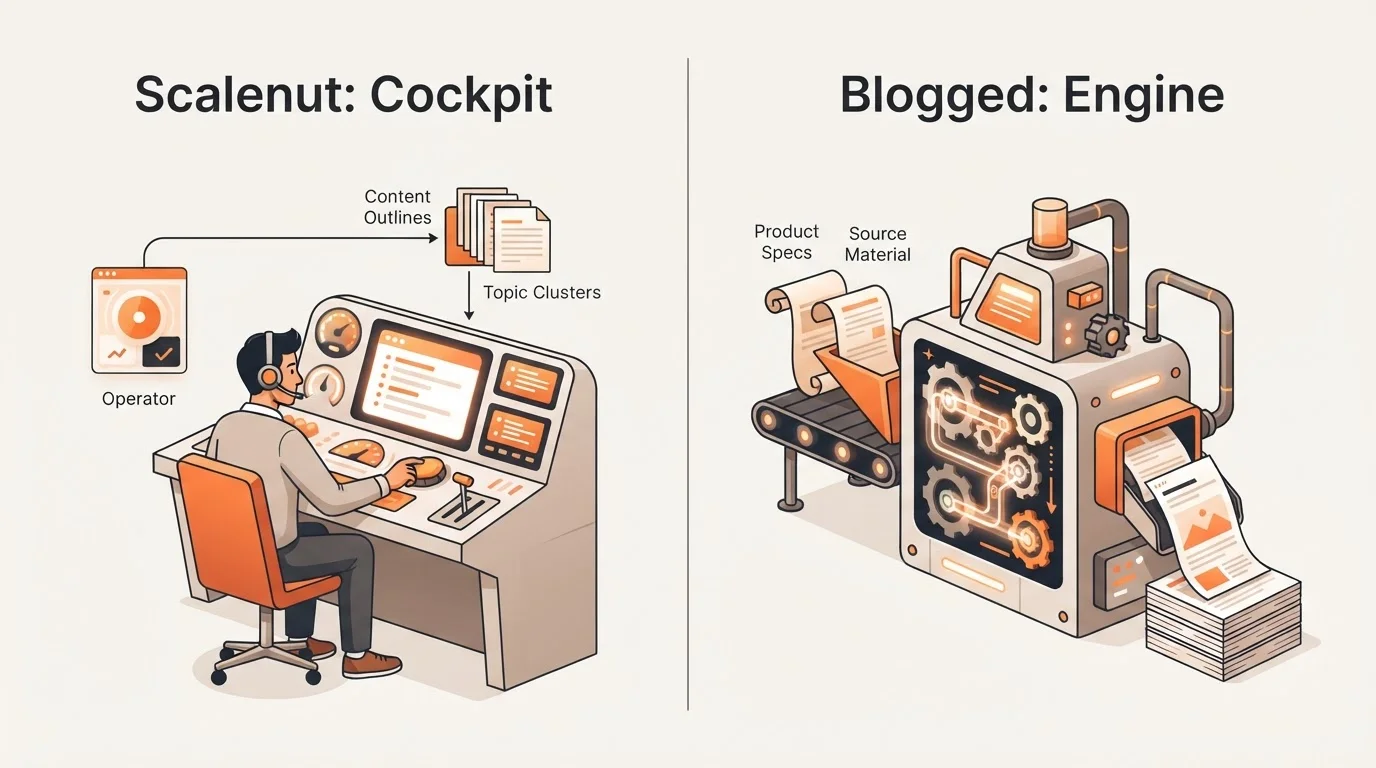
Scalenut and Blogged represent two distinct approaches to content automation. Scalenut is built as an all-in-one SEO content lifecycle platform. It focuses on helping teams rank by analyzing what is already winning on Search Engine Results Pages (SERPs). Its primary workflow, known as Cruise Mode, acts as a guided AI assistant. It streamlines the research and drafting process, but it requires a human in the captain's chair to approve outlines, select keywords, and trigger the final generation.
Blogged is built specifically for the SaaS founder who cannot afford to be a full-time editor. It is an autonomous SEO and GEO (Generative Engine Optimization) platform that manages the entire loop—from research and interlinking to final publishing. Instead of asking you for a keyword to start a draft, Blogged uses a proprietary Knowledge Engine to identify opportunities based on your product specs and market signals. This shift from manual triggers to an autonomous loop is what allows a blog to run as a background process.
Scalenut Approach: SERP-Driven Content Lifecycle Management
Scalenut's strength lies in its ability to replicate the success of top-ranking competitors. It analyzes SERP data to provide data-driven content briefs, ensuring your articles are optimized for the exact NLP terms and user intent that search engines favor. This blueprint approach is highly effective for broad SEO visibility where the goal is to out-optimize established players for high-volume keywords.
Key features include Cruise Mode, a five-minute workflow that takes you from a keyword to a draft by generating outlines based on competitor headings. The Content Optimizer provides a manual workspace where you can paste existing URLs to receive an SEO score and a list of gaps to fix. Scalenut also integrates with a Backlinks Marketplace to help users secure links directly. The platform has helped over 200 businesses grow their organic traffic, establishing itself as a reliable choice for teams that have the bandwidth to pilot their SEO strategy.
Blogged Approach: Product-Led Growth through a Knowledge Engine
For SaaS companies, content often fails at the bottom of the funnel because general AI writers lack technical accuracy. They might miss a pricing nuance or a unique feature that sets your software apart. Blogged addresses this factual gap by anchoring its AI in your proprietary product data rather than broad internet scrapes.
The Knowledge Engine allows you to provide public product sources, uploaded documents, pasted links, or written product descriptions. This ensures that every autonomous article acts as a subject matter expert on your specific software. Furthermore, Blogged allows you to organize your Ideal Customer Profile (ICP), positioning, pricing, and limits, ensuring this specific context is reused across all content pieces for consistency. This level of product integration is essential for maintaining trust as you scale.
Managing SaaS Assets and Provenance
One often overlooked aspect of SaaS blogging is the management of product screenshots and brand assets. Blogged lets users manage a private SaaS product asset library with advanced features like review queues, visible approvals, and bulk decisions. This system includes support for alt text and provenance, ensuring that every image in your blog is not just a placeholder but a high-quality, verified representation of your product. For a founder, this means the platform doesn't just write the text; it manages the visual evidence required to sell the product.
Workflow and Integration: How Content Gets Live
The final stage of the content lifecycle is where the operational differences become clear. Scalenut focuses primarily on the creation phase. While it offers a WordPress Publisher and Shopify integration, the workflow is generally manual: you create the content in Scalenut and then push it to your CMS.
Blogged treats publishing as part of the autonomous loop. Its Ghost AI Blog Publishing integration manages content creation and review within Blogged while Ghost renders the reader experience. For modern SaaS stacks, the Next.js integration allows for collecting consented visits and configured conversions directly for verified articles. This connection between the content engine and your technical stack ensures that organic traffic is immediately measurable against business outcomes.
Get practical updates on scalenut vs blogged product led content
Receive new articles and practical insights by email.
Scalenut vs. Blogged: Comparison Overview
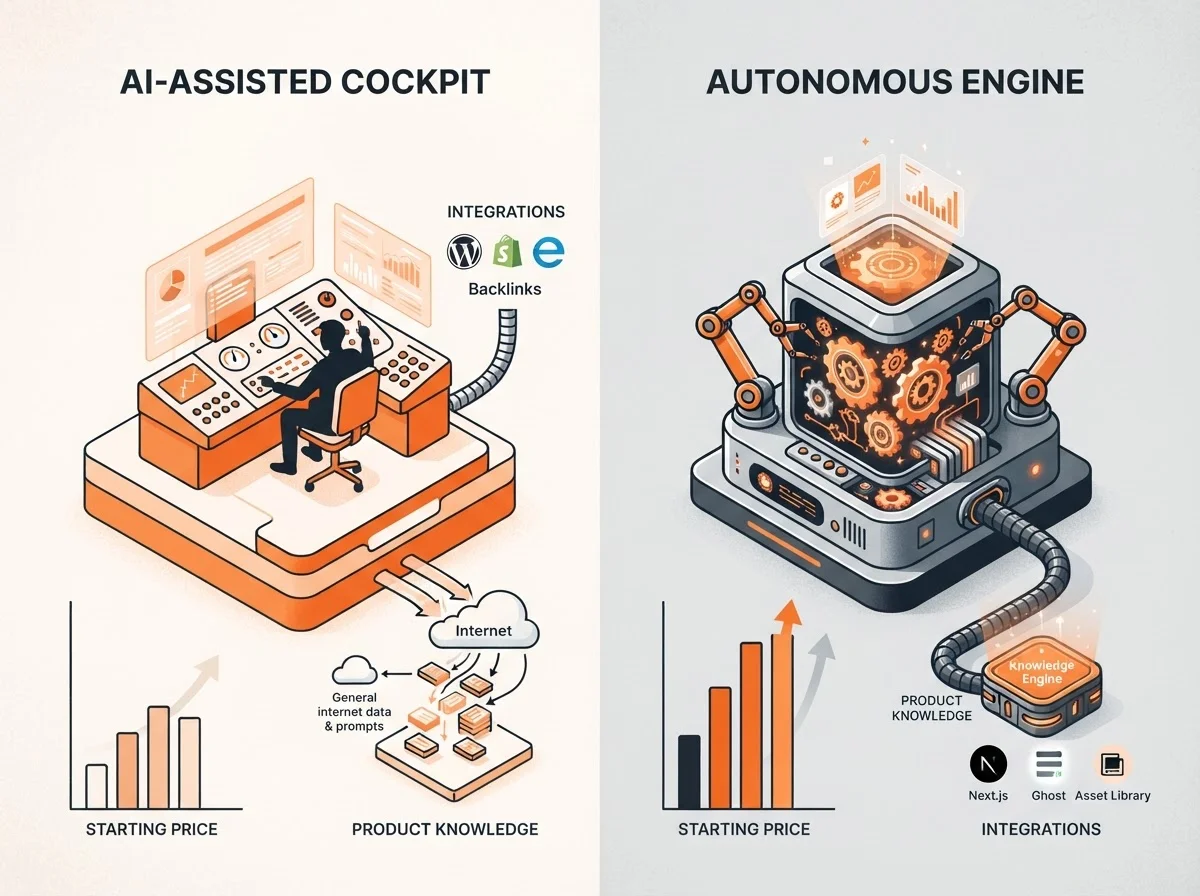
| Comparison Area | Scalenut | Blogged |
|---|---|---|
| Core Philosophy | AI-Assisted Cockpit | Autonomous Engine |
| Best For | Content teams & SEO specialists | SaaS founders & lean teams |
| Primary Goal | Keyword ranking & SERP mirroring | Product-led growth & discovery |
| Starting Price | $59 per month | $99 per month |
| Product Knowledge | General internet data & prompts | Proprietary Knowledge Engine |
| Team Seats | Plan-dependent | Unlimited team seats |
| Integrations | WP, Shopify, Backlinks | Next.js, Ghost, Asset Library |
| Workflow | Manual / Human-triggered | Proactive / Autonomous |
Decision Framework: Which Platform Fits Your SaaS?
Choosing the right platform depends on your existing resources and long-term organic goals. Neither tool is a universal winner; rather, they serve different operational stages.
Choose Scalenut if your primary goal is to grow organic traffic through a broad range of content that mirrors what is already winning on the SERP, or if you have a dedicated content manager who wants granular control over keywords and optimization scores.
Choose Blogged if your content strategy is deeply rooted in product-led growth, requiring high accuracy in technical descriptions and ICP positioning. It is the better fit if you need an autonomous platform that handles research, planning, and interlinking on a weekly schedule without manual intervention. Blogged also offers an advantage for teams that want to involve multiple stakeholders in the review process using unlimited team seats.
Frequently Asked Questions
Q: Does Scalenut handle internal linking automatically?
Scalenut provides an internal linking tool that offers suggestions to improve your site structure, though these typically require manual implementation or approval within the editor.
Q: How does Blogged keep my content accurate as my product changes?
Blogged uses its Knowledge Engine to prioritize your latest product sources. When you update your documentation or pricing links in the engine, the autonomous system incorporates that new data into future articles.
Q: Can Blogged publish directly to my custom-built SaaS site?
Yes. While Blogged offers a direct Ghost integration, it also provides a Next.js integration specifically for SaaS companies running headless or custom front-ends, allowing you to deliver verified articles directly to your site while tracking conversions.
Optimizing for the Future of Search
The decision between Scalenut and Blogged ultimately reflects your perspective on automation. If you see AI as a tool to make your current writing process faster, Scalenut offers a robust suite of optimization features. It is a powerful co-pilot for the hands-on marketer. However, if you see AI as an opportunity to remove marketing overhead entirely, Blogged is the superior choice for SaaS. By transforming your internal product knowledge into a discoverable organic engine, Blogged ensures your blog remains a high-fidelity extension of your product, allowing you to stay focused on building the software that drives your growth.