
On this page
Industry authority is the most valuable currency for a SaaS founder, yet it is often the hardest asset to build and sustain. While the market demands deep, technical, and product-led insights, the reality of scaling a software company leaves little room for the rigorous demands of manual content production. To stand out in a crowded market, founders must ground their content in the one thing their competitors cannot replicate: their unique product logic and technical expertise. Generic blog posts that focus only on broad keywords no longer suffice in an era where discovery engines prioritize specific, verifiable information.
InnovateCo, a growing data analytics platform, faced a common hurdle. They had developed a sophisticated technical solution, but their public blog was filled with generic industry trends that failed to reflect their product's true power. By pivoting to an autonomous blogging strategy grounded in their proprietary "source of truth," they transformed their content from high-level fluff into a technical asset. This shift didn't just improve their search presence; it established them as a primary authority in their niche by feeding specific product facts into their organic growth engine.
The Founder's Dilemma: Why Scaling Technical Expertise Usually Fails
Every SaaS founder acts as the primary subject matter expert of their domain. You understand the nuances of your API, the specific pain points your dashboard solves, and the competitive gaps that exist in your industry. However, there is a fundamental disconnect between possessing this knowledge and publishing it consistently. For many startups, the attempt to scale content creation follows a predictable and often frustrating pattern.
Initially, founders try to write the articles themselves. This leads to high-quality content but zero consistency. When the product roadmap accelerates or a new funding round begins, the blog inevitably goes dark. The next step is usually hiring a generalist freelance writer or a traditional content agency. While this solves the consistency problem, it introduces a significant lack of depth. Generalist writers often lack the technical background required to explain complex features or unique workflows, resulting in surface-level content that fails to resonate with sophisticated B2B buyers.
This lack of grounding has tangible costs. Generic content struggles to rank for the high-intent technical keywords that drive qualified leads. More importantly, it fails the trust test. When a prospective customer reads a guide that doesn't actually demonstrate how to solve their problem using your specific toolset, they move on. For InnovateCo, this "authority gap" meant that while their product was technically superior, their competitors were winning the narrative battle simply by being more visible and authoritative in their documentation.
The Shift to GEO: Why Discovery Now Rewards Product Specificity
The rules of online discovery are shifting toward a new discipline: Generative Engine Optimization (GEO). Users are increasingly moving beyond traditional search result pages and toward AI-driven discovery tools that synthesize answers from multiple sources. For a SaaS brand to be cited as a source by these generative engines, the content must be more than just grammatically correct; it must be factually dense and deeply specific to the product's capabilities.
Generative engines look for entity-level authority and structured facts. If your blog consists of vague industry trends, it is easily ignored or replaced by other generic sources. However, if your content is grounded in specific product knowledge—detailing technical specifications, exact workflows, and verifiable data—you become a "source of truth." This positioning makes it significantly more likely that your brand will be cited in the synthesized answers provided to prospective buyers.
InnovateCo realized that to win in both traditional search and AI-driven discovery, they needed to systematize their product-specific facts. They needed a way to ensure that every article published was technically accurate and intrinsically linked to their software's actual functions. This is where autonomous blogging, powered by a dedicated Knowledge Engine, became their primary competitive advantage in building market trust.
Grounding Content in the Source of Truth: The Knowledge Engine
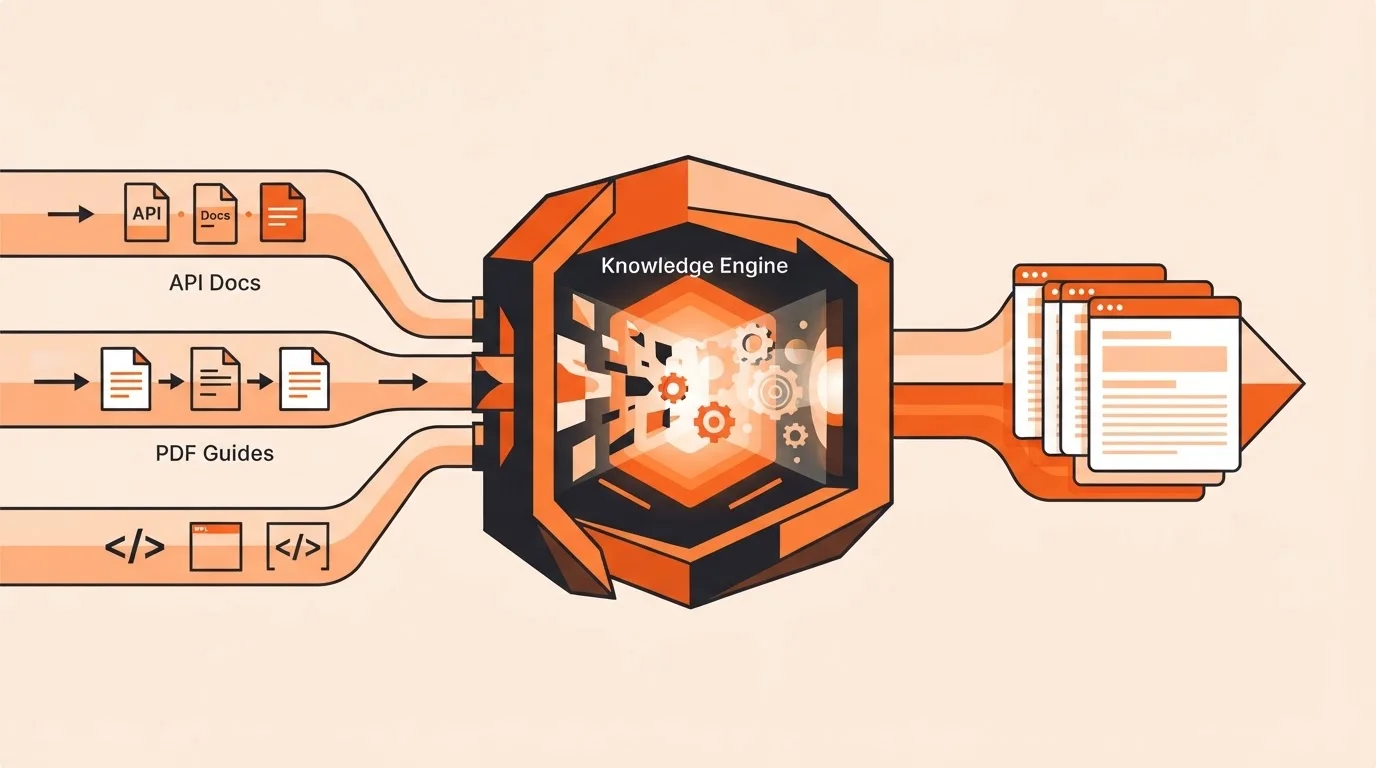
The breakthrough for InnovateCo occurred when they stopped treating AI as a creative writer and started using it as a technical translator for their product logic. By utilizing Blogged's Knowledge Engine for Autonomous SaaS Blogs, they were able to feed the system the exact data it needed to remain grounded in reality. This feature allows founders to provide public product sources, uploaded documents, pasted links, or written descriptions of their software's core functions.
Instead of an autonomous system hallucinating features or making generic claims, the Knowledge Engine builds every article around the specific realities of the product. This creates what is known as product-led content. When a user searches for a specific technical solution, InnovateCo’s blog no longer gives general advice; it explains exactly how their platform handles that specific workflow. This level of specificity is what builds unrivaled industry authority, proving that the company understands the technical nuances of the reader's problem.
By providing the system with their API documentation, customer support FAQs, and internal product specs, InnovateCo ensured that their content was uniquely theirs. This created a "moat" of proprietary information that generalist competitors could not replicate through traditional manual writing. Their blog became an extension of their product, providing value at every stage of the user journey.
Workflow Efficiency: Building Authority on Autopilot
InnovateCo’s transition to autonomous blogging wasn't just about the quality of the output; it was about the radical efficiency of the process. Before implementing an autonomous system, the team spent approximately 20 hours a month managing freelancers, reviewing drafts for technical errors, and manually formatting posts. Despite this effort, they struggled to maintain a consistent publishing schedule.
By implementing Blogged’s autonomous system, they shifted their focus from manual writing to high-level strategy. They spent a single afternoon uploading their core product documentation and API guides into the Knowledge Engine. From there, the platform's autopilot took over the research, planning, and writing phases. Because the AI was grounded in their actual technical documents, the resulting drafts required minimal editing to meet their standards for technical accuracy.
Consistency became an automatic byproduct of this workflow. InnovateCo was able to scale their publishing frequency to multiple high-quality, product-led articles per week without increasing their internal workload. The system handled the repetitive tasks of internal linking and SEO optimization, allowing the founders to stay focused on building their product while their organic presence grew in the background.
Systematizing the Technical Review Process
While autonomy handles the heavy lifting, maintaining authority requires a layer of human oversight. InnovateCo utilized the fact that Blogged includes unlimited team seats on its plans to involve their product managers and developers in the review process without additional cost. This allowed for a streamlined workflow where the technical team could spend five minutes verifying the accuracy of a post rather than five hours writing it from scratch.
Furthermore, the team utilized the built-in revision process to fine-tune their brand voice. Depending on the growth stage and specific plan, Blogged includes either 1 or 3 revisions per article. This allowed InnovateCo to ensure that every piece of content felt consistent with their established brand identity before it went live. By treating content as a team-verified asset, they maintained a level of technical integrity that generalist agencies simply could not provide.
Get practical updates on saas industry authority product knowledge content
Receive new articles and practical insights by email.
Technical Synergy and CMS Integration

A successful authority-building strategy requires seamless integration with your existing tech stack. InnovateCo utilized direct publishing integrations to remove the manual burden of content management. For instance, teams using Ghost can create a custom integration, copy the Admin API key, and verify their connection within Blogged. This allows the autonomous system to manage content creation and review while Ghost handles the reader experience.
For teams on other platforms, the process is equally streamlined. Blogged connects to self-hosted WordPress sites through a dedicated publishing plugin and an application password. These integrations are not just about convenience; they enable advanced tracking. On platforms like WordPress, Webflow, and Next.js, the system allows users to collect consented visits and configured conversions for verified articles. This data proved vital for InnovateCo, as it allowed them to see exactly which product-led topics were driving new sign-ups and trials.
The Strategic Shift: Moving from Generic SEO to Product-Led Growth
To replicate the success of companies like InnovateCo, SaaS founders must move away from a traditional "top-of-funnel" blogging mindset that prioritizes volume over value. Traditional blogging focuses on broad keywords with high search volume but low intent. Product-led authority blogging focuses on the intersection of your product’s unique capabilities and your customer’s most frustrating technical problems.
Founders should start by identifying the core technical workflows that set their product apart. These specific workflows should be the first items fed into the Knowledge Engine. By doing so, you create a foundation of content that acts as a "silent salesperson," educating prospects on your specific value proposition before they ever request a demo. This approach ensures that your content is not just an SEO play, but a conversion tool grounded in technical reality.
Finally, the goal is to create a self-optimizing growth engine. By using conversion data to identify which technical topics resonate most with your audience, you can further refine your Knowledge Engine with even deeper documentation on those subjects. This creates a cycle of increasing authority, where your blog becomes the definitive source of information for your specific industry niche.
Frequently Asked Questions
Q: What type of sources can I use to ground my content in the Knowledge Engine?
You can provide public product sources, upload documents like PDFs, paste specific links to documentation, or write a direct description of your product's functions. This ensures the AI is grounded in your specific technical logic.
Q: Does autonomous blogging require a technical setup for publishing?
No. There are native integrations for WordPress, Ghost, and Webflow. For example, the WordPress integration uses a dedicated plugin and application password to deliver articles directly to your site.
Q: How many people from my team can participate in the content review?
Blogged includes unlimited team seats on its paid plans, allowing product managers, developers, and marketers to collaborate on the review and approval process without extra costs.
Q: How do revisions work in an autonomous system?
Every article includes a revision process to ensure brand alignment. Depending on your chosen plan, the system includes either 1 or 3 revisions per article to help you fine-tune the tone and technical accuracy.
Building industry authority is no longer about who can publish the most content; it is about who can provide the most grounded, useful, and technically accurate information. For SaaS founders, the path to this authority lies within their own product documentation. By leveraging autonomous blogging platforms like Blogged, companies like InnovateCo have demonstrated that it is possible to scale technical expertise without sacrificing founder time.
Your product knowledge is your most powerful marketing asset. When you ground your content in that reality, you do more than just win search rankings; you win the trust of your market and the citations of the next generation of discovery engines. The era of generic, disconnected SaaS blogging is over. The era of the autonomous, product-led authority has begun.