
On this page
For many SaaS founders, the content marketing journey follows a predictable, painful arc. It begins with the realization that organic search is a vital long-term growth lever. You start by writing high-quality, founder-led pieces that resonate with your technical audience because nobody knows the problem space better than you do. However, as your product gains traction, the 'Founders Paradox' takes hold: the more successful your SaaS becomes, the less time you have to write about it.
Maintaining consistent content quality at scale is the primary bottleneck for software companies aiming to cross the chasm from early adopters to market leaders. Traditional manual workflows—researching keywords, briefing freelance writers, three rounds of editing, and manual CMS formatting—are inherently unscalable for a lean team focusing on product-market fit. When founders attempt to scale by outsourcing, the result is often 'commodity content' that lacks the technical depth and nuance required to convert sophisticated B2B buyers.
Autonomous blogging represents a fundamental shift in this equation. By moving from a manual writing model to an autonomous engineering model, founders can transform their internal product knowledge into a discoverable content engine. This approach handles the heavy lifting of research, optimization, and publishing while ensuring that every piece of content remains accurate to the product's actual capabilities. This guide explores how to build a scalable content engine that protects your brand voice and drives organic pipeline.
The Scaling Quality Dilemma: Why Manual Content Fails the SaaS Model
The pressure to scale content often leads to a steep decline in utility. When a SaaS company moves from publishing one founder-led post per month to ten outsourced posts, the internal resources required to maintain quality don't just grow linearly; they grow exponentially. Your blog is no longer just a marketing asset; it is a primary sales tool for buyers who define their requirements long before they ever speak to a sales representative.
There are three primary failure points when SaaS teams attempt to scale manually. First is the Research Gap. External writers rarely have access to your product roadmap, customer support logs, or technical documentation, leading to generic content that offers no real value. Second is the Brand Voice Drift. As more contributors enter the mix, the sharp, authoritative tone of the founder is often diluted into a bland, corporate persona. Third is the Optimization Bottleneck, where SEO becomes a checklist rather than a strategic integration.
Founders often find themselves trapped in the 'editing tax'—spending hours fixing factual errors in drafts that were supposed to save them time. Breaking this cycle requires a system that treats product knowledge as the core input for every article, ensuring that volume never comes at the cost of authority.
Implementing a Source of Truth: The Power of the Knowledge Engine
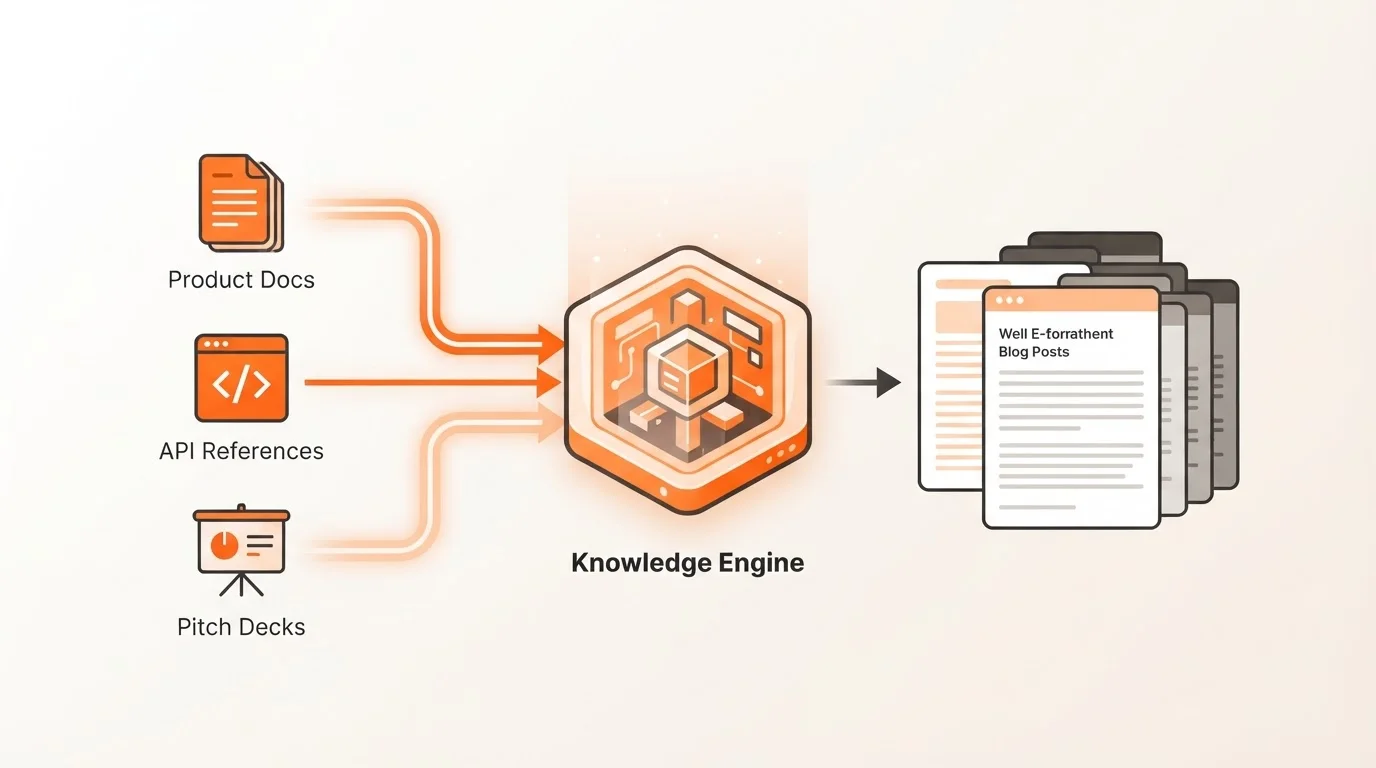
The secret to achieving consistent content quality at scale lies in how you ground your autonomous system. An autonomous blogging platform is only as effective as the data it can access. This is where the Knowledge Engine becomes a competitive advantage for SaaS founders. Unlike generic AI writing tools that guess your product's features based on public web data, a dedicated Knowledge Engine allows you to upload the 'DNA' of your software directly into the content creation process.
To ensure consistent quality, you must populate your engine with specific types of data. Public Product Sources include your existing documentation, landing pages, and API references. Internal Documents such as pitch decks and product requirement documents (PRDs) provide the 'why' behind your features. By providing these sources, you ensure the system doesn't 'hallucinate' features but instead references your specific technical facets.
Blogged's Knowledge Engine for Autonomous SaaS Blogs allows users to provide public product sources and uploaded documents to serve as a perpetual source of truth. When the platform generates a draft, it draws from these verified inputs to ensure technical accuracy. This eliminates the need to brief a writer every time you want to cover a new topic, as the 'brief' is effectively your living product documentation.
Autonomous Workflows: From Topic Supply to One-Click Publishing
Once the Knowledge Engine is established, the next phase is operationalizing the publishing schedule. For a scaling SaaS, 'consistency' means publishing at a cadence that matches your growth goals without requiring constant manual intervention. A robust autonomous system handles the entire lifecycle of a blog post, from initial keyword research to final internal link structure.
A key capability in this workflow is the ability to manage a durable topic pipeline. Blogged lets users build a durable SaaS content plan, publish on their preferred cadence, and let Full Autopilot refill a short Topic queue from approved Content Directions. This ensures you never run out of ideas while maintaining total control over the strategic themes of your blog. If your goal is to dominate a specific technical niche, you can set a Content Direction that prioritizes those pain points, and the system will autonomously research and draft articles that fit that mold.
The final step in the autonomous loop is integration with your existing technical stack. Scaling founders cannot afford to spend time copy-pasting text into a CMS. Integrations for WordPress, Webflow, and Ghost allow the marketing team to focus on conversion optimization while the autonomous system manages the delivery pipeline. This level of automation reduces the time-to-publish from days to minutes, allowing the blog to grow alongside the product.
GEO: The New Frontier of SaaS Content Quality
Content quality is increasingly defined by Generative Engine Optimization (GEO). While traditional SEO remains vital for organic search, a growing segment of SaaS buyers now starts their research inside AI-powered 'answer engines.' High quality now means being 'citable' by machines as well as readable by humans. If your content isn't cited as a source by these LLMs, your brand becomes invisible to a large portion of the market.
Autonomous blogging platforms are uniquely positioned to win in the GEO landscape because they structure content specifically for AI discovery. This includes the use of clear hierarchical headings, the inclusion of direct answers to common user questions, and the implementation of advanced schema markup. The goal is to move from 'ranking for a keyword' to 'becoming the definitive entity' for a specific category.
Quality in the age of GEO requires Technical Accuracy and Factual Precision. LLMs prioritize content that shows clear expertise and authoritative sourcing. By using an autonomous system grounded in a Knowledge Engine, your blog posts naturally contain the high-density technical facts that AI models look for when synthesizing answers. This creates a compounding growth effect: as you rank for traditional keywords, you are simultaneously building the authority required to dominate AI-driven search results.
Measuring Success: Outcomes Beyond Traffic
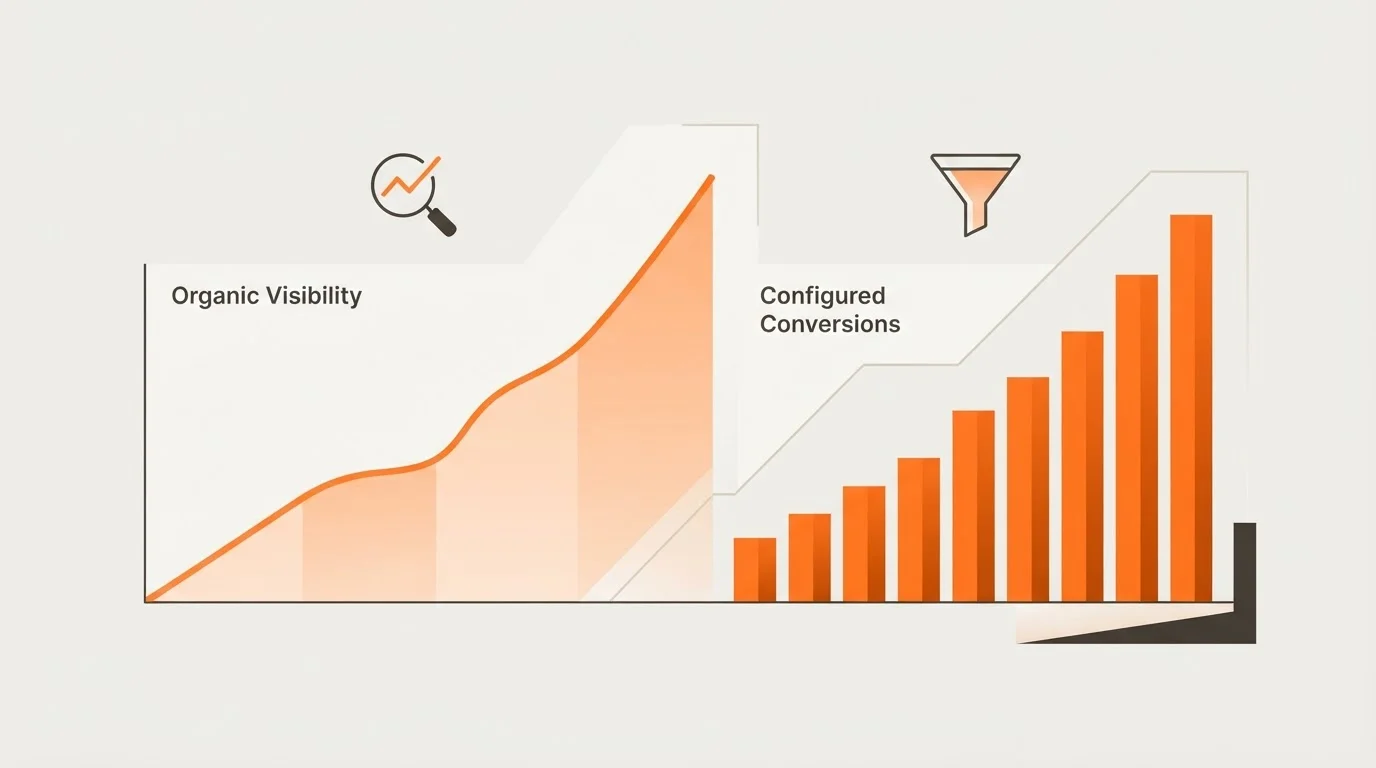
For a SaaS founder, the ultimate metric for content quality isn't just traffic; it is pipeline influence and lead growth. A high-traffic blog that attracts the wrong audience is a vanity project. A high-quality blog attracts your Ideal Customer Persona (ICP) and moves them through the funnel. Measuring this requires a direct connection between your content and your conversion goals.
Advanced autonomous platforms provide tracking that goes deeper than basic page views. Blogged lets users track Search Console performance, homepage engagement, and lead outcomes directly within the dashboard. By monitoring configured conversions for verified articles, founders can see exactly which topics are driving trial sign-ups and which are merely generating 'noise.'
This data-driven approach allows you to refine your Knowledge Engine and Content Directions in real-time. If articles about a specific integration are driving high-quality leads, you can adjust your Autopilot settings to produce more content in that category. This turns the blog from a static library of articles into a dynamic lead-generation engine that optimizes itself based on actual business outcomes.
Strategies for SaaS Founders to Scale Safely
Success with autonomous blogging requires a strategic approach to implementation. The most effective founders view autonomous blogging as a human-augmented system, not a total human-replacement system. The goal is to automate the repetitive tasks of research, SEO, and formatting so you can spend your limited time on high-impact strategic reviews.
The first strategy is to prioritize the Knowledge Base. The quality of your blog will never exceed the quality of your inputs. Update your Knowledge Engine with new product features and customer success stories at the start of every quarter. Second, leverage unlimited team seats to bring your product managers and marketers into the review process. Blogged includes unlimited team seats on its plans, allowing your subject matter experts to verify the technical accuracy of drafts without incurring additional software costs.
Third, focus on product-led content. Every article should naturally lead the reader toward a solution that your SaaS provides. If you are writing about a complex workflow, your platform’s specific features should be mentioned as a natural part of that solution. By keeping the reader's journey in mind, you ensure that every piece of 'quality content' is also a high-performing sales asset.
Frequently Asked Questions
Q: Won't AI-generated content be penalized by search engines?
Google's focus is on the value and utility of content, not the tool used to create it. High-quality autonomous content grounded in a specific Knowledge Engine provides unique, factual value that generic AI drafts cannot match.
Q: How much time does it take to set up an autonomous blog?
Initial setup, including populating the Knowledge Engine and configuring CMS integrations, typically takes less than an hour. Once the system is running on Autopilot, founders often spend just a few minutes a week reviewing and approving articles.
Q: Can the system handle highly technical SaaS topics?
Yes, provided the Knowledge Engine is fed with the right technical documentation. Because the system can process thousands of lines of API documentation or technical guides, it is often more accurate than a generalist freelance writer when explaining complex features.
Q: Does Blogged integrate with custom builds or Next.js?
Yes. Blogged offers native integrations for WordPress, Webflow, and Ghost, as well as a dedicated Next.js integration and a signed Webhook/Content API for custom technical stacks.
Get practical updates on consistent content quality saas
Receive new articles and practical insights by email.
Consistent content quality is no longer a luxury reserved for SaaS companies with massive marketing budgets. By adopting an autonomous approach, founders can break the 'Founders Paradox' and build a scaling growth engine that works as hard as their product team. The transition from manual writing to autonomous engineering allows you to reclaim your time and ensure that your brand remains the definitive authority in your category.
As the SaaS landscape becomes increasingly crowded, the ability to turn product knowledge into discoverable, high-quality content at scale will be the primary differentiator between brands that stall and brands that soar. It is time to take your blog off the back burner and put it on autopilot.