
On this page
Maintaining content accuracy in a fast-moving SaaS company is a constant race against the product roadmap. When features evolve weekly, marketing assets and documentation often lag behind, leading to a phenomenon known as content drift. For InnovateCo, a growing software provider, this gap became a significant operational bottleneck. Their engineering team was shipping faster than their content team could write, resulting in outdated guides, confused users, and a noticeable strain on their customer success resources. The disconnect wasn't just a marketing problem; it was a trust problem.
The solution for InnovateCo was a strategic move to autonomous blogging. By leveraging a platform designed to ground content in live product data, they synchronized their publishing cycle with their development cycle. This shift allowed them to maintain high content accuracy without slowing down product innovation. Through the use of a specialized Knowledge Engine, they transformed their blog from a source of confusion into a reliable, product-led growth engine that scales automatically with every release.
This case study explores the specific workflows InnovateCo used to bridge the gap between code and content, the technical integrations that enabled their success, and the measurable impact on their operations. By automating the research and publishing process, the founders shifted their focus back to building their SaaS while the autonomous platform ensured their public-facing information remained a verified reflection of the product's current state.
The Challenge: The High Cost of Outdated SaaS Content
InnovateCo thrived on an agile development culture. Their ability to ship new features and iterate on user feedback was their competitive advantage. However, this speed created a massive documentation debt. The traditional manual content lifecycle—researching a feature, drafting a post, reviewing for technical accuracy, and publishing—took weeks. By the time an article went live, the UI had often changed, or the feature had been refined, making the published information obsolete immediately.
This disconnect resulted in three primary issues. First, the user experience suffered. New users following onboarding guides found themselves stuck when the instructions didn't match the live application. Second, support costs rose as agents spent significant time correcting basic information found in outdated blog posts rather than handling complex technical queries. Third, the brand's authority was eroding. In the SaaS world, accuracy is the foundation of trust; consistently wrong information makes a product look unpolished and unreliable.
Founders often underestimate the friction caused by this misalignment. When your marketing says one thing and your product does another, you aren't just losing SEO potential—you are actively increasing churn. InnovateCo realized they needed a system where content was no longer a manual afterthought but a verified reflection of the product's current state. They needed a way to publish useful, specific content that rewarded discovery without the overhead of manual research and rewriting.
Bridging the Gap with an Autonomous Knowledge Engine
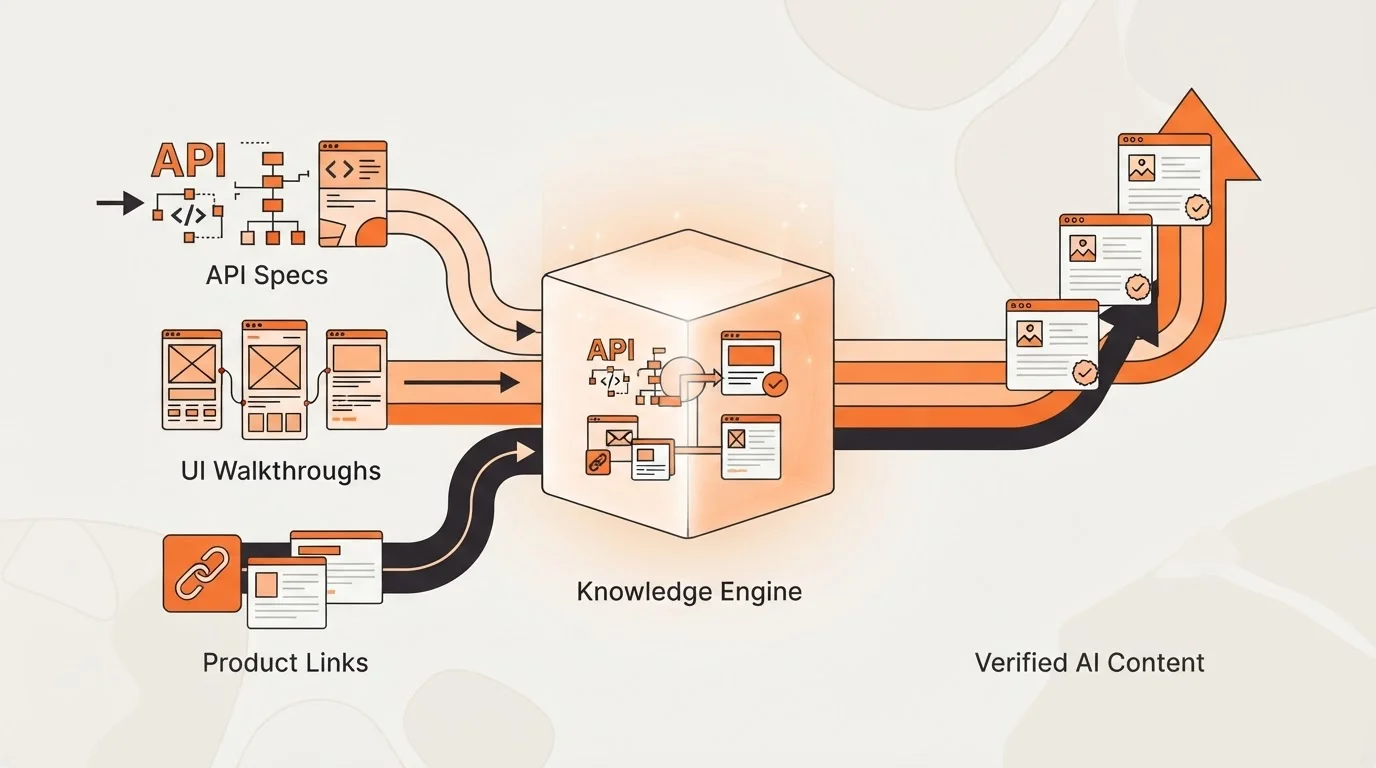
To solve the accuracy problem, InnovateCo adopted Blogged, an autonomous SEO and GEO blogging platform. The core differentiator was the Knowledge Engine, which allowed them to ground all AI-generated content in verified product facts. Instead of the AI guessing how a feature worked based on outdated training data, it drew directly from InnovateCo's own verified sources.
Blogged's Knowledge Engine for Autonomous SaaS Blogs feature lets users provide public product sources, uploaded documents, pasted links, or a written product description. This flexibility meant that InnovateCo could feed the platform their latest API specs, UI walk-throughs, and feature briefs. By centralizing this product knowledge, the autonomous system had a "single source of truth" to reference whenever it generated or updated a post.
This approach eliminated the risk of hallucinations. The AI wasn't just writing about the industry; it was writing specifically about InnovateCo's product using the exact terminology and logic defined by the product team. For a founder, this means the blog acts as a real-time mirror of the build, ensuring that even as the product iterates, the public-facing content remains factual and authoritative.
Implementation Strategy: Connecting Code to Content
The transition to autonomous blogging wasn't just about software; it was about integrating content into the development workflow. InnovateCo established a process where every major release included a step to update the Knowledge Engine. This ensured that the autonomous platform was always aware of the newest product version before it started planning new articles.
They utilized a multi-platform strategy to handle different types of content. For their marketing-heavy blog, they integrated with WordPress to capture organic search traffic. For their deeper technical documentation and tutorials, they explored different rendering environments. This dual-stack approach ensured that every segment of their audience received accurate, platform-appropriate information. By treating their knowledge base as a living asset, they enabled the platform to perform autonomous research, planning, writing, and optimization without constant human intervention.
WordPress AI Integration for Marketing Growth
For their main blog, InnovateCo needed a way to publish high-volume, SEO-optimized content without manual data entry. Blogged's WordPress AI Blog Publishing integration lets users create and review articles in Blogged, then deliver them directly to their WordPress website. This connection is both seamless and secure, designed for teams that need to maintain a high publishing cadence without sacrificing quality.
Technically, Blogged connects to self-hosted WordPress through the Blogged Publishing plugin and an application password. This allowed InnovateCo's marketing team to review the autonomously generated articles, verify the internal links, and push them live with a single click. Because the content was grounded in the Knowledge Engine, the technical verification step—which used to take hours of a developer's time—was reduced to a quick sanity check for tone and placement.
Technical Accuracy and Conversion Tracking via Ghost

For their more technical articles and guides, InnovateCo leveraged the Ghost integration. Blogged's Ghost AI Blog Publishing integration manages content creation and review while Ghost renders the reader experience. This was particularly useful for long-form guides that required high fidelity in formatting and clean layouts. To set this up, the team created a custom integration in Ghost, copied the Admin API key, and verified their connection in Blogged.
Crucially, this integration allowed InnovateCo to measure the actual business impact of their content. Blogged's Ghost AI Blog Publishing integration lets users collect consented visits and configured conversions for verified articles. By tracking how many readers of a specific "how-to" guide eventually signed up for a trial, InnovateCo could prove the ROI of their content strategy and refine their Knowledge Engine inputs to focus on the features that drove the most growth.
Operating Within Autonomous Constraints
Adopting an autonomous platform requires understanding its operational parameters. For InnovateCo, this meant planning their content around the platform's structured limits to ensure maximum efficiency. They noted that Blogged includes 2 pages and a specific revision workflow to maintain quality control. Specifically, Blogged includes 1 revision per article on certain plans (and up to 3 on others), which encourages teams to be precise with their initial Knowledge Engine inputs.
These limits actually helped InnovateCo improve their internal documentation. Because they knew the AI would use the provided sources to generate the post, the product managers became more diligent about writing clear, concise feature descriptions. This had the side benefit of improving internal communication, as the same clear descriptions used for the blog were also used by the sales and support teams. Additionally, since Blogged includes unlimited team seats on its plans, InnovateCo could invite both developers and marketers to participate in the review and approval process without additional costs, ensuring a holistic check on every piece of content.
Quantifiable Results: Slashing Latency and Driving Discovery
After transitioning to an autonomous workflow, InnovateCo saw a dramatic shift in their operational metrics. The most immediate change was the speed of publication. Previously, the time between a feature release and a live blog post was measured in weeks. With autonomous blogging, this lag was eliminated, as the platform could generate accurate, product-led content as soon as the Knowledge Engine was updated with new briefs or links.
The impact on support was equally significant. By ensuring that the blog was always accurate, InnovateCo empowered users to self-serve, reducing the volume of tickets related to documentation errors. This freed up their support agents to focus on high-priority technical issues rather than correcting UI discrepancies. From a growth perspective, the frequency of accurate, SEO-optimized posts led to improved organic visibility.
Because the content was highly specific to their product, it performed well not just in traditional search but also in Generative Engine Optimization (GEO). When AI search tools like Perplexity or ChatGPT look for specific product answers, they favor the most accurate and up-to-date sources. By publishing factual, grounded content, InnovateCo increased the likelihood that AI discovery engines would cite their blog as a primary source for user queries, positioning them at the top of AI-driven search results.
Key Takeaways for SaaS Founders
InnovateCo's success provides a blueprint for other SaaS founders struggling with the content-speed trade-off. The primary lesson is that content should be treated like code: it needs to be version-controlled, verified, and automated. By moving away from manual writing and toward an autonomous system grounded in a Knowledge Engine, founders can ensure their marketing keeps pace with their engineering.
To replicate these results, founders should first audit their current content for inaccuracies. Identify where users are getting stuck because of outdated information. Next, centralize your product knowledge. Whether it's a series of Markdown files, a public documentation site, or simple feature briefs, having a clear source of truth is the prerequisite for automation. Finally, choose a platform that integrates directly with your existing stack, whether that's WordPress, Ghost, Webflow, or a custom Next.js site using a Content API and signed webhooks.
Automation doesn't replace the need for a strategy, but it does replace the manual labor of execution. For a founder, that means more time spent building the product and less time worrying if the blog is telling the truth.
Frequently Asked Questions
Q: How does the Knowledge Engine ensure the AI doesn't make things up?
The Knowledge Engine acts as a factual boundary. The AI is instructed to prioritize the specific product sources—such as your uploaded documents and pasted links—over its general training data. This ensures that features and workflows are described exactly as they exist in your product.
Q: Can I use Blogged if I have a custom-built website?
Yes. While InnovateCo used WordPress and Ghost, Blogged also offers integrations for Next.js and Webflow, as well as a Content API and signed webhooks for fully custom stacks. This allows you to maintain content accuracy regardless of your frontend technology.
Q: How much time does the review process actually take?
Because the content is grounded in your own product data, the technical review is significantly faster. Most founders find that they only need a few minutes to scan the article for tone and internal link placement before hitting publish.
Q: Does autonomous blogging help with AI search engines like Perplexity or ChatGPT?
Yes. This is known as GEO (Generative Engine Optimization). By publishing specific, factual, and up-to-date content that is grounded in real product data, you increase the likelihood that AI discovery engines will cite your blog as a primary source for user queries.
Get practical updates on saas content accuracy product changes case study
Receive new articles and practical insights by email.
Content accuracy is not just a marketing requirement; it is a core component of SaaS operational excellence. As InnovateCo demonstrated, the traditional manual approach to content creation is no longer viable for companies that iterate rapidly. The friction caused by outdated information is too high, both in terms of support costs and lost user trust.
By adopting an autonomous blogging platform like Blogged, SaaS founders can solve the content drift problem once and for all. Through the power of the Knowledge Engine and seamless CMS integrations, you can ensure that every blog post, guide, and update is a perfect reflection of your product. This allows your team to focus on what they do best—building great software—while the autonomous platform handles the heavy lifting of driving organic growth through verified, product-led content.