
On this page
For many SaaS founders, the blog is a persistent source of guilt. You know you need a content engine to drive organic growth, but your primary focus is—and should be—building a world-class product. This leads to what we call the 'Founder’s Content Gap': a blog filled with inconsistent, generic industry news that might attract visitors but fails to move the needle on trials or demos. Improving your saas content conversion rate improvement efforts requires more than just publishing volume; it requires a fundamental shift toward product-led, high-intent content that reflects your actual software capabilities.
Traditional content marketing often forces a choice between quality and consistency. You either spend dozens of hours writing deep-dive tutorials yourself or hire a generalist writer who lacks the technical context to explain your software's unique value proposition. Autonomous blogging bridges this gap by transforming your existing product knowledge into discoverable content. By adopting a system that researches, writes, and optimizes based on your actual product documentation and assets, you can turn your blog from a stagnant cost center into a high-yield lead generation engine.
The future of organic growth for software companies isn't just about appearing in search results; it is about being the definitive answer for potential customers in both traditional search and emerging AI discovery engines. This guide explores how founders can leverage autonomous platforms to scale their content without sacrificing development time, ensuring that every article published is a strategic asset designed to convert.
The Friction of Manual Content: Why Most SaaS Blogs Fail to Convert
The standard approach to SaaS blogging is often broken by design. Founders typically start by hiring a generalist freelance writer or assigning a junior marketing hire to 'do SEO.' The result is content that ranks for high-volume, low-intent keywords. While these articles bring in traffic, they rarely address the specific pain points that lead someone to sign up for a software solution. High traffic numbers might look good on a dashboard, but if those visitors aren't exploring your product features, the ROI remains elusive.
Most SaaS blogs suffer from four core friction points that stifle conversion. First is the Intent Mismatch: blogs are often filled with 'What is [Industry Concept]?' articles that attract students or researchers, not buyers looking for a functional tool. Second is the Production Bottleneck: creating technically accurate content requires constant input from the product team, which slows publishing to a crawl. Third is the use of Generic CTAs: without product-focused content, calls-to-action like 'Join our Newsletter' lack the urgency needed to drive a trial signup. Finally, a Lack of Internal Linking prevents visitors from being guided deeper into the conversion funnel. To solve this, you need a way to transform deep product knowledge into discoverable content without draining your engineering resources.
The Strategic Shift: From Generic SEO to Product-Led Discovery
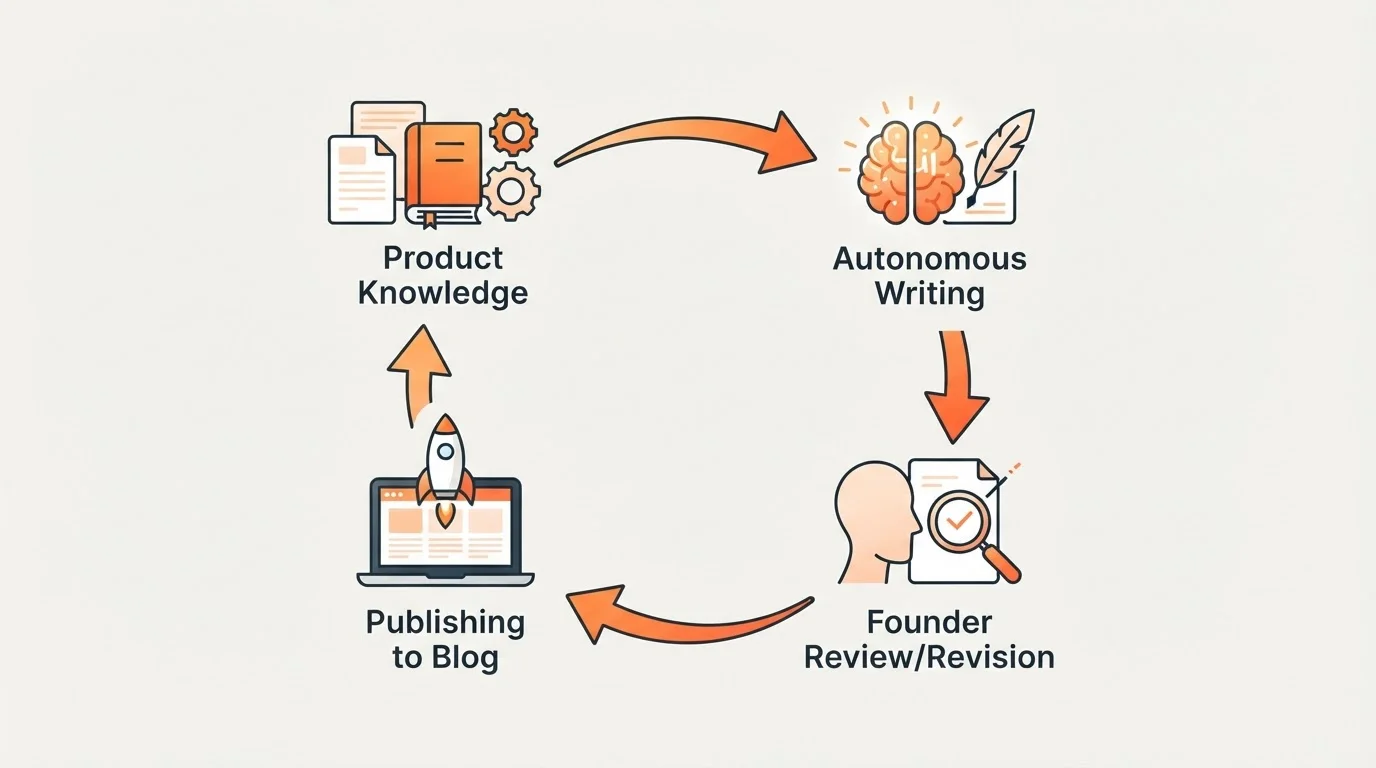
A turnaround in conversion begins by implementing an autonomous strategy designed specifically for the needs of software companies. This involves moving beyond the 'content treadmill' and focusing on product-led content. This type of content doesn't just talk about the industry; it illustrates how your product solves a specific problem. It positions your SaaS as the natural solution within the context of the user's search query.
This shift requires a platform that can intake your product knowledge—your features, use cases, and documentation—and use it as the 'source of truth' for every article. By doing so, the content produced is technically accurate and carries the authority of the founder's vision. Instead of generic advice, your blog begins publishing articles that show exactly how to use your tool to achieve a specific outcome. This 'show, don't just tell' approach is the hallmark of high-converting SaaS content, attracting visitors who are already searching for a solution rather than just a definition.
Winning the GEO Landscape: AI Discovery as a Conversion Channel
While traditional Search Engine Optimization (SEO) remains important, SaaS founders must now also optimize for Generative Engine Optimization (GEO). High-intent buyers are increasingly using AI answer engines like ChatGPT, Perplexity, and Google Gemini to research tools. They ask specific questions like 'How do I automate my SOC-2 compliance monitoring?' or 'What is the best CRM for remote sales teams?'
To capture this traffic, your content must be authoritative and grounded in specific product facts. AI engines favor content that provides direct, useful answers and cites reliable sources. By using an autonomous blogging platform like Blogged, you ensure your content is structured to be cited by these AI engines. This creates a new conversion channel where your product is recommended exactly when a potential customer is asking an AI for a solution.
Technical Implementation: Integrating Autonomous Content into Your Stack
For a SaaS company, technical friction is the enemy of adoption. You need a content solution that integrates seamlessly with your existing tech stack without requiring engineers to build custom CMS features. Modern autonomous blogging platforms provide several paths for automating this transition while ensuring you can track every lead and measure your saas content conversion rate improvement accurately.
WordPress Integration for Reliable Publishing
One of the most robust methods for automating your blog is through the WordPress AI Blog Publishing integration. By using a specialized publishing plugin and an application password, an autonomous platform can create, optimize, and deliver articles directly to your WordPress instance. This integration is designed to be hands-off; once the connection is verified, the system can handle the entire lifecycle from draft to live post.
A critical benefit of this integration is the ability to collect consented visits and track configured conversions for every verified article. For a founder, this data is essential. It moves the conversation from 'how many people read this?' to 'how many people signed up after reading this?' This granular tracking allows you to see which product-led topics are actually driving business growth.
Ghost and Webflow for Modern Marketing Stacks
For teams using Ghost or Webflow, the integration process is equally streamlined. The Ghost AI Blog Publishing integration allows founders to manage content creation and review within the autonomous platform while Ghost handles the reader experience. By creating a custom integration in Ghost and providing the Admin API key, you can automate the entire pipeline. This ensures your blog remains active and optimized without a single manual upload.
Similarly, the Webflow CMS integration lets users collect consented visits and conversions within their native environment. This means you don't have to sacrifice your preferred design or tech stack to gain the benefits of automation. You maintain full control over the user experience while the autonomous engine handles the heavy lifting of research, writing, and internal linking.
Get practical updates on saas content conversion rate improvement
Receive new articles and practical insights by email.
API-Driven Blogs and Next.js Frameworks
For founders building highly custom SaaS sites, platforms like Blogged provide a Next.js AI Blog Publishing integration and a capable API. Using a signed webhook and Content API, your developers can programmatically fetch and display autonomous content. This allows the blog to feel like a native, integrated part of the product experience. Like other integrations, the Next.js path supports collecting consented visits and tracking conversions, ensuring that even the most custom implementations have clear ROI metrics.
Maximizing ROI: Efficiency and Team Collaboration

Efficiency is the primary driver of ROI for early-stage SaaS companies. Hiring a dedicated content agency or a full-time writer can cost thousands of dollars a month and requires significant management overhead. In contrast, autonomous blogging platforms like Blogged are listed at $99 per month, making them a highly cost-effective alternative for founders who need to scale their organic reach without a massive financial burden.
Scaling shouldn't mean increasing your per-user costs. All Blogged paid plans include unlimited team seats, allowing you to invite product managers, marketers, or technical leads to participate in the review and approval process without additional fees. This collaborative environment ensures that while the writing is autonomous, the final output is always aligned with your team's expertise and brand voice.
Maintaining Quality: The Importance of Review and Revisions
Autonomy does not mean a lack of oversight. To maintain a high conversion rate, your content must reflect your brand’s unique perspective and technical accuracy. Modern autonomous systems address this by keeping the founder in the loop at critical stages. The goal is to spend just a few minutes a week reviewing suggested topics and drafts rather than hours writing from scratch.
To ensure the final output meets your standards, Blogged includes revisions in every plan. Depending on the tier you choose, the platform includes between 1 and 3 revisions per article. This allows you to fine-tune the final output, ensuring that the tone is correct and every technical detail about your software is perfectly represented. Because the system uses your specific product knowledge as its source of truth, it avoids the 'generic AI fluff' that search engines and savvy readers often ignore.
Frequently Asked Questions About SaaS Autonomous Blogging
Q: How much time does it actually save a SaaS founder?
Most founders spend less than 30 minutes a week reviewing and approving topics or drafts. The platform handles the deep research, writing, SEO, GEO, and publishing automatically.
Q: Does AI-generated content still rank on Google?
Yes, provided it is useful, original, and grounded in specific knowledge. Because Blogged uses your specific product assets to ground its writing, it avoids the generic patterns that lead to ranking penalties and provides the specific value that search engines crave.
Q: Can I use it with my custom-built Next.js blog?
Yes. Blogged offers a Next.js integration along with a robust API and signed webhooks, allowing you to fetch content programmatically and track conversions on custom sites.
Q: How many team members can I add to the account?
All paid Blogged plans include unlimited team seats, so your whole marketing and product team can collaborate on content without extra costs.
Q: How do the revisions work?
Depending on your plan, you get 1 to 3 revisions per article. This allows you to request changes to tone or technical details before the post goes live on your site.
High-converting content isn't a luxury—it’s a strategic asset that can now be built autonomously. By moving away from the manual content treadmill and embracing a platform that understands the intersection of SEO, GEO, and product-led growth, SaaS founders can finally achieve the organic lead generation they need without sacrificing the time required to build their product. The future of SaaS growth is about transforming product knowledge into discoverable, conversion-driving assets. With Blogged, that transformation is now on autopilot.