
On this page
Achieving content-market fit is the silent hurdle that determines whether a SaaS product scales or stagnates. While product-market fit focuses on the utility of the software, content-market fit is the bridge that connects that utility to a discoverable audience. For many founders, this bridge is built too slowly. Traditional content production—involving weeks of manual research and drafting—often lags behind agile product development, creating a strategic blind spot where features are built before their market demand is actually proven.
The SaaS Growth Bottleneck: The Lag Between Code and Content
SaaS founders frequently face a dilemma where engineers ship faster than marketers can generate demand. You might release a new AI-driven analytics feature in two weeks, but it often takes a content team months to produce the high-quality, product-led articles needed to rank for relevant keywords. This delay creates 'market debt,' where teams build on top of unvalidated features because they lack the organic feedback loop necessary to gauge user interest in real-time.
To break this cycle, forward-thinking founders are shifting content to the start of the development cycle. Instead of waiting for a feature to be finished, they use content as a low-cost mechanism for market validation. The goal is to produce specific, useful content that reflects evolving product knowledge, ensuring that the market is actually searching for the solutions being built. This requires a shift from manual content creation to autonomous systems that can keep pace with a rapid shipping schedule.
Why Content-Market Fit is the Prerequisite for Scale
According to the Four Fits Framework, sustainable growth happens when the Market, Product, Channel, and Model align. Most founders obsess over the first two but neglect the Product-Channel fit. If your primary distribution channel is organic search or AI discovery, your product knowledge must be architecturally designed to generate content that fits those channels perfectly.
Content-market fit is achieved when your content resonates with the specific search intent of your target audience and the technical requirements of discovery engines. For a SaaS startup, this means your blog needs to do more than just announce features. It must solve the exact problems those features address, using the precise language the market uses in search engines and Generative Engine Optimization (GEO) environments like Perplexity and ChatGPT. By adopting an autonomous blogging strategy, you can test these fits simultaneously, ensuring your engineering resources are always directed toward validated market needs.
Using Blogged to Transform Product Knowledge into Growth
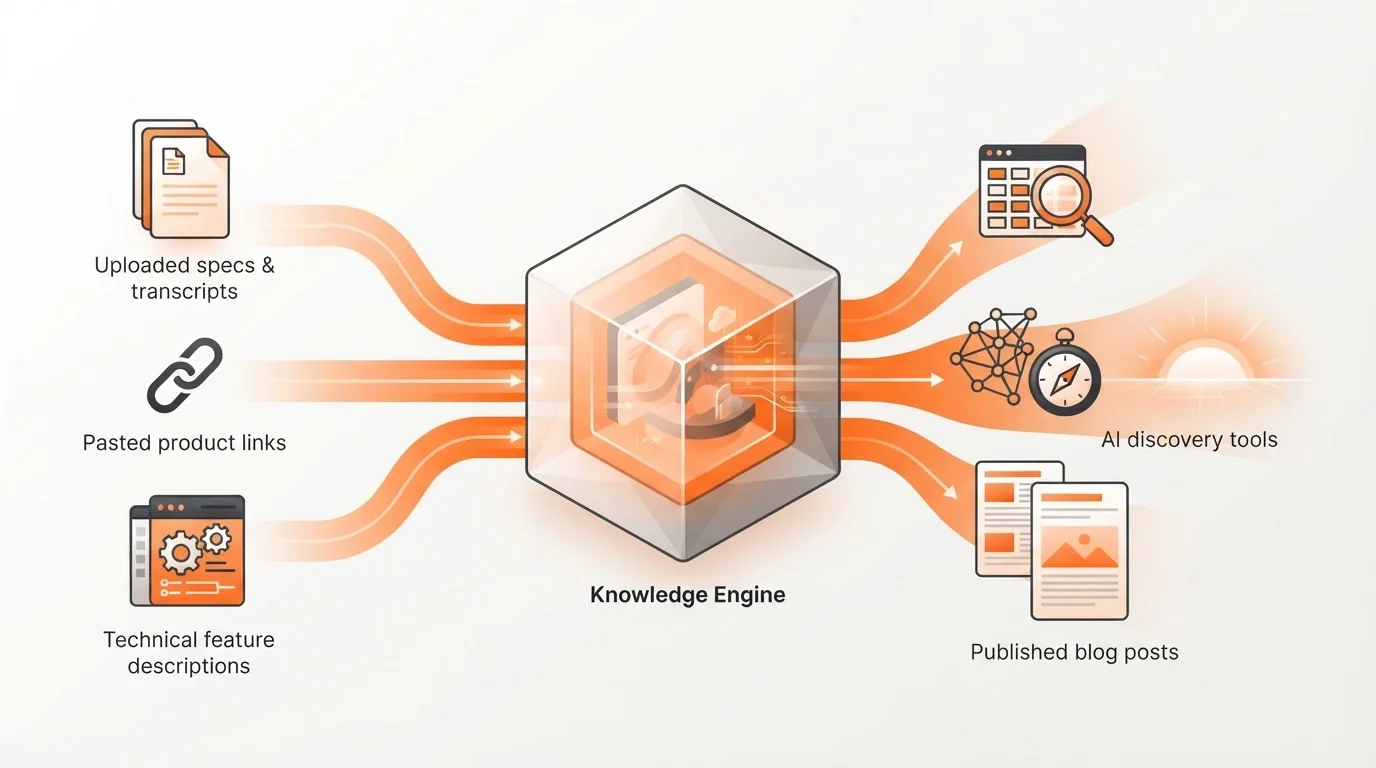
Blogged serves as an autonomous SEO and GEO blogging platform specifically designed for SaaS founders who need to move fast. The platform handles the entire lifecycle of product-led content—from research and planning to interlinking and publishing—on autopilot. This allows founders to focus on building their core product while the platform ensures their innovations are discoverable by the right audience.
A central component of this efficiency is the Blogged Knowledge Engine. Rather than relying on generic AI writing that lacks depth, the Knowledge Engine for Autonomous SaaS Blogs allows you to provide public product sources, uploaded documents, pasted links, or written product descriptions. By feeding the platform internal feature specifications or customer interview transcripts, you ensure the resulting content is deeply rooted in the actual utility of your software, rather than being mere 'fluff' for search engines.
Deep Integration with Your Technical Stack
A common concern for SaaS teams is the technical overhead of managing multiple platforms. Blogged addresses this through native integrations that fit into existing workflows. The WordPress AI Blog Publishing integration allows users to create and review articles within Blogged and deliver them directly to their site. For self-hosted instances, Blogged connects securely through a dedicated publishing plugin and an application password.
For teams using other platforms, the Ghost AI Blog Publishing integration manages the content creation and review process while Ghost continues to render the reader experience. Similar capabilities exist for Webflow and Next.js, allowing founders to maintain their existing SEO authority while modernizing the engine behind their content. These integrations also support data collection, enabling you to track consented visits and configured conversions for verified articles directly within your preferred environment.
The Strategic Workflow: A Hypothetical Roadmap to Validation
Consider a hypothetical SaaS company, 'GrowthEngine,' which needs to validate a new 'Predictive Churn' module. Instead of building the module first, they implement a 'Content-First' workflow using Blogged. They start by inputting the module's core value proposition into the Knowledge Engine. The platform then researches the competitive SEO landscape and the GEO citation environment to identify how users are currently seeking help for churn-related issues.
Next, the platform generates a series of specific, product-led articles. Because Blogged includes 1 to 3 revisions per article (depending on the plan), the team can refine the messaging to ensure it aligns perfectly with their technical roadmap. By publishing this content early, GrowthEngine can monitor organic engagement and sign-ups. If a particular article attracts significant traffic and waitlist conversions, the product team has high-confidence data to move from a hypothesis to full-scale development, potentially saving weeks of engineering effort.
Get practical updates on saas faster content market fit case study
Receive new articles and practical insights by email.
The Impact of Autonomy on Operational Efficiency

Transitioning to autonomous blogging produces a measurable shift in how a SaaS company operates. When content production is compressed from weeks to days, the entire validation loop accelerates. By publishing a higher volume of targeted, product-led articles, startups can reach statistical significance in their market research much faster than through manual efforts.
Beyond simple speed, autonomy improves the quality of the 'unintentional' SEO footprint. Because Blogged handles internal linking and SEO optimization autonomously, it often surfaces keywords and market segments that the founders hadn't initially targeted. This can lead to the discovery of lucrative new use cases. Furthermore, every paid plan on Blogged includes unlimited team seats, allowing product managers, marketers, and founders to collaborate on the content strategy without increasing costs as the team grows.
Key Takeaways for Scaling SaaS Organic Reach
To successfully scale organic growth without a massive marketing department, founders should focus on these four pillars:
- Pre-Validate with Specificity: Use autonomous blogging to test search demand for a problem before coding a feature. If the market doesn't engage with the content, they likely won't pay for the feature.
- Centralize Product Knowledge: Use the Blogged Knowledge Engine to ensure every article is a direct extension of your technical documentation and product utility.
- Integrate the Pipeline: Don't rebuild your site. Connect Blogged to your current WordPress, Ghost, or Next.js build to automate the publishing flow while keeping your existing architecture.
- Prioritize GEO and SEO: As search evolves toward AI-synthesized answers, ensure your content is structured for citation. Blogged's focus on Generative Engine Optimization ensures your SaaS remains visible in tools like ChatGPT and Perplexity.
Frequently Asked Questions
Q: How does Blogged connect to my existing WordPress site?
The WordPress AI Blog Publishing integration connects to self-hosted sites using the Blogged Publishing plugin and an application password. This allows you to review and publish articles directly from the Blogged dashboard to your site.
Q: Can I use Blogged if I have multiple product lines?
Yes. The Knowledge Engine allows you to manage different knowledge bases, making it easy to tailor content for specific products, target personas, or technical niches within one platform.
Q: How many revisions are included for each article?
Depending on your specific plan, Blogged includes between 1 and 3 revisions per article, ensuring you can maintain high editorial standards while benefiting from autonomous production.
Q: Does the platform support team collaboration?
Yes. Every paid plan on Blogged includes unlimited team seats. This allows founders, product managers, and marketers to participate in the content review and approval process without additional per-seat fees.
For SaaS startups, speed is the ultimate competitive advantage. By automating the most time-consuming parts of the content lifecycle, founders can achieve content-market fit significantly faster, ensuring they only build what the market truly wants. Platforms like Blogged transform the blog from a secondary marketing channel into a primary strategic asset, freeing founders to focus on building the future of their SaaS.