
On this page
An SEO bot is an autonomous tool designed to manage the end-to-end lifecycle of search engine optimization—from keyword discovery and article drafting to internal linking and CMS publishing. For SaaS founders, these bots promise a way to build organic search authority without the overhead of a full content team. However, not all automation is created equal. While general-purpose bots focus on high-volume news or informational content, SaaS founders often require a more specialized approach. Platforms like Blogged differ by focusing on product-led content, transforming deep product knowledge into articles that don't just rank, but actively sell the software. Understanding the specific workflow and trade-offs of these tools is essential to finding a solution that fits your unique product roadmap.
The Anatomy of an SEO Bot Workflow
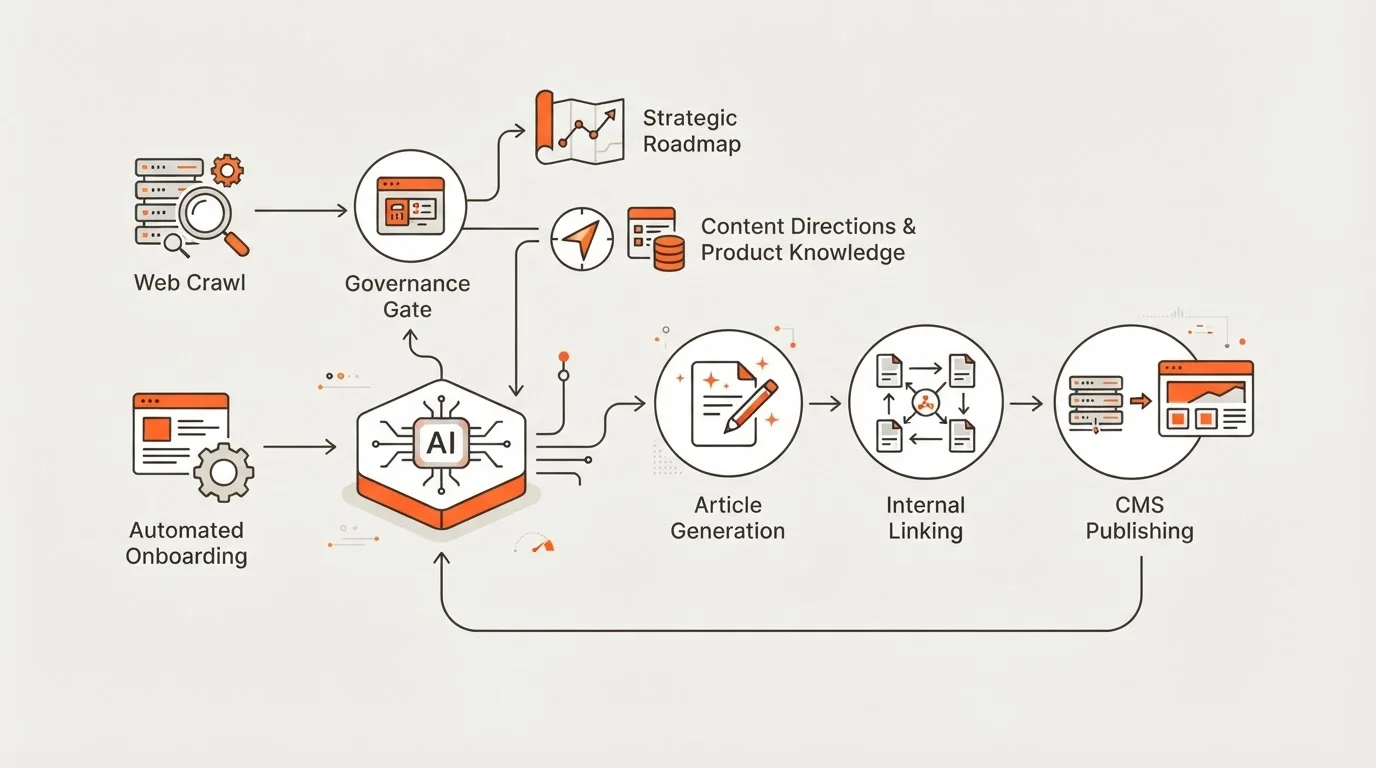
Most autonomous SEO bots operate on a set-and-forget model. The process typically begins with automated onboarding, where you provide your website URL and target audience profile. The bot then crawls the live web and competitor data to build a strategic content roadmap. Once the strategy is set, the bot enters a recurring production cycle. It generates long-form articles, manages internal linking to strengthen site architecture, and pushes content directly to your CMS. Specialized platforms like Blogged enhance this workflow by adding a governance gate. Instead of just following generic search trends, Blogged lets users set Content Directions and utilizes a private product knowledge base. This ensures that the generated content remains grounded in your actual features and value propositions, preventing the factual drift common in general AI tools.
Comparing General SEO Bots and Product-Led Platforms
When choosing between a general SEO bot and a specialized platform, SaaS founders should weigh the cost of volume against the value of precision. A general bot may offer more articles per dollar, but a product-led platform ensures those articles accurately reflect your evolving software. | Feature | General SEO Bot | Blogged (SaaS-Specialized) | | :--- | :--- | :--- | | Primary Goal | High-volume organic traffic | Product-led lead generation | | Knowledge Base | General web research | Private SaaS product asset library | | Content Freshness | New post generation focus | Autonomous updates for product changes | | Measurement | Impressions and clicks | Lead growth and CTA outcomes | | Entry Pricing | Varies by provider | $99/mo (30 posts per month) | | Team Access | Often limited by seat | Unlimited team seats | For a SaaS startup, the total cost of ownership includes the time spent manually correcting AI hallucinations. General bots often require significant human editing to ensure technical accuracy, whereas specialized platforms are built to reference a verified fact base.
Important Trade-Offs: Quality, Freshness, and Control
Deciding on a bot involves navigating critical trade-offs that impact long-term SEO performance. General bots excel at volume, which can be useful for broad informational blogs. However, SaaS founders often need content that educates users about specific features. A specialized platform focuses on high-quality, product-led content that resonates with a sophisticated B2B audience. Furthermore, SaaS products change rapidly. A general bot might publish an article about a feature today that becomes obsolete next month. Blogged is specifically designed to handle content freshness autonomously, updating existing posts to reflect new software updates or shifts in your positioning. Full autopilot is efficient, but many founders prefer a review mode. Blogged facilitates this with unlimited team seats, allowing product managers and marketers to collaborate on the review process without additional costs.
Get practical updates on seo bot features and product fit
Receive new articles and practical insights by email.
How to Evaluate Product Fit for Your SaaS
To determine if an SEO bot aligns with your business goals, consider these five evaluation criteria: 1. Strategic Alignment: Does the tool support product-led content? If your growth depends on explaining how your software solves specific problems, you need a bot that can ingest your product knowledge. 2. Integration Capabilities: Check if the platform connects to your current stack. Blogged supports WordPress (via plugin), Webflow, Ghost, and Next.js, ensuring a smooth publishing pipeline. 3. Governance and Accuracy: Does the tool offer a way to manage facts? Look for features that allow you to manage product assets centrally and verify the provenance of claims. 4. Performance Insights: A bot should report on Search Console performance, homepage engagement, and direct lead outcomes to calculate ROI. 5. Scalability: Evaluate the monthly limits. Blogged's Starter plan offers 30 posts per month for $99, while the Growth tier at $169/mo for 60 posts allows for more aggressive scaling as your budget expands.
Frequently Asked Questions
Q: Can an SEO bot help with Answer Engine Optimization (AEO)?
Yes. Many modern bots, including Blogged, optimize content for GEO (Generative Engine Optimization) to ensure your product is recommended by AI assistants like ChatGPT, Perplexity, and Gemini.
Q: Does Google penalize content generated by SEO bots?
Google rewards helpful, high-quality content regardless of how it is produced. The risk lies in publishing generic, low-value content. Using a bot that incorporates product-specific facts helps ensure your content meets quality standards.
Q: How much human intervention is required?
It varies. You can run these systems on full autopilot, but a light governance gate is recommended. This involves a quick review of the content directions or drafts to ensure brand alignment before they go live.
Q: What integrations should I look for?
At a minimum, look for native CMS connections like WordPress or Webflow. Advanced users may prefer a REST API or webhooks to deliver content into custom front-ends like Next.js.
SEO bots offer a powerful way for SaaS founders to maintain a consistent content presence while focusing on product development. However, the best-fit solution depends on whether you need simple volume or a strategic, product-led pipeline. For those who prioritize accuracy, content freshness, and measurable lead growth, a specialized platform provides the governance and product-deep integration required to turn a blog into a growth engine.