
On this page
For SaaS founders, especially those operating without venture capital, the path to product-market fit (PMF) is often a high-stakes guessing game. Statistics consistently show that the majority of startups fail not due to technical limitations, but because they build a solution for a problem the market does not prioritize. Validating a core hypothesis typically requires expensive experiments: paid ad campaigns that burn through remaining runway or months of manual outreach that may lead to dead ends.
However, a new strategic lever has emerged for the resource-constrained founder: autonomous blogging. By deploying a systematic, product-led content strategy, founders can turn their blog into a market research engine that identifies real-world demand before the first line of production code is even finalized. Autonomous blogging is not just about publishing more; it is about using AI-driven content as a series of probes to test which pain points resonate with a real audience.
This approach allows founders to observe organic search behavior, analyze engagement metrics, and gather conversion data that proves whether a proposed solution solves a painful enough problem. In this guide, we explore a framework for using autonomous blogging to achieve PMF, leveraging the exact capabilities that help bootstrapped startups move from hypothesis to early traction.
The Challenge: Validating Product-Market Fit on a Bootstrapped Budget
The primary obstacle for any bootstrapped SaaS is the feedback lag. Traditional validation methods—building a minimum viable product (MVP), running cold outreach, or buying search engine ads—all suffer from high costs or slow timelines. If you build the wrong feature, you waste weeks of development; if you buy the wrong ads, you waste thousands of dollars in capital.
Founders need a way to de-risk the development process by proving interest in specific use cases before they commit to building them. Most founders start with a vision composed of multiple sub-hypotheses. For example, a founder building a project management tool for creative agencies might assume that automated client reporting is their "killer feature."
To move from belief to data, the founder must determine if the target audience is actually searching for that solution and if they find the proposed value proposition compelling enough to take action. This is where many startups stall. They lack the time to write multiple articles every week while managing the product roadmap, yet they cannot afford a high-end content agency. To overcome this, founders must transition from manual content creation to an autonomous system that functions as a continuous market-testing lab.
Step 1: Defining the Problem-Market Statement
Before launching any content, you must articulate the specific problem your SaaS intends to solve. A generic statement like "We help businesses grow" is impossible to validate effectively. Instead, focus on a measurable claim, such as "Our SaaS helps independent consultants manage client invoices more efficiently."
By documenting this, you create a baseline for your content strategy. If consultants do not search for or engage with content regarding invoice management efficiency, your core hypothesis may need adjustment. This early signal allows you to pivot your messaging before you have over-invested in a specific feature set.
Step 2: Mapping Hypotheses to Keyword Clusters
For every feature or benefit you plan to build, identify the corresponding search intent. If you believe automated invoice reminders are essential, your keyword clusters should include terms like "how to reduce late payments for consultants" or "best automated billing tools for freelancers."
This cluster-based approach ensures you are not over-relying on a single search term, but rather measuring a broad signal of demand across a specific problem space. This mapping allows you to treat every blog post as a data point in your market validation experiment. If the cluster around "automated reminders" gets 10x the traffic of "client onboarding," your product roadmap should reflect that priority.
Leveraging Autonomous Blogging as a Market Probe
Autonomous blogging platforms, such as Blogged, transform the way founders interact with their market. Instead of spending hours on keyword research and drafting, founders can use the platform's Autopilot to handle the entire content lifecycle: research, planning, writing, SEO optimization, and publishing. This efficiency allows a founder to test dozens of different product angles in the time it would normally take to write one detailed guide.
The content acts as a series of probes into the market. By monitoring which articles attract the highest volume of qualified traffic, founders can identify emerging trends and validate the perceived value of proposed features. If an article about a specific integration outperforms a general feature guide significantly, the founder has received a clear signal on which development priorities to focus on.
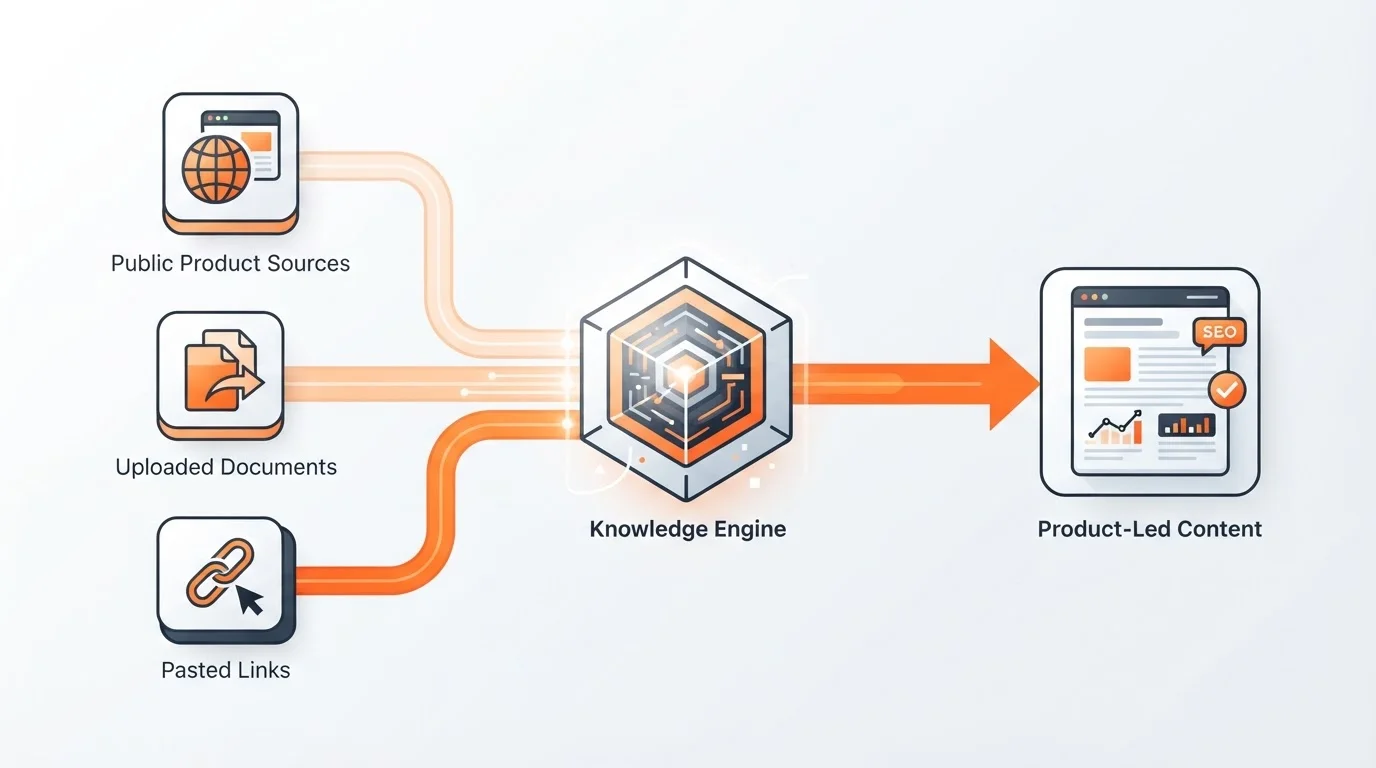
However, for this data to be useful, the content must be high-quality and product-led. Generic AI filler will not provide valid signal because it does not solve the reader's problem or offer a unique perspective. Modern autonomous systems solve this by incorporating the founder's own product knowledge. Features like the Knowledge Engine allow founders to upload documents, paste links, or provide written product descriptions, ensuring the generated articles reflect the specific nuances of their solution rather than generic industry platitudes.
Implementing Blogged: Turning Hypotheses into Discoverable Content
The transition from guessing to validating happens when you integrate your product vision directly into an autonomous publishing workflow. For a bootstrapped founder, the goal is to create a frictionless path from a product idea to a live, SEO-optimized article that captures lead data. Platforms like Blogged are designed specifically for this SaaS lifecycle.
Starting at $99 per month, the platform manages the heavy lifting of growth so founders can stay focused on their codebase. This is a full-stack SEO and GEO (Generative Engine Optimization) platform that ensures your product is discoverable not just on Google, but within AI search tools like ChatGPT and Perplexity. To implement this strategy effectively, founders should leverage several technical capabilities.
First, the Knowledge Engine ensures the AI has access to public product sources, uploaded documents, and pasted links to create content that is factually grounded in your specific SaaS. Second, deep integrations with platforms like WordPress, Webflow, and Ghost allow for seamless publishing. For instance, the WordPress AI Blog Publishing integration lets users create and review articles in Blogged, then deliver them to their site using a dedicated plugin and application password. For Webflow and Ghost users, these integrations also collect consented visits and configured conversions, turning every article into a measurable experiment.
From Vanity Metrics to Validation Data

Once your autonomous blog is live, the focus shifts to data analysis. To validate product-market fit, you must look beyond raw traffic numbers. A successful validation strategy tracks how users move through the content to the product itself. Blogged facilitates this by allowing users to track Search Console performance, homepage engagement, CTA and lead outcomes, and reader feedback directly within the platform.
If an article about a hypothetical use case leads to a significantly higher number of newsletter sign-ups or demo requests compared to other topics, you have achieved a form of early traction. This data is more authentic than a survey because it represents a user spending their most valuable resource—time—to find a solution to a problem they are currently facing.
Founders should establish baseline metrics for these experiments. Set a target for organic sign-ups or a specific conversion rate from your product-led content. If these thresholds are met, the underlying product hypothesis is considered validated. If they are not, you can use the data to pivot: adjusting your messaging or shifting your feature development toward the topics that are generating genuine engagement. Throughout this process, team collaboration is essential. Every paid Blogged plan includes unlimited team seats, allowing product managers and marketers to participate in the review and approval process without incurring extra costs.
Frequently Asked Questions
Q: How long does it take to see validation results from autonomous blogging?
While SEO results accumulate over time, autonomous blogging allows you to publish a higher volume of targeted probes quickly. Many founders begin to see initial traffic and engagement signals that inform their product roadmap within a few months of consistent publishing.
Q: Does AI-generated content hurt my brand or SEO rankings?
High-quality, product-led content is rewarded by search engines. By using a Knowledge Engine to feed the AI specific facts and sources, you avoid the generic content that search engines often penalize. Useful, specific content is the goal for both readers and algorithms.
Q: Can I use this strategy if I haven't finished building the product yet?
Yes. Validating demand through content before you build helps you avoid wasting development time on features the market does not want. This is a common strategy for building a waitlist and refining your MVP.
Q: How many team members can help review the content?
Every paid Blogged plan includes unlimited team seats with admin, editor, and viewer roles, so your entire team can collaborate on the validation process without additional fees.
Strategic Takeaways for Bootstrapped Founders
For a bootstrapped startup, every dollar and hour is a trade-off. Choosing to manually write blog posts means choosing not to talk to customers or ship features. However, choosing to ignore organic growth means missing out on a sustainable source of long-term traction. Autonomous blogging resolves this tension by providing a scalable, data-driven approach to market validation.
By treating your blog as a continuous research lab rather than just a marketing channel, you gain a competitive advantage. You can discover what your audience cares about, which language they use to describe their pain, and which solutions they are most willing to pay for—all while your autonomous system builds your SEO authority in the background.
Ultimately, achieving product-market fit is about reducing the distance between a founder's vision and the market's reality. Autonomous blogging is the engine that closes that gap, allowing you to build with confidence and grow with efficiency.
Get practical updates on saas product market fit case study
Receive new articles and practical insights by email.
Validating product-market fit does not have to be a costly or manual process. By leveraging an autonomous blogging platform like Blogged, SaaS founders can systematically test their product hypotheses through high-quality, product-led content. This strategy provides the organic traffic, user insights, and early traction necessary to build a sustainable business while freeing founders to focus on what they do best: building the product. If you are ready to stop guessing and start validating, it is time to put your growth on autopilot.