
On this page
For SaaS founders, the challenge isn't just writing content; it's ensuring that content actually ranks in an era where AI Overviews and traditional search results compete for space. On Page positions itself as a specialized suite for this exact problem, blending AI writing with technical optimization. Unlike simple text generators, the platform is built for users who need to maintain a human-in-the-loop workflow while scaling content production.
This guide breaks down the core features of On Page, its tiered structure, and the operational trade-offs you should consider. We also examine how its tool-first approach differs from fully autonomous growth agents, helping you determine which model aligns with your current stage of product development.
Core Features: Stealth AI and Optimization
On Page is built around a feature set designed to bridge the gap between AI efficiency and editorial quality. The platform's capabilities extend beyond basic drafting into deep competitive analysis to ensure content is prepared for modern search environments.
- Stealth AI Writer: This feature focuses on creating human-like articles designed to pass AI detection. It uses dynamic research to crawl the web, identifying trends and specific facts that standard LLMs often miss. This is particularly useful for SaaS companies in rapidly changing tech niches.
- AI Optimizer & Scans: This suite allows users to scan content against top-ranking results. It identifies entity gaps and keyword requirements to increase the chances of being cited by search engines and AI answer engines.
- The Audit Trail: Transparency is a major focus for teams working in collaborative environments. On Page allows users to provide an audit trail within the report, documenting changes made to a piece of content. This serves as a record of accountability for editorial teams.
Tracking and API Capabilities
For teams with technical resources, the On Page API tracks more than just standard keyword positions. It provides data on AI search presence and SERP features, giving founders visibility into how their brand appears in Google’s AI Overviews. These insights allow for a more proactive approach to Answer Engine Optimization (AEO), ensuring your product remains discoverable as search behaviors shift toward conversational queries across platforms like Gemini and ChatGPT.
Understanding Capacity and Plan Tiers
On Page offers several tiers tailored to volume and agency needs. Rather than a one-size-fits-all model, the platform scales based on the number of documents you need to optimize and the level of automation required. Founders should evaluate their monthly output goals before selecting a plan.
- Starter: Designed for those beginning their SEO journey, offering essential scanning and writing credits.
- Auto-Insert: Focuses on keyword document optimization for higher efficiency.
- Growth and Scale: These tiers provide significantly more credits for teams managing multiple domains or aggressive content calendars.
- Enterprise: For large-scale operations, these options can support up to 2,000 Stealth AI articles, providing the full breadth of the optimization suite for massive content libraries.
The On Page Workflow

Using On Page typically follows a structured sequence designed to maximize the relevance of the output. The workflow is built to ensure that even high-volume content feels personalized to the brand voice and optimized for the specific target intent.
- Dynamic Research: The user inputs a focus keyword. The system crawls the domain of the target website to learn the brand voice and service details.
- Stealth Generation: The AI produces a draft that can reach significant lengths while integrating call-to-actions and internal links automatically.
- Optimization Scan: Users run the draft through the AI Optimizer, which compares the text against the current top-ranking competitors for that specific intent.
- Refinement and Audit: The editorial team makes manual adjustments, and the platform records these in the audit trail for accountability.
- Tracking: Once published, the team monitors the content’s performance in both traditional SERPs and AI-driven answer engines via the API.
Identifying Product Fit
Determining if On Page is the right tool for your SaaS depends heavily on your team structure and growth strategy. It is fundamentally a tool for practitioners who want to drive the machine themselves.
Best Fit For:
- High-Volume Content Teams: Organizations aiming to publish large numbers of optimized articles per month who have dedicated editors to manage the platform.
- Technical SEOs: Founders who want to leverage an API for custom dashboards and AI search presence tracking.
- Agencies: Users who need clear audit trails to prove work to stakeholders.
Potential Trade-offs:
- Learning Curve: The suite is feature-dense, which may require training for new hires compared to simpler writing tools.
- Manual Management: While it offers automation, On Page is a toolset that requires a human to drive the process. It is not a set-it-and-forget-it solution.
- Strategic Overhead: The founder or a marketing manager must still decide what to write, when to publish, and how to interlink the broader content strategy.
On Page vs. Autonomous Growth Agents
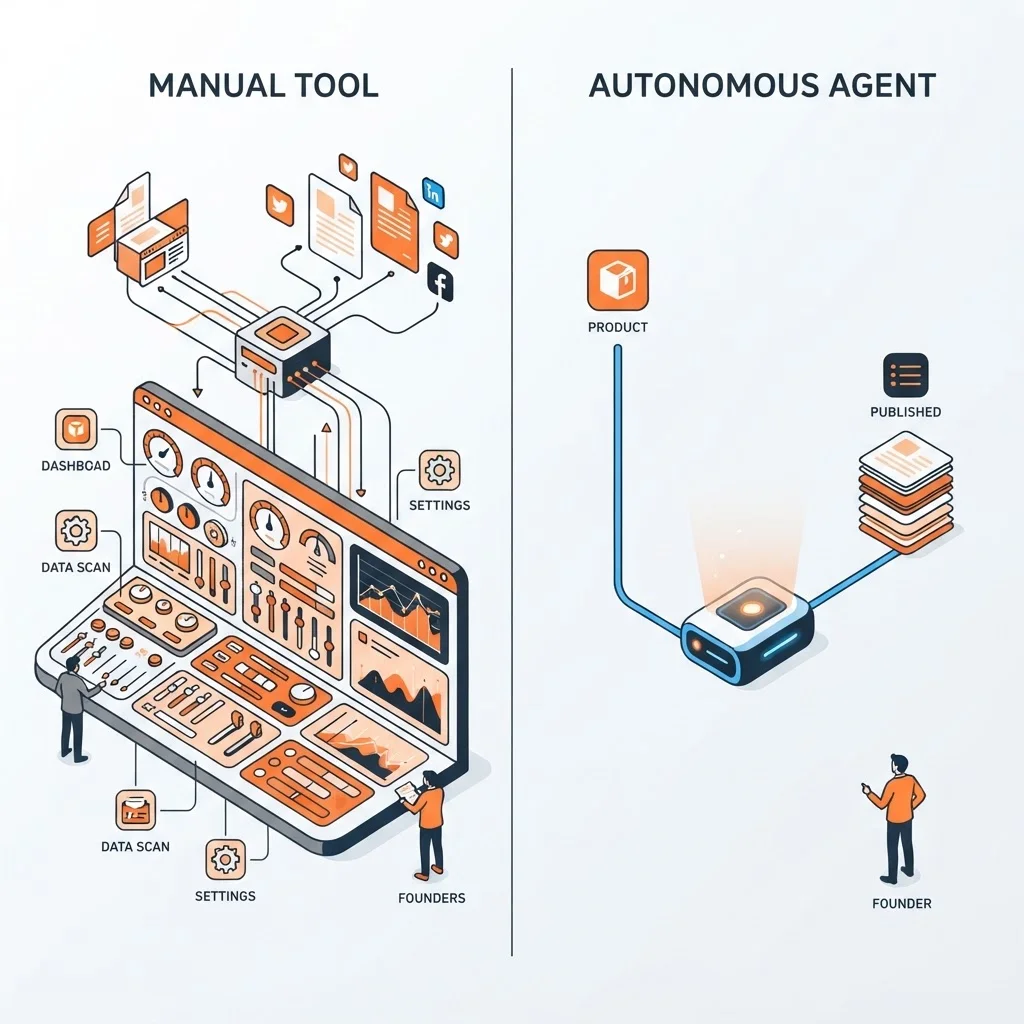
A key decision for SaaS founders is choosing between a content optimization suite like On Page and an autonomous growth agent like Blogged.
On Page provides the tools for you to build a content factory. You control the scans, the research parameters, and the manual refinement of every article. It is proactive optimization for teams that have the bandwidth to manage the tool daily. It excels when you have an existing SEO team that needs better data and faster drafting.
Conversely, an autonomous platform like Blogged is designed to run your SaaS blog on autopilot. It handles the entire lifecycle—research, planning, writing, interlinking, and publishing—without requiring you to manage the individual steps. For founders who are still actively building their product and cannot afford 10–20 hours a week for content management, the autonomous model offers a path to growth that doesn't scale with human effort. Blogged transforms your product knowledge into discoverable content while you focus on building features.
Frequently Asked Questions
Q: Does On Page provide a free trial?
On Page typically offers a paid trial, such as a 7-day period, rather than a permanent free plan. They occasionally provide limited free credits to test specific tools.
Q: Can On Page track results in ChatGPT and Gemini?
Yes, the platform's API and optimization tools are designed to track and optimize for recommendations within major AI search engines and answer engines, helping with GEO strategy.
Q: How does the Stealth Writer avoid AI detection?
It uses structural and semantic adjustments to mimic human writing patterns and includes an internal AI detection scanner to verify the output before it is finalized.
Q: Is there an API for enterprise integrations?
Yes, On Page provides an API that supports integrations with tools like Google Sheets, Zapier, n8n, and Make for custom reporting pipelines.
Final Verdict
On Page is a powerful suite for SaaS teams that prioritize high-volume content and precise SEO control. Its ability to generate humanized AI text and provide detailed audit trails makes it a strong choice for mature marketing departments with the capacity to manage complex tools.
However, for early-to-mid-stage SaaS founders, the operational overhead of managing such a feature-rich tool can be a distraction. If your goal is to achieve organic growth through SEO and GEO without becoming a full-time content manager, an autonomous solution may be the more efficient path. Choose On Page if you want a sophisticated dashboard to drive your strategy manually; choose Blogged if you want the results of a strategy while you focus on building your product.
Get practical updates on On Page features and product fit
Receive new articles and practical insights by email.