
On this page
For SaaS founders, selecting a content platform involves choosing between horizontal content automation and a dedicated autonomous blog manager. If you need a flexible platform to automate diverse content pipelines through external search APIs and web page scraping, HotPress provides a broad end-to-end content automation platform. However, if your goal is running an autonomous blog that converts software features and technical knowledge into search-optimized articles, Blogged provides a specialized solution. Sustaining consistent research, writing, and formatting while shipping code remains a core operational challenge for software startups, making the architectural difference between these systems highly critical.
The Core Difference: General Automation vs. Autonomous Blog Management
The choice between HotPress and Blogged centers on their target workflows and structural focus. HotPress operates as a broad content automation tool designed to help marketing teams scale copywriting workflows across multiple formats. It maps out content by analyzing existing domains, reviewing general audience profiles, and orchestrating multiple text generation pipelines. This versatility makes it an option for teams managing varied copy production across separate marketing channels.
In contrast, Blogged is engineered as an autonomous SEO and GEO blogging platform built specifically for SaaS founders and product teams. Instead of stretching its capabilities across generic marketing formats, it focuses exclusively on turning deep technical product context into product-led articles. The platform runs your blog on autopilot, taking care of background research, keyword alignment, content generation, and internal linking. This specialization reduces the manual management burden on engineering and product groups.
Sourcing Context: Site Scanning vs. The SaaS Knowledge Engine
An automated content pipeline requires accurate background context to produce useful articles. For software companies, generic descriptions often fail to capture specific product workflows or unique value propositions. Both tools approach this background data ingestion using completely different systems, which shapes the technical accuracy of the final articles.
HotPress: Domain Analysis and External Tool Integrations
HotPress plans its automated editorial roadmaps by performing a scan of an existing web domain. It analyzes the site's existing content footprints and cross-references them against targeted audience files to create publishing ideas. To supply its background data, the platform connects with external search, keyword, and data reading technologies.
Specifically, it utilizes Serper for search engine results analysis, DataForSEO for keyword research data, and Jina for web page content reading. It also uses Resend for transactional email delivery and Cloudflare R2 for image storage, with servers hosted on Hetzner in Germany. This setup allows teams to build broad content schedules based on live search results data and competitive scraping.
Blogged: The Dedicated SaaS Knowledge Engine
Blogged takes a product-first approach by anchoring its content planning inside its specialized Knowledge Engine for Autonomous SaaS Blogs. Instead of relying primarily on external domain scanning, this engine allows software teams to feed detailed product-specific technical material directly into the platform.
Users can supply public product sources, uploaded documents, pasted links, or a comprehensive written product description. This intake structure makes sure the platform understands the technical mechanics, target user personas, and core features of your software. The system then uses this deep background context to plan and write product-led content that accurately highlights your application's capabilities.
Feature Comparison: HotPress vs. Blogged
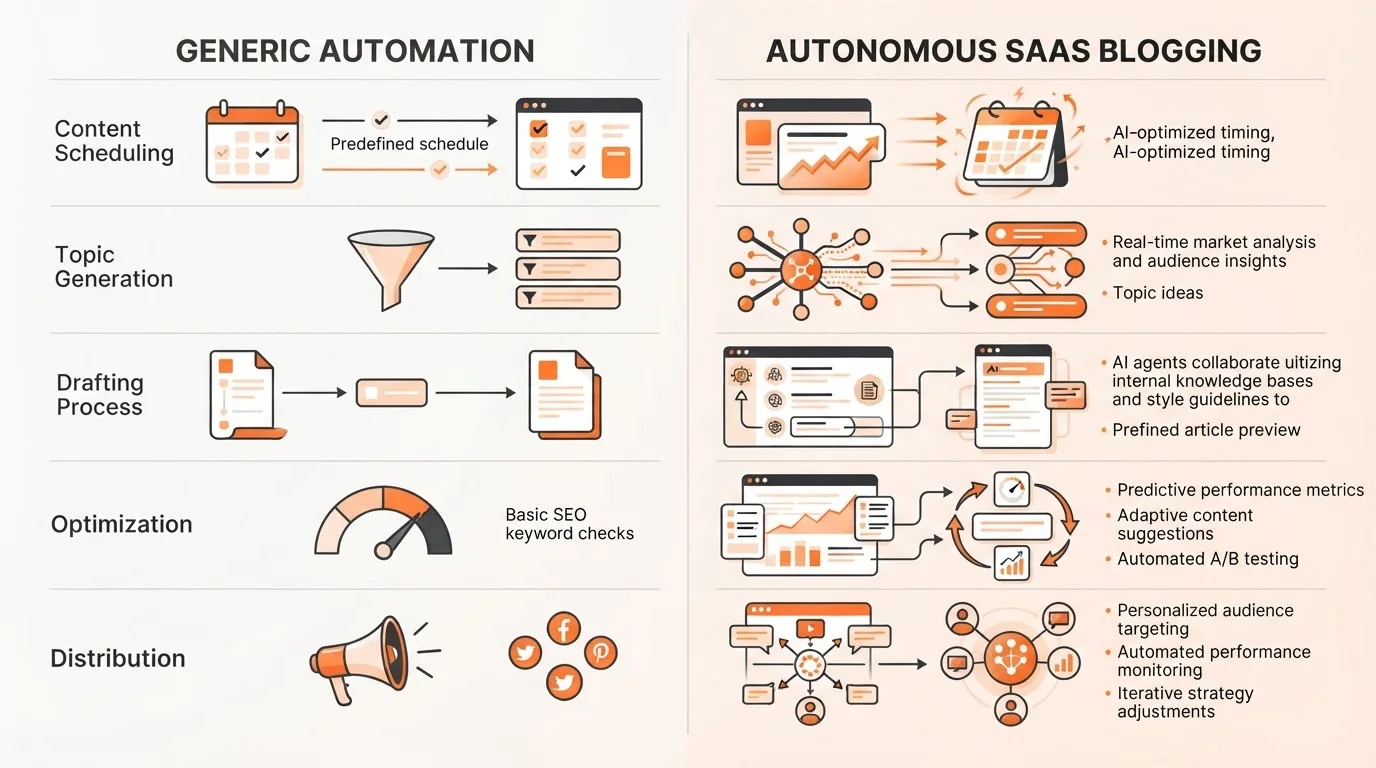
To evaluate the technical structures of both platforms side by side, the following matrix outlines their primary features, integrations, and operational tracking methods based on product documentation.
| Feature or Dimension | HotPress | Blogged |
|---|---|---|
| Primary Platform Focus | Broad content automation and SEO article workflows | Autonomous SEO and GEO blogging for SaaS founders |
| Context Ingestion Methods | Live website scanning and audience files | Public product sources, uploaded documents, links, or written descriptions |
| Search & Data Integrations | Serper, DataForSEO, and Jina content reading | Built-in autonomous research, SEO, and GEO planning |
| WordPress Support | Direct publishing paths to standard WordPress | Blogged Publishing plugin via secure application password |
| Ghost CMS Support | Not specified in documentation | Admin API key verification with in-app creation and review |
| Webflow Support | Direct Webflow publishing paths | Native Webflow CMS AI Blog Publishing integration included |
| Analytics Tracking Scope | Logs operational generation counts and CMS events | Tracks Search Console, engagement, on-site searches, and lead outcomes |
| Conversion Attribute Data | Tracks internal platform usage metrics | Collects consented visits and configured conversions for verified articles |
| Team Seat Structures | Data retained until explicit deletion request | Every paid plan includes unlimited team seats |
Distribution Workflows and CMS Integrations
Once an article is researched and written, the ease of reviewing and publishing it determines your day-to-day administrative workload. A seamless deployment pipeline must deliver content securely to your content management system (CMS) without requiring manual formatting fixes.
HotPress Publishing Paths
HotPress offers standard marketing stack distribution options to help teams push content live. After reviewing and approving an article inside the dashboard, users can export text as clean Markdown or use direct publishing pathways. The system provides automated connections to standard platforms like WordPress and Webflow.
These publishing channels help companies distribute articles across different sections of a broader marketing website. HotPress maintains internal administrative records of these events, tracking every CMS publishing action alongside feature interactions. This approach works well for companies running multi-tiered content networks that need a centralized application to log publishing actions.
Get practical updates on HotPress vs Blogged
Receive new articles and practical insights by email.
Blogged Publishing Plugins and Code Integrations
Blogged provides native integrations designed to publish content automatically while leaving founders in complete control of the final review. For platforms built on the Ghost ecosystem, the Ghost AI Blog Publishing integration divides tasks cleanly. The system handles the entire autonomous creation and review workflow inside the Blogged interface, while Ghost handles the final reader experience.
Setting this up requires creating a custom integration in Ghost, copying its Admin API key, and verifying the connection inside Blogged. For teams running a self-hosted WordPress site, the platform connects through the Blogged Publishing plugin using a secure application password. Additionally, the platform provides native integrations for Webflow CMS, Next.js sites, and a signed Content API with webhooks, allowing direct deployment regardless of your engineering stack.
Analytics, Observability, and Business ROI
Tracking the performance of your content is essential to justify your marketing spend. Software founders need clear data that ties content directly to product signups and conversions rather than simple vanity metrics like pageviews.
HotPress centers its monitoring framework primarily on backend system execution and cost metrics. Using a built-in integration with Langfuse, it provides deep AI pipeline observability and operational tracking. The platform collects usage metrics including article generation counts, AI model usage (token counts and costs), CMS publishing events, and feature interactions. This gives technical managers clear transparency regarding exactly how much computing power and budget each article consumes.
Blogged focuses its analytics dashboard on organic growth outcomes and software conversion metrics. The platform lets users track Search Console performance, homepage engagement, on-site searches, CTA and lead outcomes, lead growth, and reader feedback. Because its Ghost, Webflow CMS, Next.js, WordPress, and custom API integrations let users collect consented visits and configured conversions for verified articles, founders can track reader interactions all the way from an initial blog visit to a configured business conversion event.
Pricing Frameworks and Team Scalability

Predictable subscription tiers and flexible user limits help startups manage their operating expenses as their marketing operations grow. Software companies need clear pricing to avoid unexpected overage fees when adding team members.
HotPress retains account data and generated content securely until a user submits an explicit deletion or account closure request. This lets teams monitor their consumption patterns through internal logs. This usage tracking helps businesses align their high-volume text generation runs with internal infrastructure budgets.
Blogged utilizes flat-rate monthly subscription options listed directly on its pricing page. The Blogged Starter plan is listed at $99 per month, offering an entry point for early-stage companies setting up their first automated blog loops. The Blogged Growth plan is listed at $169 per month, and the high-volume Blogged Ultra Growth plan is listed at $229 per month. To remove administrative hurdles, every paid plan includes unlimited team seats, allowing developers, product managers, and editors to collaborate on draft reviews. The tiers also define clear refinement limits, offering either 1 revision per article or 3 revisions per article depending on the selected plan level.
Strategic Choice Guidance: Matching the Platform to Your Stack
Choosing the right platform depends on your specific company goals, operational constraints, and technical architecture.
Select HotPress if:
- You need a versatile content automation platform to handle diverse, non-blog marketing copywriting formats.
- You require deep technical visibility into your LLM metrics, tracking token usage, costs, and pipeline steps via Langfuse.
- Your model depends on high-volume production driven by domain scanning and external keyword scraping tools.
Select Blogged if:
- You are a SaaS founder or team member looking for an autonomous blogging solution that builds product-led content from your technical knowledge.
- You want to eliminate manual keyword planning by using a Knowledge Engine that consumes documentation, links, or written descriptions.
- You need to track conversion impact by capturing consented visits and CTA outcomes directly within systems like Ghost, WordPress, Webflow, or Next.js.
- You want predictable monthly pricing starting at $99 per month along with unlimited team seats for cross-functional company review.
Frequently Asked Questions
Q: Can I connect Blogged to a self-hosted WordPress blog?
Yes. Blogged connects to self-hosted WordPress setups using the specialized Blogged Publishing plugin and a secure application password, allowing you to manage drafts in the application and deliver them straight to your site.
Q: How does HotPress track AI generation costs?
HotPress uses a native Langfuse integration for AI pipeline observability, which tracks usage data like article generation counts, feature interactions, token usage, and computing costs.
Q: Does Blogged charge extra for adding team members?
No. Every paid plan on Blogged includes unlimited team seats, covering the Starter plan at $99 per month, the Growth plan at $169 per month, and the Ultra Growth plan at $229 per month.
Q: What context can I upload to the Blogged Knowledge Engine?
The Knowledge Engine for Autonomous SaaS Blogs accepts public product sources, uploaded files, pasted links, or a detailed written description of your application's functionality.
Deciding between HotPress and Blogged relies on whether your SaaS needs horizontal content automation or a specialized autonomous blog manager. HotPress delivers a multi-format generation setup backed by developer-focused pipeline observability for teams managing diverse copy needs. If your strategy focuses on organic channel growth through authoritative, product-led articles, Blogged provides the required context ingestion engines, native CMS plugins, and conversion tracking tools to scale your blog on autopilot. Reviewing your technical stack and tracking preferences will show which platform fits your growth strategy.